SMS must broaden its focus to detect emerging EXOGENOUS SAFETY RISKS

SMS is meeting a need for identifying risks; however, its aggregation of data is endogenous. NASA has recently offered a revision (resilience and adaptability) of this safety discipline’s discipline. The mission of the EU’s EPHOR[1] is to identify new and emerging threats in the workplace ( the newly coined “EXPOSOME”[2]) and as the below article exposes, this discipline has flagged a large number of heretofore unknown threats which NOW need be addressed. Not unlike the 2026 report of the National Academies of Sciences, Engineering, and Medicine’s Assessing Radiation Exposure, Health Outcomes, and Mitigation Strategies for Flight Crewmembers[3]. Unfortunately, EPHOR project did not identify any new aviation‑specific risks.
Its scope is occupational health across all sectors, and none of its published work, deliverables, or policy briefs mention aviation as a distinct risk domain. The project focuses on general occupational exposures (chemical, physical, biological, ergonomic, psychosocial) and the working‑life exposome, not industry‑specific hazards. Some of its worrisome findings (like night‑shift and circadian disruption [pilots, cabin crew], heat exposure[4] and airborne infectious disease exposure) merit aviation’s immediate attention.
To make a responsible campaign for an airline/airport/repair station to find new, emerging, and even endogenous hazards would require following the established authorities for candidate dangers to be included in Safety Risk Management programs:
- European Human Exposome Network (EHEN)
- NIOSH’s Emerging Risks
- EU-OSHA Foresight Program
- WHO / ILO Joint Occupational Health Surveillance
- OECD Working Party on Manufactured Nanomaterials
- IPCS (WHO) Chemical Safety Programme
- National Academies (U.S.) Cross‑Sector Risk Studies
To attain that level of perspicacity would require a team of professionals with substantial command of each science[5] and the knowledge of the aviation industry’s multiple workspaces to understand the research’s relevance to pilots, flight attendants, aviation maintenance technicians, ground crews, individuals who work with computers, gate/ticket/reservation agents, and management, etc.
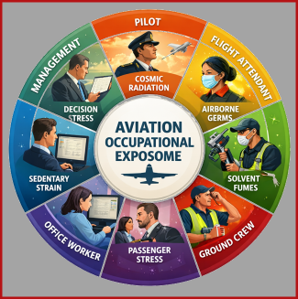
No single aviation organization can dedicate the resources required to stay current with the full spectrum of potential perils that may befall participants in this industry. The range of risks is too broad and too heterogeneous to be aggregated into a single clearinghouse. An AMT working on the ramp faces fundamentally different exposures than a technician with the same skills in a manufacturing plant. An all‑industry resource could not realistically cope with such diversity.
Aviation is fortunate to benefit from a suite of capable, mission‑focused trade associations, each with deep knowledge of its members’ operational realities. These associations provide the leverage needed to commission or acquire specialized research and to distribute findings efficiently across their companies and individual professionals. This is leverage at its best.
A practical solution would be for each association to establish a unit responsible for producing periodic Exogenous Hazard Reports tailored to the risks most relevant to its segment. These reports would then be delivered directly to the SMS teams within member organizations.
This safety discipline demands continuous awareness of developments that may harm people or property. The existing guidance has served aviation well, but SMS—by design—focuses inward. Its analytic horizon is bounded by the operator’s own data. Identifying endogenous risks is fully consistent with Part 5 principles, but the system is not built to detect hazards emerging from outside the aviation ecosystem.
To keep advancing aviation safety standards, the work cannot become Sisyphean. This gap in aviation’s recognition of exogenous hazards must be closed.

Are you prepared for the safety risks of the modern workplace?

A safe and healthy working environment benefits all, whether you’re an employee or the boss. The latest episode of the Just Europe podcast tackles the hurdles involved and potential solutions.
Did you know that today firefighters have only three to five minutes to safely exit a burning building? Thirty years ago, it was 15 minutes – up to five times longer. The world is changing – the building materials we use, the planet’s warming climate, our exposure to diseases – all these and more affect our health and safety at work. Episode 12 of Just Europe – the EU’s podcast series exploring the challenges we face on the path towards a fair and inclusive Europe – takes a closer look at occupational health and safety, and what it means in the 21st century.
The world is changing, and so are the risks
It’s not just the different construction materials in use today that make fighting fires riskier; buildings now also contain solar panels and energy electrical systems. And let’s not forget electrical vehicles and the fires they are causing. With new technologies come new risks for all workers.
As Maria Albin, a researcher involved in the EU-funded EPHOR[6] project, explains in the podcast, many exposures are closely associated, so if you are exposed to one disease-causing factor, you’re often also exposed to other disease-causing factors at the same time. For construction workers, for instance, it would be welding fumes, noise, a heavy physical workload – and these obviously add up.
Climate change and the green transition are also playing a bigger and bigger part in changing occupational health and safety risks. According to EU-OSHA Executive Director William Cockburn Salazar, one in three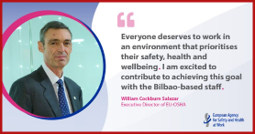 workers in some European countries are experiencing extremely high temperatures or very poor air quality. Firefighters are dealing with more wildfires, forestry workers with new mosquito-borne diseases, and commercial divers building and repairing offshore wind farms face dangers such as high-voltage electricity, entanglement in cables and water pressure-related illnesses.
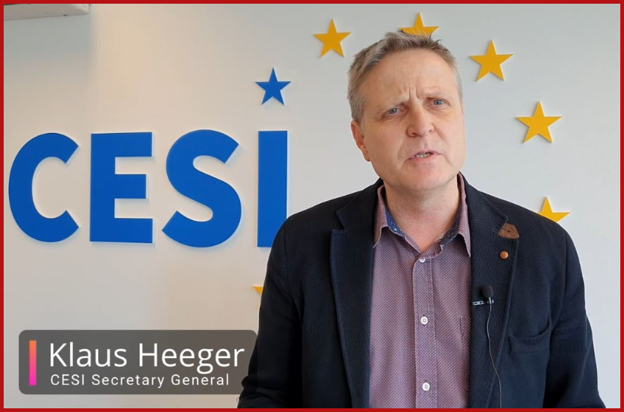 So, how well-equipped are we today to manage these combined exposures? According to Klaus Heeger, Secretary General at European Confederation of Independent Trade Unions, the easy part is to say we simply limit the exposure to a hazard by adapting shifts, using proper equipment, and harnessing AI for better work organisation. The difficulty, in his view, arises when exposure cannot be reduced any further – when the challenge becomes identifying what can still be done to limit the risk.
How to build a safer work environment
For Robert Marinkovic, Adviser at the International Organization of Employers, there is no magic solution. However, it’s important to have a data gathering system and diagnostic tools in place, a good culture of communication between workers and employers, and an environment in which workers feel safe bringing up issues.
In short, to ensure a safe and healthy workforce:
- assess the risks related to the job;
- consult your workers (they know the risks they face better than anyone else);
- take prevention measures;
- monitor employee health; and
- provide training and prepare for emergencies.
Want to learn more about creating a healthy working environment? Read how digital technologies can promote workplace safety and health.

[1] Exposome Project for Health and Occupational Research
[2] The term “exposome” was coined in 2005 by Dr. Christopher Wild to describe the measure of all environmental exposures an individual experiences throughout their life and how these exposures relate to health. It was created to complement the concept of the human genome, highlighting the importance of environmental factors in disease etiology
[3] Another similar risk recently put on aviation’s safety radar– Flares pose Safety risks; all need to broaden our attention to potential problems
[4] https://jdasolutions.aero/blog/heat-in-the-cabin-fix-by-nprm-or-sms/
[5] radiation, climate‑driven heat stress, infectious disease, novel chemicals, microplastics, nanomaterials, new cabin materials, emerging health effects
[6] Exposome Project for Health and Occupational Research– EXPOSOME is a concept used to describe environmental exposures that an individual encounters throughout life, and how these exposures impact biology and health. It encompasses both external and internal factors, including chemical, physical, biological, and social factors that may influence human health.
