NASA’s next iteration of SMS moves to RESILIENCY AND ADAPTABILITY
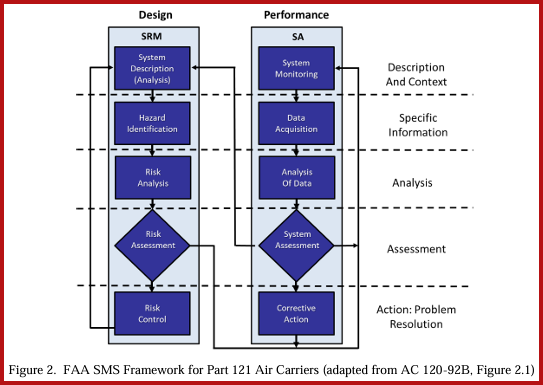
Since FAA issued the final rule in January 2015, requiring all Part 121 air carriers to implement a Safety Management Systems under 14 CFR Part 5 and as this regimen has been applied, the concept has evolved in its regulatory context. More relevantly, as the operations that have volunteered to be or have been mandated under this safety risk tool, the initial application of the rule as well as considerable knowledge has been accumulated in applying Part 5 to the individual entity, greater sophistication as to what risks must be tracked, how to best assess the relative danger of each type of risk and what remedies are most effective.
NASA commissioned a team of experts to take a forward look at
- SMS to prepare its integration with the future evolution of aeronautical systems (AI-based too),
- the increase of the data available
- plus the analytical powers to identify risks,
- the aviation professionals-machine integration
and
- a perspective that seeks to extend the point when problems may be flagged (anticipate/detect/mitigate) RESILIENT SAFETY SYSTEMS[1].
The NASA report, The Adaptable and Resilient Safety System, {see below} is an excellent review of this research, but is 37 pages of small type and academic text. This is an effort to synthesize what the NASA team found:
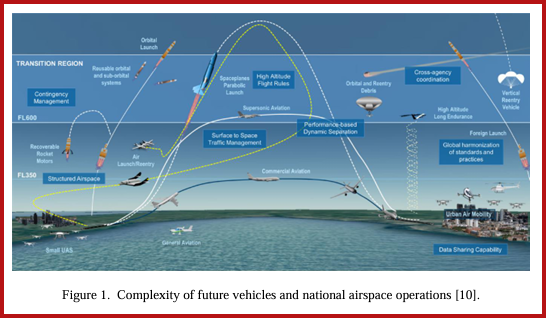
The NASA paper paints a predictable future National Airspace System (NAS) as an environment defined by high complexity, heterogeneous aircraft, increasing autonomy, and dense, dynamic operations. The FAA established as SMS as a powerful means to switch regulatory responses from retroactive to proactive, the authors propose that the standard be updated to a discipline it labels as In‑Time Aviation Safety Management Systems (IASMS). The foundation for this shift is the systems capable of continuous monitoring, assessment, and mitigation. To advance the safety intervention, the existing computer architecture must be redesigned to be more adaptable, resilient, and deeply integrated with human decision‑makers.
The NASA revision of SMS can and must be implemented based on these key trends:
- Explosion of safety‑relevant data from sensors, automation, UAS, AAM vehicles, and distributed operations.
- Need for advanced analytics and data fusion to turn raw data into actionable safety intelligence.
- Operational tempo and diversity that exceed the capacity of traditional human‑centered monitoring.
- Emergence of autonomy, which changes how humans supervise, intervene, and collaborate with intelligent systems.
In this time in which AI has been touted as the answer to complex problems, the scholars recognize that human roles will not disappear—they will change. The paper highlights four areas that must be considered to insure that the people aspects of safety solutions are included in the IASMS outcomes:
- New Human Roles and Responsibilities
- Humans will shift from direct control to supervisory, oversight, and exception‑management roles, requiring new competencies and mental models.
- New Cognitive and Information Demands
- Operators must be trained to be able to interpret high‑volume, fused, predictive safety data. The training may reduce the risks of overload, misinterpretation, and delayed intervention.
- Human‑Autonomy Teaming (HAT)
- Intelligent technologies will be teammates with the humans . NASA stresses the need for:
- Transparent automation
- Predictable system behavior
- Shared situational awareness
- Trust calibration between humans and AI
- New Design Paradigms for Human‑System Integration
- Future systems must be designed for joint cognitive work, not merely automation support. This includes adaptive interfaces, decision‑support tools, and real‑time risk visualizations.
- Intelligent technologies will be teammates with the humans . NASA stresses the need for:
IASMS is intended to enhance safety through the new technologies by
- Continuously monitoring system‑wide risk across diverse operations.
- Assessing risk in real time using predictive analytics.
- Mitigate hazards dynamically, sometimes autonomously.
- Assuring safety performance through integrated human‑machine collaboration.
- Supporting regulators, operators, and service providers with SHARED, IN‑TIME SAFETY INTELLIGENCE. This represents a shift from compliance‑based SMS to performance‑based, intelligence‑driven safety ecosystems.
- The lessons from the transition from old habits to SMS (complete?) make it 1000% clear that the field staff must begin training to the new data, mathematics, analytics, etc., required to use IASMS as their primary safety tool. Delivering a bright new shiny IASMS to the professionals responsible for assuring safety, BEFORE that cadre has been THOROUGHLY EDUCATED for their new jobs, creates resistance, doubts about the validity of the new technique and a real malaise due to a sense of incompetence.
A few closing thoughts—
- NASA and its expert study team should be commended for not following the trend that AI is THE ANSWER to everything.
- Artificial intelligence actually benefits from HUMAN INTERACTION
- Humans with experience tend to improve their ability to probe the analytic power of the computer
- The proposed balance fits aviation safety regulatory philosophy perfectly. As a profession, we rely of numbers, but are comfortable with the unknown.
- Anything that is new or unfamiliar tends to challenge those utilizing the new tool as well as the people/companies being regulated.
- IASMS sounds like CHANGE!!!
- The transition from the pre-2015 safety surveillance and SMS was FAR MORE DISRUPTIVE that the SMS-IASMS iteration.
- Those charged with implementing IASMS should caste it as an ITERATION, which it is, just with new tools.
- Adaptability and resilience are great techniques to strive toward ZERO ACCIDENTS, but PATIENCE will be needed as the regulator and the regulated go through the learning cycles.
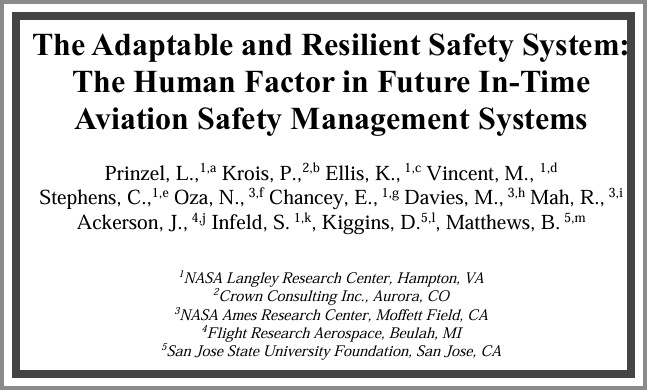
LINK to full 37 page article.
Paper’s Summary
IN-TIME INTEGRATED SAFETY MANAGEMENT will be paramount for safely enabling the envisioned transformations of the future National Airspace System (NAS). The path for realizing the vision includes addressing the increasing need for advanced data analytics and fusion of aviation safety data, managed by human decision-makers.
The paper describes safety management systems and its’ challenges, and how the concept of In-time Aviation Safety Management Systems addresses the need to ensure an adaptable and resilient future safety system in the envisioned transformed NAS.
Finally, it discusses potential human factors challenges, including new human roles and responsibilities, new information and cognitive requirements, new intelligent technologies that change human-system interaction and coordination, and new design paradigms for human system integration and teaming.
[1] Safety Resilience Safety resilience is the demonstrated ability of Boeing products, processes, and organizations to ANTICIPATE, WITHSTAND, RECOVER FROM, AND LEARN FROM SAFETY‑RELATED HAZARDS AND OPERATIONAL DISRUPTIONS. It reflects a proactive safety posture that ensures the continued protection of people, property, and the integrity of the aerospace system.
