Rocheleau leaves FAA with insight into RISK AVERSION’s diminishing

Bad news for the FAA, but great news for business aviation– CHRIS ROCELEAU, 20 years at the agency– chief of staff and deputy associate administrator for aviation safety, executive director for international affairs, assistant administrator for policy, international affairs and environment, and acting associate administrator for aviation safety- plus 2 years as Acting Administrator and Administrator—is taking his talents back to NBAA.
Comments that he made during Commercial Drone Alliance’s revealed an important, yet so far undeclared initiative of the Trump-Duffy-Bedford aviation policy, to wit:
“You look at this new technology, and you’re getting kind of nudged in the direction of ‘LET’S LEAN IN, LET’S TAKE A LITTLE MORE RISK HERE.”
Having viewed aviation from both sides, he has recognized the tension between Regulators, who by charter regard RISK as an ANATHEMA, and ENTREPRENEURS who regard RISK as a necessary aspect of their endeavors.
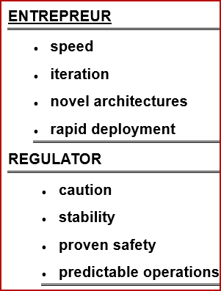
Though not with the authority, this tension has been recognized here before:
Credit to the current aviation safety policy wizards they appear to have found two approaches that bring the goals of the REGULATOR and the ENTREPRENEUR acceptably (?) closer. How is this GOVERNMENTAL RISK AVERSION being broached to accommodate THE PRIVATE SECTOR’S NEED FOR SPEED?
How does the SAFO accomplish this seemingly bifurcated view of aviation’s future—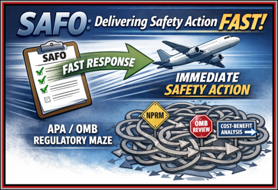
SAFOs are technically voluntary.
BUT INSURERS TREAT THEM AS mandatory risk signals.
If an operator ignores a SAFO:
-
-
- premiums rise
- coverage is restricted
- claims may be denied
- renewal may be refused
- THAT IS, airline management would be idiotic to ignore a SAFO, no FAA enforcement, but quicker action likely to be better than a “one size fits all” necessary for an NPRM mandate.
- More positively, for over a decade Part 121 operators have worked hard to create SAFETY CULTURES which would find ignoring a SAFO as inimical to their DNA[3].
-
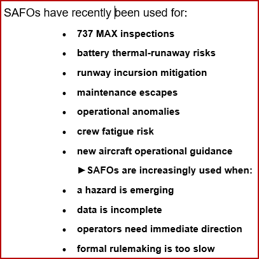 So operators basically MUST comply — just as aircraft owners complied with UL requirements before 1938. Bob Poole, my favorite aviation cognoscenti, might call this as “regulation by market (insurance) discipline.”
Using the same regulatory matrix, HOW will the eVTOL Integration Pilot Program (eIPP) allow the creativity to be tested and still preserve safety?
The parameters of this test appear to include these elements:
. corridor-specific operational cautions
. battery charging/handling advisories
. vertiport operational safety alerts
. distributed propulsion anomaly guidance
. pilot qualification or training advisories
. maintenance inspection alerts
►Following the prior regimen, the FAA probably early and often will issue operational data-driven safety recommendations.
However, this technique may not be 100% transferable; these experiments intentionally involve diverse geographical, weather, and operational scenarios, different missions (e.g., EMS as a MUST GO operation), urban/suburban/rural, different aircraft types (ePLANES) and constant adjustment to all of the safety parameters- essentially dynamic elements like:
-
-
- new risks
- new operators
- new aircraft
- new corridors
- new vertiports
-
…will create uncertainty that insurers absolutely will not tolerate without strong safety signals.. Their beginning list of definition to eIPP might include:
-
-
- corridor compliance
- battery‑safety protocols
- vertiport standards
- pilot qualifications
- maintenance documentation
- adherence to FAA advisories (including SAFOs)
-
Theory:
-
-
- FAA will issue guidance.
- Insurers will enforce it. Operators will comply.
-
Thus, the private sector safety assurers so far have been reticent to endorse coverage. At the moment, research[4] leads to following carriers’ current views-
Global Aerospace
AIG Aerospace
Allianz
USAIG
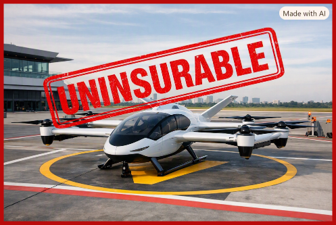
The trade press summarizes their collective position, represented by an AI created graphic current status. Insurers are signaling interest but not readiness. Every major carrier says the same thing:
We cannot price eVTOL/eIPP risk until we have actuarial data, battery‑failure models, corridor‑liability frameworks, and operational history. In other words: no data → no underwriting → no eIPP commercial operations.
The designers (obviously brilliant and creative) of eIPP are using a standard government contract form OTAs (Operational Terms Agreements) between operators to define the terms of this experiment. The adaptation of this construct to eIPPs might look like:
-
-
- proof of adequate liability insurance
- compliance with DOT minimums
- SMS participation
- maintenance and operational data reporting
- adherence to corridor restrictions
-
OTAs might require operators to maintain coverage consistent with FAA and DOT standards. Acknowledging that they may have figured this problem, but otherwise it could be a bottleneck.
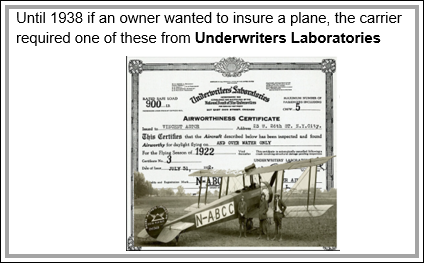 Curiously, this vision of the future includes a mirror of the past. Before 1938, there was no FAA, no CAA, no federal airworthiness certificate
From the dawn of powered flight (1903) through the mid‑1930s:
-
-
- There was no federal aircraft certification authority
- No standardized airworthiness requirements
- No regulatory oversight of manufacturing
- No formal pilot licensing (until 1926)
- No federal maintenance standards
- No federal operational rules
-
The government’s involvement was minimal and mostly postal. Aviation was essentially:
-
-
- privately regulated
- commercially insured
- technically validated by third‑party engineering bodies
-
This is the part most people forget.
Insurers were terrified of early aviation risk. They refused to underwrite aircraft unless:
-
-
- the structure
- the engine
- the electrical system
- the fuel system
- the materials
- the wiring
- the fire protection
-
…were validated by a recognized technical authority, specifically Underwriters Laboratories. UL existed before aviation regulation and had:
-
-
- engineers
- test labs
- fire‑safety expertise
- electrical‑system expertise
- materials‑testing capability
-
Insurance companies, based on UL’s technical competence to determine AIRWORTHINESS. were the de facto regulators.
That highly regarded company is still in Evanston, IL
Departing FAA Leader Says Agency Is Being ‘Nudged’ to Embrace Risk

Chris Rocheleau became acting administrator in January 2025 and is expected to leave the agency this week.
[below sections excerpted for focus on the “nudged to risk” comment]
Key Takeaways:
The FAA’s departing deputy administrator said Friday that the agency is being “nudged” to embrace “more risk” when it comes to the integration of uncrewed drones.
CHRIS ROCHELEAU, who is expected to rejoin the National Business Aviation Association (NBAA) this week after serving as FAA deputy administrator since July 2025, was speaking at the Commercial Drone Alliance’s (CDA) American Drone Leadership Summit in Washington, D.C., before a crowd of drone industry stakeholders.
 “YOU LOOK AT THIS NEW TECHNOLOGY, AND YOU’RE GETTING KIND OF NUDGED IN THE DIRECTION OF ‘LET’S LEAN IN, LET’S TAKE A LITTLE MORE RISK HERE,’” Rocheleau responded to a question about the FAA’s challenges integrating commercial drones. “That risk word is not really well embraced by the folks at FAA…There’s a reason it takes years to make a rule.”…
Rocheleau later described the FAA’s back-and-forth with the drone industry as a “healthy tension.” A major focus of the event and his remarks was the agency’s long-awaited Part 108 rule, which is under review at the White House’s Office of Information and Regulatory Affairs (OIRA).
Drone industry groups have pushed for greater leniency under the rule, which proposes a new framework for beyond visual line of sight (BVLOS) operations, while pilots represented by groups such as the Air Line Pilots Association (ALPA) have expressed concern that it is too permissive.
The White House directed the FAA to finalize Part 108 by early 2026. But the agency—facing pressure from both industry and pilots—in January reopened its proposal to public comment.
“This is a good approach to making a performance based rule, but we need to write that standard, and we’re in work on that now,” said Jenn Player, vice president of global aviation regulatory for drone manufacturer Skydio, on Friday. “There’s a lot of scale happening already today that the FAA has helped unlock, and we can’t take a step backward from that.”
….
Safety Versus Innovation
Before rejoining the FAA as acting administrator, Rocheleau held various roles—including chief of staff and deputy associate administrator for aviation safety—over 20 years across two previous stints with the agency. They were separated by his close to four years as a senior policy advisor for the Transportation Security Administration.
Safety was an immediate and prominent thrust of Rocheleau’s recent tenure.
“Clearly, something was missed,” Rocheleau said of the January 2025 midair collision.
During about six months as acting administrator, Rocheleau led the FAA’s early response to the tragedy and oversaw reforms, including the elimination of mixed military and commercial traffic over the Potomac River. The agency initiated a nationwide review of potential collision hot spots at other airports, using artificial intelligence as part of the effort.
Rocheleau also oversaw the Transportation Department’s push to “supercharge” air traffic control hiring with incentives such as cash bonuses.
After Congress confirmed Bryan Bedford, the former CEO of Republic Airways, as permanent FAA administrator in July 2025, Rocheleau assumed a deputy role. He was a key advocate for ATC modernization as well as the integration of advanced air mobility (AAM), supporting initiatives such as the Modernization of Special Airworthiness Certifications (MOSAIC) rule and eVTOL (electric vertical takeoff and landing) Integration Pilot Program (eIPP).
Rocheleau has been part of the FAA’s balancing act in developing Part 108, which would greatly expand the operation of drones BVLOS of their operators and is believed to be near the finish line.
“The FAA clearly has a responsibility to build a regulatory framework that will allow commercial drone operations at scale,” he said Friday. “And yet, we cannot ignore the POTENTIAL FOR THREAT, maybe we think about it as VULNERABILITY, when we bring these systems online.”
The Part 108 saga has involved plenty of back-and-forth between the drone industry, pilots, and the FAA. The commercial drone industry, supported by groups such as the CDA, has urged the FAA to pass a final rule in order to eliminate uncertainty.
“Convincing investors relies on certainty of regulatory approach and framework,” said Keller Cliffton, CEO of drone delivery provider Zipline, during the D.C. summit.
At the same time, groups such as ALPA and the Aircraft Owners and Pilots Association (AOPA) worry about issues of right-of-way and the maturity of detect and avoid technology,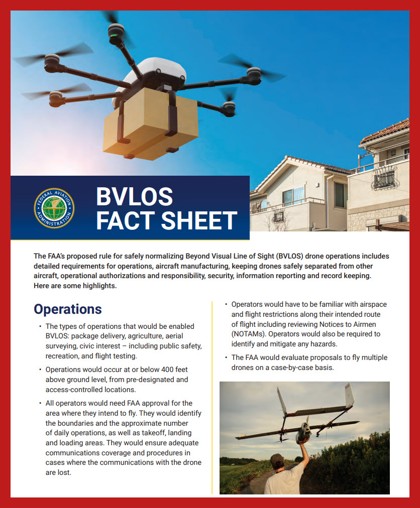 which Part 108 drones will use to deconflict with other aircraft.
Rocheleau said Friday that FAA personnel have been “working very diligently” to finalize Part 108 and that the rule will “iterate over time.” He predicted its impacts will soon be felt.
“I am encouraged that a year from now, two years from now, three years from now, we will see a whole different scale, a whole different way of operating commercial drone activities in this nation,” Rocheleau said.
Despite delays in finalizing Part 108, industry stakeholders who spoke at Friday’s CDA event were encouraged that the FAA has listened to their concerns. On the other hand, AOPA in its comments on the proposal said that concerns raised by pilots as the rule was being developed “were routinely minimized or dismissed entirely.”
“[The FAA is] a little bit more constrained, but they are looking for ways to say yes,” said Charlton Evans, founder and CEO of aircraft certification specialist End State Solutions….
Rocheleau’s remarks indicate the FAA’s desire to foster aviation innovation, but it will need to do so without sacrificing safety.
The agency earlier this year undertook a major restructuring that added three new offices and made certain leadership roles permanent. The overhaul, which Bedford described as the largest in the FAA’s history, will see the agency develop a safety management system (SMS). At the same time, Bedford said it will support ATC modernization and the integration of drones, air taxis, and other AAM aircraft.
Rocheleau was appointed to oversee the newly created Advanced Aviation Technologies office as well as the offices of Commercial Space Transportation, Security and Intelligence Organization, and Aviation Safety Oversight and Certification Organization.
Liam McKenna, the FAA’s chief counsel, will serve as acting deputy administrator in his stead, according to Bedford.

Jack is a staff writer covering advanced air mobility, including everything from drones to unmanned aircraft systems to space travel—and a whole lot more. He spent close to two years reporting on drone delivery for FreightWaves, covering the biggest news and developments in the space and connecting with industry executives and experts. Jack is also a basketball aficionado, a frequent traveler, and a lover of all things logistics.
[1] SAFO “emergency evacuations pax and bags” will lead useful, practical approaches; FAA’s SAFO on Lithium Battery moves to diminish the risk- great example of SMS works
[2] Gulf Countries eVTOL approach very close to eIPP’s “READY, FIRE, AIM” plan; eIPP’s first flights test for regulatory purposes, but other challenges may impact them
[3] . SMS requirements;. continuous oversight;. internal audit pressure;. unionized pilot safety committees
[4] Business; LinkedIn; Why

