eIPP’s first flights test for regulatory purposes, but other challenges may impact them
The eIPP has launched, as described below in Aero News’ report, what may be its first test. This is another innovative regulatory mechanism by the Administration. In lieu of engaging in extensive airworthiness proofs by the TC applicant, the eIPP is aptly described as a “ready, fire, aim” Tom Peters regulatory model: fly under OTA authority first, then use operational data to aim the future certification and operational rules. The origin and applicability of this truism:
Management writer Tom Peters used the phrase (R,F,A)widely in his talks and books to encourage rapid experimentation, action-first innovation, and iterative improvement. His usage is the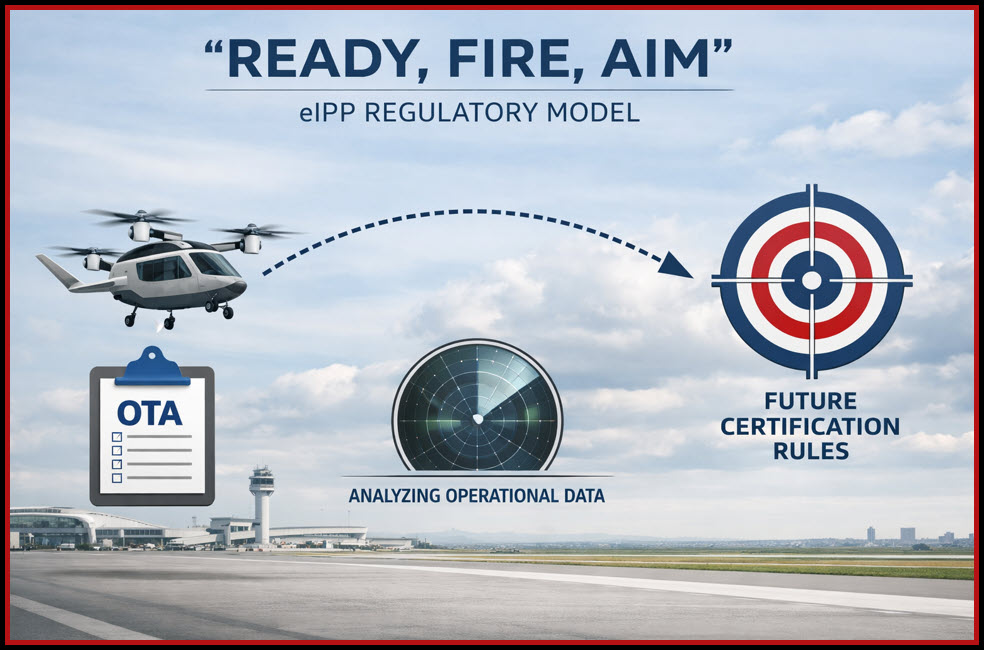 earliest popular and systematic adoption of the phrase in business culture. The R,F,A thesis emphasizes- acting quickly rather than over‑planning, learning by doing and iterating after taking initial action. In the business context, it has been successful in startup cultures, innovation teams, and change‑management environments.
Based on that theory of change, President Trump’s Secretary of Transportation and the FAA have applied the R,F,A aphorism to the eIPP as the below AI analysis assessments:
. Flights occur before Type Certification
-
- eVTOL aircraft fly under Other Transaction Authority (OTA)
- OTAs allow prototype operations without a Type Certificate (TC).
- This reverses the traditional sequence: normally TC → operational approval → flying.
- Operational data is the “aim”
The FAA explicitly states that eIPP flights are meant to:
-
- Gather real‑world operational data
- Identify regulatory gaps
- Inform future rulemaking and certification standards
In other words, the aiming happens after firing.
Risk is managed through OTA indemnification + prototype insurance
Because the aircraft are not type‑certified:
-
- The government uses OTA indemnity clauses
- Manufacturers/operators use prototype‑risk insurance pools
- This is structurally similar to early commercial spaceflight under CSLA indemnification
This is exactly the kind of environment where “ready, fire, aim” is used in policy design: controlled risk, early action, iterative learning.
-
- It does not imply recklessness
- It does not mean skipping safety analysis
- OTAs still require risk assessments, mitigations, and FAA oversight
So the analogy works as a description of sequencing, not as a critique of safety culture.
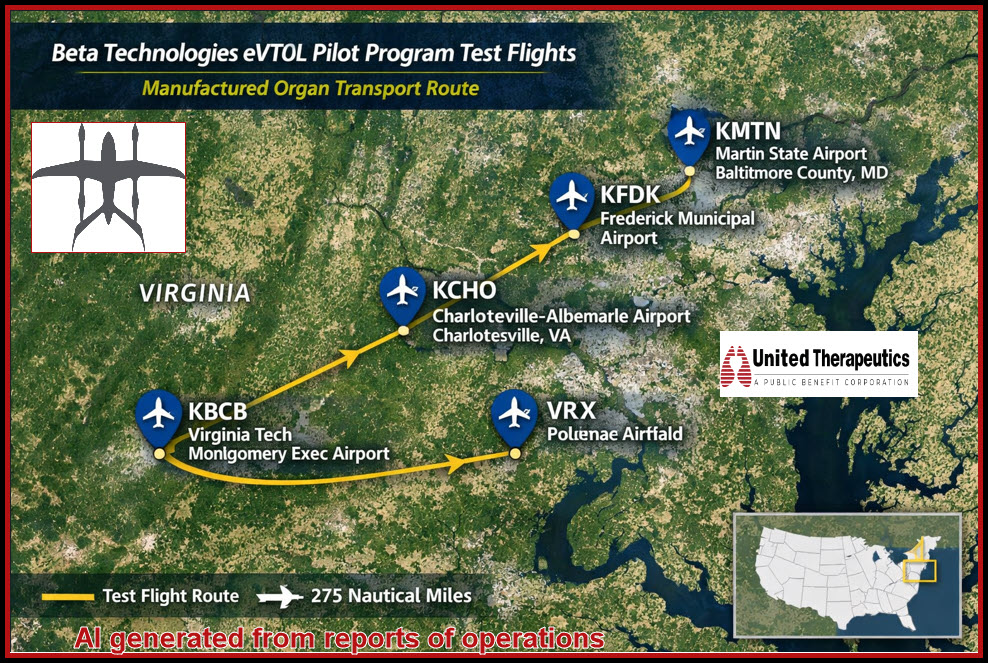
From various reports, here is what this FIRST TEST included:
- Manufacturer & Industry Press Statements (Verbatim Excerpts)
BETA Technologies – BusinessWire / StreetInsider (Official Press Release)
“The flights carried manufactured organs, being developed by United Therapeutics… The inaugural campaign demonstrated routine operations across a multistate corridor connecting Virginia and Maryland… flying between
-
-
- Virginia Tech/Montgomery Executive Airport (KBCB) in Blacksburg,
- Charlottesville-Albemarle Airport (KCHO) in Charlottesville,
- Frederick Municipal Airport (KFDK) in Frederick, Maryland, and
- Martin State Airport (KMTN) in Baltimore County, Maryland.”
-
2.Aviation International News (AIN) – Detailed Operational Reporting
“Beta Technologies completed the first operational flights… carrying manufactured organ products in development by United Therapeutics across a corridor of four airports in Virginia and Maryland… Flight‑tracking data indicates two Alia CX300s shared the mission in relay: N336MR flew the Blacksburg‑to‑Charlottesville leg before handing off to N916LF, which continued to Frederick and Martin State.”
“A container of temperature‑controlled cargo marked ‘perishable’ is carried from Beta Technologies’ Alia CX300… during the first operational flights…”
3.Tech Times – Local/Industry Reporting
“The cargo was a GENETICALLY MODIFIED PIG HEART developed by United Therapeutics… carried for research purposes… The route connected Virginia Tech/Montgomery Executive Airport, Charlottesville-Albemarle Airport, Frederick Municipal Airport, and Martin State Airport… approximately 275 nautical miles.”
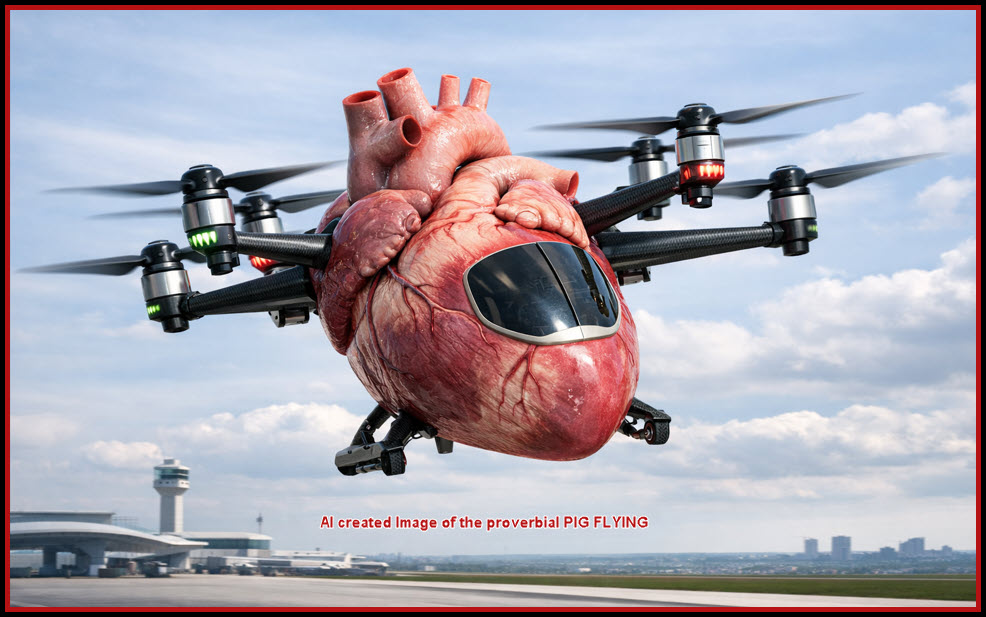
Under eIPP, Pigs can fly
- The Next Web – National Tech Reporting
“The debut missions carried manufactured organs for United Therapeutics between Maryland and Virginia (~275 nautical miles), not passengers.”
Interesting Engineering – Engineering/Infrastructure Reporting
“The flights… covered around 275 nautical miles across a multistate corridor… connecting airports in Blacksburg and Charlottesville, Virginia, with Frederick and Baltimore County, Maryland… BETA Technologies and United Therapeutics are working together to develop electric aircraft systems designed to support future organ delivery operations.”
- Insider Monkey – Business/Finance Reporting
“These inaugural missions… successfully utilized electric aircraft to transport manufactured organs developed by United Therapeutics… spanned a corridor between Virginia and Maryland.”
-
-
- Manufactured organs (United Therapeutics)
- Temperature‑controlled medical cargo
- A genetically modified pig heart (research cargo)
- No passengers
- No commercial freight
- No revenue cargo
-
The Million Dollar Question is did these flights operate COLD TURKEY, that is, WITHOUT INSURANCE???
-
- The FAA’s Other Transaction Authority (OTA) agreements included indemnity clauses protecting the government and its contractors from liability during test operations.
- This meant the U.S. government absorbed catastrophic risk, similar to early commercial spaceflight indemnification under the Commercial Space Launch Act (CSLA)
-
- Participating manufacturers (Joby, Archer, Beta, etc.) carried prototype hull and liability coverage through specialized aviation insurers (often Lloyd’s‑linked syndicates).
- These policies covered test flights, employees, and property damage, but excluded revenue passengers and commercial operations.
- The coverage was structured as experimental risk insurance, not standard Part 135 or Part 91 coverage.
-
- Because no paying passengers were aboard, there was no passenger liability component.
- Any onboard personnel were covered under corporate or government indemnity, not under commercial aviation passenger insurance.
-
- The model mirrored NASA’s experimental indemnification and FAA prototype testing for un‑certified aircraft — where the government allows flight but assumes part of the risk to enable innovation.
Aviation litigators have a history of creative claims that have avoided the strictures of insurance limits, contract exclusions and even regulations for example:
- Suing the manufacturer for “failure to warn” even when the operator violated regulations
Strategy: Plaintiffs argue the manufacturer failed to warn about foreseeable misuse. Effect: Circumvents regulatory defenses (e.g., “pilot violated FARs”) and insurance exclusions tied to illegal operations.
Examples:
-
-
- Robinson R44 fuel‑tank post‑crash fires — Plaintiffs argued Robinson failed to warn about crash‑fire susceptibility even when pilots violated flight rules.
- Cessna carb‑ice cases — Manufacturers were sued for inadequate warnings despite clear FAR‑mandated pilot responsibilities.
- Turning regulatory violations into manufacturer negligence
-
- Strategy: Even when the operator violated FAA rules, litigators argue the manufacturer should have designed the aircraft to be “error‑tolerant.” Effect: Shifts liability away from the insured operator and onto deeper‑pocket defendants.
Examples:
-
-
- Colgan Air 3407 (Buffalo, 2009) — Despite pilot error, plaintiffs targeted training‑system manufacturers and human‑factors design.
- Airbus A320 automation‑interface cases — Plaintiffs argued Airbus should have designed systems to prevent pilot mismanagement.
- Maintenance‑provider cases — Plaintiffs argued maintenance shops were joint participants in operations.
- Reframing crashes as “ground‑based negligence” to escape aviation exclusions
-
- Strategy: Claim the accident stemmed from negligent ground operations, not flight operations. Effect: Avoids aviation‑specific exclusions in general liability policies.
Examples:
-
-
- Fuel contamination accidents — Sued FBOs for negligent fueling rather than pilot error. Electricity as a fuel is novel and “proper v. improper charging” may not be well defined,
- Improper loading cases — Targeted ground handlers to bypass aircraft‑operator insurance limits.
-
NB key to eIPP immunity is inclusion in the program—these two parties (and others?) must get into the eIPP list of participants.
- Using “public nuisance” or “failure to supervise airspace” theories
Strategy: Sue municipalities or airports for failing to manage hazards. Effect: Accesses municipal liability pools not subject to aviation exclusions.
Examples:
-
- Bird‑strike accidents — Cities sued for failing to control wildlife hazards.
- Obstacle‑clearance cases — Municipalities sued for allowing structures in approach paths.
If an eIPP eVTOL crashed under OTA authority, litigators might try to use these same strategies to:
-
- bypass prototype‑risk insurance limits
- pull in manufacturers, suppliers, municipalities, or infrastructure partners
- argue negligent design, negligent entrustment, or failure to warn
- challenge OTA indemnity as insufficient or improperly applied
- sue the federal government under FTCA theories
In other words: OTA indemnity is an untested shield against creative aviation litigators.
A new technology and a novel regulatory framework and an OTA indemnification to protect all parties in the eIPP may be the brilliant legal solution to escalate the US’s eVTOL standing. That said, all of those creative constructs MAY INSPIRE DREAMS AMONG THE LARGE, TALENTED AVIATION LITIGATION BAR?


First Flights In Government’s Electric Vertical Takeoff And Landing Pilot Program

Beta Technologies said Friday it wrapped up the first test flights in the U.S. government’s sweeping electric vertical takeoff and landing pilot program aimed at making the vision of flying taxis a reality.
The aerospace company, which is backed by Amazon, said the flights transported manufactured organs from United Therapeutics [Martine Rothblatt Ph.D., J.D., M.B.A. Founder, Chairperson, and Chief Executive Officer] between airports in Maryland and Virginia. The flights totaled about 275 nautical miles.
“Today’s successful missions, set the stage for routine medical applications through electric flight at a much lower cost nationwide,” BETA CEO KYLE CLARK.
For years, the industry has touted flying cars as a solution to congested traffic, with medical, cargo and defense applications. Beta is one of several electric air taxi makers racing to secure Federal Aviation Administration (FAA) certification and to start flying passengers commercially. Timelines have been pushed off as certification has proven difficult to achieve.
The program, spearheaded by the Department of Transportation and the FAA, spans eight projects across 26 states. Beta is the most active company, participating in seven of them.
The government initially said testing would begin this summer.
Beta’s eVTOL aircraft is expected to achieve certification in 2028. The company also makes a conventional takeoff and landing craft on track for certification in 2027.
