Gulf Countries eVTOL approach very close to eIPP’s “READY, FIRE, AIM” plan
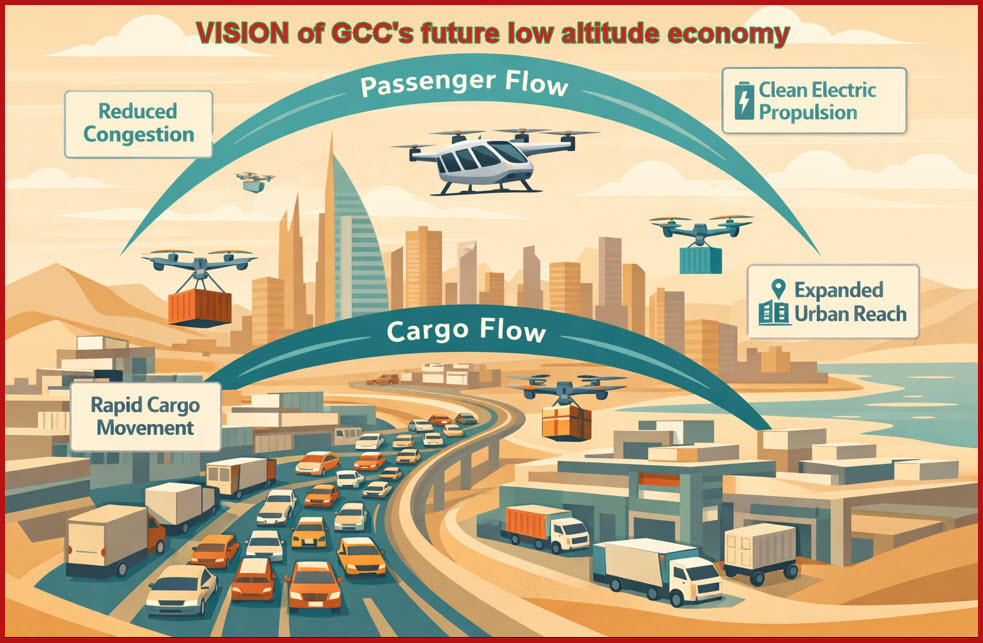
A global law firm. Morgan Lewis, published the below insightful analysis of the eVTOL development and the government support. The Gulf Cooperation Council (GCC) states are on the vanguard of making the low altitude economy work. Why this region is moving so swiftly towards Urban Air Mobility as a reality now or at least soon. The lawyers also describe how the GCC and its individual member states- Bahrain, Kuwait, Oman, Qatar, Saudi Arabia, and the United Arab Emirates- are regulating this fast-paced innovation.
Why eVTOL makes sense in this region:
→GCC consumers can afford eVTOL services, and GCC cities need congestion relief — creating a rare market where demand, ability to pay, and government willingness all align.
-
-
- High consumer purchasing power
- GCC cities (Dubai, Abu Dhabi, Doha, Riyadh) have very high per‑capita income and large populations of affluent residents and expatriates.
- AAM pricing (e.g., $50–$150 per trip[1]) fits comfortably within the spending patterns of:
- Business travelers
- High‑income residents
- Tourism segments
- This makes early adoption economically viable, unlike many Western cities where price elasticity is tighter.
- Heavy tourism + event-driven demand
- Dubai, Abu Dhabi, Doha, and Saudi megaprojects generate millions of high-spend visitors
- Tourism corridors (airport ↔ resort, city ↔ event venue) create predictable, premium routes ideal for eVTOL economics.
- Explosive urban growth
- GCC cities are expanding faster than their road networks can keep up.
- Riyadh, Dubai, Doha, and Jeddah have:
- Rapid population growth
- High vehicle ownership
- Limited legacy public transit
- This produces structural congestion that eVTOLs can bypass.
 Road congestion is chronic and worsening
 - In many GCC cities, peak-hour road speeds drop below 20–25 mph on major arteries.
- Urban form (dense cores + sprawling suburbs) creates long commutes that eVTOLs can cut dramatically.
- Governments see AAM as a relief valve for overloaded road systems.
- High consumer purchasing power
-

-
-
- Cities built for aerial mobility integration
- GCC urban planning is centralized and modern, allowing:
- Vertiports on new towers
- Corridors over highways and waterfronts
- Direct integration with metro and airport hubs
- This makes overflight solutions (eVTOL bypassing traffic) far easier than in older Western cities.
- GCC urban planning is centralized and modern, allowing:
- Cities built for aerial mobility integration
-
The DOT/FAA eIPP (see eIPP’s first flights test for regulatory purposes, but other challenges may impact them for an explanation of that accelerated project) is designed to accelerate the US’s development of eVTOLs. Moving forward on these tests BEFORE a TC issued follows a “READY/FIRE/AIM” [Tom Peters] approach- the GCC procedure is similar in that Special Flight Authorizations, No-Objection Certificates, and bespoke operational approvals are the vehicles for their current operations.
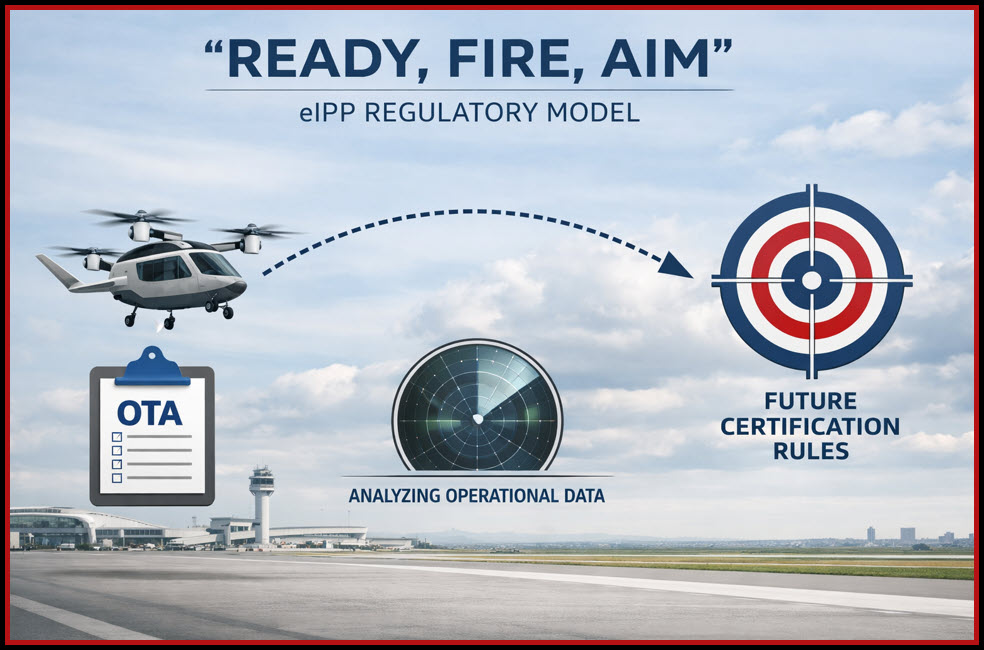
The Morgan Lewis review actually shows that the Gulf’s approach resembles eIPP, as detailed below:
→The GCC approach is OPERATIONS-LED, but each state still has a civil aviation authority (CAA) that must make airworthiness findings. The difference is how and how fast they do it:
UAE
Authority
UAE GCAA (General Civil Aviation Authority)
Airworthiness Determination
-
-
-
-
-
- GCAA issues Special Flight Authorizations, No-Objection Certificates, and bespoke operational approvals for early eVTOL demonstrations.
- They may accept foreign certification bases (EASA, FAA) as part of their evaluation.
-
-
-
-
Process
-
-
-
-
-
- Case-by-case technical review
- Safety assessment + operational risk analysis
- Often tied to specific corridors or events (e.g., Dubai air taxi program)
-
-
-
-
Status
-
-
-
-
-
- In progress — no full national airworthiness certification for commercial eVTOL yet.
- UAE is the most advanced GCC regulator in AAM.
- WHEN
-
-
-
-
-
-
-
-
-
- UAE PUBLICLY TARGETS 2026 FOR INITIAL COMMERCIAL AIR TAXI OPERATIONS.
-
-
-
-
Saudi Arabia
Authority
-
-
-
-
-
-
- GACA (General Authority of Civil Aviation)
-
-
-
-
-
Airworthiness Determination
-
-
-
-
-
-
- GACA has issued initial approvals for demonstration flights (e.g., NEOM, Riyadh).
- Uses special authorizations rather than full airworthiness certification.
-
-
-
-
-
Process
-
-
-
-
-
-
- Safety case review
- Operational risk assessment
- Integration with NEOM’s planned vertiport network
-
-
-
-
-
Status
-
-
-
-
-
-
- In progress — no full airworthiness certification yet.
-
-
-
-
-
When
-
-
-
-
-
-
- Saudi Arabia targets 2026–2027 for commercial AAM in NEOM and Riyadh.
-
-
-
-
-
Qatar
Authority
-
-
-
-
-
-
- Qatar Civil Aviation Authority (QCAA)
-
-
-
-
-
Airworthiness Determination
-
-
-
-
-
-
- Limited public activity; approvals so far are demonstration-only.
-
-
-
-
-
Status
-
-
-
-
-
-
- Early stage / in progress
- No commercial airworthiness determinations yet.
-
-
-
-
-
Bahrain
Authority
-
-
-
-
-
-
- Bahrain Civil Aviation Affairs (CAA)
-
-
-
-
-
Airworthiness Determination
-
-
-
-
-
-
- Has issued demonstration flight approvals.
- No full airworthiness certification framework for eVTOLs yet.
-
-
-
-
-
Status
-
-
-
-
-
-
- In progress
-
-
-
-
-
Kuwait
Authority
-
-
-
-
-
-
-
- Directorate General of Civil Aviation (DGCA)
-
-
-
-
-
-
Airworthiness Determination
-
-
-
-
-
-
-
- Very early stage; no known commercial eVTOL approvals.
-
-
-
-
-
-
Status
-
-
-
-
-
-
-
- Not yet active in airworthiness certification for AAM.
-
-
-
-
-
-
Oman
Authority
-
-
-
-
-
-
-
- Civil Aviation Authority (CAA)
-
-
-
-
-
-
Airworthiness Determination
-
-
-
-
-
-
-
- Limited activity; mostly exploratory.
-
-
-
-
-
-
Status
-
-
-
-
-
-
-
- Not yet active in airworthiness certification
-
-
-
-
-
-
GCC states offer speed, funding, political alignment, and early commercial visibility — exactly what eVTOL developers need. eIPP provides a comparable array of advantages, involves public private partnerships (OEMs, service providers, operators, infrastructure developers, customers and local governments) and is designed to capture the data from these test flights for refining the future rules. Few major differences but time will really tell which construct moves the needle more quickly towards the Low Altitude Economy. NB. eIPP is providing an opportunity to escalate to US companies (Archer Aviation, BETA Technologies, Joby Aviation, Wisk Aero, Electra.aero, Ampaire and Elroy Air)

Building the Operating Model: The Gulf’s Operations-Led Approach to Advanced Air Mobility
July 10, 2026

As the framework for ADVANCED AIR MOBILITY (AAM) continues to evolve around the globe, the Gulf Cooperation Council (GCC) states—including Bahrain, Kuwait, Oman, Qatar, Saudi Arabia, and the United Arab Emirates (UAE) in particular—have taken an operations-led path, allowing regulation, vertiports, air corridors, airspace management, and early commercial deployment to develop alongside one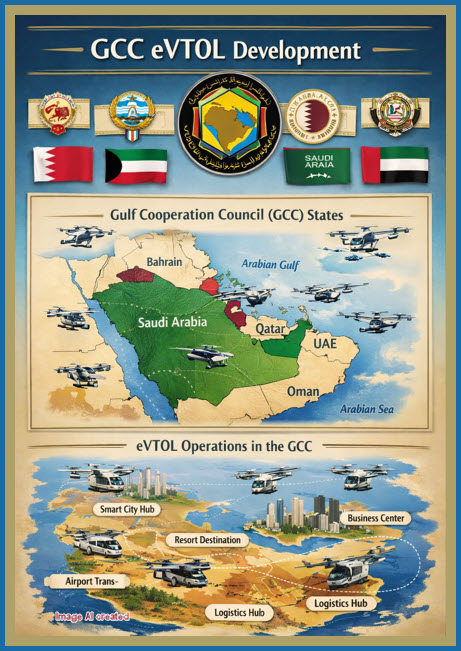 another rather than strictly in sequence.
HOW THE GCC REGULATORS ARE APPROACHING THE MARKET
The defining feature of the GCC regional approach is the speed of regulatory response rather than the comprehensiveness of any single instrument. Gulf regulators benefit from FAST POLICY NETWORKS, and they have used that advantage to integrate multiple authorities at both federal and local levels (including road and transport, air traffic management, and infrastructure and financing) around a workable solution, before building a fully robust regulatory landscape.
The emphasis is on tying the pillars together so that operations can begin, with the rules evolving as the market matures.
UNITED ARAB EMIRATES: IMPLEMENT FIRST, REGULATE ALONGSIDE
 The UAE is the most advanced AAM jurisdiction in the GCC region and is arguably one of the most advanced globally. Its implementation method for AAM is similar to the way it has handled other emerging technologies such as AI and virtual assets: begin operating while developing the regulatory framework in parallel. The logic is to make progress and refine the rules as real experience accumulates, rather than hinder deployment to wait for a complete framework.
The physical buildout is also advanced in the UAE. A vertiport near Dubai International Airport is reported to be substantially complete, with several other hubs in development, and the country is pursuing two parallel models across Abu Dhabi and Dubai, each progressing with its own original equipment manufacturer relationships. The UAE frames AAM specifically as an urban mobility solution (i.e., a response to rapid population growth in its major cities), which sharpens the commercial case and explains the urgency behind reaching operations.
AAM stakeholders also benefit from broad policy support from the UAE, including promotion of public-private partnership: regulators and government entities have been willing to give operators the breathing space to work through challenges unique to the region, from extreme weather to dense and busy airspace, by negotiating positions collaboratively rather than imposing them.
Stakeholders also benefit from sandbox regimes: time-limited exemptions from existing regulations, typically running between one and five years, that LET A COMPANY TREAT THE UAE AS A WORKING LABORATORY TO TRIAL ITS TECHNOLOGY, UNDERSTAND THE MARKET, AND ADAPT ITS OPERATIONS BEFORE FIXED RULES ARE FINALIZED.
On commercial readiness, Dubai is close to a first pilot operation. Timelines may slip, but the direction is clear: the UAE intends to be a first mover, and has shown itself to be a quick learner and adaptor.
SAUDI ARABIA: BUILDING THE CITY AROUND THE TECHNOLOGY
Saudi Arabia is solving a different problem. While the UAE is addressing the needs of mature, established urban centers, Saudi Arabia is building those centers, and it has folded urban air mobility into Vision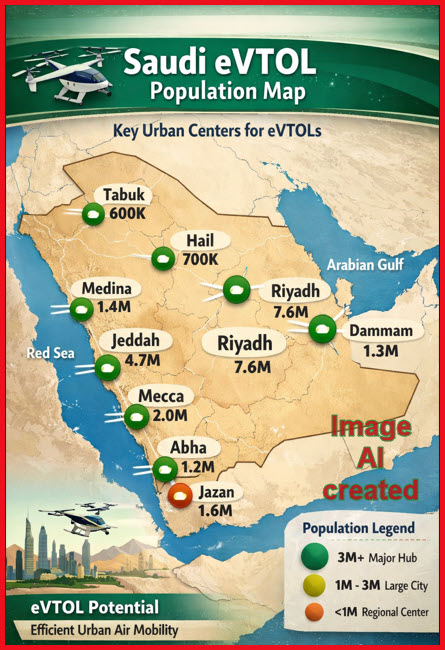 2030 as one of the tools for developing its smart cities and gigaprojects. AAM features across the Red Sea developments, NEOM, and the buildout of Riyadh as a financial and infrastructure hub, with a clear emphasis on tourism and on positioning Riyadh as a modern global center.
That orientation means progress is, in some respects, more measured: much more of the surrounding framework has to be established from scratch, and several of the relevant projects remain in development. The policymaking itself, however, is far from passive. A recently activated memorandum of understanding between Boeing’s Saudi entity, the civil aviation regulator, and a national university is intended to deliver a broad operational feasibility analysis for the Kingdom, including a framework for airspace management driven by AI models, effectively removing human intervention from airspace deconfliction.
WHY TECHNOLOGY AND CYBERSECURITY HAVE MOVED TO CENTER FOCUS
If the operating model is what distinguishes the Gulf, technology and cybersecurity factors will increasingly determine whether it holds. Two developments have pushed these issues to the front of the regulatory agenda.
The first is the region’s security environment. Recent geopolitical events have prompted a genuine concern that AAM projects could be derailed; in practice, the short-term operational impact has been limited and activity has largely returned to pace, with governments publicly reaffirming their commitment to the sector.
The longer-term consequences, however, are a discernible tightening of expectations and a particular and growing focus on data and cybersecurity. Regional disruption to digital infrastructure has also sharpened official thinking about resilience and contingency: the need for credible backup arrangements for critical data and a recognition that operations, including government functions, can be affected when cloud infrastructure is compromised. For an AAM operator whose aircraft generate continuous flight telemetry, generate mapping and passenger data, and depend on resilient connectivity and positioning, this is not a peripheral concern.
The data dimension is where the Gulf’s posture is evolving fastest and where it most clearly enables market entry. The UAE applies data localisation requirements in areas such as the Internet of Things (IoT), and because that regulation is broadly drafted the authorities in practice take a wide, formalistic view of which data must remain in the country and on what terms it may be transferred abroad.
The recently announced consolidation of data, AI, IoT, and cybersecurity oversight into a single federal authority signals an intent to deploy a more unified regime on foreign technology entrants, with data localisation and intellectual property treated as cornerstone issues.
Enforcement of localisation has historically been lighter than the rules themselves imply, but that is shifting, driven in part by the state’s heightened concern to know what happens to data that leaves the country, including the possibility of its misuse. Saudi Arabia’s privacy and cybersecurity laws differ markedly from the UAE’s and in several respects demand stricter compliance.
OUTLOOK
The UAE and Saudi governments want to actively develop the AAM market, which points to continued investment, more public-private partnerships, and more experimental regulatory structures designed to turn ambitious concepts into practical, revenue-generating operations.
For AAM stakeholders, the guidance that follows is consistent: engage the regulators early and often, build through partnerships and ecosystem participation rather than standalone product approval, think well beyond aircraft certification to infrastructure, energy, connectivity, and data, and treat cybersecurity and data governance as central design questions rather than afterthoughts.
Above all, proposals that align with national strategic objectives—diversification, smart-city development, and resilience—will find the fastest path to operations.
Contacts
If you have any questions or would like more information on the issues discussed in this Insight, please contact any of the following:
Authors

Ksenia Andreeva (Dubai)
Sourabh Bhattacharya (Dubai / Riyadh)
[1] This is a WAG not supported by any research!!!