CONGRATULATIONS FAA team- SAFO 26002 delivers swift, sound safety action at NTSB speed
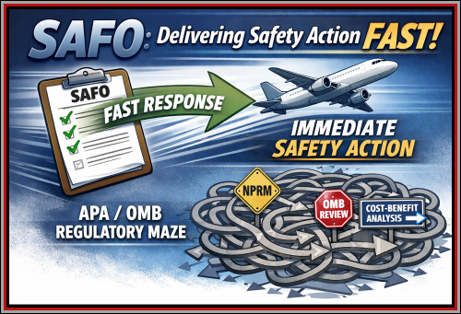
The FAA recently issued a SAFO, that recommends (not mandates) that –
The FAA recommends that each operator who has a CVR installed confirm that company manuals contain instructions that the CVR circuit breaker be pulled after a reportable event. The instruction that the CVR circuit breaker is pulled could be included in flight operation manuals, maintenance manuals, and dispatch manuals, increasing the likelihood that the task is accomplished.

This action is part of a recent FAA trend, like this CVR SAFO, to move safety concerns to action faster. Here is a brief explanation of how this SAFO/informal action trend is TRULY INNOVATIVE!!! Credit to the current FAA team, especially AGC-1
SAFETY is indeed the reason why there are both an NTSB and an FAA. There, however, is some tension between the two organizations’ authority- the Board investigates, but cannot act; while the Safety Administration’s safety mission has historically moved through the labyrinth of the Administrative Procedure Act. These differences have been highlighted by a recent meeting between the two leaders as noted in recent blog:
“FAA Administrator Bedford and NTSB Chair Homendy, according to second hand accounts, was characterized by words like “unusually sharp…a rare public rift…a tense exchange over urgency vs. process…dismissive… anger…lack of control of emotions…clash…EVEN…the 4 letter word starting with F.”
Not the atmosphere conducive to high level policy discussions.”

The Chair is driven by her view that the NTSB is there to save lives and such a noble mission has a very low tolerance for delay. The FAA, however, is a prisoner of a long list of statutory mandates, all of which add steps in order for a rule to become a REQUIREMENT.
The NTSB frustration about CVRs shows how the SAFO approach may be a long term way to resolve these different perspectives—
-
- The NTSB‑instigated push to retain cockpit voice recorder (CVR) audio longer has partially succeeded.
- The FAA issued a final rule in February 2026 requiring 25‑hour CVRs on newly manufactured aircraft, but the rule does not apply to the existing fleet, which still overwrites audio after two hours unless operators voluntarily retrofit.
The CVR retrofit requirement would have been required (all significant rules are) to undergo (44 U.S.C. § 3501 et seq. — the Paperwork Reduction Act) an OMB/OIRA review (Circular A‑4) Regulatory Impact Analysis (RIA) and the FA A must demonstrate– quantified costs, quantified benefits, discounting over time, alternatives analysis, and distributional effects, and justification for any rule whose costs exceed benefits. The NTSB’s request would have failed in this accounting because Industry estimates place retrofit costs at $20,000–$40,000 per aircraft, plus downtime. For ~7,000 U.S. transport aircraft, that is $140–$280 million in direct cost. But CVR retrofits do not show the benefits to outweigh these expenses because the addition of this equipment would not prevent accidents and arguably only improves post‑accident investigation quality.
Now, the SAFO avoids that track and makes an immediate declaration that saving CVR information immediately after reportable event. The introductory sentence makes it clear that the action is not a rule:
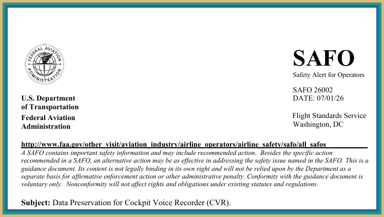
“This is a guidance document… Conformity with the guidance is voluntary only.”
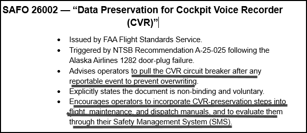 Traditional thinking looks at this as inadequate; it is not enforceable. ALL TRUE, but
Under Part 5 SMS, All Operators must identify hazards, assess the risk identified,
implement mitigations, document the mitigation and monitor effectiveness. A SAFO is treated as a hazard identification from the regulator.
Thus, without mandating the practical reality is that no airline would ignore the “recommendation.” SMS is not focused on enforcement but compliance. A long final rule is intended to set precise, enforceable standards, but the application of the SAFO’s guidance will vary between carriers and even within fleets likely may involve different steps [N.B. Alaska BEFORE the SAFO implemented detailed instructions in all of its relevant internal documents/manuals.]
The ultimate, not always infallible, enforcer, is private litigation AND
If an accident occurs and the airline:
-
-
- ignored 26000 SAFO
- failed to preserve CVR data
- and the missing CVR audio is relevant to probable cause
-
then in civil litigation:
-
-
- plaintiffs will argue negligence per se
- plus ask the judge for a jury instruction that the absence of the SAFO data should be presumed to have been evidence damaging to the airline
- juries will see the SAFO as a clear warning
- the airline will appear reckless
- damages will skyrocket—i.e., the insurers will likely include an exclusion in the coverage .
-
The current FAA team should be credited with finding this regulatory work around. This SAFO is but one of a series of swift, sound safety actions:
SAFOs (Safety Alerts for Operators)
SAFOs are the FAA’s primary “informal request” mechanism. Recent examples include:
-
-
- SAFOs on runway incursion risk (post‑Austin near‑collision).
- SAFOs on turbulence‑injury prevention (post‑Hawaiian Airlines severe turbulence event).
- SAFOs on lithium‑battery fire response (multiple cargo‑fire events).
-
InFOs (Information for Operators)
InFOs are even lighter-touch than SAFOs. Examples:
-
-
- InFOs on pilot mental health reporting (post‑Germanwings and ARC recommendations).
- InFOs on flight deck distraction mitigation.
- InFOs on maintenance human‑factors best practices.
-
As someone who had the job of bringing safety actions on an expedited basis, this is a brilliant legal solution. CONGRATULATIONS!!!
FAA Issues New Guidance to Prevent CVR Data Loss
Safety alert aims to ensure critical cockpit voice recorder audio is preserved for accident investigations.
 Meg Godlewski Wednesday, July 08, 2026 at 10:00 AM ET

Key Takeaways:
The FAA is developing recommendations to protect information captured by the cockpit voice recorder (CVR) of an aircraft that has been involved in an accident or reportable incident.
The agency has issued a Safety Alert for Operators (SAFO) advising airline crews and maintenance teams to shut off power to the CVR to protect critical audio data after a reportable event. CVRs are designed with a finite amount of memory that is overwritten, unless the circuit breaker for the device is pulled.
The SAFO advises operators to provide clear shutoff instructions for the CVR through flight, maintenance, and dispatch manuals, and instructs airlines and air taxi companies to assess applicable procedures through their Safety Management Systems (SMS) to ensure the guidance is implemented and effective.
ACCORDING TO THE FAA, THE SAFO ADDRESSES A NATIONAL TRANSPORTATION SAFETY BOARD (NTSB) RECOMMENDATION IN 2025 STEMMING FROM THE JANUARY 2024 IN-FLIGHT LOSS OF A DOOR PLUG FROM ALASKA AIRLINES FLIGHT 1282, A BOEING 737-900. The mid-exit door plug (MED) departed the aircraft shortly after takeoff from Portland International Airport (KPDX) in Oregon.
The loss of the MED as the jet climbed through 14,830 feet resulted in explosive decompression. The door, along with unsecured objects including cellphones, paper, children’s toys, clothing, and parts of the aircraft interior rained down on a Portland suburb.
One flight attendant and seven passengers received minor injuries. The captain, first officer, three flight attendants, and 164 passengers were uninjured. Video taken from inside the aircraft during the return to KPDX appeared on social media, showing supplemental oxygen masks hanging from the ceiling, seat frames twisted as if they were made of Play-Doh, and a gaping hole in the fuselage with the city lights of Portland below.
The aircraft was able to land safely at the airport, where the passengers and crew departed.
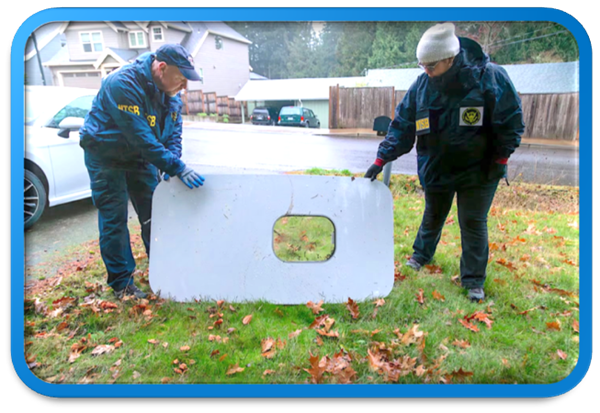
Mid-exit door (MED) plug from Alaska Airlines Flight 1282. [Credit: NTSB]
During the preliminary NTSB hearing it was learned that the force of the decompression blew open the cockpit door and the flight crew lost their headsets. The loss of cabin pressure necessitated the use of supplemental oxygen, which further made it difficult for the crew to communicate. In addition, the interphone was knocked out, making it impossible to reach the flight attendants in the cabin to determine the extent of the severity of the event.
The CVR was not available for review by the NTSB, because, as noted by several people during testimony, BY THE TIME THE TECHNICIANS RETURNED TO THE COCKPIT, THE CVR HAD OVERWRITTEN itself as it is designed to record two hours at a time, then recycle. The procedure in the event of an accident or incident is to pull the circuit breaker to preserve the information on the CVR, but it was noted that the flight crew was focused on the welfare of the passengers and getting the aircraft safely back on the ground.
As the FAA report indicates, because the CVR had been overwritten, the NTSB was not able to fully evaluate some flight deck environment events associated with the rapid depressurization, such as the difficulties the pilots had establishing communications back to their headsets after removing oxygen masks.
Because of the missing CVR, the NTSB could not determine whether factors other than the loud noises in the airplane contributed to the reported communication difficulties that occurred while the pilots were wearing their oxygen masks, such as the captain and a flight attendant reporting inability to communicate with each other over the interphone despite multiple attempts.
“Such a determination would support the development of recommendations for safety enhancements, which, depending on the reason for the difficulties, could involve equipment, procedural, or training solutions,” the FAA report stated.
One of the recommendations to come out of the NTSB investigation was to require CVRs capable of recording 25 hours at a stretch before the overwrite.
The FAA recommends {SAFO} that each operator with a CVR installed “confirm that company manuals contain instructions that the CVR circuit breaker be pulled after a reportable event. The instruction that the CVR circuit breaker is pulled could be included in flight operation manuals, maintenance manuals, and dispatch manuals, increasing the likelihood that the task is accomplished. Certificate holders operating under Title 14 Code of Federal Regulations (14 CFR) parts 121 or 135 should use their safety assurance processes within their Safety Management System (SMS) to ensure the recommended risk controls are analyzed and assessed to meet the organization’s safety objective.”
In an email to the FAA, the NTSB noted that following the accident Alaska Airlines implemented several changes related to preserving flight data recorder (FDR) and CVR data after an incident or accident, such as adding circuit breaker information to the Quick Reference Handbook (QRH) used by pilots, and adding a reminder to the flight operations duty officer and dispatch brief checklists to confirm that CVR and FDR circuit breakers are pulled following an event.
The airlines {AS?} also revised the Emergency Coordination Center maintenance and engineering checklist, non-Emergency Coordination Center maintenance control checklist, and Emergency Coordination Center flight operations checklist to prioritize timely pulling of the FDR and CVR circuit breakers following an event.
“The FAA recognizes the importance of protecting cockpit voice recorder (CVR) data following a reportable event,” said FAA Administrator Bryan Bedford in an email to the NTSB. “There are several 14 CFR sections, §§ 121.135, 125.73, 135.23, and 91.1025, that stipulate manual content requirements. However, none of these sections require operators to ensure the cockpit voice recorders (CVR) circuit breaker has been pulled after a reportable event.”
Bedford’s email continues, noting that after May 28, 2027, “every Part 121 and Part 135 certificate holder is required under 14 CFR Part 5 to have a Safety Assurance module within their Safety Management System which WILL REQUIRE THEM TO CONSIDER NOTIFICATIONS FROM EXTERNAL SOURCES and, therefore, use their safety assurance module to determine if they have procedures in place to ensure that CVR data retention is located throughout their manual system.”

