ICAO’s Next SMS Iteration: Not FAA-Required, but Useful for Assessing Your Safety Culture
REDiFly has published the below exposition of a new iteration of SMS, entitled ICAO Annex 19, Edition 3.The premise of this advanced safety risk discipline, which EASA supports and to which the FAA has posted an exception, is that SMS is more than a manual, paperwork, procedures, and forms. There needs be evidence that the process is working within your organization.
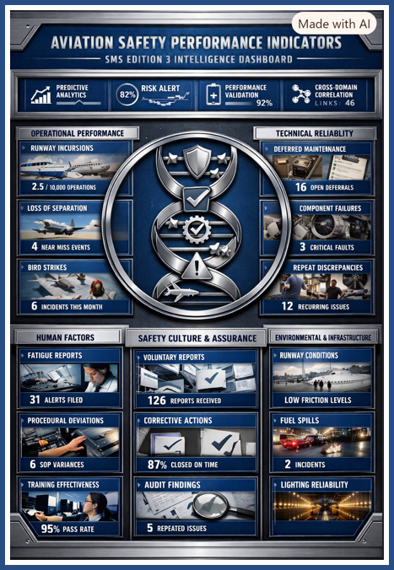
The revision is named Safety Intelligence and it focuses on SAFETY PERFORMANCE INDICATORS [SPIs] which the REDiFly authors ably explain in their paper.
SPIs are not yet required by the FAA. United States has formally filed “differences” with ICAO for portions of Annex 19, meaning the FAA acknowledges non‑alignment but has not provided a public justification. Based on what it has published and what can be inferred from the regulatory structure, here are some of the likely reasons why SPIs have not been added to 14 CFR Part 5.
- First, SMS was introduced seriatim- Part 121, Part 135,Part 145(voluntary), § 91.147 Air Tour Operators, TC & PC holders, and by extension certain Part 139 airports. Each addition required time to rewrite the FARs and then to apply this discipline to the specific operational safety risks .
- Second and related to 1, NPRM projects require major dedication from the staff- drafting, circulating internally, rewriting (the safety offices, lawyers (crafting any rule must be enforceable/clear), quantitative and qualitative analysts, environmental experts, coordinating (OST and OMB), frequent revisions based on the comments of others, publication in the Federal Register, reading the public comments and promulgating the final version . THAT COMMITMENT OF TIME AND RESOURCES does not merit the Edition 3 rewrite.
- The FAA believes its existing system already satisfies the intent of Annex 19. FAA oversight culture is compliance‑based, not performance‑based. To add SPIs would require the NPRM process first, followed by transferring the regulatory lexicon to specific guidance relative to inspectors.
- An honest assessment might point out that there is significant variance in implementation among all of the organizations subject to SMS .
 GOOD NEWS- you don’t have to comply. BETTER NEWS- the general concepts and specific suggestions might help assess your SAFETY CULTURE.
That said SMS philosophy can be easily written down on paper and records document steps taken. Safety Intelligence attempts to elevate all who work in aviation to believe in the 24/7/365 surveillance for possible risks. There is no safety thermometer to measure the temperature of the individual. SPIs, as objective as they can be, LOOK FOR:
- Not just a stack of papers, but free submission of reports. The volume and specificity of these initial safety indicators should tell whether SMS DNA exists.

- How well the review, analysis, discussion, and recommendation steps perform is hard to discern after the fact. SPI for this critical aspect of SMS can be found in through initial reports; one tell would be if the submitter writes in vague terms so as to avoid drawing the ire of supervisors and coworkers.

- It’s one where frontline staff are actually submitting reports — regularly, confidently, without friction.
- An active register with CAPAs assigned, tracked, and closed with evidence.
 Managers treating the SAFETY REPORT as priorities, along with– not behind work production tasks. Their INBOX relies on useful data that provides a basis to take meaningful remedial actions as important, need-to-fix actions.
- Documents’ vitality shown by the manager remembering what was done abased on a cogent risk analysis. Memory would be great, but even taking a few minutes to find the well-organized file.
Safety Culture is so important to achieving the highest levels of risk management for your company. The Edition 3 rubric, though not required in US, includes insights on how to measure your internal commitment to the preeminent goal of aviation.

ICAO Annex 19 Edition 3: What It Means for Your Aviation SMS
[EXCERPTED]

If you’re responsible for safety management at an airline, Part-145 MRO[1], or CAMO, you’ve probably already heard that ICAO Annex 19 has been updated. The third edition was adopted in June 2025, became effective in November 2025, and reaches its formal applicability date on 26 November 2026.
What you may not have heard, or at least not had spelled out clearly, is what it actually means for how your aviation safety management system needs to operate between now and then. Because this isn’t a documentation update. It’s a fundamental change in what regulators will expect to see when they walk through your door.
What Is ICAO Annex 19 Edition 3 and What Changed in 2026?
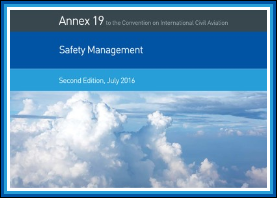 ICAO Annex 19 is the international standard for aviation safety management. Published by the International Civil Aviation Organization, it defines the framework that States and aviation service providers — airlines, MROs, CAMOs, aerodromes, and others — are required to follow when implementing a Safety Management System.
The third edition, known formally as Amendment 2, is the most significant update since the Annex was introduced in 2013. Previous editions defined what an SMS needed to contain. The third edition raises the bar by defining how well it needs to work.
The core change for operators and maintenance organisations: ICAO has moved away from a compliance-based model, where having the right procedures documented was broadly sufficient, toward a performance-based, intelligence-driven one, where organisations must show their SMS is actively functioning, generating useful data, and influencing real decisions. To support this, ICAO has published a new Safety Intelligence Manual, Doc 10159, with structured guidance on how organisations should collect, analyse, and act on safety data day to day.
Put simply: the third edition doesn’t just ask whether you have an SMS. It asks whether it’s working.
The Change That Actually Matters
Most of the commentary around ICAO Annex 19 Edition 3 has focused on EXPANDED APPLICABILITY — RPAS OPERATORS, CERTIFIED HELIPORTS[2], AND SO ON. That matters for those sectors, but for aircraft operators and Part-145 organisations who already have an SMS requirement, the more important shift is subtler and considerably more demanding.
ICAO has moved the standard for a compliant SMS from having one to proving it works.
The third edition puts formal weight on safety intelligence, measurable SAFETY PERFORMANCE INDICATORS (SPIs-[Flight Safety Foundation’s explanation.]), and the ability to show that your SMS is actively shaping decisions across the organisation, not just sitting in a manual on a shared drive. Doc 10159 makes the direction clear: organisations need to move beyond collecting safety data toward making sure it’s trustworthy, contextualised, and actually acted on.
Your SMS needs to show its work.
EASA has been heading this way for a while. Their Management System Assessment Tool, the framework EASA inspectors use when they evaluate your SMS, states directly that “being compliant with the requirement does not necessarily mean being safe” and that assessors must look at the difference between compliance and performance. That’s not new language. But the November 2026 deadline gives it real teeth for organisations that still haven’t closed that gap.
Under current EASA SMS requirements, this assessment is already happening. The MSAT framework is the live benchmark, not a future consideration — evaluating systems on a four-stage scale: present, suitable, operating, and effective.
What “Operational” Actually Looks Like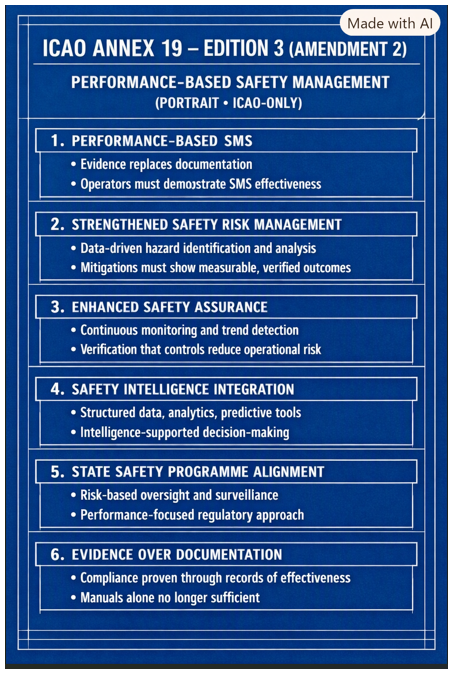
There’s a distinction that comes up constantly in the safety world: the gap between a documented SMS and an operational one.
A documented SMS ticks the right boxes on paper. If an auditor shows up and asks to see the manual, you can hand it over.
An OPERATIONAL SMS IS SOMETHING DIFFERENT. It’s one where frontline staff are actually submitting reports — regularly, confidently, without friction. Where hazards flow from those reports into a live risk register. Where CAPA[3]s are assigned, tracked, and closed with evidence. Where management is getting meaningful safety data and doing something with it. Where, if an inspector asks to see how a specific hazard evolved over the past six months, you can pull that up in five minutes, not spend an afternoon piecing it together from three different spreadsheets.
Under ICAO Annex 19 Edition 3, the second version is what’s required. And here’s the uncomfortable question: if you’re running your SMS on spreadsheets, shared folders, and email chains, which version do you actually have?
Why Your Current Tools May Be the Problem
This is where the conversation tends to get a bit uncomfortable.
Spreadsheets and email-based safety management don’t fall short because the people running them aren’t capable or committed. They fall short because the tools themselves make a genuinely operational SMS impossible to sustain. We’ve looked at the hidden administrative burden of spreadsheet-based safety management before, but the Edition 3 deadline makes the stakes considerably higher.
Think about what actually happens day to day. A report arrives by email and sits in an inbox. The hazard doesn’t reach the risk register until someone manually moves it across. The CAPA lives in a separate document with no reminders, no escalation, no automatic trail. The audit record, who approved what, when, and why, exists only if someone remembered to save the right version of the right file at the right time.
Edition 3 asks organisations to demonstrate defined SPIs, alert thresholds, trend analysis, and evidence of management review cycles. You can’t produce that reliably from a fragmented, manual system. Most aviation SMS software built around disconnected tools simply wasn’t designed for this kind of joined-up output, and the administrative effort required to fake it is more than most lean safety teams can absorb.
EASA’s own inspector framework puts it clearly: being compliant with the requirement does not necessarily mean being safe, and that’s the standard assessors are now formally applying. Demonstrated effectiveness is the bar, not documented intent.
Why Reporting Culture Matters More Under Annex 19 Edition 3
There’s another dimension to this that the regulatory guidance doesn’t spell out directly, but that anyone who’s been doing this job for more than a year already knows.
PERFORMANCE-BASED SMS ONLY WORKS IF PEOPLE ARE REPORTING.
ICAO’s safety intelligence framework assumes your organisation is generating a meaningful, consistent flow of data — occurrence reports, near-miss observations, hazard identifications — that can be analysed for trends. If your frontline staff aren’t reporting, there is nothing to analyse. You’re measuring silence, not safety.
Reporting culture is shaped by leadership, trust, Just Culture, and how people feel their reports will be used. ICAO Annex 19 Edition 3 strengthens the requirements around protecting reporting sources and supporting Just Culture environments precisely because data quality depends entirely on whether people feel safe contributing to it. You can’t mandate that culture into existence. But you can make it easier or harder through the tools you put in front of people.
When submitting a report takes fifteen minutes, involves a clunky form, or disappears into an inbox with no visible outcome, people quietly stop doing it. Not because they don’t care, but because the process tells them it doesn’t matter. The organisations that hold up well under Edition 3 oversight will be the ones where reporting is genuinely frictionless, where the gap between a crew member noticing something and that observation reaching the safety system is as small as possible.
If your tools make reporting hard, you’re not just failing a usability test. You’re eroding the data foundation that Edition 3 now formally requires you to demonstrate.
What Regulators Will Actually Ask For
Here’s what demonstrating SMS effectiveness looks like in practice, because it’s more concrete than it might sound.
When an EASA inspector or national authority auditor sits down with your safety team, expect questions along these lines:
- Can you show me how a specific hazard was identified, assessed, mitigated, and closed, with timestamps and owners at each stage?
- What are your current SPIs, and when I look at your last three management review records, will I find evidence that safety trends actually changed any operational decisions?
- How does safety data from frontline reporting connect to decisions made at management level?
- Can you give me examples of changes your organisation made as a direct result of SMS data, and show me the trail that led to that decision?
These aren’t gotcha questions. They’re reasonable expectations for any organisation that’s had an SMS requirement for several years. But they need connected, traceable, time-stamped data behind them, and the ability to pull that together quickly. If the answer involves an afternoon of spreadsheet consolidation while the inspector waits, that gap won’t go unnoticed.
…
[1] FAA’s own ICAO SMS/QA/Recordkeeping presentation makes it clear that the United States has formally filed “differences” with ICAO for portions of Annex 19, meaning the FAA acknowledges non‑alignment but has not provided a public justification.
[2] 14 CFR Part 5 does not apply to RPAS (drone) operators or to certificated heliports.
[3] Corrective and Preventive Action
