FBO safety training should include a broad horizon of risks
NBAA and NATA, see below, have provided excellent advice for enhancing the SAFETY of a FIXED BASED OPERATION. As they explain the workplace is
-
-
- Dynamic environment,
- with lots of moving parts,
- in all types of weather,
- under varying demand for services (arriving and departing),
- a wide variety of aircraft,
- adjacent to taxiways and runways,
- contiguous to other airport tenants
- (food services, fuelers, private hangars, baggage handling, MX stations, CFR stations, ATC ground vehicles, FAA Flight Safety cars, and airport staff)
- with a wide range of user sophistication[1]
-
Experience suggests that a micro review of an FBO’s safety risks maybe MYOPIC. Having the views of JUST the professionals on your staff really may not capture all of the potential exposure of your aircraft and your team/customers. A 360⁰ horizon, in at least the development of a full SMS and the creation of a Training Course, should result in a more complete picture for design of and training for your SAFETY PROGRAM.
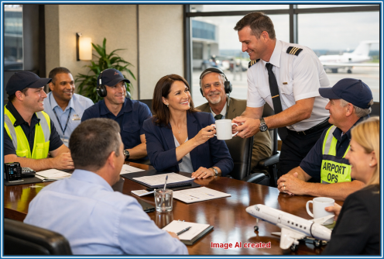
The AI cover picture may look a little too crowded, so let’s review why each participant may contribute to SAFETY PROGRAM.
Any program must be a systematic, organization‑wide approach to managing safety—covering structures, accountabilities, policies, and procedures across every level of the operation, not just wing walkers or CSRs. That equates to invitations to everyone whose actions, decisions, or observations affect risk: ground handlers, customer service, maintenance, office managers, clients, pilots, FAA/ATC, and airport personnel.
Different roles = different hazard lenses
Each group sees hazards others literally cannot:
- Ground handlers & ramp staff Knowledge base: aircraft movement, fueling, towing, de‑icing, loading, GSE use. Unique hazards: FOD, jet blast, wingtip strikes, mis‑loaded baggage/cargo, fueling errors, icy ramps. SMS
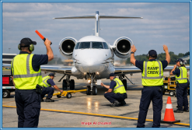 value: They are the first to see unsafe ramp layouts, rushed turnarounds, or chronic near‑misses around tugs and belt loaders—classic inputs to Safety Risk Management (SRM) and safety assurance.
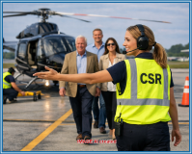
 - Customer service representatives & office managers Knowledge base: passenger flow, scheduling, documentation, vendor coordination, billing, and policy enforcement. Unique hazards: miscommunicated departure times, incorrect passenger counts, mishandled special needs, pressure to “get the client out now,” documentation gaps. SMS value: They see operational pressure and organizational drift—how commercial demands erode safety margins. SMS guidance for airports explicitly calls out the need to integrate administrative and organizational processes into safety risk management.
- Maintenance technicians & mechanics Knowledge base: airworthiness, defect trends, MEL use, reliability data, tooling, and maintenance procedures. Unique hazards: repeat defects, deferred maintenance culture, tooling issues, rushed sign‑offs, poor tech data. SMS value: ICAO and FAA SMS material emphasize maintenance participation in hazard identification and risk assessment; they feed safety assurance with reliability trends and “weak signals” long before an incident.
- Pilots & client flight departments Knowledge base: operational risk in real time—weather, ATC constraints, aircraft performance, crew workload, client expectations. Unique hazards: unstable approaches, rushed departures, fatigue, “get‑there‑itis,” non‑standard client demands. SMS value: They are central to safety reporting systems (ASAP‑style), FOQA data interpretation, and risk controls in the cockpit. SMS training literature explicitly stresses role‑specific training for pilots and line operations.
- FAA ATC & airport personnel (ops, ARFF, wildlife, etc.) Knowledge base: traffic management, runway/taxiway configuration, NOTAMs, construction, wildlife, emergency response, airport infrastructure. Unique
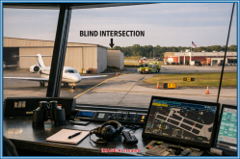 hazards: runway incursions, hot spots, construction mis‑coordination, wildlife strikes, emergency access issues. SMS value: FAA’s airport SMS guidance and ACRP reports highlight multi‑stakeholder safety risk panels and cross‑functional SRM as essential—bringing airport ops, ATC, tenants, and users together to analyze risks and design mitigations.
When you put all of these together, you get the “390‑degree” view: not just every angle around the aircraft, but also the organizational, commercial, and regulatory dimensions that surround it.
Yea, yea, yea that sounds great but getting them altogether is difficult and taking them all from their jobs is expensive. All true, but the time spent in these sessions is a fraction of such meetings.
- When an arriving plane is held up by the ground crew, the pilot becomes an advocate telling his passengers the safety exposure that may be causing the delay.
- When a CSR gets a demand from the ground crew, the time spent understanding the risks out on the ramp is information which will facilitate the change in schedule. The schedule is important, but the CSR now fully understands the consequences of trying to cut a corner.
- The Controller’s view of a troublesome intersection is the reason why the airport and the FBO manager decide to improve the sight lines on the ground (warning lights- altering the taxiway?)
- Better hazard reporting and data quality when participation in these 360⁰ exercises are extended beyond pilots and safety staff to “everyone in the organization,” hazard reports increase significantly and become more diverse—covering maintenance, ground ops, and administrative issues, not just flight events.
- In the complex workplace, all of the players are more aware of what others may need for them to perform their jobs and vice versa.
Any view of your own performance or safety culture may suffer from inherent biases.. Self‑auditing is inherently subjective, but the degree of subjectivity depends on the structure, controls, and independence built into the process. The range of techniques for keeping the conversation FOCUSED and the alternative approaches to solve identified risks are limited by the background of the company’s facilitator. A good way of efficiently conducting the meeting and designing the remedial procedures is the employ of someone not wed to the company’s past practices and with real objectivity.
Company-Wide Ground Safety Culture Is Key in Business Aviation
June 29, 2026

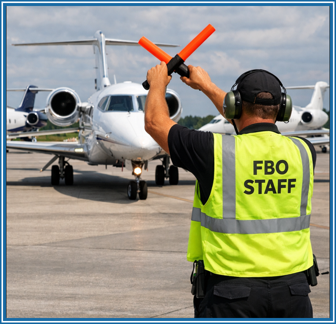
IMAGE AI Created 1
Although aviation remains the safest mode of transportation, too many people are injured each year in accidents on airport runways and ramps, underscoring the IMPORTANCE OF PROVIDING SAFETY TRAINING FOR ALL those who may find themselves near active aircraft areas.
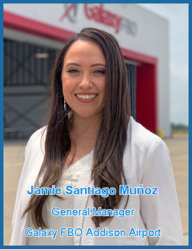 “I think when people are being introduced to the company and its operating environment, it’s really important to immediately establish some kind of standardized and recognized form of ground safety training,” explained Jamie Santiago-Muñoz, general manager of the Galaxy FBO in Addison, TX. “The overall environment can be very confusing to many people.
“When a new employee starts here, OUR NUMBER ONE FOCUS is on stressing safety, whether they are working on the ramp or as a CSR [customer service representative],” she continued. “We want them to understand that everything they do can impact safety, from taking the wrong fuel order or not receiving the correct readback from someone on the ramp – they need to understand these tasks and how they can lead to serious mistakes.
“There can be so much going on, so one of our big points is to stress situational awareness,” Santiago-Muñoz said. “Being continually vigilant and aware of what’s going on around you. Not just the aircraft, fuel trucks, and tugs, but also passenger who have access to the ramp in their cars. They’re all added layers of complexity to an already busy and distracting environment.”
Regarding passenger vehicles being granted ramp access, Santiago-Muñoz emphasized that this convenience must have prior approval, and a member of Galaxy FBO’s staff must always be with them.
“The way our ramp is laid out here at Addison Airport [ADS], we can do it safely, but it has to be done correctly,” she added. “We teach all our CSRs to be aware of the environment and look for areas where there could be issues. If they see an aircraft firing up and a car is coming through the access gate, they make sure the pilot and the car’s driver see each other before proceeding. The aircraft always has the right-of-way.”
Related article: Procedures, Culture Drive Proper Response to Ground Safety
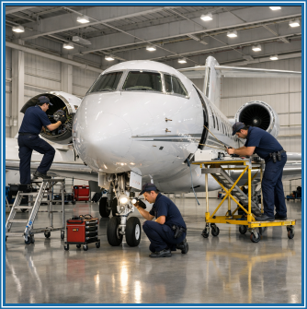
IMAGE AI Created 2
Leverage Safety Certification Programs
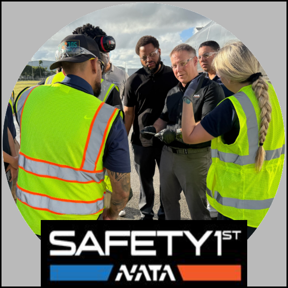
Galaxy FBO relies on the National Air Transportation Association (NATA) Safety 1st Certification Program as its primary training tool. “Formal safety training is an absolute necessity for anyone who either works or has any reason to be around any active aircraft or ground service equipment,” said NATA Manager, Safety and Training Brandon Popovich. “Working around aircraft is a skilled professional position, and every employee needs to be properly trained in the best safety practices for each situation.
 “Also, the implementation of an SMS [safety management system] is growing throughout the business aviation industry,” Popovich added. “Even if a company or FBO does not have a formal SMS in place, they still need to provide some type of structured safety training program.
“People with any ramp or hangar access need to know what a FLASHING BEACON on an aircraft means and the dangers of propellers, JET BLAST, FOD (foreign object debris), and all that plays into effective training for anyone who goes on the ramp, even if it’s not their primary job responsibility,” he said. “NATA’s Safety 1st program provides the BASS – Basic Apron Safety and Security Certification. When an NATA customer company puts a new employee in our online Safety 1st Training Center, they are automatically enrolled in the BASS program.”
Also, for operations personnel who have safety management responsibilities, NBAA’s Safety Committee – in collaboration with Advanced Aircrew Academy, Convergent Performance and Fireside Partners – developed the SAFETY MANAGER CERTIFICATE PROGRAM, which is designed to provide participants introductory to mid-level training on safety in business aviation operations. The course offers the tools to effectively manage a business aviation organization’s safety management effort, including its SMS.
Hold Informal Cross-Training Sessions
Also, both Popovich and Santiago-Muñoz encouraged operators to consider bringing together representatives from various teams – CSRs and aircraft fuelers for example – for informal information-sharing sessions with all the other members of their shift.
“Cross-training is becoming quite popular among the larger flight departments so they can all understand what others do on a daily basis,” Popovich said. “A scheduler or CSR can learn how long it takes to fuel an airplane or remove it from the hangar. A fueler can hear what types of things a pilot or maintainer {why not include both of them- the essence of SMS is a 360⁰ } will ask of an office person.
“It’s a very effective way for everyone to better understand all the different parts that make ground services work,” said Popovich. “And better understanding is a big step towards greater awareness and safety.”
“I would say that training is step one in the safety process,” said Santiago-Muñoz. “You really have to create a culture where people are not afraid to speak up when they see a potentially dangerous situation. That’s really the next key step after you have your training program in place.”
Review NBAA resources on hangar and ground safety.
[1] Here are some recent cases involved with risk in ground work- https://jdasolutions.aero/blog/iams-ramp-threat-analysis-is-right-on-its-path-not-expeditious-there-is-way-to-risk-reduction-now/; https://jdasolutions.aero/blog/airport-safety-needs-the-magnifying-glass-of-sms-not-list-of-16/; https://jdasolutions.aero/blog/what-lesson-from-the-jazz-crash-at-lga-airports-should-implement-soon/

