An Educated Guess at Why Establishing ASM Took Nine Months

On January 27, 2026 FAA Administrator Bedford, five months after his swearing-in, issued his Flight Plan 2026. The Order issued several major initiatives for the organization. Most prominent was his decision to withdraw the authority of line organizations to manage the VRDP/ASRS process and make a new Aviation Safety Management Office (ASM).
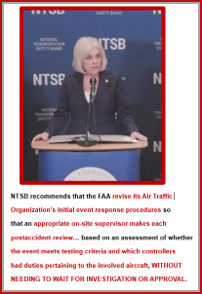 The trade press highlighted that the impetus for this SMS change was the American Eagle Flight 5342, a Bombardier CRJ700 operated by regional carrier PSA Airlines, with a U.S. Army helicopter near REAGAN NATIONAL AIRPORT IN JANUARY 2025. The NTSB stated that DCA tower personnel had repeatedly documented close‑proximity hazards — including helicopter/air carrier conflicts — through internal voluntary reporting channels (VRDP‑like submissions and other tower‑level safety logs).They found 15,214 total close‑proximity / near‑midair events in the DCA terminal area, 85 of those were classified as serious close‑call incidents.
On September 16, 2026 the orders of almost nine months ago were codified in Order 1030.8 signed by the Administrator. WHAT did it TAKE SO LONG TO CONVERT THE ADMINISTRATOR”S VERY CLEAR DECISION INTO A 68 PAGE DOCUMENT??? The delay was needed because major cross‑FAA authority realignment had to be delineated. The time[1] needed to negotiate the “tearing down of the silos” included the following tasks:
-
-
- Developed the FAA Enterprise SMS Framework
- Created the Enterprise Safety Risk Management (SRM) process.
- Stood up the Executive Safety Council (ESC) support structure
- Initiated FAA‑wide hazard taxonomy harmonization
- Launched enterprise safety data integration work
- Drafted enterprise safety promotion materials
-
One possible explanation for this glacier like progress could be the ASM, while writing its Magna Carta, was absorbed with acting on existing risk assessments and thus not able to expedite their organizational design. However, a CoPilot AI search was unable to find such a diversion of attention, e.g.:
ASM has not yet done
-
-
- It has not issued public SRM documents.
- It has not published enterprise hazard analyses.
- It has not released public recommendations on specific events (e.g., runway incursions, DCA events). These will come later once the enterprise SMS is fully operational.
-
The nitty gritty of this drafting assignment was not words, but having to deal with this hard point within the FAA
-
-
-
- DCA tower management historically took minimal or inconsistent remedial action on repeated runway‑incursion‑type events.
- Under Order 1030.8, they no longer control the review pipeline.
- ASM and the enterprise SRM process will now:
-
-
-
-
-
-
- identify systemic hazards
- escalate risk decisions
- require corrective actions
- track compliance
- prevent local management from ignoring patterns
-
-
-
But one might observe that the executives, managers and supervisors had no real choice but to follow the FAA’s “CEO”’s edict. What is missing from this realignment is NATCA and here is what outside sources surmised:
“ NATCA is uniquely positioned because:
-
-
-
- Controllers generate the majority of FAA’s operational safety data (ATSAP, VRP/VRDP, tower logs, operational error reports).
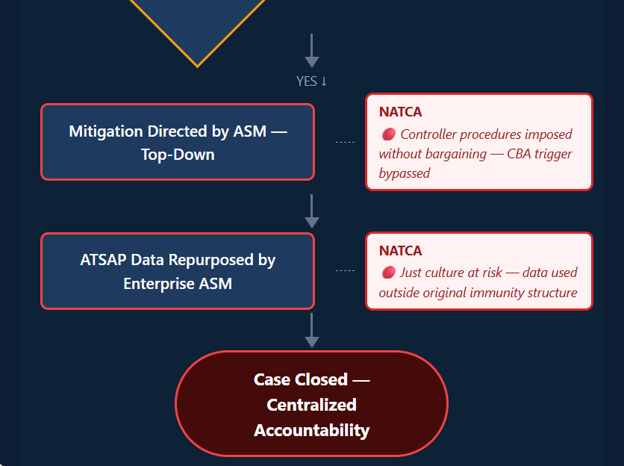
- Any change to how that data is reviewed, escalated, or used can trigger bargaining obligations under the CBA.
- ATO cannot implement changes to controller oversight without NATCA concurrence or formal negotiation.
-
-
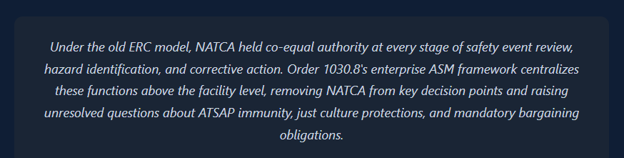
Order 1030.8 centralizes safety‑event review authority under ASM — meaning:
-
-
-
- local facilities (like DCA tower) lose unilateral control over reviewing operational errors
- ATO’s internal SMS processes become subordinate to an enterprise SMS
- enterprise hazard identification can override local management decisions
- enterprise SRM panels can require corrective actions that affect controller procedures, staffing, or training
-
-
So while NATCA cannot veto an Administrator’s decision, they can slow the clearance process by requiring:
-
-
-
- pre‑decisional consultation
- impact and implementation bargaining
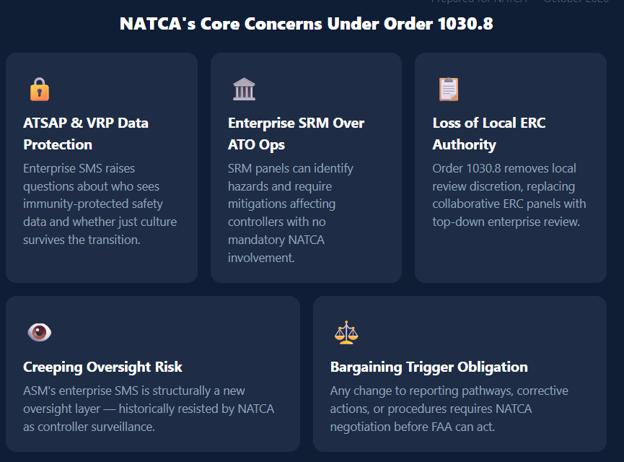
- clarification of how ATSAP/VRP data will be protected
- assurances that enterprise SMS will not be used for punitive action
- guarantees that ASM will not interfere with negotiated safety reporting protections
-
-
Protection of ATSAP and VRP/VRDP data
NATCA is extremely protective of:
-
-
-
- ATSAP immunity
- non‑punitive reporting
- limits on management use of safety data
-
-
Order 1030.8 shifts data oversight to ASM, raising questions NATCA needed answered:
-
-
-
- Who sees ATSAP‑derived hazard data?
- Can ASM trigger corrective actions that affect controllers?
- Does enterprise SMS change the “just culture” protections?
-
-
These questions require negotiation.
Enterprise SRM authority over ATO operations
Enterprise SRM panels can now:
-
-
-
- identify hazards in ATO operations
- require mitigations
- escalate risk decisions above ATO leadership
-
-
NATCA needed to ensure:
-
-
-
- mitigations do not impose new controller procedures without bargaining
- staffing‑related hazards are not addressed unilaterally
- ASM cannot override facility‑level operational decisions
-
-
Removal of local management control over safety‑event review
Order 1030.8 effectively removes:
-
-
-
- local review authority
- local discretion to ignore patterns
- local control over corrective actions
-
-
NATCA historically prefers local collaborative safety processes (e.g., ATSAP ERCs). Enterprise review introduces a new actor (ASM) outside the CBA structure.
Fear of “creeping oversight”
NATCA has long resisted:
-
-
-
- external oversight of controller performance
- new layers of review
- any process that could be interpreted as surveillance
-
-
ASM’s enterprise SMS is, structurally, a new oversight layer.
Need to clarify bargaining triggers
Any change to:
-
-
-
- reporting pathways
- hazard review processes
- corrective action mechanisms
- training requirements
- operational procedures
-
-
…requires bargaining.
FAA cannot issue an order that implicitly changes working conditions without NATCA sign‑off.
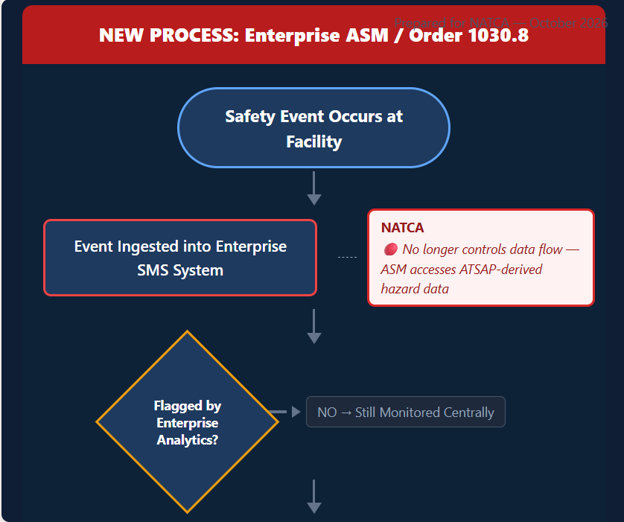
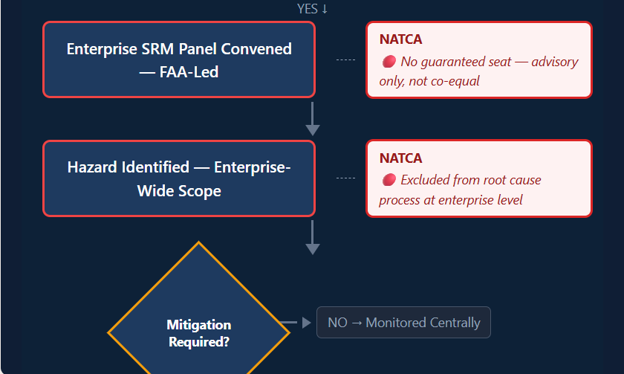
Sadly, although the Administration (POTUS, S-1, and AGC-1) all supported removing the ERC decision process to an enterprise-wide, objective and seeking good preventative actions ORGANIZATION consumed 9 months. NATCA’s small victory = delay of truly RESPONSIVE SMS reviews.

FAA Order Lays Groundwork for Unified Agency SMS
Order follows creation of Aviation Safety Management Office earlier this year
By Kerry Lynch • Editor, AIN monthly magazine

September 17, 2026
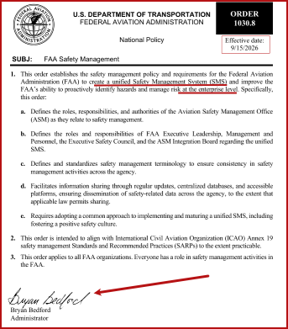
The FAA this week released an order implementing a UNIFIED SAFETY MANAGEMENT SYSTEM (SMS) throughout the agency. Effective September 15, [2026] Order 1030.8 establishes safety management policy and the requirements for a single SMS under the Aviation Safety Management Office.
IN JANUARY, the agency announced a reorganization that included a new safety oversight office tasked with implementing a single safety management system and risk management strategy throughout the FAA. The agency said that instead of having individual offices monitor their own safety metrics, the new office would pull together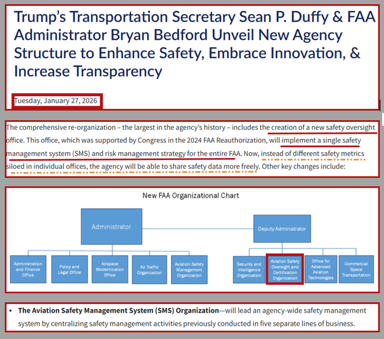 and share safety data from across the agency.
At the time [1/27/2026], FAA Administrator Bryan Bedford had outlined a “Flight Plan” for the agency that called for streamlining its safety management activities. He explained to the Aero Club of Washington that there have been 14 lines of business at the FAA, and “We don’t collaborate well. We don’t share data across the silos. So we’re tearing those silos down, and we’re creating one FAA SMS and moving really more…to true risk management, risk identification, and threat assessment.”
The order reiterated that the policy and requirements are designed to “improve the FAA’s ability to proactively identify hazards and manage risk at the enterprise level.” It outlines the roles and responsibilities of the Aviation Safety Management Office regarding SMS, as well as those of the agency’s executive leadership, Executive Safety Council, and other personnel.
In addition, the order defines and standardizes safety management and facilitates information sharing, requiring a common approach to implementing and maturing a unified SMS that fosters a positive safety culture.
Key in the order is that it applies to all FAA organizations: Everyone has a role in safety management activities in the FAA,” the agency said.

FAA Administrator: Safety, Risk Management Top Priorities
Karen Walker September 24, 2026

WASHINGTON—SAFETY AND RISK MANAGEMENT has become a renewed focus for the FAA since the FATAL COLLISION of American Eagle Flight 5342, a Bombardier CRJ700 operated by regional carrier PSA Airlines, with a U.S. Army helicopter near REAGAN NATIONAL AIRPORT IN JANUARY 2025.
FAA Administrator BRYAN BEDFORD, who took up the role in July 2025, explained what that safety focus means under his leadership.
Addressing the Regional Airline Association’s (RAA) Leaders Conference in Washington, D.C., on Sept. 23 in a fireside conversation with RAA president and CEO Faye Malarkey Black, Bedford—who was CEO at regional carrier Republic Airways before becoming administrator—said that on coming onboard, he studied some FAA history.
“There are two core things that every administrator does. The first thing they do is reorganize the FAA, the leadership team, and then they announce a modernization plan,” Bedford said. … it was also a perfect time to restructure the safety office. WE HAD NO SINGLE POINT OF SAFETY. Across all these different lines of businesses there was a piece of the safety ecosystem but there was no place where everybody had line of sight on everything. So, we have fixed that and the safety management team is fully operational now.”
“I think the [FAA] safety culture was always strong,” he added. “It MAY NOT HAVE BEEN WELL ALIGNED, but the mission is safety and efficiency, with safety above all. Now, we are bringing data to identify what are truly the highest risks within the [national airspace system] and how do we stratify that risk?”
Bedford said that across the aviation industry, organizations and companies have made risk management a strategic initiative.
“We have taken those practices into the FAA and focused on where we have high risk versus low risk or high frequency versus low frequency and how we are looking at mitigation,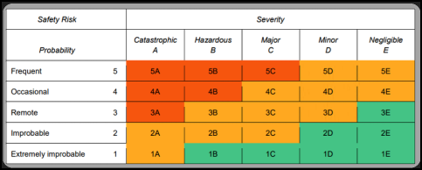 even when it’s low frequency but high risk,” he said. “And [we] ask: how are we addressing that?”
Bedford highlighted voluntary safety disclosure programs as one part of the safety management toolbox. “Everybody has voluntary safety disclosure programs and within different lines of business, technicians, flight attendants, pilots, dispatchers respond differently,” he said. “What you are looking for is: ARE WE GETTING RESPONSES? And do people believe that voluntary safety disclosures ACTUALLY TRANSLATE INTO ACTION?”
“So, we are really focused on re-tasking ourselves across the lines of business to promote the fact that everybody has a voice in safety and we want to hear your voice,” Bedford said.
Asked how FAA was working with industry to improve safety, Bedford responded, “I think there’s a lot we can learn from one another. Collaboration has been the key strategic initiative for us; it’s happening already. We have been out with the industry collaboratively and individually, not only with safety officers but also with the leadership teams across industry. I think there’s a lot we can learn in terms of the safety best practices that industry has. And I think there are things that, obviously, we can share with industry. But what we don’t want is to not learn from the failures of the past.”
[1] President Trump’s DOT Secretary and Administrator Bedford have made the following general policy directive, which seem to be contrary to this 9 month delay—“… we streamline, modernize, and strengthen our regulatory approach.”