A SAFETY MESSAGE that needs to be HEARD
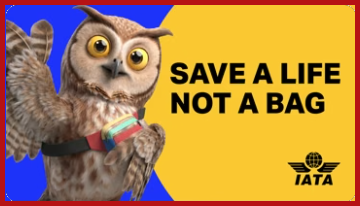
IATA has created the above public service campaign to RAISE AWARENESS ABOUT EMERGENCY EVACUATION PROCEDURES among the flying public. This message is critical for the safety of all, but despite the repeated efforts to broadcast these rules, pictures people fleeing from an aircraft are prominently shown after every accident or incident.
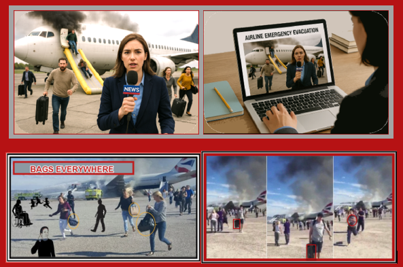
The prevalence of this ignorance or the passengers’ ignoring to follow this safety advice demonstrate that the communication has failed. Numerous articles discussing– why this life-saving information does not appear to be retained by the passengers—are published:
- SAFO “EMERGENCY EVACUATIONS PAX AND BAGS” WILL LEAD USEFUL, PRACTICAL APPROACHES
- CONTINUOUS AVIATION SAFETY IMPROVEMENT must look at the details-even the color of the Passenger emergency cards text
- DO NOT CARRY BAGS Emergency Evacuations-PRESS needs to put message in Passengers’ FORETHOUGHT
- MORE INEXPLICABLE PASSENGER BEHAVIOR DURING EMERGENCY EVACUATIONS- ACT NOW!!!
Despite IATA’s well designed visuals and carefully crafted words, its early impact is disappointing, as an AI search found—
Based on the latest search results, no U.S. national TV network (CNN, NBC, ABC, CBS) and no major U.S. or global newspapers have published coverage that explicitly references IATA’s “Save a Life, Not a Bag” campaign. The only confirmed coverage remains from CNA (Channel NewsAsia) and a handful of international digital outlets, not U.S. national broadcast or major print media.
- The New York Times
- The Washington Post
- The Wall Street Journal
- USA Today
- Los Angeles Times
- Chicago Tribune
- The Guardian
- The Times (UK)
- Financial Times
- Le Monde
- El País
- Süddeutsche Zeitung
- Nikkei
The coverage was limited to

- The Straits Times– ‘Every second matters’: Don’t take cabin bags in flight evacuations, urges IATA
- ATC network —IATA Launches “Save a Life, Not a Bag” Passenger Safety Campaign
- CNA (Channel NewsAsia) — TV
- Aviation Business News — Industry press
Considering the degree to which the media seems infatuated aviation, especially negative stories, the paucity of coverage is surprising. Experts say safety enhancing behavior campaigns rarely receive U.S. national TV coverage unless tied to a recent accident or regulatory action. Instead, major outlets prioritize policy, accidents, airline economics, or consumer‑impact stories. IATA’s communications usually are covered by industry press unless they intersect with a major news cycle.
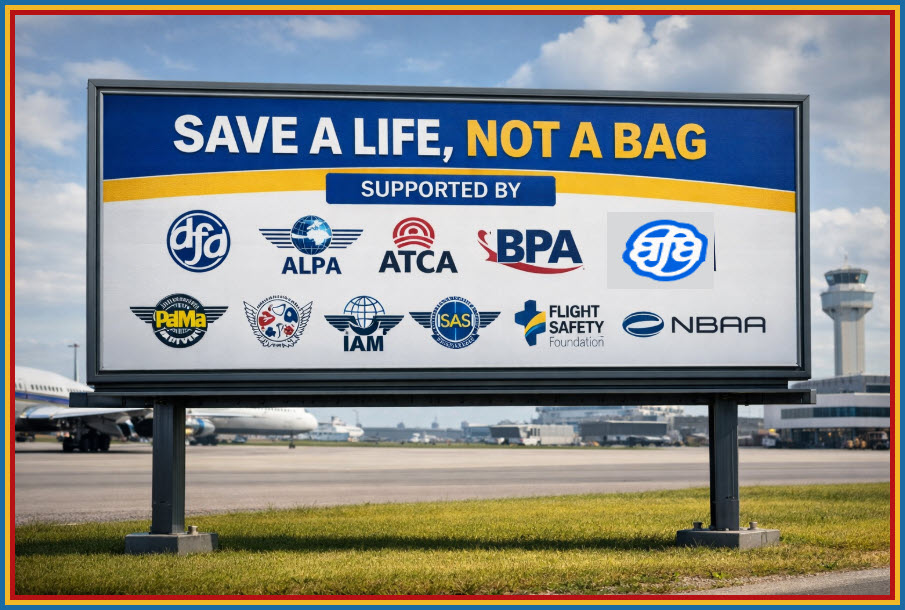 ALL OF THE AVIATION PROFESSIONAL ORGANIZATIONS and EACH AVIATION PROFESSIONAL SHOULD STRONGLY CONSIDER TRYING TO CARRY THE “SAVE A LIFE, NOT A BAG” TO THEIR LOCAL MEDIA. The IATA kit (linked to the below article) provides a strong factual basis for the need for these emergency evacuation procedures. Stories that inform the readers/viewers about a safer way to travel may appeal to local
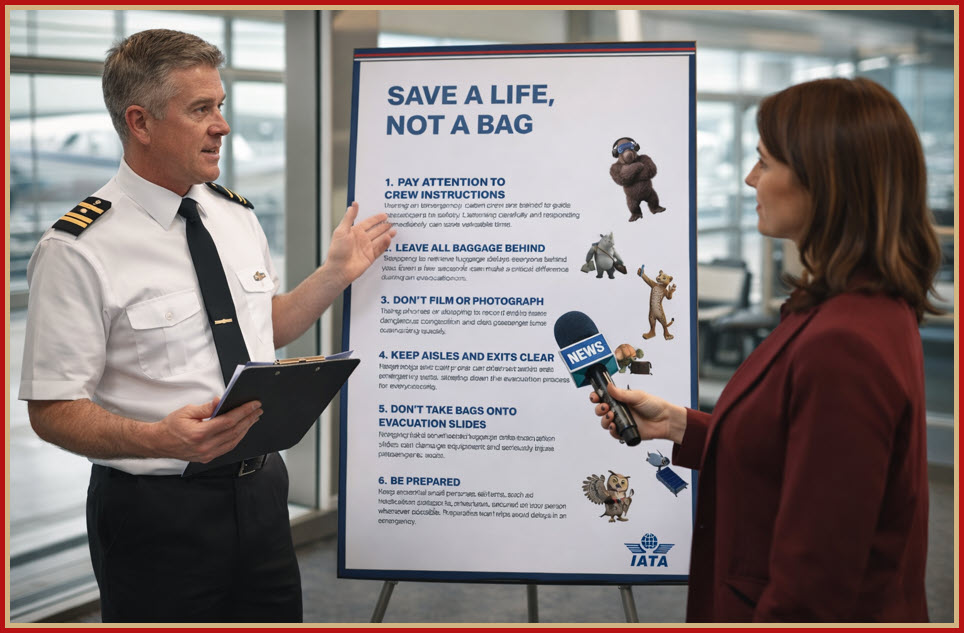 audiences. Reporters always appreciate getting content that makes good copy. A phone call, email or visit will impress the newsperson, by your sincerity, that this is an important package.
PLEASE TAKE THE INITIATIVE AND CONNECT-time well spent may save lives.

Save a Life, Not a Bag
Every Second Counts During an Evacuation
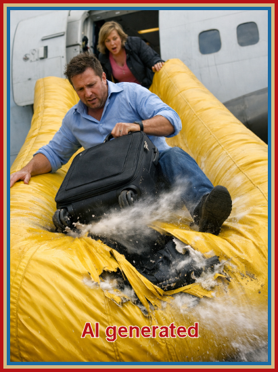
Passengers taking baggage during aircraft evacuations is not a new issue. But videos and reports shared across social and mainstream media continue to show that THE RISK REMAINS REAL.
Despite clear crew instructions, some passengers still stop to collect bags, phones, or other personal items. In an evacuation, this CAN BLOCK AISLES AND EXITS, SLOW OTHER PASSENGERS, DAMAGE EVACUATION SLIDES AND PUT LIVES AT RISK.
In an aircraft evacuation, every second counts. Passengers must listen to crew, move quickly, and leave all belongings behind.
That is why IATA has launched Save a Life, Not a Bag, a passenger safety campaign supported by the Federal Aviation Administration (FAA) and the European Union Aviation Safety Agency (EASA) to raise awareness of safe emergency evacuation behavior.
Six Safety Behaviors Every Passenger Should Remember
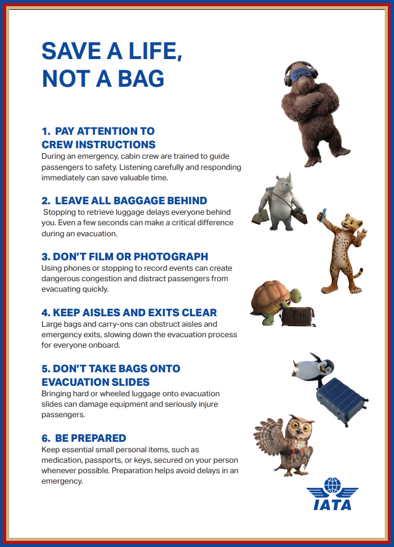
In the unlikely event of an aircraft evacuation:
- Pay Attention to Crew Instructions: During an emergency, cabin crew are trained to guide passengers to safety. Listening carefully and responding immediately can save valuable time.

2.Leave All Baggage Behind: Stopping to retrieve luggage delays everyone behind you. Even a few seconds can make a critical difference during an evacuation.
3.Don’t Film or Photograph: Using phones or stopping to record events can create dangerous congestion and distract passengers from evacuating quickly.
4.Keep Aisles and Exits Clear: Large bags and carry-ons can obstruct aisles and emergency exits, slowing down the evacuation process for everyone onboard.

- Don’t Take Bags onto Evacuation Slides: Bringing hard or wheeled luggage onto evacuation slides can damage equipment and seriously injure passengers.
- Be Prepared: Keep essential small personal items, such as medication, passports, or keys, secured on your person whenever possible. Preparation helps avoid delays in an emergency.
Want to help spread the message
Download our Passenger Evacuation leaflet (pdf) for a simple guide to the 6 safety rules that can help save valuable seconds during an emergency evacuation.
Passenger Research
IATA passenger research shows a clear gap between what passengers think they know and what they would do in an emergency.
- 80% of passengers said they know what to do in an emergency.
- But only 61% correctly said that they should leave everything behind.
- That means nearly 4 in 10 passengers did not choose the safest action.
- The research also found that 60% of passengers said they would be less likely to take baggage if essential items were already secured on their person.
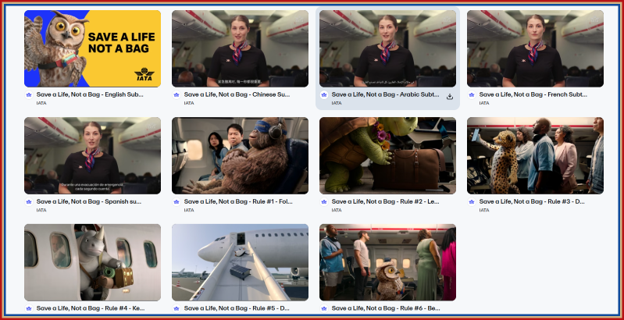
To support this effort, IATA has developed multilingual digital resources that airlines and aviation partners can easily share across websites, apps, social media, and passenger communications. These materials, developed with input from human behavior specialists, provide simple, memorable guidance to help passengers make safer decisions during an evacuation.
Watch the Evacuation Safety Series
The short animations below highlight common evacuation mistakes and demonstrate the actions passengers should take instead during an emergency.