MORE INEXPLICABLE PASSENGER BEHAVIOR DURING EMERGENCY EVACUATIONS- ACT NOW!!!
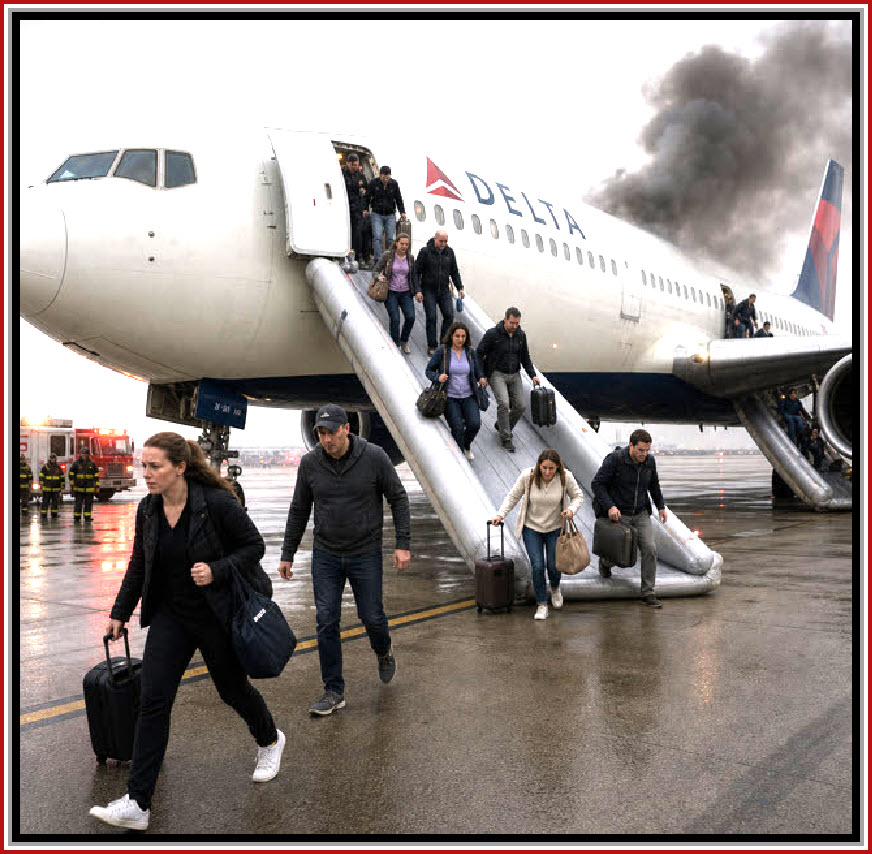
There have been way too many emergency evacuations in which passengers have left an airliner with roller bags and other Carry Ons. That history, see recent Simple Flying article that records more such potential tragedies that the standard pre‑flight verbal announcement IS NOT AN EFFECTIVE COGNITIVE INTERVENTION FOR PREVENTING PASSENGERS FROM TAKING BAGS DURING AN EVACUATION. It fails for predictable human‑factors reasons. More effective approaches exist, but each has tradeoffs.
First why does this easily understood warning not work? Passengers hear the “leave all belongings behind” line hundreds of times. From a cognitive standpoint, it suffers from:
-
-
- Habituation — repeated exposure turns the message into background noise.
-

-
-
- Low salience — it competes with boarding distractions, seatbelt fumbling, kids, headphones, and pre‑departure stress.
- No emotional imprint — the message is abstract, not vivid, and not tied to a concrete consequence.
- Weak encoding — PASSENGERS DO NOT STORE THE INSTRUCTION IN WORKING MEMORY LONG ENOUGH FOR IT TO SURVIVE THE SHOCK OF AN EVACUATION.
- No behavioral rehearsal — without practice, people revert to habits (grabbing bags) under stress.
-
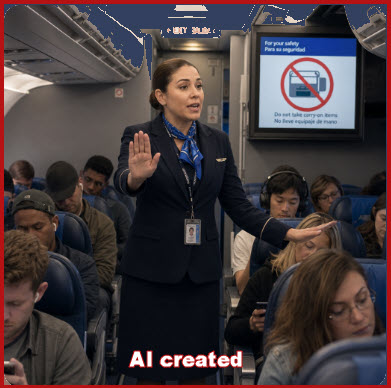
In other words: the announcement is informational, not behavioral, and evacuations require behavioral compliance under acute stress.
What may be some options and which might be most effective:
Overhead‑bin placards placed at the point of behavior (the bin) leverage environmental cues.
Physical bin‑locking systems — Highly effective but operationally complex PLUS might discourage passengers from stowing their carry-ons.
DOT or FAA public‑service announcements
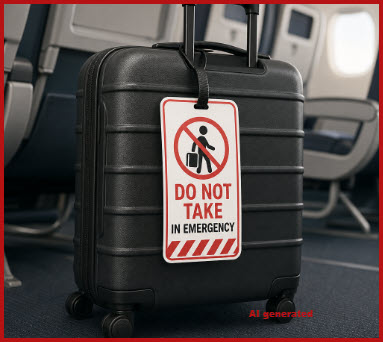
Tagging carry‑ons with “Do Not Take in Emergency” labels
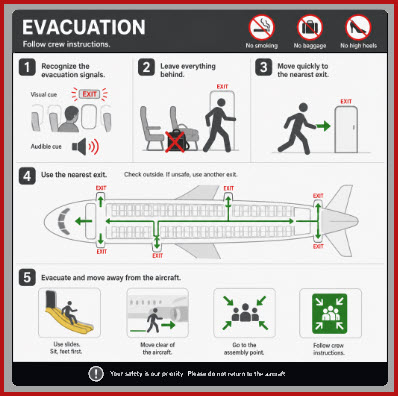
Revised safety‑card
Pre‑flight video redesign
Here’s a scorecard on the merits of each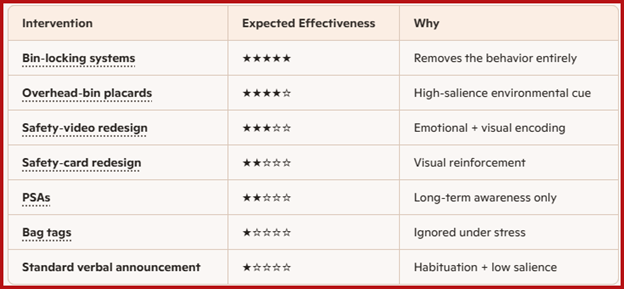
Revising the safety card, while not a panacea, provides an immediate response to this recurrent problem and research suggests that an improved display could enhance safety
-
-
-
-
-
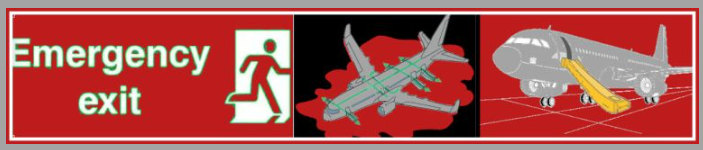
- The image should be a three‑panel sequential strip (left → right) which are perceived as scripts, not pictures. Scripts survive panic. Panel 1 Alarm + urgency cue; Panel 2 — Aisle movement—Large red “X” over the bag‑grabber; Panel 3 — Exit door
- Use culturally neutral human figures
- This increases global comprehension and reduces misinterpretation.
-
-
-
-
This is the most important improvement.
Passengers ignore “don’t do this” unless they see why.
Add a small inset in Panel 2 or 3:
-
-
-
-
-
- A bag blocking the aisle
- A passenger tripping
- A slowed line at the exit
- High contrast
- Clear negative space
- Use one line only, placed under the strip:
-
-
-
-
LEAVE ALL BAGS BEHIND — THEY BLOCK THE EXIT
The image at the beginning of this blog captures these elements.
It is likely that President Trump’s Secretary of Transportation is available for a PSA.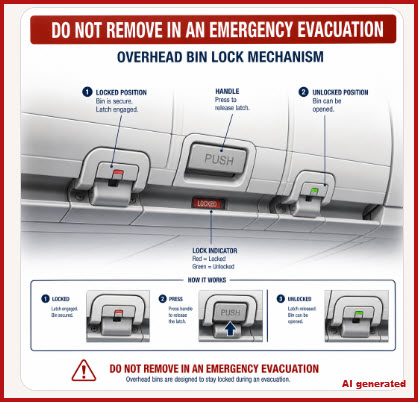
The other options merit study. The overhead bin placard addition is another possible quick response. The most effective, the bin-locking system, needs additional technical study. Another quick fix would be the bag tag- cheap.
Cognitive science explains why the current emergency evacuation risks are not being effectively controlled. Action NOW is clearly merited!!! Some of the AI created list will require FAA review; there’s help available.
The Problem Airlines Won’t Talk About: Emergency Evacuations Are Failing In 2026
By Abid Habib

While flying has remained the safest mode of transportation for years now, of late, there has been an undeniable increase in incidents, close calls, and accidents worldwide. As such, it is worth evaluating whether the safety standards for procedures, such as emergency evacuation, remain relevant today or require updates.
The above question is considered following the release of the National Transportation Safety Board’s (NTSB) report regarding a 2025 incident in the US, which saw passenger noncompliance and a reaction during an emergency evacuation, damaging the aircraft’s safety slides.
The Incident: United Airlines’ Airbus A319 Evacuation After Engine Failure
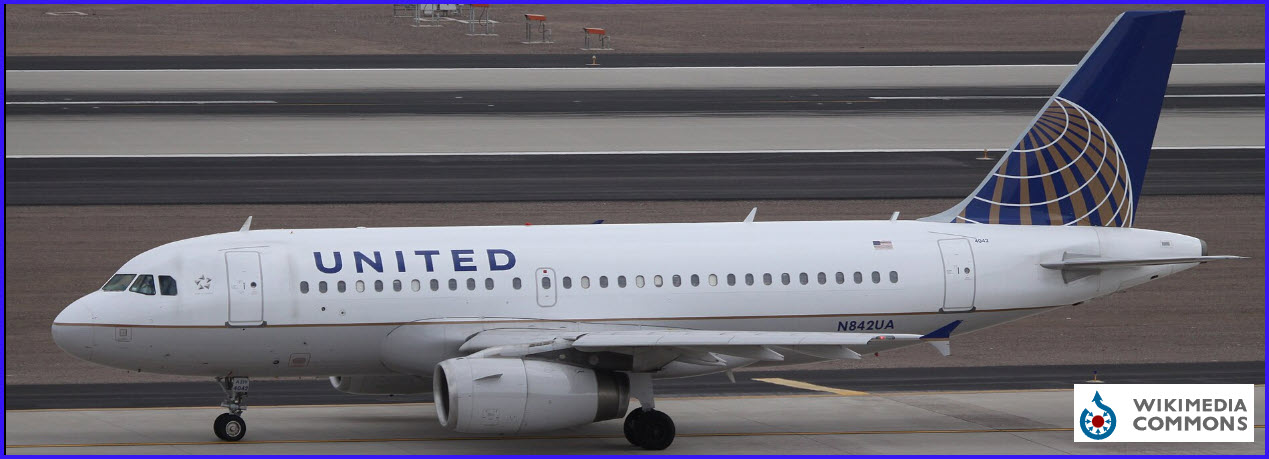 This incident occurred in February 2025, when an Airbus A319 operated by United Airlines suffered an engine failure during its takeoff roll at George Bush Intercontinental Airport (IAH). This prompted the flight crew to initiate a high-speed takeoff rejection at 115 knots (213 kmph) and to request that emergency vehicles, such as fire trucks, meet the aircraft on the runway.
The aircraft involved, N837UA, is over 25 years old and was operating the flight UA1382, bound for LaGuardia Airport (LGA). While the aircraft can accommodate 126 passengers, on that day the flight reportedly carried 107 passengers and five crew members. All passengers and crew members evacuated the aircraft with no reported injuries.
The engine failure reported occurred on the aircraft’s number two engine (the right engine), and the aircraft was met by fire trucks. While it was reported that passengers were panicking due to a fire in the engine, it was later confirmed that there was no fire for emergency responders to put out. While the aircraft was grounded after the incident, it returned to service around a month later.
The NTSB Findings: Miscommunication & Passenger Non-Compliance
Following the incident in February 2025, the NTSB released the final incident report last week, shedding light on several important points. One was a MISCOMMUNICATION BETWEEN CABIN CREW AND FLIGHT CREW, while the other was PASSENGERS PANICKING AND NOT COMPLYING WITH CREW INSTRUCTIONS.
Crew miscommunication
The NTSB report states that after the aircraft came to a halt, the cabin crew initiated the passenger evacuation using the aircraft’s emergency slides. However, THIS DECISION TO EVACUATE THE PASSENGERS WAS NOT COMMUNICATED TO THE FLIGHT CREW, nor was the evacuation alarm activated. Due to a lack of coordination between the two sets of crew, the report indicated that the aircraft’s left engine (engine one) remained running during the evacuation, which was very risky and compromised safety.
Passenger non-compliance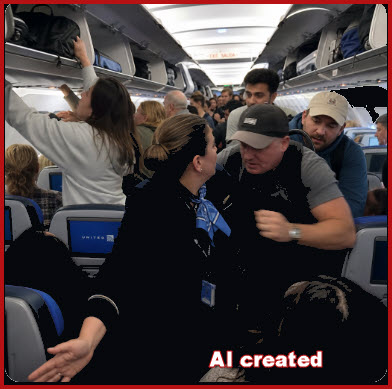
The report also found that PASSENGERS WERE IN A STATE OF PANIC, creating a stressful and chaotic environment for both passengers and crew members, and that multiple passengers reportedly shouted that the engine was on fire. Some PASSENGERS WERE REPORTEDLY STANDING AND RETRIEVING THEIR BELONGINGS, WHILE THREE PASSENGERS PUSHED PAST A CREW MEMBER manning the exit and jumped down the slide before it was fully deployed, causing it to deflate and become unusable.
The passengers are always instructed during the safety briefing (by safety video or crew members) that it is imperative that they should leave their bags and belongings when evacuating the aircraft, and yet, as seen in many scenarios, a small portion of the passengers unfortunately do not comply, putting themselves and fellow passengers or crew members at serious risk.

