Enterprise Safety Management System Office Takes Early Swift, Needed Action—and a Lesson Learned
AVI-GO has published the below report on the FAA’s order to its controllers at Centennial Airport (KAPA) tower
“…prohibiting touch-and-go landings and suspending simultaneous departures from the airport’s parallel runways until additional safety measures can be implemented.”
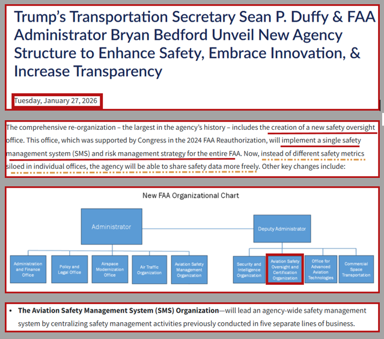
The primary point of the article is AOPA’s complaint that the imposition of this safety measure did not follow accepted notifications to KAPA’s users. The critique is well taken, but the origin of this FAA order may explain WHY the change was not adequately announced and also examine what may be a landmark decision by Administrator Bedford’s Flight Plan 2026’s Enterprise Safety Management System (Enterprise SMS) Office( SEO-not an FAA official designation) .
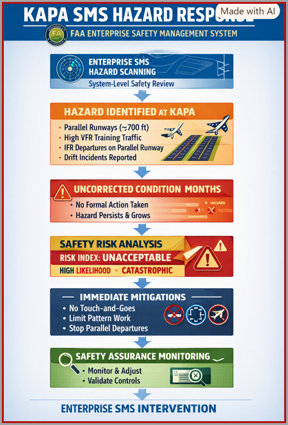
Its significance is that the KAPA action is a first high‑visibility cases by the new office exercised its authority to impose real‑time operational restrictions at a busy GA airport. It demonstrates Bedford’s shift toward centralized, enterprise‑level hazard control, rather than relying on local ATC judgment or regional offices.
The past record at this busy GA airport explains why quick action (perhaps not on an unannounced basis) was taken.
KAPA’s pattern of drift events and parallel‑departure conflicts was flagged because:
-
-
- a 2021 midair collision between two aircraft approaching separate runways
- The hazard persisted for months without formal SRM documentation.
- Exposure increased steadily as training traffic grew.
- Local ATC adjustments were insufficient and not formally logged.
- Under Bedford’s 2026 SMS doctrine, long-duration unmitigated hazards automatically escalate to the Enterprise SMS Office.
-
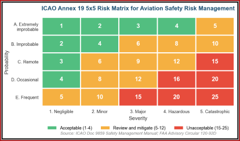
The SEO, following the standard Safety Risk Analysis, likely made the following determinations:
Safety Risk Analysis (SRA)
Likelihood: High
-
-
- Repeated drift events
- High training density
- Mixed IFR/VFR operations
- Tight parallel spacing
-
Severity: Catastrophic potential
-
-
- Loss of separation
- Collision risk during initial climb
- High workload during critical phases
-
Risk Index: Unacceptable (RED)
Under Bedford’s SMS doctrine, RED = immediate operational mitigation required.
SEO must have determined that the correct mitigations must be operational, not procedural; so it decided to”
-
-
- Remove high‑risk VFR operations from the conflict zone.
- Reduce simultaneous runway usage.
- Simplify controller workload during peak periods.
-
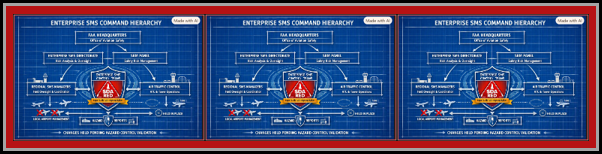
The organizational path for the Mitigation Orders went from SEO → Denver TRACON → KAPA Tower with the following immediate risk reduction actions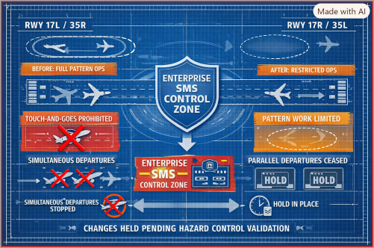
-
-
- Prohibit touch‑and‑goes
- Limit pattern work
- Stop clearing simultaneous departures from the parallel runways
- Cease parallel‑runway departure operations immediately
- Hold changes in place until hazard‑control validation is complete
-
The FAA has made it clear that the permanent mitigation procedures will be discussed with the airport, users (probably including Mr. Schuster), and the ATC team. The failure to warn (SEO, Region, ATCT?) the fliers about the safety restrictions necessitated by the risks will be an important lesson for the new SMS[1] organization.
The new Enterprise Level SMS office was created to insure that diminution of a significant safety risk was EXPEDITED. Better communication from the organization chain to the public should be included in their SOP.
FAA Bans Touch-and-Goes and Restricts Parallel Departures at Centennial Airport Near Denver

Why It Matters Sudden safety-driven restrictions at a major training airport can ripple across a whole regional network, pushing flight schools and traffic toward neighboring fields with little lead time.
What happened
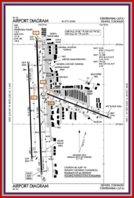
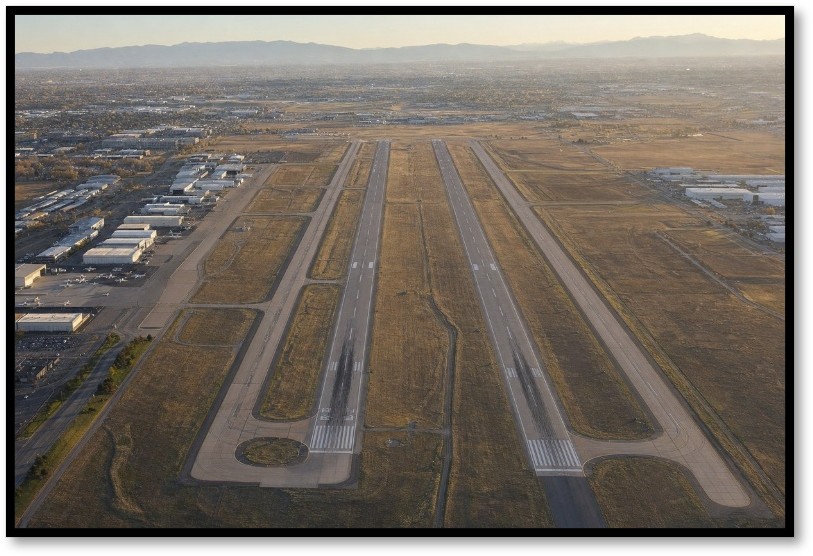
The Federal Aviation Administration has imposed new operational restrictions at Centennial Airport (KAPA) near Denver, prohibiting touch-and-go landings and suspending simultaneous departures from the airport’s parallel runways until additional safety measures can be implemented. The FAA directed controllers to halt parallel departures, citing potential conflicts between departing IFR and VFR traffic. Centennial’s parallel runways are separated by approximately 700 feet, and existing FAA guidance warns pilots of the risk of drifting into adjacent departure corridors.
The Aircraft Owners and Pilots Association raised concerns on Thursday about the abrupt changes, particularly the absence of advance notice to pilots. AOPA Northwest Mountain Regional Manager BRAD SCHUSTER said the sudden decision appeared unprecedented. “After nearly a week, the FAA has yet to issue a NOTAM or update the airport’s ATIS with this critical information at one of the nation’s busiest general aviation airports,” Schuster said. Centennial Airport handles more than 300,000 aircraft operations annually and hosts numerous flight schools and other general aviation businesses. AOPA warned the restrictions could displace training activity to other airports along Colorado’s Front Range, potentially raising traffic and noise concerns in neighboring communities.
CENTENNIAL HAS A PRIOR SAFETY HISTORY INVOLVING ITS PARALLEL RUNWAYS, INCLUDING A 2021 MIDAIR COLLISION BETWEEN TWO AIRCRAFT APPROACHING SEPARATE RUNWAYS. The Arapahoe County Public Airport Authority, which operates the airport, acknowledged the disruption in an email to tenants, stating that flight schools, instructors, pilots, and airport businesses were all affected. The authority said it was working to find a path forward while addressing the FAA’s identified safety concerns.
Industry impact & what to watch
Restrictions imposed abruptly and without a NOTAM or ATIS update point to a safety concern the FAA judged URGENT ENOUGH TO ACT ON BEFORE THE USUAL NOTIFICATION CHANNELS caught up, a pattern that tends to surface at busy general aviation fields where parallel runway operations depend on precise lateral separation. At a 700-foot runway spacing, the margin for a drifting departure or approach is thin, which is why FAA guidance already flagged the corridor-conflict risk even before this week’s directive.
General aviation airports that host high volumes of touch-and-go training are particularly exposed to this kind of disruption, because training traffic is what drives repeated close-proximity operations on parallel runways. When one airport restricts that activity, the traffic does not disappear — it moves to neighboring fields, which is exactly the displacement AOPA is warning about for Colorado’s Front Range.
What happens next depends on how quickly the FAA and the Arapahoe County Public Airport Authority can agree on the ADDITIONAL SAFETY MEASURES NEEDED TO LIFT THE RESTRICTIONS, and on whether a formal NOTAM follows to give pilots the documentation AOPA says has been missing. Flight schools and operators at Centennial, and at the airports likely to absorb displaced traffic, are the parties with the most immediate stake in how fast that resolution comes.

[1] SMS requires continuous learning and updating from lessons learned.
