Boeing’s Chief Safety Officer highlights a practice that builds trust and engages everyone in effective risk management

Boeing’s chief aerospace safety office, a/ka/ (?) ACCOUNTABLE EXECUTIVE, told his peers at the International Aviation Safety Summit in Montreal that the FREE FLOW OF SAFETY INFORMATION is CRUCIAL to reducing risk in his company. The specific image conveyed by his talk is, like the above AI image, the SMS team leaders spending time on the shop floor.
His message was impactful, but brief, i.e., right length for the audience. It might be helpful to add some of the experiences that move the relationship from that the participants will NOT BE PUNISHED, which is an SMS essential, to a more proactive, positive realm of TRUST and contribution.
►SMS depends on data, but the data originate with people. The Safety Review team analyzes hazards, assesses risk, identifies trends, and track mitigations only to the extent that employees are willing to notice, interpret, and communicate weak safety signals.
► That process is summarized by these steps—
EMPLOYEE VIGILANCE → REPORTING → BETTER SAFETY DATA → BETTER RISK DECISIONS → SAFER OPERATIONS.
But that chain breaks at the first step if employees do not trust what happens after they speak up. The reward premise is negative- “Nothing bad will happen to me if I tattletale.” The subliminal message to a submitter is “employees do not perceive reporting as professionally dangerous, embarrassing, futile, or an invitation for retaliation.”
►Confining SMS to a non-punishment sets a floor of employee attitude/expectations domination with thoughts like:
-
-
- nobody really cares;
- nothing happens;
- only accidents and obvious hazards are worth reporting;
- “that’s not my department”;
- “everyone already knows that”;
- “it’s working, so why question it?”
-
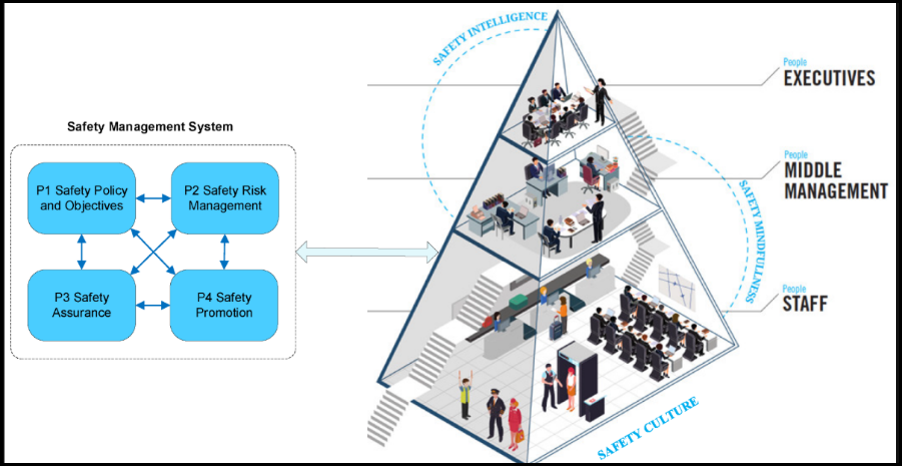
► Our experience has been that positive reinforcement changes the employee’s role. Mr. Ruhmann’s example, connecting with all employees, especially all the safety critical functions, starts with the SMS team’s presence on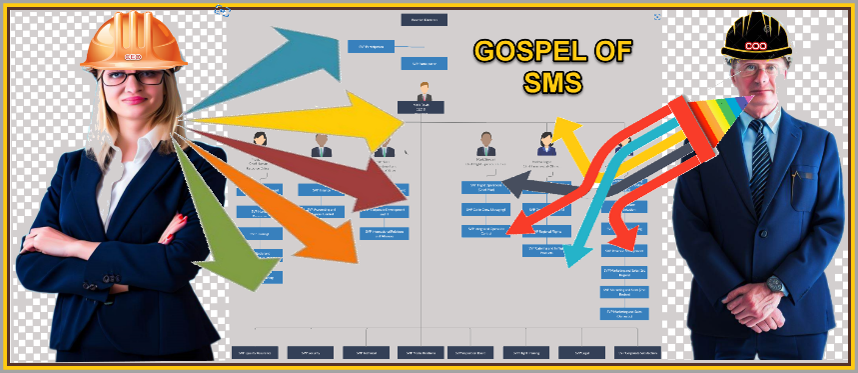 the floor. That simple practice transitions
-
-
-
- the employee’s FACELESS image of the SMS team
-
-
to
-
-
-
- a guy who has come to see me at my job, expresses interest in learning what I do and exudes commitment to SMS.
-
-
Those are ingredients to creating the first molecule of SAFETY DNA—TRUST.

Making SMS a corporate culture transitions SMS from a reporting system into a distributed safety-sensing system. Everyone, not just the professionals on the hanger floor (even a junior cost accountant) becomes another set of eyes looking for:
- An existing hazard
- An emerging hazard
- A weakness in something that currently works
- A mismatch between procedure and reality
- A lesson discovered elsewhere
- A transferable internal innovation
- A weak signal or anomaly
► The SMS syllogism now reads
NOTICE → QUESTION → CONNECT → REPORT → LEARN → IMPROVE → SHARE
►This connection should be receive positive reinforcement –
- Every submission should be noted in the employee’s personnel file, even if no action is taken
- When the Safety Review Committee acts positively on the suggestion, the individual should be publicly commended, preferably by a member of the team.

- American Airlines and Alaska Airlines already hold high level ceremonies where the most notable SMS advancement are rewarded and the individual recognized
►SMS’s trail within the organization now includes:
TRUST → MORE VIGILANCE → MORE OBSERVATIONS → RICHER DATA → EARLIER DETECTION → BETTER RISK MANAGEMENT → VISIBLE ORGANIZATIONAL RESPONSE → GREATER TRUST.
What JDA’s time dealing with organizations that are clearly implementing SAFETY CULTURE support this conclusion/goal:
A mature Safety Management System should not merely create an environment in which employees are unafraid to report known hazards. It should create an environment in which employees are positively motivated to search for weak signals, emerging risks, improvable processes, and transferable safety lessons, and are recognized for bringing those observations into the SMS whether or not their particular recommendation is ultimately adopted.
That is a substantially more ambitious conception of SMS.
It transforms the employee from a source of reports into a sensor in the safety system, and transforms trust from simply “I won’t be punished” into “my organization genuinely wants me to look.”

Boeing safety chief says factory floor contact key as output rises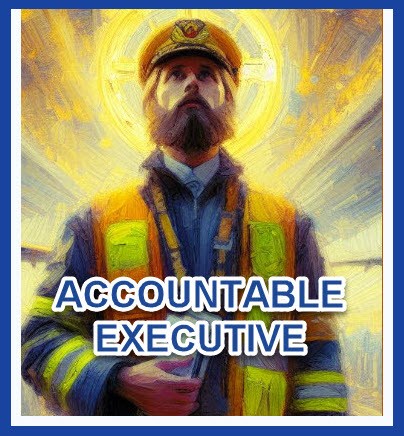
Vlad Schepkov

Tue, 10 November 2026 at 2:08 pm
Investing.com — Boeing’s chief aerospace safety officer said Tuesday the planemaker must maintain CLOSE CONTACT WITH FACTORY WORKERS to ensure safety information continues to flow as the company increases production of its commercial aircraft.
Don Ruhmann told the International Aviation Safety Summit in Montreal that staying connected to the factory floor remains critical as Boeing scales up operations.
“As we’re growing and scaling, STAYING CLOSE TO THE WORK, I think that’s really important,” Ruhmann said at the conference.
The safety chief WARNED AGAINST RELYING ONLY ON DASHBOARDS AND REPORTS FOR SAFETY DATA, saying this approach “is where you might get disconnected, because being at work and present on the floor is usually where the hard information surfaces first, and where people get to talk about it for the first time.”
The conference focused on whether aviation can scale safely as planemakers increase production. Airline trade group IATA expects global air travel to more than double by 2050, though high jet-fuel prices currently present challenges.
Boeing has implemented measures to improve its safety culture following scrutiny in 2024 when a door plug blew off a nearly new 737 MAX. The model had also been involved in two earlier crashes.
The company is working with the Federal Aviation Administration to increase 737 MAX production rates while facing challenges in its factories and supply chains.
On Monday, Boeing’s commercial division announced a 5% workforce reduction to align with a slower production increase.
Ruhmann said employees must trust the system to report concerns. “If they feel like their concern was heard, they were respected and also protected, and I emphasize PROTECTED, they will do that over and over and over again, so the information keeps flowing.”

