IATA reiterates its Safety Leadership Charter Concrete examples of effective and ineffective leadership
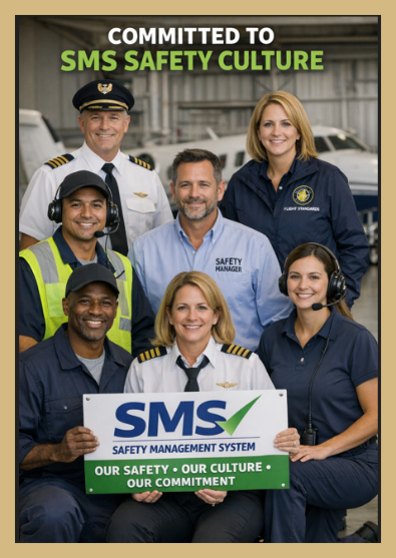
IATA has once again urged its members to make their SMS program VIBRANT. The following is not the association’s words, but may be more useful: something more than handbooks, policy statements, paperwork, sterile review processes, nice posters, and vapid, verbose pronouncements.
It cites the eight core principles established in its Safety Culture Leadership Charters as guidance for all airline employees and especially the leaders of the companies. IATA’s SMS goals set a proper direction, but the message may have greater impact with some specific examples, like the following found through research:
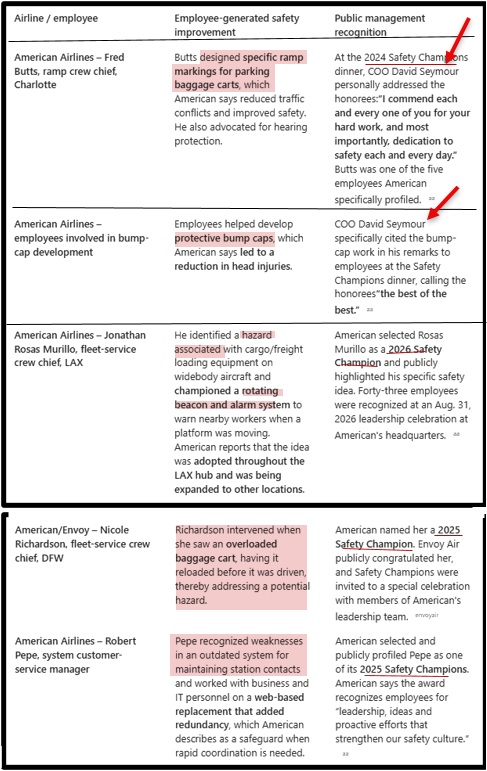
American is not the only carrier that made its Safety Recognition public; here are some more examples:
►Alaska Airlines operates the Safe Operations Award & Recognition Program (SOAR). The program recognizes employees who have been nominated for their actions prioritize safety and “prevented an unsafe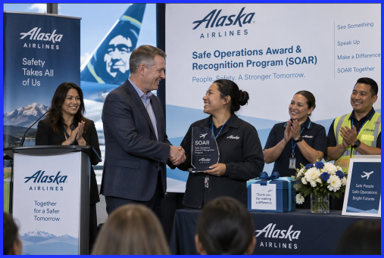 condition.” The recognition includes a gift, and the airline says the employee’s action serves as an example for colleagues facing similar circumstances. The airline also states that every employee is empowered to stop an operation that feels unsafe.
►British Airways has established a Staff Suggestion Scheme that publicly credited employees with operational improvements. While the focus is not strictly safety, it has resulted in safety improvements. For example, an employee suggested that aircraft toilet pipes should be descaled, which reduces weight, improving toilet performance and reducing risk of deleterious damage from an overflow. Jonathon Counsell, BA’s Head of Environment, publicly praised the collective employee effort, saying, “This really has been a team effort.”
► BA38 flight, at about 720 feet above the ground, had its right engine stopped responding properly to commands for increased thrust and its power decreased. Seven seconds later the left engine also lost power. British Airways then-CEO Willie Walsh awarded the crew Safety Medals, and publicly praised the employees’ professionalism and said the airline was extremely proud of them. Not an employee-generated safety improvement, but the action of the airline’s CEO recognizing the efforts of the crew to land without passenger fatalities supports the importance of a SAFETY CULTURE.
►Qantas Group has encouraged its employees to report safety and security matters, including situations in which they themselves were closely involved. Company documents describe the reporting as part of its “just culture” and says those reports “help us improve the way we work both in the air and on the ground.” Unfortunately, there are no announcements of recognition—NOT A POSITIVE EXAMPLE, but it may suggest that the leadership is stronger on words than actions.
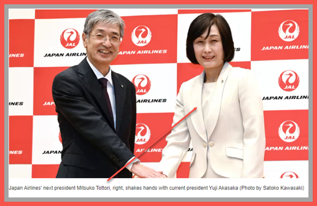
Perhaps the best example of leadership that really gets the embodiment of the Safety Culture Leadership actions was the case of JAL Executive Discipline sets a new SAFETY CULTURE STANDARD. Two pilots reported for duty in Melbourne, Australia unfit for duty (above blood alcohol) and the Board decided to take strong, highly visible action against its two most senior executives- substantial, immediate reduction of pay and removal of safety oversight from the Chairman’s purview.
These real world positive steps are likely to reinforce the SMS objectives–Recognition is different from monetary incentives for low accident rates. It can instead reinforce the behavior SMS wants identifying hazards, speaking up, proposing mitigations, intervening appropriately, and improving the system. Further, beyond the aviation examples, OSHA’s current recognition guidance says workplace safety and health recognition programs help to focus on performance, innovation, or engagement.
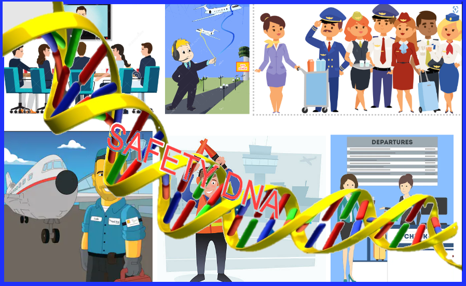
Perhaps why IATA is repeating its Safety Culture Leadership Charter is that its audience may need reminding about the value of the DNA’s fermentation not just as the bottom levels, but throughout the organization. The NTSB has found that management’s leadership was deficient as to husbanding the employee’s comfort with reporting risks:
►NTSB member Jennifer Homendy in describing the Board’s investigation of Survival Flight, a helicopter air-ambulance operator, found the carrier to have deficient SMS DNA . The management pressure, the final decision, to complete flights in poor weather and a safety culture that employees described to investigators as “damaging” and “toxic.” Employees told investigators that they were afraid to report unsafe conditions and experienced negative consequences for speaking up; the NTSB also cited verbal abuse from management when flights were delated.

►The Board’s decision in Liberty Helicopters/NYONair made it clear that pilots repeatedly raised safety concerns about passenger escape issues associated with the operation, but those concerns were DISREGARDED BY NYONAIR’S CEO AND MANAGEMENT. The NTSB explicitly recognized the “words versus behavior” problem. An NTSB safety-culture publication makes the principle unusually clear: “If leaders say safety is their top priority, but then turn a blind eye to safety concerns under pressure, employees will understand safety is not the most important value.” The NTSB identifies top-level management commitment as a critical element of safety culture and describes employee empowerment as employees having a substantive voice in safety decisions and the ability to initiate and achieve safety improvements.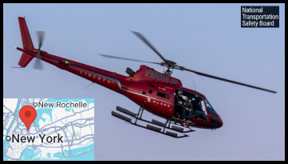

All that said, experience has contributed to this formulation of what is at the heart of attaining IATA’s leadership statement :
SAFETY CULTURE is an ACCOUNTABLE EXECUTIVE (AE) who is
-
-
-
- visible to all,
- establishes clear policies and procedures.
-
-
The AE allocates resources ensuring that safety is an integral part of the organization.
She or he must foster an environment where employees are empowered to prioritize safety without fear of reprisal. As trust is a cornerstone of effective safety leadership.
AEs must earn the trust of the employees, enabling smoother implementation of safety policies and obtaining necessary approvals.
When trust exists, employees are more likely to comply with safety instructions and procedures. While safety managers focus on compliance with regulations, AEs must actively promote safety as a core value. They seek ways to enhance safety protocols and mitigate hazards proactively, rather than merely reacting to incidents.
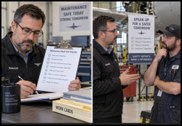 Aviation safety regulation has a history of relying on rules, paperwork, procedures, among other objectively determined indicia. SMS, Safety Culture, Leadership, Trust, Accountable Executives are all stuff of the softer science and may not be measurable in ways upon which management has relied for decades. Checking a box is quick and easier; assessing whether some AMT feels comfortable reporting some potential issue through a process requires very different skills of perception. If this observation has value, the leaders may need to sharpen their more sensitive sensors.
Making safety culture tangible

A strong safety culture is essential for all airlines and aviation stakeholders.
Leadership is vital as this creates an environment where employees are empowered to raise concerns and are confident that issues will be resolved quickly and effectively.
There are two key IATA initiatives: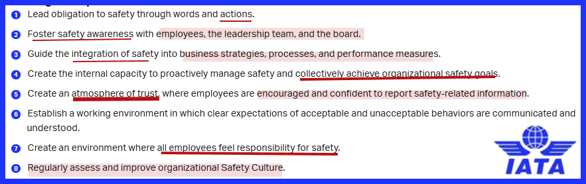
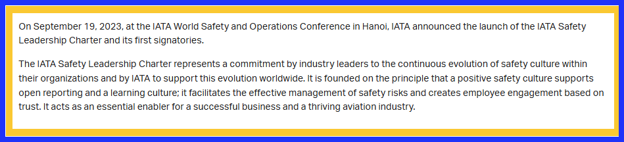
- The Safety Leadership Charter promotes eight core principles of safety leadership and covers about 90% of global traffic, strengthening a culture built on leadership, global standards, and data.
- IATA Connect brings together 5,600 users from over 600 organizations. It enables access to IOSA documentation, the Safety Issue Hub, and Safety Connect, and will soon expand to include ISAGO users.
Safety Leadership’s eight core principles are:
The principles formed the basis of a session at the World Safety and Operations Conference on how to establish a safety culture.
It was noted that there are a lot of CULTURAL INFLUENCES on an employee, from a NATIONAL culture to the PROFESSIONAL culture to ORGANIZATIONAL AND TEAM cultures. All have different characteristics and must be considered when establishing safety first priorities.
An organization might have safety top of its agenda, for example, but communicates more often or stridently on its sustainability objectives. The necessary trade-offs or compromises need to be acknowledged to put a meaningful safety culture in place.
A key factor is taking more note of day-to-day work, which can often go unnoticed. Major failings are obvious but there can be small gaps between the work done on a daily basis and theoretical processes.
This can lead to the erosion of safety principles in plain sight, while procedures and practices should be regularly reviewed to ensure both are performing successfully.
Any SAFETY ISSUES RAISED should be WELCOMED IN AN ATMOSPHERE OF TRUST. That prohibits defensive responses. Moreover, the loop should be closed with timely feedback, so the employee knows their information has been treated with due respect.
It was further suggested that safety improvements should be made visible throughout the organization. STORIES SHOULD BE SHARED AND THE TANGIBLE IMPROVEMENTS EXPLICITLY HIGHLIGHTED, WITH ALL CONTRIBUTIONS RECOGNIZED.
A final point was the need for constant practice, especially for the unexpected. A safe testing environment encourages the exploration of ideas and strengthens teamwork and adaptability.