Airspace- the delicate balance between civil and military use- history, present, and FUTURE???
Aviation Week’s Group Air Transport Editor-in-Chief has authored the compelling paper, see below, alleging that the DOD has exhibited disregard for the FAA’s Air Traffic controls rules designed to assure the safety of the traveling public. EXHIBIT #1 in her proof was the January 2025 Mid-Air crash between a military helicopter and a commercial flight. Her SECOND FACT was the DOD’s impatience with the FAA delay in approving a test of its counter-UAS laser weapon; so, they went ahead and used the laser on a flying object of some sort.
These stories are part of a long relationship between the aviation safety organization and the department that defends [1]our nation.
FAA (1958–present) Created to ensure the safety and efficiency of the National Airspace System (NAS), the FAA’s statutory mission is civil‑aviation–first: separation standards, air traffic control, and risk mitigation.
DoD (1947–present) Responsible for national defense, including training, readiness, and operational missions that require large, flexible airspace blocks, high‑performance maneuvering, and weapons testing.
-
-
- These mandates naturally create structural tension:
- FAA prioritizes predictability, safety, and shared access.
- DoD prioritizes operational realism, rapid response, and mission secrecy.
- These mandates naturally create structural tension:
-
Yet both agencies have also depended on each other for decades: the FAA needs DoD radar, surveillance, and security coordination; the DoD needs FAA airspace access and ATC services.
The Rise of Special Use Airspace (1960s–1990s)
Beginning in the Cold War, the DoD requested large tracts of airspace for high‑speed, high‑altitude, and weapons‑related training. The FAA approved most of these requests, creating the modern system of:
-
- MOAs (Military Operations Areas)
- Restricted Areas
- Warning Areas
- Alert Areas
- Prohibited Areas
By the 1980s–1990s, MOAs had become the dominant category of Special Use Airspace by lateral area in the U.S. (a point supported by multiple analyses and echoed in prior research). The U.S. ultimately developed MORE SEGREGATED MILITARY AIRSPACE THAN ANY OTHER COUNTRY, reflecting both its global military posture and the FAA’S LONG‑STANDING WILLINGNESS TO ACCOMMODATE DOD TRAINING NEEDS.
1980s — Escalation Over Low‑Level Training Routes
1980–1989: MTR (Military Training Route) Conflicts
- Civil aviation groups protest unsafe low‑level, high‑speed military flights.
- FAA considers stricter oversight but backs down after DoD argues national security necessity.
1986: Goldwater–Nichols Era
- DoD centralizes operational authority, strengthening its negotiating position with FAA.
1990s — The “Trust but Tension” Era
1991: Gulf War Air Defense Posture
- DoD requests rapid airspace restrictions for homeland defense.
- FAA approves with minimal review, setting a pattern for expedited military TFRs.
Post‑9/11: A Shift Toward Security‑Driven Airspace
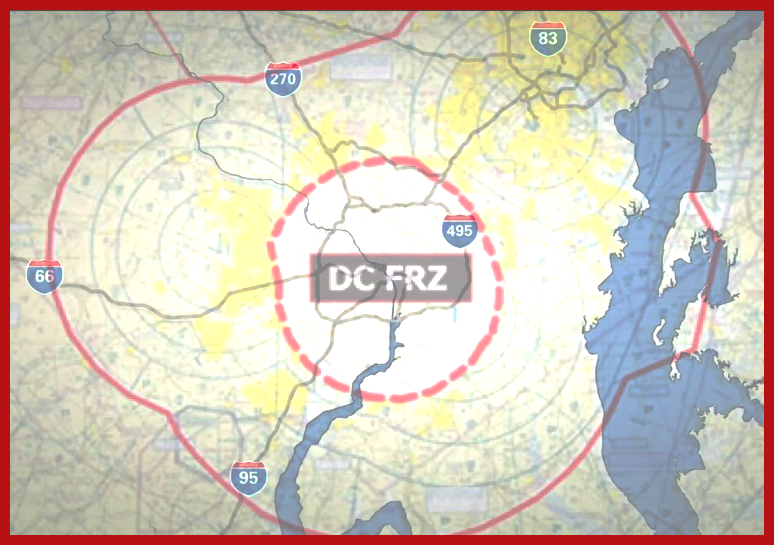 After 2001, the FAA granted the DoD and DHS unprecedented authority in the National Capital Region (NCR), including:
-
- The Flight Restricted Zone (FRZ) around Washington, D.C.
- The Special Flight Rules Area (SFRA)
- Permanent priority for national‑security missions.
This era cemented a pattern: when national security and civil access conflict, the FAA tends to defer to DoD and DHS—but with increasing procedural safeguards.
1980s — Escalation Over Low‑Level Training Routes
1980–1989: MTR (Military Training Route) Conflicts
-
- Civil aviation groups protest unsafe low‑level, high‑speed military flights.
- FAA considers stricter oversight but backs down after DoD argues national security necessity.
1986: Goldwater–Nichols Era
-
- DoD centralizes operational authority, strengthening its negotiating position with FAA.
1990s — The “Trust but Tension” Era
1991: Gulf War Air Defense Posture
-
-
- DoD requests rapid airspace restrictions for homeland defense.
- FAA approves with minimal review, setting a pattern for expedited military TFRs.
-
Mid‑1990s: GPS Interference Testing Conflicts
-
-
- FAA repeatedly objects to DoD jamming tests that disrupt civil navigation.
- DoD continues tests with FAA‑approved NOTAMs, often on short notice.
-
2010s — UAS, Cyber, and Spectrum Conflicts
2012–2016: UAS Integration Battles
-
-
- DoD seeks broad exemptions for military UAS operations.
- FAA insists on COAs and safety mitigations.
- Repeated disputes over:
- Sense‑and‑avoid requirements
- Lost‑link procedures
- Temporary restricted areas
-
2015–2018: GPS and Spectrum Interference
-
-
- DoD electronic warfare tests cause civil GPS outages.
- FAA protests the safety impact; DoD maintains operational necessity.
-
2020s — High‑Energy Weapons, UAS Defense, and Rapid TFRs
2020–2023: Counter‑UAS and Directed Energy Tests
-
-
- DoD conducts laser and high‑power microwave tests near civil airspace.
- FAA expresses concern about unquantified risk to civil aircraft but still approves airspace closures.
-
2023: DoD Directive 5030.19 Reissued
-
- DoD formalizes its internal structure for interacting with FAA, reinforcing its authority, and establishing the Policy Board on Federal Aviation.
2024–2026: Rapid TFRs and Emergency Coordination
-
- FAA’s System Operations Security office documents ongoing friction in:
- Short‑notice DoD requests
- UAS security operations
- Homeland defense airspace measures
- FAA’s System Operations Security office documents ongoing friction in:
-
- FAA guidance emphasizes consensus but acknowledges that tactical situations rely on verbal, rapid coordination, OFTEN FAVORING DOD TIMELINE
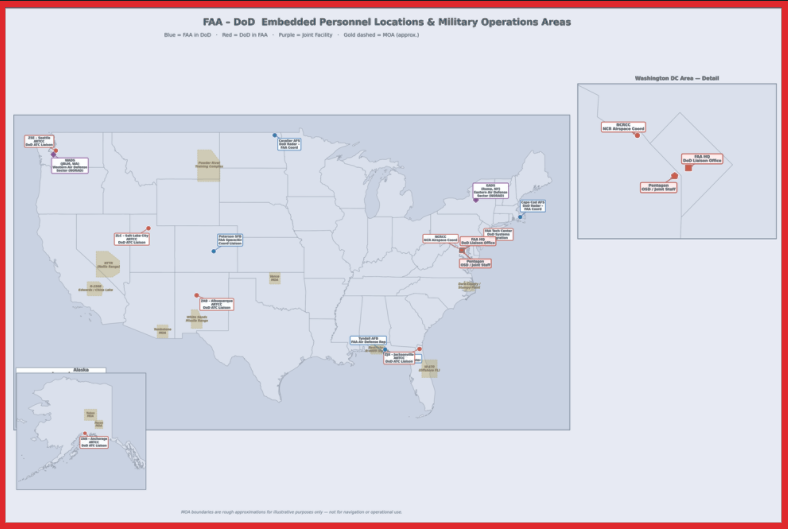
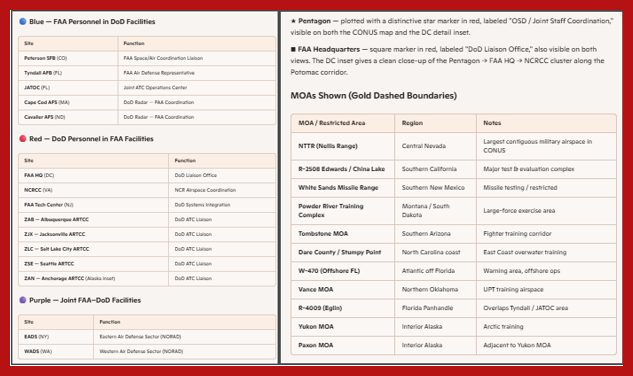
These intertwined interests have resulted in major secondment of each organization’s ATC representatives in the coordinating offices of the other—

FAA Personnel Embedded in DoD Facilities
NORAD / NORTHCOM Air Defense Sectors
The FAA maintains permanent civilian specialists inside NORAD/NORTHCOM facilities to coordinate:
-
-
-
-
-
-
-
-
-
- Air defense identification zone (ADIZ) operations
- Intercepts
- Special security events
- Real‑time air traffic data feeds
-
-
-
-
-
-
-
-
This is explicitly shown in FAA organizational structures, which list:
NORAD–Northcom ATSC Team (AJR‑2430)
-
-
-
-
-
-
-
- CONR ATSC Team (AJR‑2440)
-
-
-
-
-
-
These teams exist inside DoD command centers.
Estimated staffing: typically single‑digit to low‑dozen FAA specialists per sector.
Joint Air Traffic Operations Command (JATOC)
FAA personnel are permanently assigned to the Joint Air Traffic Operations Command, which is a DoD–FAA fusion cell for:
-
-
-
-
-
-
- National airspace security
- Special events
- Crisis response
- Military operations affecting civil ATC
-
-
-
-
-
FAA organizational charts explicitly list JATOC under the Air Traffic Organization.
Estimated staffing: small teams (likely <20 FAA personnel).
Embedded FAA Technical Operations Staff
DoD ranges and bases with radar, navigation aids, or shared infrastructure often have FAA technical specialists on site or co‑located.
Examples include:
-
-
-
-
-
-
- Long‑range radar sites
- Joint-use airfields
- Shared communications facilities
-
-
-
-
-
These are usually 1–5 personnel per site, not large offices.

DoD Personnel Embedded in FAA Facilities
FAA Headquarters – Security & Airspace Integration
FAA’s System Operations Security organizations include DoD liaison officers who coordinate: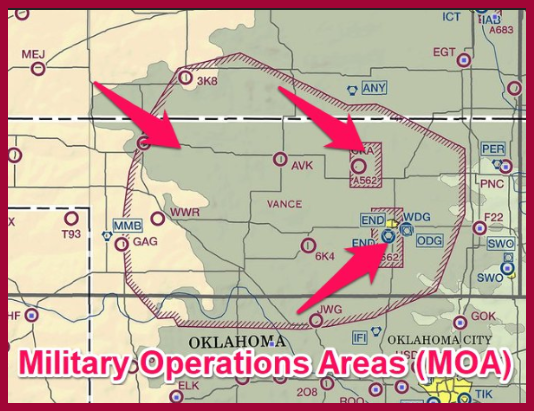
-
-
-
-
-
-
- Special Use Airspace (MOAs, Restricted Areas)
- National defense airspace
- Military flight operations
- UAS and counter‑UAS integration
- The FAA organizational chart explicitly lists a DOD Team (AJT‑1210) within Air Traffic Services.
- These are DoD personnel working inside FAA structures.
-
-
-
-
-
Estimated staffing: small — typically 5–15 DoD personnel.
National Capital Region Coordination Center (NCRCC)
The NCRCC is a multi‑agency security center that includes:
-
-
-
-
-
-
- FAA
- DoD
- DHS
- Secret Service
- Capitol Police
-
-
-
-
-
DoD maintains permanent staff here to coordinate restricted airspace around Washington, D.C.
Estimated staffing: low‑dozen DoD personnel.
Air Route Traffic Control Centers (ARTCCs)
Some ARTCCs have permanent DoD liaisons, especially those managing:
-
-
-
-
-
-
- Large MOA complexes
- High‑volume military training routes
- Space launch corridors
-
-
-
-
-
These are usually 1–3 DoD officers per center.

Locations Where Permanent Co‑Location Is Known or Highly Likely
FAA inside DoD
-
-
-
-
-
- Peterson SFB (NORAD/NORTHCOM)
- Tyndall AFB (CONR)
- Joint Air Traffic Operations Command (location varies)
- Selected DoD radar and comms sites
-
-
-
-
DoD inside FAA
-
-
-
-
-
- FAA Headquarters (Washington, DC)
- National Capital Region Coordination Center (NCRCC)
- Air Route Traffic Control Centers (e.g., Albuquerque, Jacksonville, Salt Lake City)
- FAA Technical Center (Atlantic City) for R&D coordination
-
-
-
-
Perhaps the awful accident and the unconscionable El Paso excursion have been catalysts for significant change?
The New FAA–DoD Counter‑UAS Agreement (April 2026)
The FAA and DoD signed a formal safety agreement governing high‑energy laser C‑UAS systems. Key elements include:
-
-
-
-
-
- Completed Safety Risk Assessment (SRA)
-
-
-
-
The FAA evaluated: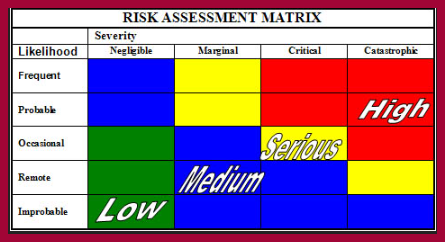
-
-
-
-
-
- Laser effects on aircraft structures
- Avionics susceptibility
- Pilot visibility
- Potential for collateral damage
-
-
-
-
The FAA concluded that, with controls, the system does not increase risk to civil aviation.
-
-
-
-
-
- Pre‑Approved Operational Use
-
-
-
-
DoD can now deploy the system under defined conditions without triggering automatic airspace closures.
-
-
-
-
-
- Formalized Coordination Procedures
-
-
-
-
The agreement mandates:
-
-
-
-
-
- Pre‑deployment notification
- Shared situational awareness
- Standardized communication during active operations
-
-
-
-
This is the most structured FAA–DoD C‑UAS framework to date. The relationship should be neither purely deferential nor adversarial. It must be a negotiated partnership shaped by:
-
-
-
-
- National security imperatives
- Civil aviation safety
- Technological change
- Congressional oversight
- Public‑safety expectations
-
-
-
These are noble definitions for cooperation between these two critical governmental bodies. LEADERSHIP from President Trump’s Secretary of Transportation[2] Duffy and Secretary of War Hegseth will define how those words translate to action, WE’LL SEE?!?

U.S. Military’s Concerning Disregard For Commercial Airspace Rules
Karen Walker April 06, 2026

FAA’s abrupt closure of airspace over and around El Paso Airport in Texas cast a spotlight on the U.S. military’s apparent disregard for the rules that maintain the safety of America’s commercial airspace.
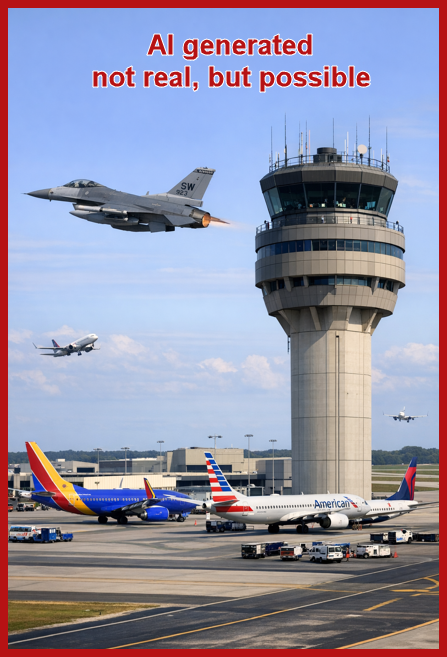
FAA and its controllers had kept the nation’s complex air traffic management (ATM) system safe for decades despite antiquated equipment and a shortage of controllers. But the DEADLY MID-AIR COLLISION BETWEEN A U.S. ARMY HELICOPTER AND A PSA AIRLINES REGIONAL JET, OPERATING AS AMERICAN EAGLE, ON FINAL APPROACH TO RONALD REAGAN WASHINGTON NATIONAL AIRPORT (DCA) IN JANUARY 2025 ENDED THE SAFE RUN.
An NTSB investigation concluded the accident was caused by multiple factors, including FAA’s placement of a helicopter route close to a DCA APPROACH PATH. Until the crash, in which 67 people died, it was not generally known that army helicopters regularly crisscrossed the busy airport’s near-airspace for training missions, OR that the US Department of Defense (DOD) DID NOT INFORM FAA or the Department of Transportation (DOT) of the frequency of near incursions with airliners around DCA.
The good news is that DOT Secretary Sean Duffy last year launched a massive ATM modernization program and is fronting that campaign with full support from FAA Administrator Bryan Bedford, who has called it a “must do.”
The bad news is that what happened at EL PASO IN MID-FEBRUARY is far from clear, but initial reports suggest a shocking, maybe illegal, violation of FAA rules by DOD and the Department of Homeland Security (DHS), which runs the Transportation Security Administration (TSA) that operates US airport security and screening.
The initial order from FAA was for airspace over the airport to be closed to commercial flights for 10 days. Federal officials blamed a “cartel drone incursion;” in other words, unmanned aerial system (UAS) vehicles, or drones, were operating illegally in the area, probably from across the border in Mexico for drug-transport purposes.
But then the airspace closure was lifted less than 12 hours later. A well-researched article in the NEW YORK TIMES attributed the cause of the shutdown to unauthorized testing of a counter-UAS laser weapon loaned to DHS immigration agents by DOD, WHICH HAS BEEN PUSHING FAA TO PERMIT USE OF THIS TYPE OF WEAPON WITHIN COMMERCIAL AIRSPACE.
FAA has been slow to test, approve and certify any form of counter-UAS system, not only lasers, BECAUSE THEY CAN BE DANGEROUS TO AIRLINERS. It APPEARS THAT DOD LOST PATIENCE AND PROVIDED THE WEAPON TO DHS AGENTS FOR AN UNAUTHORIZED TEST NEAR EL PASO (apparently shooting down a metallic party balloon, not a drone).
If proven to be the case, the cavalier DOD action in El Paso shows a distinct disregard and disrespect for FAA and the laws that are responsible for the safe operations of airliners within US airspace.
Further, a bipartisan bill known as the ROTOR Act passed the Senate unanimously in December and WOULD HAVE REQUIRED AIRCRAFT IN COMMERCIAL AIRSPACE TO CARRY ADS-B IN TRACKING TECHNOLOGY that experts believe would have prevented the Reagan collision. But the House narrowly failed to pass the bill in February after DOD, citing security and cost concerns, withdrew its support. In other words, the US military rejected potential legislation that would likely have saved the lives of its own helicopter pilots.
Another bipartisan bill called the ALERT Act has been proposed to improve US airspace safety. Among its calls are a REQUIREMENT FOR CLOSER COORDINATION BETWEEN DOD AND FAA ON COLLISION-AVOIDANCE SYSTEMS AS WELL AS THE STRENGTHENING OF HELICOPTER SAFETY MANAGEMENT SYSTEMS in shared civilian-military airspace.
The Air Line Pilots Association Int’l supports that bill and is working to get an ADS-B In requirement included. Those are the right calls. But they’ll only work if DOD leaders support new airspace safety regulation, respect FAA and abide by the rules.
Email: karen.walker@informa.com
Karen Walker is Air Transport World Editor-in-Chief and Aviation Week Group Air Transport Editor-in-Chief. She joined ATW in 2011 and oversees the editorial content and direction of ATW, Routes, and Aviation Week Group air transport content.
[1] True now that they call themselves the Department of WAR???
[2] This is the words used on every DOT press release about the Honorable Sec, Duffy—HONEST.