Will eIPP hasten the eVTOL Future?

Credit is due to President Trump, President Trump’s DOT Secretary and FAA Deputy Administrator. Back in September 2025 they issued their Electric Vertical Takeoff and Landing and Advanced Air Mobility Integration Pilot Program (eIPP and on March 9, 2026 (see below press release), 173 days later (warp speed for collection, evaluation, and selection within the federal government) they anointed eight of 30 bids to evaluate the NEXT GENERATION OF AVIATION!!! The significance of this big, brand-new method of aerial commerce is demonstrated by the absolute plethora of media (press {some included below}, radio and tv coverage and the omniscient social media) that found this announcement SO newsworthy.
As Erasmus of Rotterdam wrote in the 1st decades of the 16th century “Haste maketh waste,” or in more contemporary vernacular, these words of wisdom:
 “Hurry blinds you to the essentials.”
- “Speed can make you skip the crucial step.
- “When you rush, the important things slip past unnoticed.”
- “Haste hides the details that keep you safe.

Did the authors of eIPP do a good job of this defining this initiative of both aerospace and industrial importance globally? What does the record reveal?
The stated goals of eIPP-
Accelerate safe integration:
Generate operational data and lessons learned:
Demonstrate scalable concepts
Strengthen public‑private partnerships
Goals are only as good as the objectivity of the measures of success and here are their proposed standards-
-
-
- Demonstrated, repeatable operations under FAA oversight;
- Data robust enough to inform rulemaking and guidance;
- Clear, transferable playbooks for other jurisdictions to adopt.
-
The parameters of success, monitoring, and data/reporting are further refined as follows-
-
-
- Data‑driven outcomes:
- Each pilot program must generate operational, safety, and policy‑relevant data that FAA can use for regulations and guidance.
- Required project documentation (high level):
- Detailed operations plan across selected use cases;
- Aircraft and operational readiness plan;
- Policy/regulatory insight potential;
- Evidence of stakeholder support (MOUs, commitments, resources).
- Reporting/monitoring (inferred from SIR structure
- Ongoing data sharing from each pilot to FAA;
- Periodic progress and lessons‑learned reporting;
- FAA use of those reports to evaluate scalability, safety performance, and regulatory implications.
- Flight operations (profiles, routes, volumes);
- Safety events and mitigations;
- Integration with ATC and ground infrastructure;
- Community/noise/acceptance data where applicable.
- Data‑driven outcomes:
-
-
-
- Submit periodic narrative reports:
-
-
-
- Progress against their operations plan;
- Regulatory/policy issues encountered;
- Lessons learned and recommendations for national scaling.
- Progress against their operations plan;
-
-
-
- Participate in FAA evaluation activities:
-
-
-
-
- Workshops, technical interchange meetings, and possibly joint publications or case studies.
-
-
Who is leading this experiment?
Wade E.K. Terrell
2025–Present — Director / Acting Director, Advanced Air Mobility Operations Division (AAM‑1)
2023 — Manager, Flight Procedures and Airspace Group (AFS‑420)
2020 — Senior Role, Flight Technologies & Procedures Division (AFS‑400)
Even AI could not ferret out more of Mr. Terrell’s resume. He is clearly familiar with the inner workings of Flight Standards, the organization which sets standards for type certification, operations by a “carrier” and integration into the National Airspace System- all relevant aspects of eIPP. His elevation last fall indicates that the senior FAA political staff has confidence in his ability to manage this landmark mission.
What is not as evident, perhaps his work and education before 2020 includes more quantitative experience, but more likely, the eIPP analyses will be done by someone in President Trump’s Secretary’s staff. The metrics of aviation safety are not always intuitive; so, the DOT experts assigned to eIPP will hopefully not be novices.
More complex will be the translation of operational data. It is not clear whether the reporting parameters were written to provide numbers sufficiently standard to allow cross comparisons. The next task is to determine if this record is of sufficient volume and reliability to be statistically relied upon. For example, if the eight test beds had weather that was primarily CAVU, can a regulation be written that establishes a mandated minimum.
Of GREATEST CONSEQUENCE TO THE FUTURE OF EIPP is whether autonomous flights (only at FDoT and Albuquerque) can JUSTIFY FLY-BY-COMPUTER flights. Respected aviation experts have opined that piloted eVTOLs will result in charges so high that only a small segment of demand will find attractive. If nothing else, the INSURANCE industry will regard the numbers very carefully.
Several CAAs have granted their eVTOLs greater latitude than the US. eIPP is intended to escalate the US forward in this “RACE.” If well-conceived, it will be a big plus. The GREATEST WORRY WITH ANY INNOVATION IN AVIATION IS THAT AN EARLY CRASH WILL DESTROY CONSUMER DEMAND DISASTROUSLY. Less than a robust performance in eIPP could have consequences.
Congratulations to the Winning 8!!! While the DoT has defined what you do, there is nothing preventing you from adding to your team help that has already advised a country on a project similar to your task. By upping the ante, your greater contributions (i.e., in terms of more useful data that might justify autonomous eVTOLs) will help eIPP be successful and attract industry to you.

THE FUTURE OF AVIATION IS HERE: Trump’s Transportation Secretary Sean P. Duffy and FAA Unveil Eight Selections for Pilot Program Testing Next-Gen Aircraft in America’s Skies
Monday, March 9, 2026
{excerpted to focus on technical aviation matters}
WASHINGTON, D.C. – U.S. Transportation Secretary Sean P. Duffy and the Federal Aviation Administration (FAA) today announced eight proposals were selected as part of the brand-new Advanced Air Mobility and Electric Vertical Takeoff and Landing (eVTOL) Integration Pilot Program (eIPP). eVTOLs are futuristic aircraft that have the potential to generate new jobs, connect communities, and strengthen American leadership in aviation.
…
Together, these pilot projects will create one of the largest real-world testing environments for next-generation aircraft in the world. In addition to offering the American people an exciting window into the future of aviation, data from the pilot projects will be used by the FAA to develop new regulations that safely enable this futuristic technology at scale. The American public will start to see operations begin under this program by summer 2026.
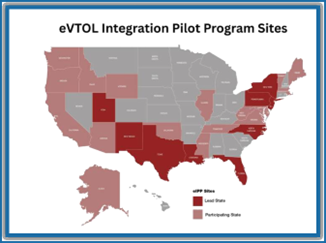
[from https://www.theregister.com/2026/03/10/evtol_pilot_26_states/] ]
The eight selected projects span 26 states and involve leading aircraft manufacturers, operators, and state partners. They include a range of operational concepts, including:
-
-
- Urban air taxi services
- Regional passenger transportation (including short Takeoff and Landing aircraft)
- Cargo and logistics networks
- Emergency medical response operations
- Autonomous flight technologies
- Offshore and energy-sector transportation
-
…
“These partnerships will help us better understand how to safely and efficiently integrate these aircraft into the National Airspace System,” said FAA Deputy Administrator Chris Rocheleau[1]. “The program will provide valuable operational experience that will inform the standards needed to enable safe Advanced Air Mobility operations. We appreciate the strong interest reflected in the many proposals we received.”
Specifics on Selected Projects
The following projects[2] were selected to participate in the eVTOL Integration Pilot Program:
Port Authority of New York and New Jersey
Multiple industry partners will collaborate on 12 different operational concepts across New England, including eVTOL passenger operations at the Manhattan heliport.
Partners: Archer, BETA, Electra, Joby
Texas Department of Transportation
Industry partners will support regional flights connecting Dallas, Austin, San Antonio, and eventually Houston, with air taxi networks expanding from each city to extend regional reach.
Partners: Archer, BETA, Joby, Wisk
Utah Department of Transportation
Four states spanning the Pacific Northwest, the Rocky Mountains, and the Plains of Oklahoma will test a wide range of next-generation aircraft and operational concepts.
Partners: Ampaire, BETA, Joby, Other
Pennsylvania Department of Transportation
The NASAO AAM Multistate Collaborative will work across 13 states to revitalize regional flights across the country, including routes similar to those supported through the Essential Air Service program.
Partners: BETA, Electra, Other
Louisiana
Operations will test cargo and personnel transportation capabilities to enable flights over the high seas into the Gulf of America and to energy industry locations in Louisiana, Texas, and Mississippi.
Partners: BETA, Elroy Air, Other
Florida Department of Transportation
A statewide effort featuring multiple industry partners will include three phases of operations focused on cargo delivery, passenger transportation, automation, and medical response, supported by significant public and private investment.
Partners: Archer, BETA, Electra, Joby, Other
North Carolina Department of Transportation
Working with industry partners to establish piloted medical and regional operations across the state while also developing an AUTONOMOUS flight operation extending into Virginia.
Partners: BETA, Joby, Other
City of Albuquerque
A focused project designed to achieve early advances in autonomous operations through an existing partnership with an ADVANCED AUTONOMY DEVELOPER already operating in the region and coordinating with the FAA.
Partner: Reliable Robotics
…

The press coverage on eIPP was substantial
As shown by this sampling of some of the articles
Includes a few salient quotes
- FAA clears 26-state air taxi trials
- “Industry leaders say the eIPP could cut years off certification timelines, with Beta Technologies projecting operations a year earlier than planned and Archer targeting the 2028 Los Angeles Olympics.”
- “…experts warn that full commercial service depends on years of additional rulemaking, vertiport and charging infrastructure buildout, and integration into crowded airspace. Early operations will be tightly controlled, with human pilots required and autonomous flights limited to specific programs. Cities must address noise, land use, and equity concerns, deciding where to locate vertiports and how to balance benefits with community impacts
- Electric Aircraft Pilot Program Opens a New LOGISTICS Frontier
- Electric aircraft and eVTOL systems occupy a potential middle ground between trucking and traditional aviation….Trucks offer flexibility but are constrained by congestion, distance, and road infrastructure…Electric aircraft introduce the possibility of short-range aerial logistics corridors connecting regional distribution points without the infrastructure requirements of commercial aviation.
- FAA Selects Eight Projects For eVTOL Integration Pilot Program
- Reliable Robotics, City of Albuquerque Aviation Department Partner to Enhance Aviation Safety Through FAA Advanced Air Mobility Integration Pilot Program
- “AUTONOMOUS COMMERCIAL CARGO AIRCRAFT will be used to connect Albuquerque and other communities in the Four Corners region. Completion of this program will mark the first commercial operation of regional air cargo service by a large UAS in the United States.”
- “Under the eIPP, Reliable’s wholly-owned subsidiary, Albuquerque-based commercial air cargo operator Reliable Airlines, will conduct AUTONOMOUS air cargo operations from Albuquerque International Sunport (ABQ), New Mexico’s largest commercial airport, to Durango-La Plata County Airport, CO (DRO) and Santa Fe Regional Airport (SAF).”
- TxDOT selected for futuristic air taxi testing program
- “..regional test flights connecting the Texas Triangle (Dallas/Fort Worth, Austin, San Antonio, and Houston) and rural communities with air taxi networks expanding from each city to extend regional reach.
- Joby selected for early eVTOL operations across ten US states
- FDOT, PANNYNJ, TxDot, NC DoT, Utah DoT = partners
- Flying cabs, next-gen aircraft cleared for takeoff in 26 states
- US Aviation Authority approves eight pilot programmes for air taxiscom
- NBAA Welcomes DOT Programs to Accelerate Safe eVTOL, AAM Operations
NBAA’s Emerging Technologies Committee, composed of experts with backgrounds in technology, aviation regulation, operations, business, law and more.
- Additionally, the NBAA AAM Roundtable provides a forum for original equipment manufacturers of AAM aircraft and other systems to engage in high-level planning discussions on the integration of AAM technologies.
- Wisk and Texas Selected by White House to Lead the Safe Introduction of Autonomous Air Taxi Flight
- three-phase “crawl-walk-run” approach as part of a multi-year phased flight program.-Initial Phase; Integration Phase; Advanced Operations Phase
- New York, Florida among the states selected for electric aircraft pilot program
[1] Not insignificantly. to Deputy Administrator Chris Rocheleau was quotes in this release. The selection of the Deputy reinforces the FAA’s January 27, 2026 reorganization reporting structure relevant to this announcement the Office of Advanced Aviation Technologies which is responsible for integrating eVTOLs. Reorganizations can easily be drawn on charts, but REAL responsibility is shown by action.
[2] If you are curious, the elected officials of the participants are $ Republicans and Democrats

