SOLVING AVIATION’S WORKFORCE BOTTLENECK REQUIRES INDUSTRY-WIDE ACTION NOW!!!
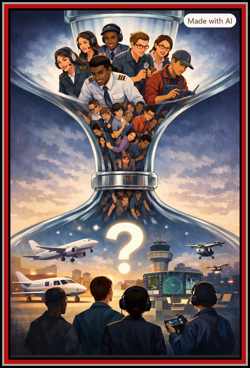
Below are articles from AvWeb (source ),FLYING, the GAO, and AIAA highlight a critical imbalance between the supply of aviation professionals and the growing demand across General Aviation (GA), Commercial Aviation, and emerging eVTOL/UAS sectors. The papers highlight:
- the shortfall of Aircraft Maintenance Technicians (AMTs),
- proactive changes that the FAA could make in its testing for this skilled shortage to improve throughput
- Four Universities’ offering for pilots, remote pilots, engineers, and air traffic controllers
- AIAA’s honoring of young achievers in the OEM sector
These findings underscore the need for coordinated action among industry, education, and community stakeholders. What might other participants do to avoid this potentially disastrous lack of good employees? The attached articles and the following content are LONG, but befitting the MASSIVE CHALLENGE that this projected need for qualified workforce. Please take the time to read this material
PRIVATE INDUSTRY
- OEM Work/Study Programs
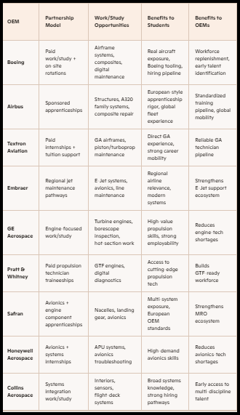
Original Equipment Manufacturers (OEMs) \ partnered with FAA-approved maintenance schools and universities to create paid work/study programs. Students gain hands-on experience while earning credit toward certification. “Earn While You Certify” internships that count toward FAA experience requirements. Like these:
- Airline-Sponsored Pilot Financing
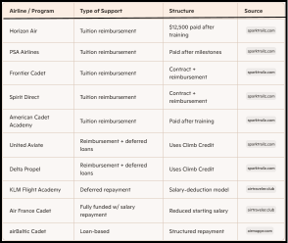
Airlines provide deferred low-interest loans or tuition reimbursement for pilot training, tied to post-certification employment commitments. For example:
- eVTOL and UAS Entry-Level Pathways
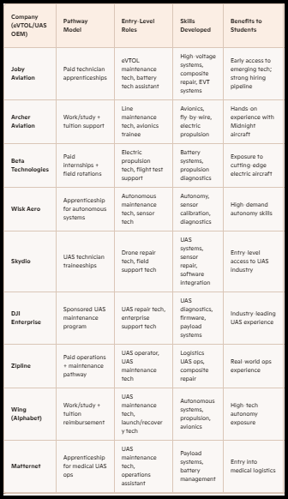
Emerging operators are hiring candidates without full technical credentials and provide on-the-job training ladders—from assembly technician to flight operations support—creating mobility within the new aviation ecosystem.
These are great models for others to adopt. While some of these support systems are well publicized, it would behoove all to inform the potential candidates of this option. The more widely dispersed these “work study” paths to aviation become known, the greater the likelihood that the better the applicant response (numbers and quality) will be.
State and County educational Institutions
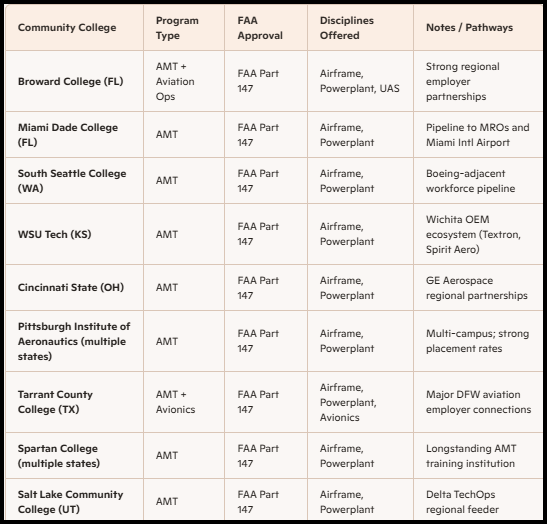
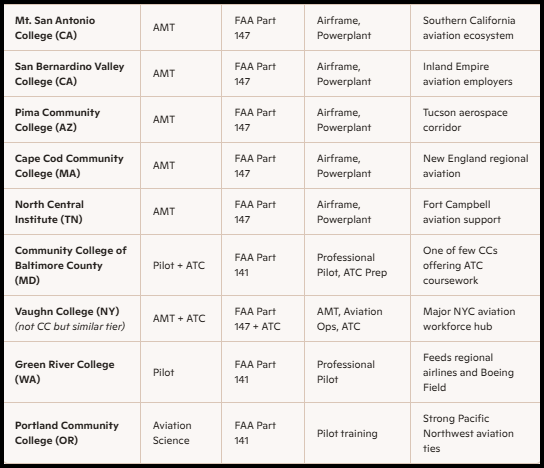
- Local governments can establish community college aviation programs with reduced tuition, co-funded by regional airports and employers.
These pose economic opportunities especially in the exploding UAS and eVTOL sectors. President Trump’s Secretary of Transportation’s eIPP signals that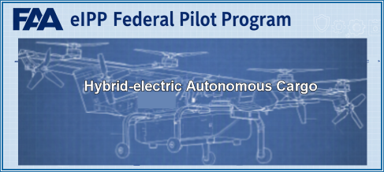 these new methods of flight will be part of the economy. Each technology brings new transportation and distribution enterprises. Here are recent discussions of this sector development:
These flights are more than fixes to urban congestion; so all communities should benefit from them. The first beneficiaries of this low altitude business will be the ones who are already have, or soon to have, trained work force.
- High School Outreach and STEM Pipelines
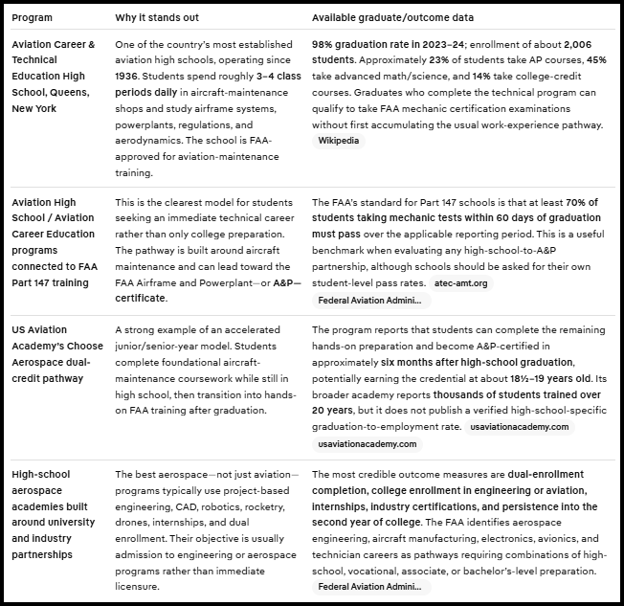
Aviation foundations and trade associations can sponsor STEM‑to‑Skies programs introducing maintenance, avionics, and ATC careers before college. There are many of these classes available; so, here is a table of the some of the best:
- Community and Public Engagement
Public Awareness Campaigns
Trade associations and safety foundations (A4A, ATEC, FSF, ARSA, NBAA, AOPA) can run public campaigns showing the scale of future demand—with testimonials, salary data, and scholarship links.
Local Career Fairs and Open Hangar Days
Airport authorities and chambers of commerce can host career fairs to connect residents with aviation employers.
Mentorship Networks
AIAA, AIA, RTCA, FSF, and SAE can expand their young engineer awards into mentorship pipelines, pairing awardees with high school or college mentees.
Veteran Transition Programs
Defense contractors and airlines can create transition pathways for veterans with mechanical or avionics experience into civilian AMT roles.

FAA Issues Record Number of Mechanic Certificates
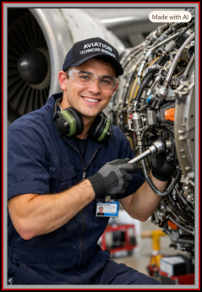
New certifications jumped 23.2% in 2025, but industry forecasts still point to a sizable workforce shortage.
.
Schools Drive Growth
Aviation maintenance technician schools accounted for 7,496 of the new mechanics, a 27% increase from 2024 and another annual record. Enrollment at FAA-certificated maintenance schools increased 13.5% to 27,740 students. The civilian-experience pathway, which includes apprenticeships, grew 21%, while certifications based on military experience increased 5% to 1,375. The growth comes as the FAA continues examining testing access for students entering the maintenance pipeline through high school programs.
 “The overall growth trend and underlying drivers are encouraging signs that industry is making progress in its effort to expand and diversify the technical workforce pipeline,” said CRYSTAL MAGUIRE, executive director of ATEC. “We need to continue building momentum to meet both near-term and long-term demand needs, and that includes ensuring we’re attracting sufficient resources as well as workforce candidates.”
Demand Still Outpaces Supply
Despite the record numbers, Oliver Wyman projects a North American MECHANIC SHORTAGE OF ABOUT 9,100 certificated mechanics this year. By 2030, the projected deficit grows to roughly 20,000 mechanics, or 12% of anticipated demand. The report also says 44% of the certificated mechanic population is over age 60, with more than 39,000 retirements expected during the next decade.
The numbers have particular implications for GA maintenance, where certificated mechanics account for 86% of the technical workforce, according to ATEC. Training programs also have room to grow. Despite last year’s enrollment increase, only 62% of available A&P program seats were filled, leaving the industry with the challenge of expanding the pipeline fast enough to offset retirements and rising demand.
The High School Programs Training a New Generation of Aviation Mechanics
 Every flight you’ve ever taken has relied on aircraft mechanics to maintain the plane and its engines. Sometimes, your flight might even be delayed because of maintenance.
The commercial airline industry has a strong demand for mechanics. With current openings and a wave of retirements, airlines will need to fill an estimated 11,000 job openings each year.
We recently looked at programs for high school students that could help to address this shortage. Today’s WatchBlog post looks at this new report.
Classroom with Plane Engines at a Certified High School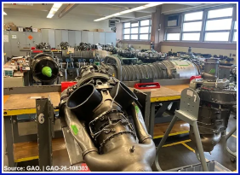
How high schoolers are learning aviation maintenance
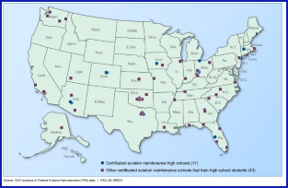
ABOUT 100 SCHOOLS around the country offer training to high school students on aviation maintenance. Some high schools offer this training directly. But, in most cases, high schoolers access training through local colleges, universities, or career and technical education schools.
And the Federal Aviation Administration (FAA) certifies not all of these programs.
Certified schools are in-person schools that are overseen by the FAA and must meet certain regulations. For example, classes must be taught by certified mechanics. And shop class size is limited to no more than 25 students per instructor.
Uncertified schools provide exposure to aviation maintenance through online and classroom instruction. But students attending these programs are not generally eligible to take the FAA mechanic tests without further education at certified schools. These tests are the first step to becoming a qualified aviation mechanic.
Locations of Certified Schools That Train High School Students in Aviation Maintenance
 High schoolers who study aviation mechanics MAY go on to pursue a range of career paths including working for major airlines, airplane manufacturers, or the military. Skills learned in this training are also transferrable to other in-demand fields, like maintenance on oil rigs or at amusement parks.
While these courses may offer lucrative career options, experts we spoke with identified SEVERAL BARRIERS that may prevent more students from pursuing careers as aviation mechanics. Foremost among these barriers is a lack of awareness of the profession, as mechanics are less visible than other aviation professionals, like pilots.
But another key barrier is the cost of testing and additional education. Testing costs can be thousands of dollars. And if students wish to continue their education, additional education costs may also be significant. This is especially true for graduates of uncertified programs.
Reducing testing barriers to meet workforce demands
Graduates of uncertified programs are generally ineligible to take the FAA general knowledge test. To become eligible, they must retake courses at certified schools. This can be a time consuming and costly process that may discourage students from pursuing careers in aviation maintenance—eliminating potential candidates who could help fill workforce needs in this field.
Electrical Circuitry Board for Students to Diagnose Issues at an Uncertified Aviation Maintenance Program
In 2024, Congress required FAA to establish a working group of aviation industry experts to assess whether high school students should be allowed to take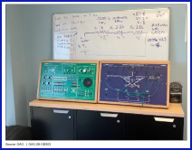 the exam, regardless of whether the program is certified or not. This change would potentially open a door for graduates of uncertified programs and increase the pool of potential mechanics. However, FAA has not established the working group or completed the assessment because a key committee was terminated.
Even so, WE RECOMMENDED FAA CONVENE A WORKING GROUP AND COMPLETE THIS ASSESSMENT. Doing so could help identify opportunities to expand the pool of qualified aviation mechanics. This effort would also give FAA an opportunity to consider how to address concerns about having enough qualified aviation mechanics in the workforce.
To learn more about aviation maintenance training opportunities for high school students, check out our recent report.
Colleges Embrace Aviation Home Field Advantage
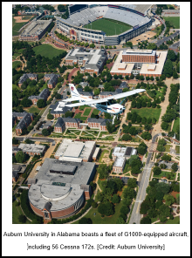
Four school-owned airports embrace their storied histories and modern aviation training.
[excerpted]
Here are four college aviation programs conducting student pilot training at their own airports.
Purdue University
Purdue University was founded in 1869 in West Lafayette, Indiana, and Purdue University Airport (KLAF) opened 61 years later in 1930. The airfield has been an important training site for aviators since its early days, and the famed aviatrix Amelia Earhart was a faculty member at the school for several semesters.
…
“Our airport has a unique ethos centered on education, innovation, and transportation. The airport is often called the largest classroom on the West Lafayette campus,” said Baxmeyer, noting that this informal distinction goes back decades.
The university’s trainer fleet consists of 18 Piper Archers, four Piper Seminoles, and one Super Decathlon. …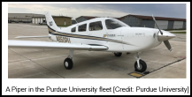
Purdue’s School of Aviation and Transportation Technology offers four majors—aeronautical engineering technology, aviation management, professional flight, and unmanned aerial systems. Many students who are pursuing the three non-flying degrees still opt to pursue ratings, even though it is not a requirement to graduate.
“We have two Part 141 schools based at the airport,” Baxmeyer said. “One is Purdue University’s School of Aviation and Transportation Technology, for Purdue students pursuing a degree in professional flight. They fly university-owned aircraft. Anyone else interested in learning to fly can do so through Purdue Aviation, which is an independent FBO based here at the field. They have flight students from many different majors as well as individuals from the Greater Lafayette community.”
The towered airport has two runways, the longest of which is 6,600 feet long. The airport isn’t only the “largest classroom on campus” for flight students, as non-flying majors frequently use it in their coursework as well. For example, students in the airport management and airport operations programs witness airfield inspections firsthand, which includes examining the runways’ condition, the fuel farm, snow removal equipment, and emergency equipment. Students also hold positions both in airport operations, as well as at the FBO, flight school, and airline ground handling.
Purdue’s other aviation facilities are robust. The Holleman-Niswonger Simulator Center houses a Boeing 737 and Airbus A320 flight training devices (FTDs), as well as a Hawker 900XP Level D full-motion simulator. There is an Operations Control Center, where students can watch and support program flight operations—of which there are more than 100 per day. There are also powerplant, electronics, materials, and advanced materials labs, which are used by aeronautical engineering technology students.
Ohio State University
Ohio State University in Columbus offers three aviation degree programs—a bachelor’s degree in aviation, a bachelor’s in air transportation, and a bachelor’s in aviation management. In total, there are about 500 students enrolled in aviation at Ohio State, 155 of whom are actively flying the university’s trainer aircraft. The program boasts 19 Cessna 172s and one Piper Seminole.
…
Strzempkowski pointed out that these opportunities present a great way for students to gain industry experience in a real environment and start an aviation career. Some of the roles include working at the FBO front desk or on the flight line or supporting the flight education program.
An integral part of the airport property is the Austin E. Knowlton Executive Terminal & Aviation Learning Center, which opened in 2019. Within the facility, there are three classrooms where ground schools are conducted for private, instrument, flight instructor, and commercial ratings. The terminal space is where the FBO is located, allowing students to conveniently network with pilots and aviation crewmembers. There are indoor and outdoor seating areas overlooking the airfield, including the NetJets Observation Deck.
…
Auburn University
Auburn University Regional Airport (KAUO) in Alabama may be one of the best airport investments of all time. James Birdsong, who serves as the director for Auburn’s School of Aviation, said that the university purchased the land where the airport now sits for $375 in 1939.
…
“We have just under 1,000 students, and about 600 are in the flight program,” said Birdsong. “About 90 percent to 95 percent of the flight students qualify for the FAA Restricted Airline Transport Pilot [R-ATP] certification and go to the airlines. A few will go corporate, and a handful will join the military, typically in the [National] Guard or Reserves.”
Birdsong said Auburn has a large fleet of modern, G1000-equipped aircraft. The school also sports 56 Cessna 172s and 11 Piper Seminoles.
The capstone course for flight students takes advantage of the university’s Airbus A320 simulator located in the 23,000-square-foot Delta Air Lines Aviation Education Building. Opened in 2018, the facility houses a collection of other advanced aviation training devices (AATDs), as well as classroom facilities. The building’s eponym underscores the aviation program’s strong relationship with Delta, which has headquarters less than a two-hour drive from campus. The professional flight program has partnered with Delta through its Propel Pilot Career Path Program, which provides a clear pathway for the airline to hire students after graduation. Delta also has provided endowed professorships to attract and retain experienced faculty.
Another important industry partnership seeks to support the growing need for aviation maintenance technicians.
Southern Union State Community College’s A&P program opened a hangar this spring that’s located at the Delta Air Lines Aviation Education Building. This provides a convenient way for Auburn students interested in aviation maintenance to learn more and complete coursework on the field.
…
University of Oklahoma
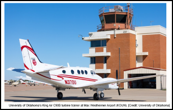
Located about three and a half miles from the heart of campus in Norman, Oklahoma, Max Westheimer Airport (KOUN) is where all major-specific courses are taught for the University of Oklahoma’s five aviation degree offerings. The 720-acre site boasts two paved runways, a control tower, classrooms, and simulator lab, as well as hangar space for the school’s 33 training aircraft.
Eric Wydra, director of OU’s School of Aviation, said a student flight club was started in the late 1920s. the airport has continually served as an important place for aviation education.
…
“About four years ago, the university made a partnership with Norman Public Schools, and they are in the process of building an aviation high school here, which will be completed this fall,” Wydra said. “There will be a 10,000-square-foot building that includes four classrooms, office space, and a library for students [high school and college].”
Wydra said this project will more than double the current classroom footprint. Once constructed, the space will also be the site for future Sooner Flight Academy activities, including its summer camps.
…
One of the program’s many headwinds is its proximity to Oklahoma City, and the FAA’s office located there. That’s why one of the OU School of Aviation’s areas of focus is its air traffic management degree.
“We were the first four-year collegiate program to be certified by the FAA for what they call the Enhanced Air Traffic-College Training Initiative [E-CTI],” Wydra said. “That’s where our ATC students go directly to a control tower if they successfully complete the program, which is housed out here in our simulator building. We have both en route and tower ATC sims.”
The school offers a bachelor’s degree in aviation with five concentrations. Aviation management is becoming an increasingly popular option, with 90 students in the program and an incoming freshman class of around 40. The airport serves an important purpose to these students as well since they can gain job experience through shadowing or an internship. The airport is less than a 20-minute drive from the National Weather Center, where students can learn more about meteorology.
Flight students utilize a fleet of Piper Warriors, 100is, and Seminoles. Those taking the turbine transition course fly a Beechcraft King Air C90B. Students pursuing their professional flight/helicopter degree complete rotorcraft coursework in a two-seat Guimbal Cabri G2. The maintenance hangar for all aircraft is based at the airport, so students can witness the return-to-service requirements for the aircraft that they are flying—an added bonus, as some schools perform their fleet’s maintenance off-site.
More than 100 students per year earn their private pilot certificate at the Norman airport, which is an important local economic engine in addition to being an integral flight training facility.
2026 AIAA 30/30 Recipients Announced: Aircraft Technology, Integration, and Operations Category
AIAA has identified 30 EXCEPTIONAL YOUNG PROFESSIONALS who are advancing aerospace through technical achievement, innovation, and leadership. The 30/30 PROGRAM HIGHLIGHTS individuals in their 30s who are driving breakthrough research, advancing next-generation technologies, leading impactful programs and teams, and accelerating innovation across aerospace. They are presented in seven different technical categories. Meet the winners in our Aircraft Technology, Integration, and Operations Category below. And learn about the full list of 30 exceptional individuals at aiaa.org/get-involved/honors-awards/awards/30-30-recognition-program.
Aircraft Technology, Integration, and Operations
 James “JP” Stewart
Senior Vice President of Product Development
Electra
James “JP” Stewart is a 31-year-old aerospace engineer and leader of note. As senior vice president of Product Development at Electra, he is responsible for all aspects of the company’s operations.
Stewart is transforming the future of flight through a new Direct Aviation paradigm for regional air mobility that gives people the freedom to travel from where they are to where they want to go, avoiding long drives and overburdened airports. Ultra-short takeoff and landing aircraft are the key enablers. Electra has successfully designed and flight demonstrated the world’s first two-seat EL-2 Goldfinch aircraft, which requires only a 150-foot runway for takeoff and landing. EL-2 proved the feasibility of an integrated system with blown-lift technology and hybrid-electric propulsion. As the EL-2 Program Manager, Stewart brought his exceptional technical expertise, practical insights, and impressive business acumen to bear on this successful endeavor. Stewart is now focused on developing the game-changing nine-passenger ultra-STOL EL-9 aircraft with entry into service in 2029.
Stewart is a 2026 AIAA Associate Fellow; a National Business Aviation Association 2024 Business Aviation Top 40 Under 40 award recipient; a 2021 Virginia Tech Alumni Emerging Leaders award honoree; and a 2016 Aviation Week 20 Twenties laureate. He is an active pilot and instructor, flying both sailplanes and powered aircraft. He has represented the U.S. Soaring Team four times in World Championships. Stewart earned a University Honors Bachelor of Science in Aerospace Engineering from Virginia Tech in 2018.
Evan Harrison
Senior Research Engineer and Division Chief
Georgia Institute of Technology
Evan Harrison has made significant contributions to the aviation field, particularly in aerospace systems safety, airworthiness certification, and model-based systems engineering (MBSE). At the Aerospace Systems Design Laboratory, his work bridges the gap between complex aircraft design and regulatory compliance.
One area of impact is Harrison’s research on advancement of model-based approaches for aircraft certification. Collaborating with agencies like FAA and NASA, he has developed frameworks to streamline noise certification and conduct regulatory gap analyses for novel, electrified powertrain aircraft. His research has provided foundational MBSE methods to support the airworthiness standards for innovative concepts like NASA’s X-57.
As an expert in vehicle- and system-level safety assessment, his research focuses on predicting and mitigating loss-of-control incidents for general aviation and evaluating the operational reliability of emerging urban air mobility and eVTOL vehicle designs. His safety frameworks and energy-based flight safety analysis methods have contributed to modern flight-data monitoring programs aimed at improving fixed-wing aviation safety.
He has also been impactful as an instructor for various undergraduate and graduate-level courses at Georgia Tech, educating the next generation of aerospace engineers about aircraft design, safety by design, and vehicle performance. Harrison contributes to the aerospace profession through his technical publications and active membership in the AIAA General Aviation Technical Committee and the Transformational Flight Technical Integration and Outreach Committee.
Through his research, teaching, and industry engagement, Harrison helps shape the future of safer, cleaner, and more efficient vehicle architectures.
Sang-A Lee
Graduate Research Assistant
Embry-Riddle Aeronautical University
Before the age of 30, Sang-A Lee has established herself as one of the leading emerging scholars in aviation safety and unmanned aircraft systems (UAS) research. As Lab Manager and principal research contributor on multiple FAA-sponsored ASSURE projects, she has helped secure and execute a portfolio exceeding $10 million in federally funded research focused on UAS traffic analysis, collision risk, remote identification, and airspace integration. Her work directly supports FAA efforts to safely integrate emerging aerospace technologies into the National Airspace System.
Lee’s innovative contribution includes her dissertation on aviation maintenance safety culture. Through the development of new frameworks examining trust, fear, and organizational influences on safety performance, she has introduced a human-centered approach to understanding and mitigating maintenance-related risk.
Her impact also extends beyond dissertation. Lee authored a 155-page FAA-sponsored gap analysis synthesizing 238 technical sources and has presented her work to FAA officials, industry leaders, military executives, and academic audiences. With 17 peer-reviewed publications, multiple first-author articles, and leadership of interdisciplinary research teams, she is shaping the future of aviation safety and advanced air mobility through research that is both scientifically rigorous and operationally relevant.
Max Z. Li
Assistant Professor, Aerospace Engineering
University of Michigan
Max Li is an emerging aerospace engineering leader whose work is shaping exciting advances in air transportation systems, including next generation air traffic management, aviation operations, airline and airport systems, and advanced air mobility. At the University of Michigan, Li has established a vibrant research program and the Laboratory for Air Transportation, Infrastructure, and Connected Environments (LATTICE) dedicated to air transportation system resilience, optimization, and decision-making under uncertainty – areas of critical importance to the future of air transportation. His work imaginatively addresses significant challenges, including how to make aviation networks more efficient, robust, adaptive, and capable of operating safely under uncertainty and disruption. Specific examples of his impactful research contributions include analysis of autonomous vehicle impacts on airport leakage and environmental implications, development of large-language-model-driven conversational agents for strategic air traffic flow management, and stochastically optimized distributionally robust ground delay programs using learning-driven airport capacity predictions.
Li’s extensive publication record includes more than 30 journal articles and more than 70 conference papers addressing a broad range of topics in air traffic control, air traffic management, network optimization, airline and airport operations, and advanced air mobility. He has built strong collaborations across academia, industry, and government with research projects sponsored by NASA, FAA, DARPA, MITRE, NSF, and Collins Aerospace. Beyond research, Li has taught hundreds of students at Michigan and contributed extensively to the aerospace community through editorial service, technical committee leadership, conference organization, and international engagement.
 Aman Deep Tripathi
Product and Commercialization Lead
Wisk Aero
As Product and Commercialization Lead at Wisk Aero, a Boeing subsidiary developing autonomous eVTOL aircraft, Aman Deep Tripathi leads the market requirements and business case for the Generation 6 aircraft and Wisk’s future product strategy. His work sets the technical roadmap guiding 800+ engineers through a decade-long certification effort..
Tripathi co-authored the Wisk–Boeing and Wisk–Skyports Concepts of Operations for autonomous air mobility. These have become foundational references across the international AAM standards and policy community, informing efforts at NASA, FAA, and ICAO, and shaping how the industry integrates uncrewed aircraft into the airspace. He has also published research with multiple NASA divisions.
He also gives generously to the profession – serving on the Transportation Research Board’s aviation economics committee, advising ICAO’s AAM Study Group, reviewing articles for leading aerospace journals, judging the CES Innovation and Global AAM Awards, and authoring a case study for a University of Washington competition (350+ students), alongside several U.S. patent applications in autonomous flight.
Colleagues and supervisors say that what distinguishes Tripathi is range: he turns market demand into engineering requirements, financial cases, and operational concepts that others now build upon. He is a leader both today and in the future and his blend of technical depth and commercial impact continue to make an impact.
