Scholars Define a Mature SMS and Explain How Their Recommendations Advance $afety

Below is a paper (Safety Science, Oct 2023) that posits that SMS often fails as intended in real aviation operations, even though its safety results are estimable and implemented on a global scale. The author thesis is real-world constraints are limiting the likelihood that management will include them in operational decision-making.
The scholarly article is about 9,000 words (pdf link attached);so, with the help of AI, here is a summary of their thoughts_
► SMS becomes compliance‑driven rather than risk‑driven
The article highlights that many organizations treat SMS as a documentation and audit exercise, not a living risk‑management system. This leads to:
-
-
-
- Overemphasis on manuals, forms, and checklists
- Underemphasis on operational risk intelligence
- Safety actions chosen for auditability, not effectiveness
-
-
►Weak integration into operational decision-making
The central limitation: SMS outputs rarely shape real operational choices (dispatch, maintenance release, staffing, scheduling, ATC flow decisions, etc.). Reasons include:
-
-
-
- Operational managers prioritize efficiency, schedule, and cost over SMS recommendations
- Safety risk assessments are too slow or too abstract to influence time‑critical decisions
- SMS staff lack authority to override operational imperatives
-
-
► Hazard identification is incomplete and biased
The article notes that hazard identification processes:
-
-
-
- Rely heavily on voluntary reporting, which underreports systemic issues
- Focus on individual events, not organizational patterns
- Are shaped by cultural reluctance to report issues that implicate management decisions
-
-
This results in blind spots in the hazard register.
►Safety Assurance loops are weak
SMS requires continuous monitoring of risk controls, but the article argues that:
-
-
-
- Feedback loops are slow
- Data quality is inconsistent
- Trend analysis is often superficial
- Assurance findings rarely lead to operational changes
-
-
Thus, the “closed loop” of SMS is often open or ineffective.
►Cultural and organizational barriers
The article emphasizes that SMS limitations are not technical — they are cultural:
-
-
-
- Hierarchical structures discourage upward reporting
- SAFETY DEPARTMENTS ARE SILOED
- Operational leaders see SMS as EXTERNAL TO “REAL WORK”
- SMS messaging fails to resonate with frontline staff
-
-
Based on these insights, the authors argue:
►Shift SMS from “system” to “practice”
Focus on behaviors, not documents:
-
-
-
- Embed risk thinking in daily operations
- Simplify SMS tools
- Prioritize frontline usability
-
-
► Integrate SMS into operational decision pathways
Ensure SMS outputs directly influence:
-
-
-
- dispatch decisions
- maintenance release
- crew scheduling
- ATC coordination
- airport operations
-
-
► Strengthen safety culture through leadership modeling
Leaders must:
-
-
-
- demonstrate risk‑based decision-making
- reward reporting
- SHOW VISIBLE COMMITMENT TO SAFETY TRADEOFFS
-
-
►Improve data quality and analytic rigor
Move from:
-
-
-
- descriptive statistics → predictive analytics
- event counting → risk modeling
- siloed data → integrated safety intelligence
-
-
►Align SMS with QMS and operational performance systems
Avoid parallel systems; integrate safety into:
-
-
-
- quality processes
- operational KPIs
- performance dashboards
-
-
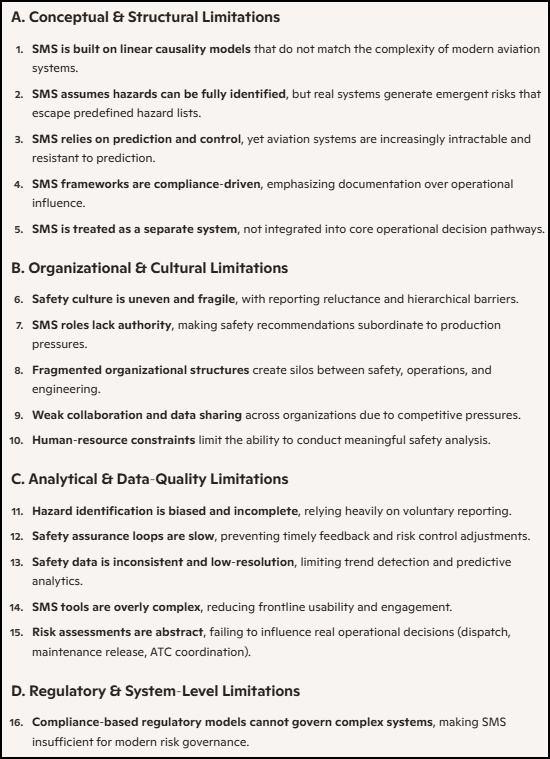
The text provides some specificity as to 16 deficiencies of the current practice of SMS that merit display :
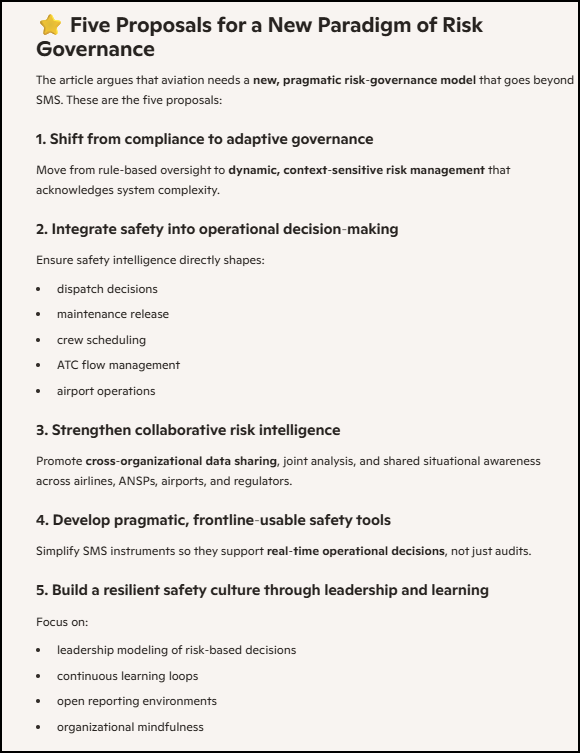
The research suggests that all aviation entities consider these five elements to reach their vision of SMS:
 One of the most salient recommendations of the Direct Science article is the need for an effective visible SMS advocate or Apostle. The religious connotation of that word is appropriate because the SMS Accountable Executive should address the subject with fervor
.
Some of the observations made in this paper appear to be more narrow than what is being practiced. The Event Review Committees JUST involves management, employee representative (union), and the FAA. There are reasons why the ERC members are limited. Other SMS internal organizations are more inclusive– Safety Review Board (SRB), Safety Action Groups (SAGs), and SMS Risk Panels / SRM Panels.
By including the people who share safety responsibility and are responsible for operational/profit results, the reasoning behind the action items and a good grasp of the benefits will be part of the decision process, as well as – perhaps more relevantly, these business function representatives will be able to explain the WHY of the SMS action.
The motivation of most executives, particularly if their compensation is tied to performance, places a high value on profitability. Some of these busy employees, not all, focus on the time and assets devoted to SMS. After some unfortunate, highly publicized accident, there is a recognized need to make SAFETY a measurable indicator of corporate success. The link between operational integrity and good financial results is clear, but even those who recognize that may still regard SMS as paperwork, interminable meetings and decisions that may detract from returns.
The good news is the people at Lloyd’s of London and the aviation insurance carriers do understand that good safety results in good earnings. So much so that insurers calculate that reduction of risk as a reason to lower premiums. Research shows that multiple aviation‑risk consultancies and underwriters state this directly.

For example, PAI Aviation Risk Consulting has stated that compliant, data‑driven SMS “demonstrates measurable risk reduction that insurers recognize and reward with lower premiums.” One of the largest insurers in this field, Global Aerospace has a SM4 Safety Program provides premium credits for operators who demonstrate strong safety‑management practices aligned with SMS principles. AeroMind Underwriting Advisory (2026) has commented that underwriters now require SMS maturity evidence for Part 135 renewals and offer premium reductions when operators show hazard‑closure discipline and trend‑analysis capability.
The reason why these financial institutions are successful is that they are masters of quantitative analysis. Their auditing of all aviation enterprises involves these calculations and examinations;
-
-
- loss frequency
- loss severity
- predictability
-
They apply these measures to SMS MATURE organizations and find:
-
-
- Lower loss frequency
-
Better hazard identification → fewer incidents → fewer claims.
-
-
- Lower loss severity
-
Risk controls reduce the scale of events (e.g., fire containment, stabilized‑approach policies).
-
-
- Higher predictability
-
Insurers hate uncertainty. SMS provides:
-
-
-
- documented risk assessments
- trend data
- corrective‑action closure
- organizational accountability
-
-
Like the observations in the ScienceDirect, this exercise is more than a check list; rather there is an Important nuance: SMS must be operationally integrated. There evaluation carefully scrutinizes for
-
-
-
- An acknowledged, effective SMS Apostle,
- one capable of making technical analyses,
- one familiar with the FARs and the work cards
- one with the ability to articulate the need for SMS to the C suite and to the folks on the shop floor.
- A mature system
- An acknowledged, effective SMS Apostle,
-
-
-
-
-
-
- Trend analysis — insurers want 12–24 months of safety‑trend data
- Training records — recurrent + scenario‑based
- A closed‑loop process
- Hazard‑closure evidence — proof that hazards are not just logged but resolved
- Data‑driven decisions based on categorizations that are well defined
- Maintenance discrepancy trends — especially deferred items
- A record of producing measurable safety outcomes
- Operational decision integration — insurers check if SMS affects dispatch, scheduling, route planning
- A corporate community not just aware of the SMS results, but proud of their risk reduction performance
- That record should show that the SMS decisions influenced positively operational decisions in both dimensions $afety as joint symbol
-
-
-
It is said that certificate holders who meet these indicia of an effective can benefit with these $afety results
-
-
-
- 5–15% premium reductions after demonstrating SMS effectiveness
- improved renewal terms
- fewer coverage exclusions
- faster underwriting cycles
-
-
If you feel as though your organization could benefit from this $afety culture, contact Mike Rioux.

A pragmatic approach to the limitations of safety management systems in aviation

~18 pages
Stathis Malakis , Tom Kontogiannis, Anthony Smoker

Abstract
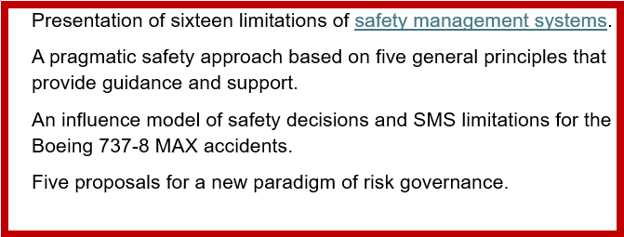
Commercial aviation systems are increasingly stretched to their capacity while existing Safety Management Systems (SMS) do not live up to our expectations as higher efficiency standards are taxing human resources, higher competition levels are reducing the potential for collaboration and the sharing of risk data, and technological advances are making systems difficult to operate and re-design. Aviation systems become intractable, defying SMSs that could support prediction and control, and hence, are not amenable to compliance models of regulation. Instead, it is argued here that this ability can be developed by APPLYING A PRAGMATIC SAFETY APPROACH BASED ON THE IDENTIFICATION OF SIXTEEN LIMITATIONS OF SMSS ACROSS AVIATION SYSTEMS, regardless of the theoretical perspectives and safety techniques adopted. A variety of data collection methods have been employed such as, analysis of incidents, interviews with safety practitioners, participation in group discussions and consideration of safety training. The proposed sixteen limitations of SMS can be useful in addressing these new challenges in the aviation environment by stressing the need for a new perspective in aviation risk governance.
Introduction
The purpose of a Safety Management System (SMS) is to provide a systematic way to control risks and assure that safety controls are effective. The SMS provides certificate holders with a means of meeting statutory safety requirements and evaluating management capabilities. Earlier SMS generations have focused on operating a safety system relatively independent from the production processes in an effort to achieve a balance between protection and production. Modern SMS approaches seek to implement a PERFORMANCE-BASED FRAMEWORK that emphasizes the INTEGRATION OF SAFETY WITH OTHER BUSINESS PROCESSES in meeting commercial, quality, and safety requirements.
Over the last years, research literature on SMS has been dominated by two interleaved strands. The first strand has focused on how theoretical perspectives, such as accident-related models, and organizational models can provide guidance for elaborating and developing certain SMS aspects of complex systems in isolation from other organizational processes (Provan et al., 2019, Hollnagel, 2014, Hollnagel, 2017, Leveson, 2012, Pęciłło, 2016, Valdez Banda and Goerlandt, 2019, Li and Guldenmund, 2018, Adjekum and Tous, 2020, Bridi et al., 2021, Khalid et al., 2021). The second strand has focused on how SMS can be best integrated with other management systems in an effort to deliver synergistic results, not only in safety, but also in productivity, quality, and environment (Kontogiannis et al., 2017a, Kontogiannis et al., 2017b, Álvarez-Santos et al., 2018, Hollnagel, 2020, Leveson, 2020). Advocates of the second perspective have worked on how SMS can be re-casted into a ‘performance oriented’ model that is more proactive, participative, and better integrated with other organizational processes. A common characteristic of the two strands is that SMS limitations are seen as unwanted products of deficiencies in the management system and that better results will be achieved by matching a particular safety perspective with their respective risk management techniques.
Although the two strands have contributed to a fruitful dialectic in safety science, SMS applications have not managed to tackle many problems in the aviation domain. There are many examples of cases where safety approaches and their SMS applications did not live up to the expectations of safety practitioners, such as tracing interactions in aircraft certification processes, bridging gaps between aviation sectors, making a business case for safety, sharing risk information between stakeholders, empowering front-line people in the organization, and disseminating lessons learnt. In most cases, the limitations of SMS are “colored” by the safety perspective that each organization adopts (McDonald, 2018).
In this paper, we take a pragmatic perspective and focus on a number of SMS limitations that cut across most safety perspectives. It is emphasized that the title of the paper reflects the approach taken in identifying the limitations of the SMS and not refer to any approach on how to overcome them. These limitations reflect recent trends in the aviation domain where efficiency standards set excessive demands on traffic flows, high competition reduces the potential for collaboration, technological advances make systems difficult to operate, and hierarchical structures of control restrict the adaptation of practitioners (Dekker, 2011, McDonald, 2018, McDonald et al., 2019, McDonald and Ulfvengren, 2019). Hence, we argue that although safety perspectives and SMS performance issues are undoubtedly important, they can be greatly supported by a thorough examination of SMS limitations and a new pragmatic approach to safety management.
This paper is structured as follows. After this introduction, we discuss the fundamentals of SMS in commercial aviation SMS. Section 3 presents the methods used in our research. Section 4 elaborates into several SMS limitations. Finally, Section 5, discusses a case study in the context of a major aviation accident and difficulties in managing the SMS limitations.