Might Alaska’s Threat-Forward Briefing enhance your flight crews’ SAFETY AWARENESS
As well explained in AIN’s contributor, after a significant accident and subsequent research, Alaska Airlines adopted a departure and arrival procedures during which the cockpit crew collaborates to define how they will respond to flight specific threats. Alaska’s Threats, Plan, Considerations (TPC)[1] has been well received by its pilots, but there is no publicly available information indicating that other US carriers have adopted it.
There are no public endorsements from Flight Safety Foundation (FSF)[2], Airlines for America (A4A)[3], or ICAO[4] formally endorsing threat‑forward briefings. The absence of endorsement is not because they oppose the concept — in fact, all three bodies publish material that is philosophically aligned with threat‑forward briefings. The most likely reasons are structural, procedural, and jurisdictional, not conceptual.
Other processes that the airlines have implemented include
-
-
- TEM — Threat and Error Management
- A theoretical framework describing how crews anticipate, trap, and mitigate threats, errors, and undesired aircraft states.
- Threats (external hazards)
- Errors (crew actions)
- Undesired aircraft states (unstable approach, altitude deviation)
- Scope: A continuous model applied throughout the flight.
- CRM — Crew Resource Management
- A behavioral and communication philosophy governing how crews interact, make decisions, share workload, and maintain situational awareness.
- Communication
- Leadership
- Workload management
- Decision‑making
- Monitoring
- Scope: A broad set of interpersonal and cognitive skills used across all phases of flight.
- TEM — Threat and Error Management
-
Here is the same assessment of TPC:
-
-
-
- TPC — Threats, Plan, Considerations
- A briefing method (Alaska Airlines’ innovation) used before a flight to create a shared mental model of the day’s highest‑risk elements.
- T — What could hurt us today
- P — How we will manage those threats
- C — What could change, and what we’ll do if it does
- Scope: A specific technique for a specific moment (the briefing).
-
-
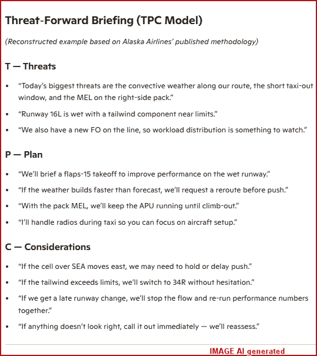
The company emphasizes that TPC is “a collaborative, threat‑focused discussion…The goal is to move away from rote, checklist‑style briefings and toward a shared mental model of the highest‑risk elements of the flight.”
Public sources also note:
-
-
-
- It is short, dynamic, and focused on the day’s unique threats.
- It is not a script; it is a conversation.
- It uses the TPC structure:
- Threats — what could hurt us today
- Plan — how we will manage those threats
- Considerations — what could change, and what we’ll do if it does
- “BRIDGE” between CRM and TEM.
- It takes TEM’s threat identification
- And uses CRM’s communication and collaboration tools
- To produce a shared, actionable plan for the flight
-
-
Safety techniques do not need to be uniform. Each airline has its own personality/culture. TPC works for Alaska; it has prospered there, possibly because two of their pilots helped design it. Cognitive Recall Erosion is a documented mental phenomenon which recognizes that rote reading of lists over and over tend to diminish the important safety message. Perhaps Alaska’s real time, collaborative, unscripted approach could be worthwhile for other airlines to consider/implement.

AINsight: THREAT-FORWARD BRIEFINGS ARE SMART AND SAFE
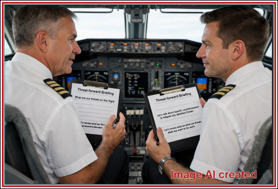
Skip the formulaic approach/departure briefings for ones that highlight specific threats and create open dialogue
- By Stuart “Kipp” Lau
- Contributor – Safety
June 26, 2026Nearly 10 years ago, Alaska Airlines redesigned its departure and approach briefings to focus on FLIGHT-SPECIFIC THREATS. The airline moved away from lengthy, generic briefings that had become routine box-checking exercises on flight decks worldwide. In their place, it introduced a more dynamic process grounded in threat and error management, giving pilots flexibility to scale and tailor briefings to the situation at hand.
Research into threat-forward briefings began following the 2013 fatal crash of an Airbus A300-600 freighter in Birmingham, Alabama. Both pilots were killed.
After a review of the cockpit voice recorder, investigators noted that the pilot flying (PF) “ticked all of the required boxes” during the approach briefing—it was perfect and on script. However, neither of the fatigued crewmembers discussed relevant threats or countermeasures related to a nonprecision approach at night to a seldom-used short runway with limited lighting in weather conditions that were lower than expected.
The NTSB would list the probable cause of the accident as “the flight crew’s continuation of an unstabilized approach and their failure to monitor the aircraft’s altitude during the approach, which led to an inadvertent descent below the minimum approach altitude and subsequently into terrain.”
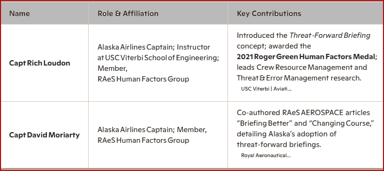
Alaska Airlines captains Rich Loudon and David Moriarty, members of the Royal Aeronautical Society’s Human Factors Group, wrote in the Flight Safety Foundation’s AeroSafety World publication that, following the Birmingham accident, research into U.S. and international airlines found that all had departure and arrival briefings that were “strikingly similar.” These researchers found that “a decades-old briefing method” neither adapted to next-generation flight decks nor incorporated breakthroughs in our understanding of human cognition.
These briefings were simply too long and redundant, and involved one-sided conversations that lacked involvement from the other pilot.
Alaska Airlines then reviewed its own departure and arrival briefings and found they were similarly inadequate. An analysis showed the briefings had become overloaded and were often performed by rote: crews either followed the policy mechanically, or some pilots disregarded it altogether. In both cases, significant time was spent briefing without focusing on the threats and countermeasures that mattered most.
Four Goals
Drawing on advances in cognitive theory and decision-making, the airline set four goals to improve its briefings:
THREAT FORWARD. Following the law of primacy (information presented first is better retained), crew briefings should first address the RELEVANT THREATS to the flight, followed by a discussion about SPECIFIC COUNTERMEASURES to mitigate any identified threats.
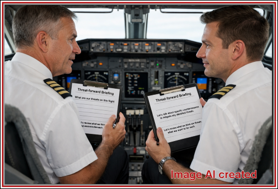 INTERACTIVE. A threat-forward briefing should encourage interaction between the PF and pilot monitoring (PM). It’s recommended that the PM be the first to open the conversation about threats. To be successful, captains must set the tone and promote an environment that is psychologically safe and that encourages an open dialogue. The mindset should be “our leg,” not “my leg/your leg.”
SCALABLE. Crew briefings need to be scalable. This requires a high level of autonomy. Pilots know what is important based on experience, familiarity, complexity, and a host of other factors. A daytime visual approach to Cedar Rapids is much different than an arrival and approach into Teterboro in low-IMC conditions.
COGNITIVE. Following the principle of recency (that information presented last is also well retained), the conclusion of each briefing should include a recap of the critical threats and the associated countermeasures. By recapping the threats and countermeasures at the end of the briefing, crews are mentally primed to act quickly and accurately through pattern-matching. This is also a good time to discuss specific PM or PF duties.
A Little T-P-C
To support these four goals, it is recommended to begin with a “silent set-up.” Essentially, this involves normal preflight actions and cockpit set with very little discussion other than those things critical to flight safety.
The crew then begins the briefing using the threats-plan-considerations (T-P-C) framework. The PF prompts the PM to identify relevant threats, often with a simple question such as, “What are our threats?” This approach gives the PM a stronger sense of ownership and encourages open engagement. Once the threats are identified, the crew then discusses appropriate countermeasures.
Next, the PF outlines the plan, scaling the briefing to the situation. A visual approach to a hometown airport is typically low-threat and may not require an extensive briefing because of crew familiarity and proficiency. By contrast, a circling approach into Teterboro in gusty conditions may call for a more detailed briefing that covers the threats, countermeasures, instrument approach, circling procedures, automation use, and PF/PM duties.
Finally, the considerations portion of the briefing is intended to recap or summarize the discussion. In a scenario involving a high-risk or complex briefing, be sure to revisit the specific PF/PM duties.
Personal Experience
When Alaska Airlines began sharing its research on threat-forward briefings, the concept immediately resonated with me. I believed in the approach and was glad when my company adopted the policy. I had already incorporated threat management into my briefings; the new policy gave it a more formal structure.
The first step is establishing a psychologically safe microculture on the flight deck that builds trust and encourages open dialogue. Be interactive. Researchers have found that pilots engage in “self-silencing” when there is not a psychologically safe environment.
Effective use of a threat-forward briefing requires pilots to think carefully—not only to identify threats, but also to scale the briefing appropriately for the situation. This is not simply another canned briefing; keep it fresh, adapt it creatively, and make it engaging.
[1] There is no trademark, no copyright, no patent, and no proprietary licensing associated with:
- “Threat‑Forward Briefing”
- “TPC”
- “Threats–Plan–Considerations”
Alaska Airlines has never claimed ownership of the method.
[2] FSF has published articles supporting TPC
[3] A4A typically focuses on regulatory advocacy, operational data sharing, and SMS alignment
[4] ICAO supports the framework but not the specific technique.
