IATA shares its wisdom and work on Aviation Safety Culture
IATA has issued THE standard for determining how strong an airline’s safety culture is by measuring nine core drivers of safety performance I‑ASC (IATA Aviation Safety Culture Survey). Our past experience with 2 mainline air carriers and 2 regional operators confirmed IATA’s position that Aviation Safety Culture assessment are vital for assuring that each organization’s environment was truly aligned with an all-encompassing determination to identify and address risks. Delivery of our observation were eye-opening to the companies and each saw the results as a wakeup call for all.
The Study’s findings come from IATA’s experience from its hands on experience counseling some of its members like–
One of the precursors to the I-ASC
A culture can be said to exist ONLY when all employees, particularly those working at the intersection of deadlines and SAFETY, readily recognize when senior leaders visibly prioritize safety. The evidence is not just clever graphics repeating the SMS mantra. The positive and negative proof of this leadership look like:
- Senior executives flagging a need for more resources (time and personnel) to assure that a turn really allows the AMTs need to check—THAT NEWS IMMEDIATELY IS SENT THROUGHOUT THE ORGANIZATION. (Leadership Commitment)
- Equally telling is when, for example, a QC staffer FLAGS a long revered supplier is producing less quality parts than an alternative. If the suggestion is rejected out-of-hand, particularly because of cost, doubt about leadership’s adherence to the mantra increases. (Open Reporting Culture)
- How the SMS process works is another measure of Safety DNA. Not every ASAP report needs to be resolved exactly as the person submitting the issue; rather it is important that the discussion has safety as the sole goal and thoroughly explains why and how the alternative selected balances the airline’s safety goals (Open Reporting culture)
- Again within the Safety Risk Assessment process, decisions that recognize that HONEST MISTAKES are acceptable and that clear examples of NEGLIGENCE and INTENTIONAL ACT are not
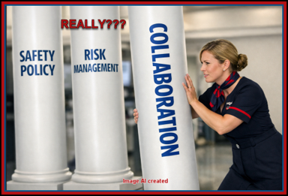 tolerated. (“Just Culture”)
- Now more than ever, aerospace is infused with innovation/change. The rank and file feel the impact of these challenges. When management fails to adjust the company’s tested practices, they see that as myopic management by the executives.( Organizational Adaptability).
- An airline or an OEM or a Repair Station is a highly integrated organization. The typical range of skills include, for example, flight ops, cabin, maintenance, ground handling, cargo, security,
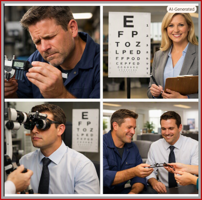 engineering, QA/QC, airport operations, line inspectors, health, hiring, etc. If these offices become silos, the need for a broader view to identify risks and to contribute to solutions, more importantly, become imperiled. Positive proof of an embedded safety culture can be seen when the Safety Risk team discusses a report that bad QA measurement of parts prior to inclusion in supplies. The PERSONNEL MEMBER of the group chips up and says, “we will add an eye test” prior to employment in those positions, the HEALTH REPRESENTATIVE chimes in ”on an on-going basis, we will check eyesight of all of that staff” and finally the HR PERSON who works on employees notes “Visual Acuity is an important aspect of everyone’s safety awareness, LET’S MAKE FREE EYEGLASSES A WORK-RELATED BENEFIT.” (Safety Knowledge & Awareness)
- Even the general public is aware of the dynamic nature of all of aerospace. Today’s past bears less resemblance with the future than our work has seen in decades (1903?). These businesses must proactively deal with these leading edge of technologies (AI, BWB eVTOL, bio based aircraft coatings). Resting on what has worked for years is filled with risk. High level scientific research have found new risks (UV rays, cosmic flares, etc.). The basic tool for SMS is evolving (ECA calling out the need to proactively identify hazards and to mitigate the related safety risks before and more see “Collateral Lesson from ECA ‘documentary’ about SMS”. There is much to be learned within our industry. (Continuous Learning)

- It is not enough to rely on ASAP to identify potential problems. Sometimes an outside of the process observation will reveal a risk that has not been seen by the ordinary sentinels. Recent SMS culture trends in aviation are reported in two authoritative reviews by IATA ( 5 Recurring Trends in Aviation Safety Culture) and the FAA (Proactive Risk Identification).
- Standard Operating Procedures are essential to safety, but, as they say, “the proof is in the pudding”. The aphorism applied to aviation hits these descriptions:
- A Safety Management System is only meaningful if it produces safe outcomes.
- Safety culture surveys matter only if behavior actually changes
- Policies are irrelevant unless front‑line staff experience them in practice. (Adherence to Safety Protocols)
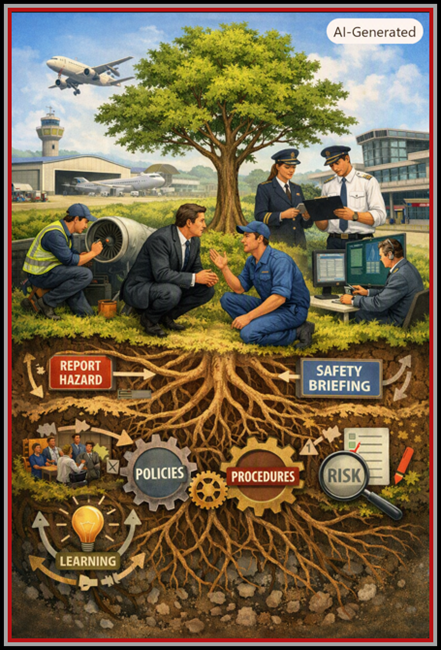
- Each of these elements matter, but there needs to be a composite perception of “how seriously the organization takes safety.” I‑ASC benchmarking shows wide variation across airlines and departments. Safety Culture as an ecosystem as multi‑layered, interdependent, and shaped by interactions — exactly what “ecology” implies. SMS as a living system with continuous improvement, feedback loops, and adaptation, which are ecological principles.
-
-
- Safety researchers use “ecology” to highlight:
- Safety is emergent, not engineered.
- Culture is co‑created by leadership, frontline staff, and operational realities.
- SMS effectiveness depends on interactions, not just documents.
- Weak signals, reporting behavior, and informal norms are ecological indicators.
- Change in one part of the organization affects the whole ecosystem.
-
(Overall Safety Climate)
IATA’s work and wisdom have developed a useful tool which they have used to assess and advise airlines. These are not measured with a micrometer, but are essentially very subjective judgments. Folks, who have contributed to their company safety DNA, will be hard pressed to be objective. Further, more than likely their experience is limited to one or few employers- thus their range of alternative approaches to a specific problem is limited. An outside team has the benefits of being more objective, less likely to be influenced by company politics and has seen what works and does not contribute to safety ecology. IATA’s #1 message is the importance of their I-ASC rubric. JDA can help.
I-ASC: IATA Aviation Safety Culture Survey
UNDERSTAND, BENCHMARK, AND IMPROVE YOUR SAFETY CULTURE WITH CONFIDENCE.
A positive safety culture is the cornerstone of effective safety. It is built on a shared commitment across all hierarchies to proactively uphold safety and is a reflection of the wider organizational culture, shaped by the priorities, behaviour, and values senior leaders establish and demonstrate.
I-ASC enables airlines and other aviation service providers to assess, benchmark, and improve their safety culture using a standardized, data-driven approach.
Whether you’re setting a baseline, tracking progress, or refining your safety strategy, I-ASC enables improved insight into potential risks and vulnerabilities, providing actionable results that help drive continuous improvements.
What is I-ASC?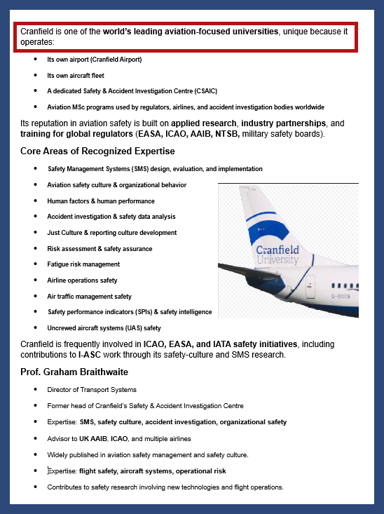
Developed specifically for the aviation industry by IATA, Cranfield University (UK)[1] and Ipsos, I-ASC is an industry-wide comprehensive survey solution, designed to provide an impartial assessment to support aviation organizations in measuring and demonstrating continuous improvement of their safety culture.
Using a standardized methodology, I-ASC allows airlines to benchmark themselves against their peers across the industry and internally, all without committing internal resources. The survey evaluates nine key safety culture drivers, providing detailed quantitative and qualitative data, as well as expert analysis to guide improvements.
Even if you already conduct internal surveys, I-ASC adds value through industry-level benchmarking, advanced analytics, and expert guidance to help you interpret results and build targeted action plans.
How I-ASC supports you
- Make safety culture measurable: Assess nine specific drivers that offer a clear roadmap for improvement. Drill-down into each safety culture driver for deeper insights.
- Benchmark with confidence: Compare performance internally and against global peers to identify strengths and gaps.
- Reveal hidden risks: Gain honest, anonymous employee feedback to uncover safety risks before they lead to incidents.
- Build a smarter safety strategy: Leverage both quantitative metrics and qualitative insights to shape effective mitigations and improvement plans.
- Reach your global workforce: Deploy surveys in six ICAO languages (with additional options available) to maximize participation.
- Show your progress: Track improvements over time with consistent metrics that demonstrate ongoing commitment.
- Strengthen a safety-centric mindset: Foster a harmonized safety-first culture across all employee levels and organizational areas.

