BATTERIES as the green aviation’s future? China’s today ahead, but…?
The pros and cons of electric powered aircraft as a future solution for Net Zero Carbon is a matter of significant debate today. Here are some recent posts on this tricky technical challenge–
- The Yin and Yang of transitioning to Electric Aircraft 10/2024 Prospects For Advanced Electric Aviation Powerplants (2025–2050) 03/2026
- Beta’s Alia Sale Precursor Of Big Electric Ram Market? Where, Why, And When? 03/2026
- GAO Report On Electric Aircraft Is Well Grounded. 06/2026
- Electric Hybrid Is Now An Airbus Project After Years Of No? 08/2026
To summarize the pending question broadly stated-CAN ELECTRICITY BE A GREEN SOLUTION FOR AVIATION?
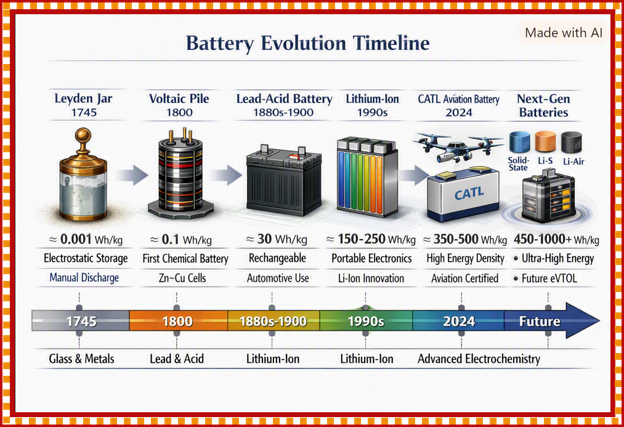
History (see above image) is a useful prologue for what can be expected—
From the Leyden jar’s first static charge, to Volta’s pioneering electrochemical pile, to the industrial reliability of lead‑acid and the modern leap of lithium‑ion, BATTERY TECHNOLOGY HAS ADVANCED IN BURSTS RATHER THAN SMOOTH CURVES. Yet even today’s best lithium‑ion chemistries—remarkable for eVTOL and short‑haul aviation—remain far from what true regional or long‑range electric flight demands. If batteries are to play a role beyond niche aviation profiles, the next evolutionary jump must arrive quickly: solid‑state architectures, lithium‑sulfur, lithium‑air, or entirely new chemistries capable of breaking through the hard limits that have defined electric propulsion for two centuries.
Good news??? Automotive World (below) reported that a Chinese company has successfully passed a most rigorous test of its prismatic-cell system battery and THE EQUIPMENT IS AT THE TOP OF THE WORLD’S ENERGY DENSITY SOURCE FOR POWER ON EVTOL AND POSSIBLY OTHER SHORT HAUL AIRCRAFT.
Here is a scoreboard of where CATL and its competitors stand today in energy density-
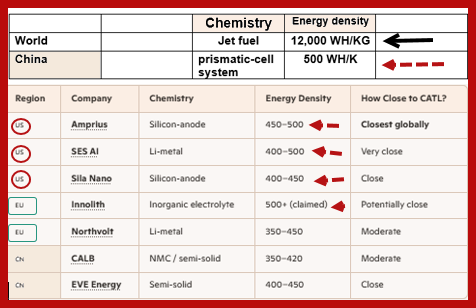
China is overwhelmingly the leader in the immediate future of battery development — and not by a small margin. CATL ALONE HELD 39–40% OF THE GLOBAL EV‑BATTERY MARKET IN 2025–2026, WITH BYD ADDING ANOTHER 14–16%, MEANING CHINESE FIRMS SUPPLIED OVER 70% OF ALL EV BATTERIES INSTALLED WORLDWIDE. Their dominance is not just scale: CATL is pushing ultra‑fast‑charging LFP (Shenxing), high‑density nickel‑rich packs (Qilin), and even sodium‑ion platforms, while BYD’s Blade architecture continues to set safety and structural benchmarks.
But China is not unchallenged. South Korea’s LG Energy Solution, Samsung SDI, and SK On remain serious contenders, especially in North America and Europe, where IRA incentives and EU industrial policy are driving massive gigafactory build‑outs. Japan’s Panasonic still leads in high‑performance cylindrical cells and is scaling 4680 production. And a new wave of challengers is emerging EVE Energy, SVOLT, Gotion, and CALB are rapidly expanding capacity and innovating in solid‑state, cobalt‑free chemistries, and large‑format cylindrical cells.
The U.S. prospects in next‑generation batteries are real but uneven, and NASA is one of the few organizations pushing genuinely breakthrough aviation‑grade chemistries.

The U.S. has world‑class research institutions (NASA, DOE labs, ARPA‑E, university consortia) and several commercial players (QuantumScape, Solid Power, SES AI, Amprius). But none currently match China’s CATL or BYD in scale, supply‑chain control, or speed of commercialization. The U.S. excels in frontier science; China excels in industrialization.
NASA is heavily involved in aviation‑grade battery research, far more than most people realize.
Two major NASA programs stand out:
SABERS — Solid‑State Architecture Batteries for Enhanced Rechargeability and Safety developing solid‑state sulfur–selenium batteries specifically for aviation. These batteries are designed to be:
-
-
- lighter
- safer (no liquid electrolyte)
- more energy‑dense
- stackable without heavy casings
-
NASA reports that SABERS is exceeding its initial goals and attracting interest from industry and government partners.
Lithium‑Air Research for High‑Energy Electric Aircraft
NASA is also pursuing lithium‑air batteries, which have theoretical energy densities far beyond lithium‑ion. NASA studies identify:
-
-
- 400 Wh/kg as the minimum for general aviation
- 750 Wh/kg for regional commercial aviation
-
Current lithium‑ion is ~200 Wh/kg and may plateau at ~300 Wh/kg — far below aviation needs. NASA’s lithium‑air research aims to develop ultra‑high‑energy, rechargeable, safe batteries capable of meeting aviation requirements.
Bad new/good news-
BAD
-The news from China is evidence that they are the top producer of the batteries with the best weight/energy ratio.
GOOD
-
-
- Thanks to NASA The U.S. leads in experimental high‑energy chemistries (SABERS or lithium‑air ).
-
UNKNOWN
-
-
- Can US industries reach manufacturable maturity, the U.S. could leapfrog current lithium‑ion leaders?
-
CATL’s eVTOL battery passes “world-first” safety test
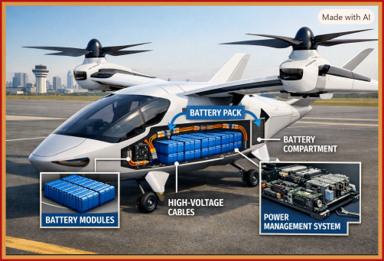
Aviation certification work doubles as safety research CATL can feed straight back into its core automotive batteries.
By Stewart Burnett August 10, 2026
CATL[1] has confirmed that its landmark aviation battery system for passenger electric vertical take-off and landing (eVTOL) aircraft has passed a “world-first” safety test, showing no thermal runaway propagation when two adjacent cells were deliberately triggered simultaneously. The 350 Wh/kg prismatic-cell system is now ready for mass production and will first power passenger aircraft from Autoflight, a Chinese eVTOL maker backed by CATL.
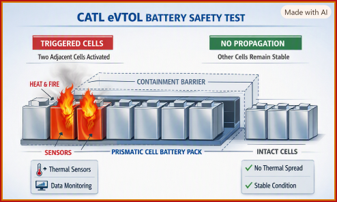 The test itself sets A MATERIALLY HIGHER BAR than current industry practice. Manufacturers typically verify only that a single triggered cell will not cause a chain reaction across a battery pack; CATL triggered two adjacent cells simultaneously, at both a central and a corner location within the pack. Representatives from the Civil Aviation Administration of China[2] were present to witness and verify the production, inspection and testing processes throughout, laying the groundwork for eventual civil aviation certification.
CATL’s relationship with Autoflight is nothing new, dating back to August 2024 when it first became a strategic investor with an outlay in the hundreds of millions of US dollars. The development marked its first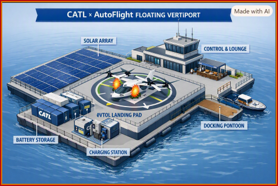 publicly disclosed investment in an eVTOL company. The two firms went on to unveil a floating vertiport[3] in November 2025: a battery-powered vessel combining an eVTOL landing platform with solar energy storage and charging systems. The vertiport was successfully demonstrated at Dianshan Lake using a two-tonne aircraft from Autoflight’s existing range.
Autoflight itself is one of China’s most established eVTOL developers, founded in 2017 and holding cumulative commercial orders for 2,000 aircraft going into 2026. Orders span multiple models, including the Prosperity and CarryAll. It has already made some deliveries, including a five-seat Prosperity to a customer in Japan in spring 2024, claiming the world’s first civil eVTOL delivery in the one-tonne weight class. The company has since logged demonstration flights across distances of up to 123 km.
Clearly, eVTOLs represent an attempt by CATL to diversify beyond its core automotive and energy storage businesses. However, the physics behind aviation batteries explain why the firm is very unlikely to extend this bet into long-haul commercial aviation. JET FUEL CARRIES ROUGHLY 12,000 WH/KG of energy against current electric vehicle (EV) batteries’ roughly 200-280 Wh/kg. Even CATL’S OWN AVIATION-GRADE CELLS MAX OUT AT AROUND UP TO 500 WH/K.
Because an aircraft’s fuel burns off and lightens the plane during flight while a battery’s weight stays constant from take-off to landing, a fully electric transoceanic airliner would need to be built almost entirely of battery mass, leaving practically no room for passengers or cargo. Decarbonisation of the aviation segment remains heavily focused on alternative fuels, perhaps most prominently hydrogen.
Instead, CATL is building toward shorter-range and higher-margin flight. Urban and regional routes of 20 to 150 miles are already achievable with 300 to 350 Wh/kg packs in small passenger aircraft. Aviation-grade cells, which demand far stricter safety tolerances and higher discharge rates than commoditized EV batteries, carry meaningfully better margins at a time when EV battery pricing faces intensifying competitive pressure.
The same non-propagating cell design work required for aviation certification also has a plausible path back into CATL’s higher-performance automotive packs. CATL’s eVTOL push functions less as a bet on replacing jet aircraft and more like an attempt to strengthen and hedge against its own core business. Aviation certification doubles as safety research that feeds back into automotive batteries, while the segment itself offers margin insulation from an EV market CATL already dominates but which is prone to demand and price shocks.
[1] Contemporary Amperex Technology Co., Limited, (CATL) is a CHINESE battery manufacturer and technology company founded in 2011 that specializes in the manufacturing of lithium-ion batteries for electric vehicles and energy storage systems, as well as battery management systems (BMS). CATL is the biggest EV and energy storage battery manufacturer in the world, with a global market share of around 37% and 36.8% in 2022 and 2023, respectively.
[2] Xinhua News Agency reporting that “the test was conducted under the supervision of the Civil Aviation Administration of China (CAAC)”;China Daily coverage citing CAAC’s involvement; CATL’s own press release, which states the test was “witnessed by CAAC representatives”. CAAC’s English website does not refer to the test.
[3] AutoFlight floating vertiport was unveiled on November 22, 2025, at Dianshan Lake in Kunshan, Suzhou, China. This “Water‑based Green Vertiport” demonstration featured AutoFlight’s 2‑ton‑class eVTOL aircraft taking off from a solar‑powered floating platform integrated with CATL’s battery and energy‑storage systems. The facility combines photovoltaic charging, intelligent dispatch, and communication modules to support passenger and cargo eVTOL operations over rivers, lakes, and coastal areas.

