Electric Hybrid is now an AIRBUS project after years of NO?
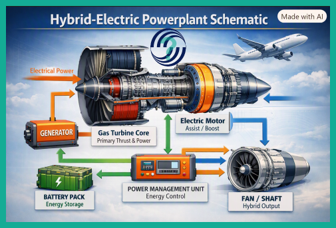
Time to consider a Unified Technological Solution and then figure out the implementation?
At Farnborough, Airbus held a press conference which generated a SIGNIFICANT CHANGE IN THE COMPANY’S APPROACH TO ELECTRIC ENGINES. Since 2017 various senior officers declared that electric batteries do not provide sufficient power-to-weight ratios sufficient for commercial aircraft[1]:
- Airbus press release (2017): “Electric flight: challenges ahead”
“Today’s batteries do not yet provide the power‑to‑weight ratio needed for large commercial aircraft.”
“The technology challenges around batteries and high‑voltage systems remain significant.”
And:
“The pace of alternative propulsion development has not yet reached the level needed for commercial aircraft.”
- Airbus CTO Grazia Vittadini interview (2019–2020)
“With current battery technology, fully electric propulsion is limited to very small aircraft.”
And:
“We do not see a path to a battery‑electric single‑aisle aircraft with today’s energy density.”
- Airbus “Future of Flight” technical article (2018)
“Batteries are still too heavy for anything beyond small aircraft.”
And:
“Electric propulsion alone cannot meet the energy requirements of commercial aviation.”
The headline states that the Toulouse company is ELEVATING a hybrid-electric integration through a project supported by the EU and involving an impressive team of partners:
-
-
- AVL,
- Collins Aerospace,
- the European Aerospace Science Network (EASN),
- Fraunhofer-Gesellschaft, Liebherr Aerospace,
- Lynxeo,
- the Netherlands Aerospace Centre (NLR), Safran,
- SAFT,
- the University of Warwick,
-
and
-
-
- Wroclaw University of Science and Technology.
-
The company’s Head of aircraft of tomorrow Research and Technology at Airbus, not a senior officer, stated
“Our progress in developing hybrid-electric technologies and our move into the LEIA demonstrator marks a PIVOTAL SHIFT in how we design the future of flight,”
Pivotal shift from Airbus’ history of 9 years high level executives of absolute negative opinions to hybrid-electric non-propulsive energy architecture for the next generation of commercial aircraft– maybe limited to short-to-medium range aircraft?
Airbus is not alone in this category of potential believers in the hybrid-electric technology potential as shown in this AI chart
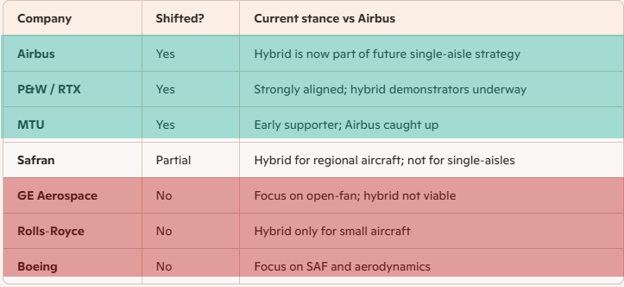
Airbus:
Shifted from skepticism to active investment once motors reached ~6–8 kW/kg and high‑voltage systems matured.
Pratt & Whitney / RTX: Strongly aligned with Airbus.
-
-
- P&W was already ahead with hybrid turboprop demonstrators.
- Collins Aerospace’s power electronics work directly supports Airbus’s hybrid roadmap.
- Their position strengthened as technology matured.
-
MTU Aero Engines: Fully aligned.
-
-
- MTU is a core partner in the Airbus SWITCH hybrid GTF program.
- MTU’s stance didn’t “change” — they were early believers, and Airbus essentially caught up.
-
Safran: Partially aligned.
-
-
- Safran invests heavily in hybrid systems for regional aircraft (EcoPulse, distributed propulsion).
- But for single‑aisles, Safran remains cautious; they prioritize open‑fan architecture over hybridization.
- Their position improved slightly but remains conservative for large aircraft.
- Safran invests heavily in hybrid systems for regional aircraft (EcoPulse, distributed propulsion).
-
GE Aerospace: Not aligned.
-
-
- GE sees battery mass as prohibitive for airliners.
- Their RISE program is explicitly non‑hybrid.
- GE’s stance has not changed — they remain focused on advanced cores and open‑fan.
-
Rolls‑Royce: Not aligned for airliners; aligned for small aircraft.
-
-
- RR supports hybridization for regional and business aviation.
- But for widebodies and large single‑aisles, RR still sees hybrid systems as too heavy.
- Their position remains essentially unchanged.
-
Might there be something beyond technology that influenced the change? Here is an AI summary of some of the possible source for Airbus’ new GREEN approach
1.Clean Aviation (EU’s flagship aerospace R&D program)
►Clean Aviation’s funding priorities strongly align with Airbus’s new hybrid stance:
-
-
-
-
- The Switch hybrid GTF program is co‑funded by Clean Aviation.
- Clean Aviation’s 2035 roadmap explicitly includes hybrid-electric propulsion for regional and single‑aisle aircraft.
- EU climate policy (Fit for 55, ReFuelEU Aviation) pushes OEMs toward multi‑path decarbonization.
-
-
-
►Clean Aviation documents often say things like:
“Hybrid-electric propulsion is a key technology for next-generation regional and short‑medium range aircraft.”
This is essentially an endorsement of the direction Airbus has taken.
- European Commission
-
-
- 2050 net‑zero aviation target
- SAF mandates
- Hydrogen research funding
- Electrification R&D partnerships (Airbus–Renault, Airbus–STMicroelectronics)
-
The EU’s policy environment encouraged Airbus’s pivot.
- ICAO
ICAO documents describe hybrid-electric propulsion as:
“a potential contributor to long-term emissions reductions.”
The range of independent research for greener technology is broad. That may make sense to find something that works. Since 1991, early days of CAEP, through CORSIA, here all the avenues being pursued on what appears to be an uncoordinated basis
-
-
- Sustainable Aviation Fuel (SAF)
- High‑bypass turbofans, winglets, composite structures:
- Open‑fan / advanced core (CFM RISE)
- Ultra‑efficient cores (RR UltraFan, GE advanced engines)
- Electric and hybrid‑electric propulsion
- Hydrogen propulsion
- Air traffic management (SESAR, NextGen)
- Airport and ground operations decarbonization
- Contrail and non‑CO₂ impact research
-
The estimates say about $3.2 trillion will be needed by 2050 to find some solution. The policy “solutions” are in the hands of ICAO and the EU—ETS a scheme which looks to increase costs as a way of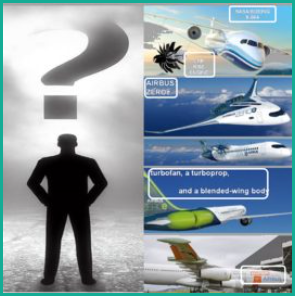 reducing carbon emissions. The nine above initiatives (there likely are more technologies being pursued) collectively have promise somewhere among them, but not all of them. The capital markets plus some governments subsidies are deciding which ventures get funded. Query whether politics might influence where the money flows?
Might it not be a good idea to allow these policy and technical pursuits to continue, BUT immediately convene decision-makers (not ICAO or EU) to review, prioritize and monitor these efforts to save the planet?

Airbus elevates hybrid-electric integration with LEIA Project
Farnborough, United Kingdom, 22 July 2026 – Airbus, with partners from across the European Union, the UK and the US, is pursuing its ambition to pioneer a hybrid-electric non-propulsive energy architecture for the next generation of commercial aircraft with LEIA – Large Scale Integration Demonstrator of Hybrid Electrical Architecture.
 LEIA, a project supported by the European Union Clean Aviation Joint Undertaking, will be fundamental to advancing high-voltage generation and distribution for innovative electrical aircraft systems for short-to-medium range aircraft. By bridging the gap between component-level innovation and aircraft-level maturity, the project aims to prepare these technologies for future integration and certification.
“Our progress in developing hybrid-electric technologies and our move into the LEIA demonstrator marks a PIVOTAL SHIFT in how we design the future of flight,” said Karim Mokaddem[2], Head of aircraft of tomorrow Research and Technology at Airbus. “By moving to integrated, intelligent hybrid-electric architectures, we are actively laying the physical and digital foundation for the next generation of aircraft. This evolution demonstrates that the future of aviation is about more than just new power sources; it is also about the new ecosystems that will manage them.”
LEIA builds on the successful completion of the SWITCH project, which focused on hybrid-electric powertrain subsystems and reached a key milestone in July when Collins Aerospace completed integrated laboratory testing. This achievement is a result of a strong collaborative effort by the project partners, including Pratt & Whitney, GKN Aerospace, and MTU Aero Engines.
These subsystems, which operate in tandem with simulated aircraft and engine systems, are now transitioning to the Airbus Sustainable Technology and Engineering Projects (STEP) laboratory in Ottobrun, Germany. There, Airbus teams will conduct critical aircraft-level integration testing, including design, battery interfacing and energy-management systems.
Airbus is leading the integration of a suite of advanced electrical components, including scalable motor/generators, next-generation electronic controllers, power distribution equipment, alongside various other aircraft systems. These systems will be validated through a comprehensive testing programme, culminating in a pivotal ground demonstration by 2027.
Both SWITCH and LEIA build on Airbus’ ongoing collaboration across multiple Clean Aviation projects, which target electrification technologies for regional and short-to-medium range aircraft. By managing cross-border supply chain integration and rigorous technical requirements, Airbus continues to drive the transformation of the aviation industry toward a more electric future with the ultimate goal of reducing greenhouse gas emissions in aviation.
Airbus collaborates with several partners on the LEIA project: AVL, Collins Aerospace, the European Aerospace Science Network (EASN), Fraunhofer-Gesellschaft, Liebherr Aerospace, Lynxeo, the Netherlands Aerospace Centre (NLR), Safran, SAFT, the University of Warwick, and Wroclaw University of Science and Technology.
Click here to read more about the LEIA project.
@Clean Aviation #Electrification #Decarbonisation
[1] Jet fuel has ~12,000 Wh/kg of usable energy.
Lithium‑ion batteries (2017) had ~200 Wh/kg.
Even optimistic projections only reached 400–500 Wh/kg.
[2] Karim Mokaddem is Head of Aircraft of Tomorrow Research and Technology at Airbus. In this role, he is responsible for establishing and overseeing Airbus Commercial’s future aircraft research and technology portfolio.
Karim has held a variety of engineering, project leadership and management positions since starting his career in 1996. During his 14-year tenure at PSA Peugeot Citroen, he held several high-level roles, including Executive Chief Engineer of Technoboost, a joint-venture between PSA Peugeot Citroen and the French government. In 2014, he was named General Manager of AALPS Capital, an asset management company in low-carbon, hydrogen and fuel cell mobility.
Prior to joining Airbus in 2020, he was Chief Technology Officer of Balyo, a company that develops markets and installs fully autonomous material-handling robots. Karim joined Airbus as FastTrack Electrification leader before leading Airbus Group Hybrid Electric Strategy.
