AFA’s “turbulence” end run of ERC lowers SMS’ COLLABORATION
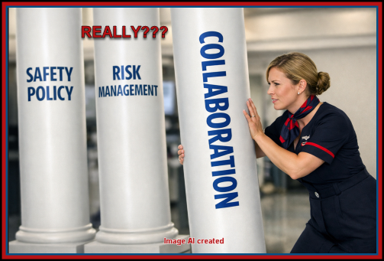
Few issues should unite airline labor and management MORE THAN SAFETY. The current world standard regimen for reducing risks in flight is Safety Management Safety, which has as pillars NON-PUNITIVE AND COLLABORATIVE procedures. In that context the attached story is distressing- first, because AFA alleges that their members on flights operated by Endeavor (owned by Delta) intentionally do not interrupt their passenger service when turbulence is close. That means, as well described by KALUM SHASHI ISHARA, the cabin crew
-
- does not immediately make the safety announcement,
- does not stow the service carts/ stop serving the passengers and
- return to their seats which are located for emergency evacuation.
AFA contends that this aberration from standard procedures is driven by the fear that the stopping of service[1] will negatively reflect the passenger satisfaction. SUCH A CONFLICT between standard safety steps and customer satisfaction SHOULD BE EASILY RESOLVED the SMS.
The procedures and policy are in place—
-
- AFA‑CWA and Endeavor have in effect a Memoranda of Understanding (MOU) tied to its Aviation Safety Action Program (ASAP) and broader Safety Management System (SMS)
- AFA‑CWA, on behalf of its members, actively participates in the Event Review Committee (ERC) meetings at which both Endeavor management and the FAA also contribute.
- Reports submitted through WBAT are reviewed jointly — management cannot unilaterally discipline employees for self‑reported safety events.
- The process is non‑punitive and collaborative, designed to identify hazards and corrective actions rather than assign blame.
- Cabin crew reports feed into joint safety analysis with management and union oversight.
- Fatigue reports are required when attendants call in fatigued, and these are reviewed under the Fatigue Risk Management Plan — another area where union input is recognized.
- The system encourages attendants to report “fatiguing situations” even if they did not call in fatigued, reinforcing a shared safety culture.
The public record[2] reflects a Collaborative Safety Partnership; Endeavor’s ASAP program is operated “in cooperation with our employee labor organizations and the FAA.”
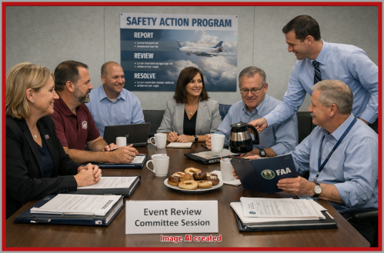
ASAP is fed by individual event reports; so, technically this systemic problem (the impact is recorded well post the flight “incident”) does not easily fit into the typical ERC in-box. However, if AFA raised this safety problem at one of these sessions, no one should have objected.[3] The resolution of these turbulence incidents (for example, a simple rule that turbulence encountered during a flight could void the consumers’ bad service grades) through an ERC would provide useful example for airlines which may have the same problem. Significantly, AFA’s commitment to COLLABORATION is lessened.
WHY DID AFA FIRST ISSUE ITS PRESS RELEASE RATHER THAN REQUEST AN ERC REVIEW ? One possible reason for publicizing, rather than submitting the issue through SMS, is that the union’s audience is both the Endeavor/Delta cabin crew AND the DELTA (mainline) flight attendants who are not unionized. Issuing a press release reaches the largest unorganized cabin cadre (28,000 FAs) and reminds their Atlanta cousins them that
-
- They do not have union representation on an ERC.
- Their safety reporting programs are company‑run, not jointly governed.
- Any ERC‑like review for cabin crew is internal, not tri‑party.
- There is no independent employee representative in the process.
- Delta uses internal “peer representatives,” but these are company‑appointed, not elected or union‑backed.
- That AFA is willing to aggressively advocate on safety issues and place protection over the union’s participation in ASAP when that process is necessarily slower.
The basic message that AFA will aggressively pursue measures that will protect the safety of their members HAS ITS MERITS. Avoiding the ERC diminishes its value and might even be cited as a precedent that management may employ sometime when it advances their goals. Exposing a safety deficiency may actually hurt AFA members and the company at large. A collateral consequence may be that a prospective customer might not fly Endeavor because of the union’s safety complaint. Whatever the reason, SMS’s focus is SAFETY not union-management relations. A process that avoids an ERC is a short term ploy and may limit the long term efficacy of SMS.

Why Some Delta Regional Flight Attendants Skip Turbulence Safety Steps During Flights
BY KALUM SHASHI ISHARA Published on June 16, 2026
If you fly Delta Connection routes operated by Endeavor Air, you may want to know what’s happening behind the scenes during turbulence. Flight attendants at the regional carrier say they are skipping standard safety procedures because they worry about how passengers will rate them afterward.
The concern comes from the Association of Flight Attendants (AFA), the union that represents cabin crew at Endeavor Air, a wholly owned Delta subsidiary that operates regional flights under the Delta Connection brand. Union representatives say CREW MEMBERS FEEL PRESSURED TO KEEP SERVICE MOVING EVEN WHEN CONDITIONS IN THE CABIN ARE UNSAFE.
What the union is saying
According to the AFA, flight attendants at Endeavor are being judged on customer satisfaction surveys that passengers fill out after their flights. Those scores carry weight inside the company, and crew members say a pause in service during turbulence can drag those numbers down.
The result, according to the union, is that some flight attendants continue working the aisle, serving drinks, and collecting trash during turbulence instead of taking their jump seats and buckling in. That GOES AGAINST STANDARD PROCEDURE, which calls for cabin crew to stop service and secure themselves when a captain turns on the seatbelt sign or when turbulence becomes severe.
The union raised the issue publicly to highlight what it describes as a conflict between passenger experience metrics and basic safety rules that exist to protect both crew and travelers.
Why turbulence procedures matter to you
Turbulence is the leading cause of injuries on commercial flights in the United States. When a plane hits rough air without warning, anyone not strapped in can be thrown against the ceiling, seats, or the floor. Flight attendants face the greatest risk because they are usually standing and moving through the cabin.
The Federal Aviation Administration requires airlines to follow specific procedures when the seatbelt sign is on. Cabin crew are expected to secure carts, stop service, and take their seats. Passengers are expected to return to their seats and fasten their seatbelts.
When flight attendants skip those steps, the risk shifts onto everyone in the cabin. A loose cart can become a projectile. A crew member who is knocked off balance can fall onto passengers. And if a flight attendant is injured, fewer people are available to help in an emergency.
How customer satisfaction scoring works
Airlines like Delta use post-flight surveys to track how passengers feel about their trip. Scores can influence everything from crew bonuses to performance reviews. The metrics often focus on things like friendliness, attentiveness, and whether service was completed.
The problem, according to the AFA, is that these surveys do not always account for circumstances outside the crew’s control. If a flight hits 45 minutes of continuous turbulence and service gets cut short, passengers may rate the flight lower even though the crew followed safety rules correctly.
Flight attendants say that pressure adds up over time. Crew members who consistently receive lower scores can face uncomfortable conversations with management, even when the reasons for those scores were tied to weather or safety decisions.
What Endeavor and Delta have said
Endeavor Air operates as a regional carrier feeding passengers into Delta’s mainline network. Its flight attendants are not part of the same union contract as Delta mainline cabin crew, who are not unionized. THE AFA HAS BEEN PUSHING TO ORGANIZE DELTA MAINLINE FLIGHT ATTENDANTS FOR YEARS.
 The union’s claims about turbulence procedures put a spotlight on how regional carriers measure performance. Delta has not publicly disputed the existence of customer satisfaction scoring at Endeavor, and the airline has long emphasized service quality as a brand differentiator.
What this means for your next flight
If you are flying on a Delta Connection flight operated by Endeavor or another regional carrier, here are a few things worth keeping in mind.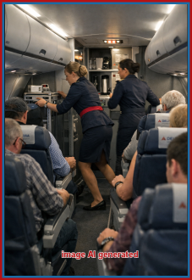
First, the seatbelt sign is not optional. Even when the ride feels smooth, clear-air turbulence can hit without warning. Keep your belt fastened whenever you are seated.
Second, if a flight attendant pauses service during rough air, that is the correct response. A delayed drink is far better than an injury. Crew members who follow procedure are protecting you, not ignoring you.
Third, when you fill out a post-flight survey, consider the context. If the cabin crew stopped service because of turbulence or other safety reasons, that decision should not count against them.
The bigger picture
The issue at Endeavor reflects a tension that exists across the airline industry. Carriers compete on service, and surveys are one of the few ways to measure that service at scale. But when those metrics influence how crew members behave during safety-critical moments, the system can produce outcomes that nobody wants.
Turbulence injuries have drawn more attention in recent years, with several high-profile incidents on international flights resulting in serious harm to passengers and crew. The National Transportation Safety Board has repeatedly recommended that airlines and passengers take turbulence more seriously.
For now, THE AFA IS USING ITS PLATFORM TO ARGUE THAT SAFETY PROCEDURES SHOULD NOT BE WEIGHED AGAINST SURVEY SCORES. Whether Endeavor or Delta makes changes to how it evaluates regional flight attendants remains to be seen. In the meantime, the best thing you can do as a traveler is simple. Buckle up, listen to the crew, and rate them fairly.
[1] on flights that only average 180 minutes but potential service time cannot be performed during the take-off, climb to cruising altitude and descent phases
[2] The January 2025 MEC report does include: AFA’s problems with the ASAP Event Review Committee; Management’s approach to safety reporting; but there is no evidence in publicly available reporting that Endeavor Air management has spoken about flight attendants skipping safety procedures due to fear of passenger ratings
[3] The January 2025 MEC report discusses:-Problems with the ASAP Event Review Committee and Management’s approach to safety reporting
