California, Florida and Utah invest in the eIPProgram- Bull or Bear???

The White House/DOT eIPP INITIATIVE has catalyzed a race for certification of electric aircraft AND to have the prerequisite infrastructure ready for the future operations (some examples of eIPP-inspired developments). Below are excerpted articles about the substantial investments (billions) being made by Florida, California, and Utah.
Public infrastructure investments have made financial sense– if not on the strict ROI of the facility (airport), the economic impact of direct and secondary jobs and taxes have justified these expenditures. The eIPP participation of states, cities and regions in building the vertiports, charging stations, electricity generation, safety requirements, etc. may or may not meet their tolerance for risk. Collateral justification might include the alleviation of surface transportation congestion. The eVTOL noise is projected to be positive; however, may be optimistic –over the past few decades, the public has become more and more sensitive for aircraft generally. It is not a foregone conclusion that communities will accept eVTOL noise or presence.
So what do the financial markets say about the likely profitability of the eVTOL operations? Wall Street / hedge-fund-style views on early eVTOL profitability around two themes:
- economics are dominated by certification delays, ops approvals at federal and local authorities, and manufacturers ability to attain the lower costs through scale—not the aircraft spec alone,
and
- consumer demand is expected to arrive first for piloted or “pilot-in-the-loop” experiences, with no-pilot acceptance modeled as a later, $ risk-reduced phase, but as yet unknown consumer willingness to fly without a human at the controls.
Research has found the specific comments:
- Early eVTOLs are typically treated as development-stage / pre-unit-economics businesses where “profitability” is mostly a timeline and cash-burn argument (how long until revenues and utilization scale enough to offset capex/opex).
- A concrete example: a hedge fund criticized one company’s path to profitability and argued that the company’s stated break-even timing was unrealistic, focusing on cash runway/burn, battery/technical constraints, and manufacturing/cost assumptions. AIAA
In that same ecosystem of commentary, the skeptical pattern is:
- Costs won’t fall fast enough(manufacturing ramp + certification/maintenance overhead).
- Utilization is too low early(fleet size + scheduling + vertiport readiness).
- Demand won’t support early pricing(especially without broad
route networks).
- Autonomy isn’t a nearterm margin saviorunless regulators and operations already allow it at scale.
- Consumers are more likely to accept no-pilot once the service shows:
- consistentreliability
- incident-freeoperation patterns
- robustcustomer-facing procedures (booking, troubleshooting, ground support)
- clearcommunication about safety and what happens when issues occur
BUT ONE EARLY ACCIDENT MAY IMPERIL POSITIVE CONSUMER ATTITUDES piloted or autonomous!!!
These are generalized comments; some opinions may vary between OEMs, eVTOL operators and locale (congestion (urban areas which also tend to correlate with higher incomes), rural communities with poor needs, businesses with just-in-time requirements (,i.e. FedEx or Amazon particularly in the last mile delivery scope), and any of the unique businesses that build their business model on the eVTOLs’ unique transportation capacities.
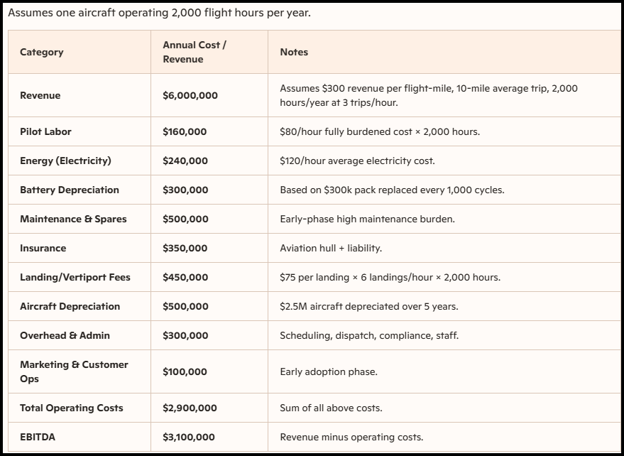
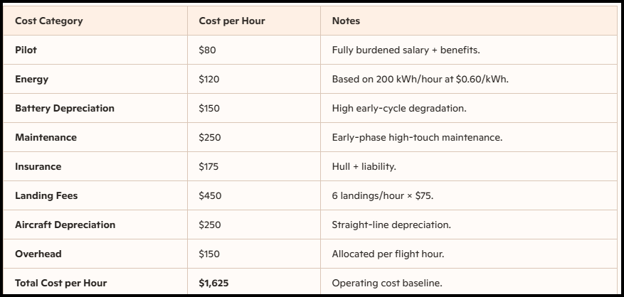
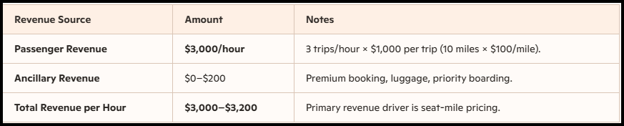
The crystal ball for eVTOL flights to find demand/revenue that exceeds fully allocated costs is built on a lot of assumptions. AI has modeled the following financial forecasts for a generic eVTOL carrier, which illuminates the impactful variables:
AI P&L Summary (Annualized)
AI Unit Economics (Per Flight Hour)
AI Revenue Model (Per Flight Hour)
AI Break-Even Analysis
-
-
-
-
-
-
-
-
-
-
-
-
-
- Break-even revenue per hour: $1,625
- Break-even revenue per mile: $162.50 (assuming 10 miles/hour)
- Break-even revenue per passenger-mile: $40.63 (4 seats)
-
-
-
-
-
-
-
-
-
-
-
-
Early eVTOL operations may REQUIRE PREMIUM PRICING comparable to helicopter transfers.
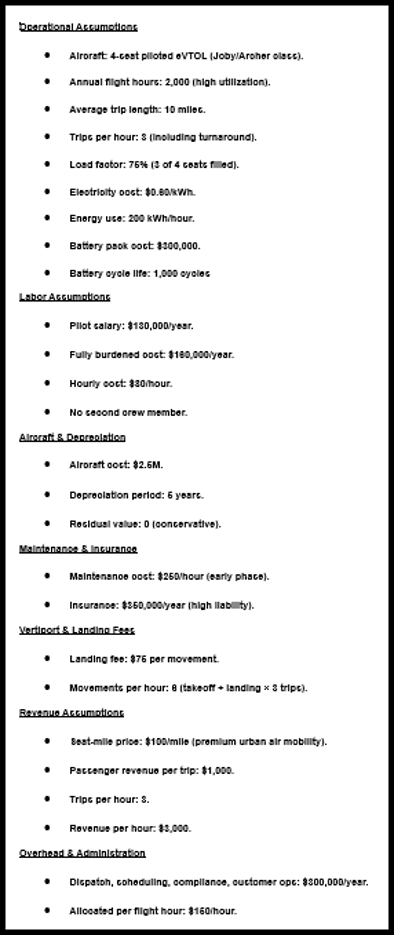
Assumptions Page
The eIPP initiative has drawn in an impressive list of participants.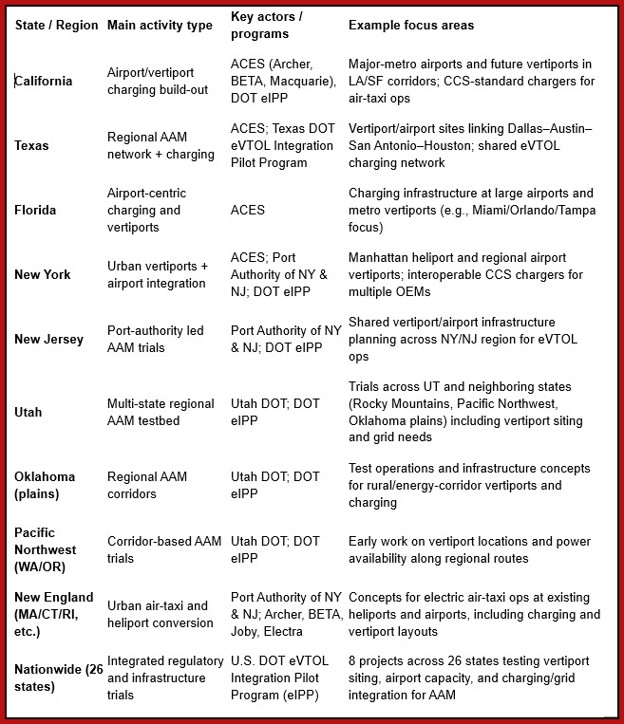
This list of entities attracted to this prospect of economic development appears to be based on the White House’s imprimatur, the excitement surrounding the Low Altitude economy and hopefully a financial forecast with substantial credibility!!!
Early successes, in terms of safety record, reliability and positive experiences, will reduce the risk. Early investment in these infrastructure projects may have very good returns.

{articles excerpted }
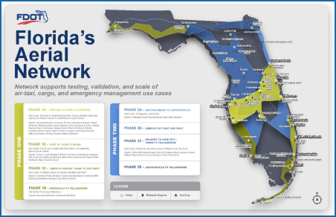
Governor Ron DeSantis Highlights Florida’s One-of-a-Kind Facility to Advance the Future of Transportation
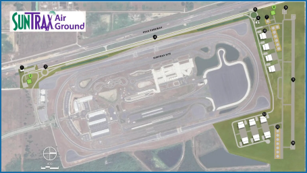
SunTrax AirGround will test eVTOL aircraft by end of year, support autonomous vehicle deployment across the state, and train Florida’s workforce for advanced transportation technology

AUBURNDALE, Fla.— Today, Governor Ron DeSantis highlighted SunTrax, Florida’s premier, nation-leading facility for research and development of emerging transportation technologies and innovations. Located along the Interstate 4 (I-4) corridor in Polk County, the 775-acre SunTrax campus, which was initially built to test connected and autonomous vehicle (CAV) technologies, has now expanded to also include air technology.
This new expansion was purpose-built to help with the safe and innovative development of Advanced Air Mobility (AAM) technology, or “flying cars”. AAM will offer a brand-new transportation option to Florida’s communities that will relieve congestion and restore regional air services in the state. With this resource, Florida expects to host a series of AAM test flights by the end of the year.
“Great to be at the SunTrax Testing Grounds in Auburndale today to highlight Florida’s leadership in the future of transportation,” said Florida Governor Ron DeSantis. ” BY THE END OF THIS YEAR, Florida will be actively testing electric vertical takeoff and landing (eVTOL) aircraft, while SunTrax Air Ground is actively testing and supporting the deployment of autonomous and connected vehicles. I was also proud to announce that FDOT is partnering with Embry Riddle and Polk State to help Florida students prepare for exciting career opportunities in the next generation of transportation. Florida has the innovation-friendly policies, the universities and research institutions, the infrastructure and forthcoming infrastructure investments, and the talent needed to become the premier location for emerging transportation technology.”
…
“Polk State College is pleased to be a lead partner with FDOT in supporting workforce development and preparing the next generation of professionals for the future of aviation,” said Polk State College President Anastasios Kamoutsas..
…
AAM has the potential to provide new transportation options for passenger air taxis, cargo delivery, medical transportation and emergency response. Florida was also specially selected to lead the development of safety and operational policies for eVTOL and AAM technology through the Federal Aviation Administration’s electric Vertical Takeoff and Landing (eVTOL) and AAM Integration Pilot Program (eIPP). Cutting-edge research supporting Florida’s participation in the national initiative is being conducted by Embry-Riddle Aeronautical University.
As these technologies move from development and testing toward deployment, Florida is also preparing the workforce needed to operate them. FDOT is partnering with Embry-Riddle Aeronautical University and Polk State College to develop training and credentialing opportunities for the next generation of pilots, maintenance technicians, engineers and other transportation professionals. These partnerships will help ensure Florida has the skilled personnel needed to test, maintain and operate advanced transportation technology as the industry continues to grow.

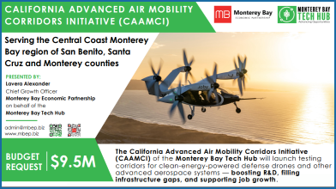
Will US airports be ready for eVTOLs? California’s CAAMCI is providing infrastructure, finance and community engagement answers
August 6, 2026Philip Butterworth-Hayes
The California Advanced Air Mobility Corridors Initiative (CAAMCI) is building CALIFORNIA’S FIRST FEDERAL AVIATION ADMINISTRATION-COMPLIANT, MULTI-AIRPORT FLIGHT NETWORK FOR ADVANCED AIR MOBILITY (AAM) aircraft as part of a USD7.45 million Monterey Bay Economic Partnership (MBEP) programme. The initiative connects four rural public airports on California’s Central Coast into a coordinated system where eVTOL and other next-generation aircraft can test, gather operational data, and move toward commercial certification…
{excerpted}
CAAMCI’s role has been to start building out the infrastructure that will take these separate activities and bring them together so testing is enhanced and we can see from the use cases what’s in it for the community. As the OEMs continue on their journey toward certification and commercialization, this coordinated system will help address the problems that the community had already identified in our planning documents. We want to learn from each other and create a system that could scale across California, maybe not immediately, but in time, connecting all our public-use airports. I think in California, we have something like 200 to 300 plus, public-use general aviation airports.
…
One of the issues is that Joby and Archer use completely different charging systems.
The charging stations may be one of the easiest challenges we need to solve. Worst case scenario, you simply would have two charging stations at each airport. The first phase of CAAMCI, which meets the requirements of the state, will be completed in January 2028. So we will have this built and ready to scale to other spaces across the state so other airports can join the network quickly.
The airports and OEMs are discussing a universal charger that will support them as well as other OEMs that may want to come into the region and use CAAMCI.
…
How have you ensured the community engagement work you have developed reflects the real hopes and fears of communities?
…
There are a lot of myths around AAM that people get excited about. The aircraft are beautiful and brilliant, but I often caution community members: “Don’t focus on the aircraft, focus on what it’s supposed to do for you.” What is the use case attached to that aircraft? And as aircraft continue to move through certification, hold the sector accountable so that it delivers tangible public benefit to the community. MBEP doesn’t simply advance economic development, we are champions of inclusive economic development, which means that we invite the community to the table from the beginning, alongside other stakeholders, to advocate for what it wants and what it needs.

Utah Begins Real-World Hybrid-Electric Aircraft Demonstrations

Mission marks ‘first of several’ planned flights at state’s airports.
Key Takeaways:
The Utah Department of Transportation (UDOT) has launched real-world demonstrations with a hybrid-electric aircraft, which Thursday morning flew close to 250 miles from Salt Lake City to Cedar City.
Utah residents who missed the landmark flight need not worry. UDOT said it was the “first of several” hybrid-electric demonstrations to come over the next three years under a new FAA program.
The aircraft involved was California-based Ampaire’s hybrid-electric EEL testbed, which flew from the company’s headquarters at Long Beach Airport (KLGB) to Salt Lake City International Airport (KSLC) on Monday, according to FlightAware.
Ampaire is using the EEL—a modified Cessna 337 Skymaster—to develop and refine its flagship AMP-H570 hybrid-electric propulsion system. The AMP-H570 is intended to power the company’s Eco Caravan, a retrofitted Cessna 208B designed to reduce fuel burn by 50 to 70 percent without sacrificing the Caravan’s regional range.
Ampaire’s hybrid-electric EEL testbed landed and took off at Salt Lake City International Airport (KSLC) on Thursday in the ‘first of several’ planned demonstrations, per UDOT. [Credit: Ampaire]
The FAA said Thursday that the hybrid-electric EEL flight marked THE “SECOND MAJOR STEP” in its eVTOL (electric vertical takeoff and landing) Integration Pilot Program (eIPP). The agency launched the eIPP at the White House’s direction in order to collect data from real-world operations of precertified electric, hybrid, and autonomous aircraft, the idea being that it could inform future regulatory standards.
…
Thursday’s demonstration marked the start of uFLY, the UDOT-led portion of the eIPP being conducted in partnership with Oregon, Idaho, Arizona, and Oklahoma. It is one of eight lead projects the FAA announced earlier this year.
Per UDOT, activities will take place in a variety of locations including “urban areas, rural corridors, mountainous terrain, and wildfire-prone regions” across the Western U.S. In addition to the EEL and Eco Caravan, it intends to oversee demonstrations of all-electric aircraft built by Joby Aviation and Beta Technologies. The department said the effort comprises more than 30 public and private partners.
Beta in July conducted the first official eIPP operations, delivering organs manufactured by its customer United Therapeutics in Maryland and Virginia.
Utah Looks to the Future
Ampaire in July conducted non-eIPP flights between California and Utah. According to co-founder and CEO Kevin Noertker, this week’s demonstration was different.
“uFLY is about moving hybrid-electric aviation from demonstration into real-world operations,” Noertker said in the company’s announcement Thursday.
The manufacturer said eIPP activities will begin with the EEL for “early operational learning” purposes. Electric propulsion drives the modified Skymaster’s nose propeller, while combustion propulsion drives the aft propeller. Its battery systems are produced by a Utah-based company. Because the Ampaire powertrain can recharge during flight, it does not require new charging infrastructure at airports.
The EEL landed at Salt Lake City International on Monday evening. On Thursday morning, Ampaire test pilots flew it to Cedar City Regional Airport (KCDC). It departed Cedar City later that day and landed back at Long Beach Airport at 12:48 p.m. PDT, per FlightAware.

