Vertiport Expert says development needs to be ready for eVTOLs in 9 Months- AGREE???

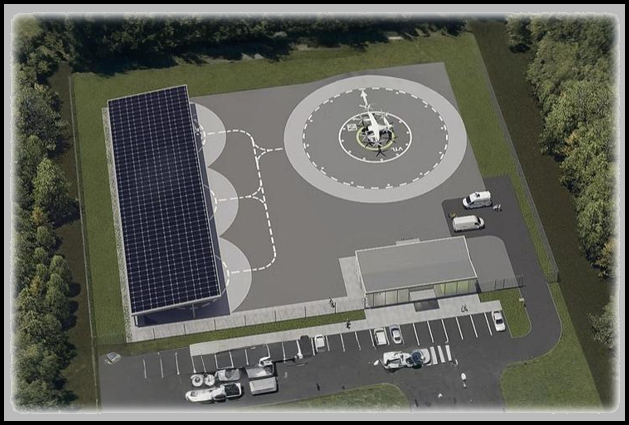
CityBiz has published a prescient article about the development of urban vertiports. Expert developer, Lisa Wright, “issued a timeline warning for commercial real estate owners evaluating advanced air mobility infrastructure opportunities.” She sets NINE MONTHs as the target for first eVTOL commercial operation sites to be ready. Her timeline includes
-
-
- site selection permitting,
- energy infrastructure coordination,
-
and
-
-
- construction
-
Yes, indeed, the eVTOLs are coming!!! Late 2026? Maybe the FAA will issue its first Type Certificate for these innovative AAMs by the end of the calendar or even fiscal year. And, yes, the White House’s eVTOL and AAM Integration Pilot Program (eIPP) will assure that introduction of this new form of aviation will go with “all deliberate speed.[1]”
There are a number of competing eVTOL developers and the likely leader has made significant investments in what is needed to fly paying passengers, like these:
-
-
- acquired and is expanding manufacturing facilities Joby is moving from prototype to serial production readiness, a prerequisite for commercial fleet operations.
-
-
-
- Started an FAA‑approved Part 141 flight school
- Purchased its simulators for training
-
-
-
- Created a full internal training pipeline: ground school → simulator → aircraft transition.
-
-
-
- Qualified as Part 135 Air Carrier Certificate
- Holds an FAA Part 145 Repair Station Certificate
- Has reached Type Inspection Authorization (TIA) status which is supported by multiple FAA‑accepted certification plans (structures, mechanical, electrical, cybersecurity, human factors, noise).Authorization for‑credit testing of components and aerostructures.
- Authorization to use FAA‑conforming hardware for human‑factors evaluations.
- Partnered with airlines, ground transportation providers, and infrastructure partners.
-
The public record about this OEM/Operator has not yet-
-
-
- Reached Utility‑level power‑purchase agreements
- Charging‑infrastructure partnerships with airports or vertiport developers
- Grid‑capacity studies or interconnection agreements
- On‑site energy storage or microgrid plans
-
However, cognoscenti expect the likely leader to pursue:
-
- On‑site battery storage at vertiports
- High‑power DC fast‑charging systems integrated into vertiport design
- Utility partnerships in launch cities (e.g., California, Dubai, Japan)
- Renewable‑energy procurement to support zero‑emissions branding
–> These services may have immediate value; in particular, governments that may see lower charges as a good economic development tactic and/or an energy source with attractive rates and/or some joint venture (AI center) for more efficient use= rates: Opportunity?
Being first has its advantages, but the next tier gets the benefit of learning from the leader’s successes and mistakes.
One as-of-yet not fully developed aspect of this nascent business is the SAFETY STANDARDS applicable to the VERTIPORTS. While FAA Engineering Brief EB 105A – Vertiport Design (Dec 27, 2024) and AC 150/5390-2D Heliport Design have provided a great deal of technical standards, it is fair to assume that updates will be issued. The FAA is trying, as a general policy to use performance-based standards. The data needed to refine the safety criteria are being collected now. So, design with some flexibility. Developers hate investing in infrastructure with uncertain or evolving requirements; including someone who knows the FAA’s airports may help anticipate the trend line for this critical infrastructure.
Stay tuned; the jockeying to be first has been filled with surprises already. The White House, DOT and Congress have all made it clear that the FAA must expedite its actions. It will be interesting to see how Administrator Bedford and his Office of Advanced Aviation Technologies can meet or exceed their expectations!!!

Infrastructure Developer Highlights Timeline Convergence as eVTOL Certification and Vertiport Development Both Require Nine Months, Creating Binary Decision Point for Property Owners
February 7, 2026
Landings has issued a timeline warning for commercial real estate owners evaluating advanced air mobility infrastructure opportunities: the window for positioning properties as vertiport-ready sites before eVTOL certification is compressing to nine months or less.
“At the fastest, we could bring a site online in nine months—and that would be incredible,” said LISA WRIGHT, Founder and CEO of Landings. “These aircraft are going to be approved within the next nine months.[2] If you’re not on the map now, you’re already behind.”

The timeline equation is unforgiving. Electric vertical takeoff and landing aircraft (eVTOLs) are approximately nine months from FAA certification. VERTIPORT INFRASTRUCTURE DEVELOPMENT REQUIRES NINE MONTHS MINIMUM FROM SITE SELECTION THROUGH PERMITTING, ENERGY INFRASTRUCTURE COORDINATION, AND CONSTRUCTION. Property owners who wait will be nine months behind competitors who moved proactively.
Wright’s company is building a network of 2,000+ vertiport locations across North America, focusing on rural markets where infrastructure gaps create immediate use cases for electric aviation. The timeline reflects actual project experience, not theoretical projections.
Market indicators support urgency. China already operates autonomous eVTOL air taxis on daily passenger routes. U.S. manufacturers including Archer, Joby, Beta, and Electra are in final certification phases[3]. State networks are being announced weekly across Miami, Ohio, and Texas.
“Within the last three or four months, agencies have stopped looking at individual sites and started looking at networks,” Wright noted, attributing the shift partly to Transportation Secretary Sean Duffy’s approach to advanced air mobility infrastructure.
Portfolio-Scale Analysis Transforms Planning
Landings recently launched beta testing of proprietary feasibility software analyzing properties across seven infrastructure criteria: parcel size, terrain contours, zoning compliance, FAA obstruction clearances, energy grid capacity, distributed energy resources, and soil stability.
The platform processes up to 200 addresses simultaneously, delivering feasibility reports in approximately eight minutes. “We can run 500 locations in about 20 minutes to whittle down which ones we’d approach,” Wright said.
First-mover advantages are substantial: aircraft manufacturers need operational test locations for final certification work, and in markets where one vertiport serves a 12-25 mile radius, the second site faces difficult unit economics.
Energy Infrastructure as Critical Constraint
Energy infrastructure has emerged as the PRIMARY BOTTLENECK. Wright’s strategy positions vertiports as multimodal EV charging centers serving aircraft, rural school buses, municipal fleets, and community vehicles. This shared-use approach, discussed in recent meetings with NYSERDA, distributes infrastructure costs across multiple revenue streams.
Landings operates asset-light through revenue-sharing partnerships. The company doesn’t purchase or lease property—it secures site options, arranges capital and equipment partnerships, and shares operational revenue with landowners.
Traditional FBO operators like Atlantic and Signature entering vertiport infrastructure signals market validation. “There’s more than enough here for us to work together,” Wright said. “We’ll be the endpoints for their locations, and they’ll be endpoints for ours.”
“If you put the first one in, you get to be that test location,” Wright said. “If you adopt early, you’re guaranteeing traffic to your location.”
The infrastructure opportunity is binary: move within the nine-month window and be operational when certification arrives, or spend nine months watching competitors capture routes and relationships.
About Landings
LANDINGS is building North America’s first comprehensive network of vertiport landing and charging infrastructure for electric aircraft. With a planned network of 2,000+ rural locations across North America, Landings is laying the groundwork for Advanced Air Mobility to reach critical mass at scale. Founded by architect and energy management expert Lisa Wright, the company takes an infrastructure-first, asset-light approach through revenue-sharing partnerships with commercial property owners. Learn more at landings.co.
[1] The phrase “with all deliberate speed” from the Brown v. Board of Education decision signifies the Supreme Court’s directive for the gradual desegregation of public schools, balancing urgency with practical implementation challenges
[2] This timeline may be a little aggressive, butt her point that Real Estate development NOW may well be advisable/
[3] Significant differences among the status of these TC applicants.