INNOVATIVE system that promises to coordinate and avoid AIR TRAFFIC COLLISIONS- READ ABOUT IT
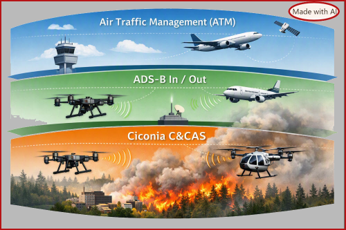
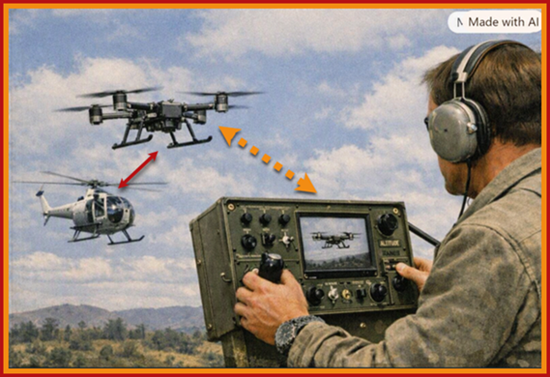
Following this brief introduction is a lengthy (~2,000 words), is an insightful article by AIM’s Editor-in-Chief that provides substantial information about an innovative COORDINATION & COLLISION AVOIDANCE SYSTEM that allows two aerial vehicles to “WORK TOGETHER (COORDINATION) as well AS AVOID EACH OTHER (COLLISION AVOIDANCE).” Taking time to read it will be worthwhile because while the C&CAS will not replace Air Traffic Management (ATM) or ADS‑B In/Out outright — but it will reshape their roles by decentralizing tactical separation and enabling mixed crewed–uncrewed operations. Here is a succinct AI created comparison:
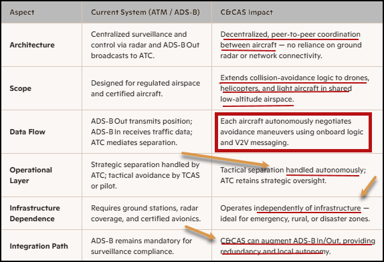
- For ATM: C&CAS could offload tactical deconfliction from controllers, allowing ATM to focus on flow management and airspace allocation.
- For ADS‑B: It complements rather than replaces ADS‑B In/Out — using its positional data but adding real‑time negotiation logic between aircraft.
- For mixed operations: Enables safe coexistence of drones and helicopters in emergency or urban airspace without centralized coordination.
Third‑party observers describe it as “a bridge between traditional ATM and autonomous airspace management” — a system that “adds intelligence to the edge of the network” rather than replacing the network itself.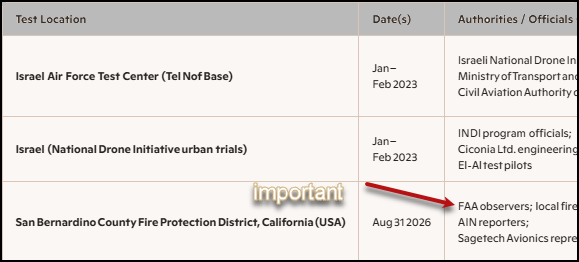
The C&CAS has been subject to three tests, and likely more-
Innovative change, even if its promise is great, can threaten other systems, particularly those in which stakeholders have invested substantial time. Reading the AIN article should provide an initial tranche of information to help guide your opinion on the C&CAS!
Ciconia C&CAS Demos Coordination, Collision Avoidance
Product enables aircraft to work together with no need for satcom or cellular communications
By Matt Thurber • Editor-in-Chief 
August 31, 2026
During a demonstration by the San Bernardino County Fire Protection District on August 12, a Ponderosa FireSparrow Mk10 drone and two Robinson R44 helicopters equipped with Ciconia’s vehicle-to-vehicle Coordination & Collision Avoidance System (C&CAS) flew in close proximity. The demonstration in California at the Glen Helen North Training Center was intended to answer a critical question as drones proliferate in airspace heretofore reserved for larger and crewed aircraft.
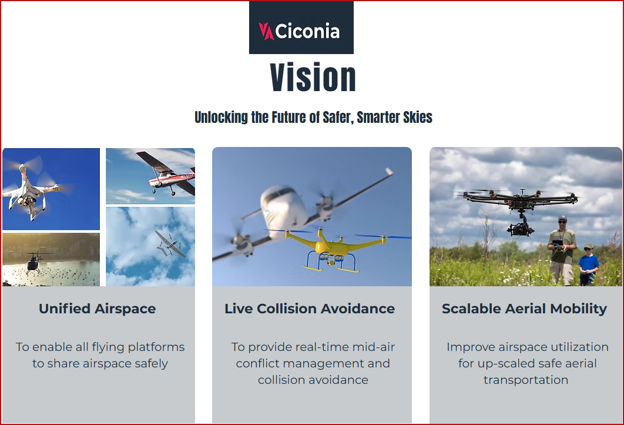
That question is: instead of trying to restrict operations of certain types of aerial vehicles and arguing about which has the right of way, why not figure out how to allow them to WORK TOGETHER (COORDINATION) as well AS AVOID EACH OTHER (COLLISION AVOIDANCE)?
According to Ciconia, this is exactly what Ciconia’s software and associated hardware, developed with partners such as SAGETECH AVIONICS and QUALCOMM, are designed to accomplish, and the demonstration showed that it works. Using Ponderosa’s FireSparrow Mk10 Heavy-Lift drone and R44 helicopters provided by HeliStream, the demonstration was one of a series and follows flights that began in Israel at the Israel Air Force Test Center in 2023.
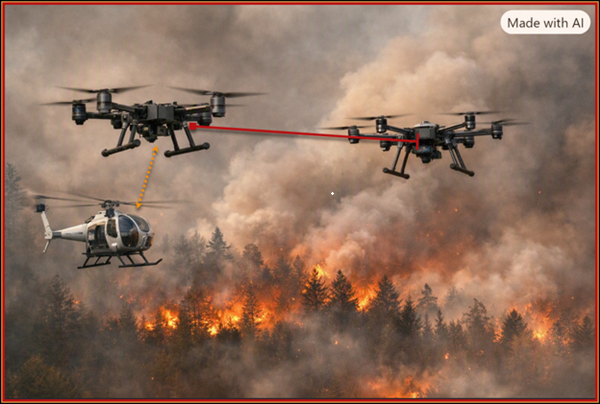
C&CAS is designed to permit what Ciconia calls “SAFE AND DENSE AERIAL OPERATIONS.” It does this with lightweight equipment that relies on vehicle-to-vehicle (V2V) communications and software that acts much like an advanced airborne collision avoidance system (ACAS). Like ACAS X, which isn’t yet fielded in a certified application, C&CAS will provide much more sophisticated resolution advisory instructions to piloted aircraft while at the same time enabling injection of steering commands into a non-crewed or remotely piloted vehicle, not only to prevent collisions but to facilitate cooperative operations. An example of this would be aerial firefighters coordinating with drones that are being used to enhance data gathering while not putting humans at risk.
The key to making this work is that THE HARDWARE MUST BE LIGHT AND SMALL. Sagetech Avionics has been developing ACAS for military helicopter applications, drones, and autonomous flight programs such as Reliable Robotics and has worked with Ciconia for the past five years.
“Our role is to make the hardware,” said Sagetech CEO Tom Furey. “We’ve been talking about doing a demonstration here because we know San Bernardino County Fire is very interested in being able to get more aircraft and more people on targeted fires.
“We need to have manned aircraft an unmanned aircraft working the same area at the same time, and we can do that with C&CAS, because C&CAS relies on a close-coordination vehicle-to-vehicle link. It doesn’t rely on ADS-B with excess latency, and it doesn’t rely on UTM [UAS traffic management]. You can have aircraft fly in much more tactical formations [and] operate in the same airspace and still not swap paint and keep firefighters’ lives safe.”
TO ENSURE ROBUST COMMUNICATION BETWEEN THE C&CAS-EQUIPPED VEHICLES, CICONIA TAPPED QUALCOMM TO MAKE THE V2V RADIO SYSTEM.
“We’re here today because we are trying to address a very practical challenge during wildfires,” said Leslie Barnes, Qualcomm senior director, government affairs. “Crewed aircraft and drones need to coexist in the same shared airspace to improve firefighting operations. This is where Ciconia’s collision-avoidance system comes in…by providing a direct communications lane…enabling nearby aircraft to exchange in real time safety-critical information such as location, altitude, speed, trajectory, et cetera. This communications link is completely off-network, so it doesn’t require connection to the cellular network or a satellite connection to provide that real-time collision avoidance. The great thing about this technology is that we are developing it through Ciconia and our partners in San Bernardino to make sure it meets the needs of public safety. This is what our Technology for Good program is all about, testing real-world technologies with public safety professionals who both know the mission and are deeply committed to the mission.”
Present for the demonstration were representatives from a variety of law enforcement and firefighting agencies. These also included leaders and UAS team members from the LOS ANGELES COUNTY FIRE DEPARTMENT, CAL FIRE, LOS ANGELES FIRE DEPARTMENT, VENTURA COUNTY FIRE DEPARTMENT, THE U.S. WILDLAND FIRE SERVICE, AND OTHER AGENCIES AS WELL AS LOCAL POLITICIANS.
“I think they have a cutting-edge technology that can save lives,” said former San Diego chief of air operations Chuck Macfarland, who is now an industry consultant. “We look at this technology…how we [can] deflect and detect with the UAS operating in our airspace. But think how this technology can work when we have two or three helicopters working in that airspace. Even though we have TCAS and ADS-B, this can be a simple technology that saves lives. And as we get more and more UAS incursions into our fire traffic area, it’s technologies like this that are going to make a big difference.”
 Solving the Big Problem
“The problem we are trying to solve is that low-altitude aircraft separation today depends on procedures and on your judgment,” said Ciconia CEO Moshe Cohen. Because people sometimes don’t follow procedures and misjudge separation, safety buffers have to be added to prevent collisions. “The result is most of the skies are safety buffers,” he said.
Sometimes the buffers don’t work, or people don’t adhere to them—for example, drones flying illegally during fire operations. During the January 2025 Palisades fire in Southern California, a drone collided with a Canadair CL-415 Super Scooper, damaging the aircraft’s wing and causing a disruption in firefighting operations and grounding of beneficial aircraft and drones.
“When drones were mostly needed, when the firefighters on the ground need to see whether or not they’re being burnt over, they had to land their drones because there is lack of trust in the current situation,” he said.
“A few months later, in Texas [during a] rescue operation, a helicopter hit a drone.” On July 10, a Super Scooper ran into the cable supporting a water-carrying bucket hoisted by a Super Puma, but luckily both aircraft were able to land safely with no injuries to the occupants. Then there was the August 2 midair collision of two firefighting Bell 214s in Athens, killing the crew on one of the helicopters.
“The solution is a decentralized system,” Cohen said. “We call it V2V or A2A, aircraft to aircraft C&CAS. The A or V means that aircraft are sharing the information among themselves. They’re using a very light radio, a very little amount of data, [over a] very short range. With the C&CAS, there will be significantly less midair collisions, crewed and uncrewed [aircraft] can share the skies, and pilot judgment will be protected from misjudgment [and] against human error.”
How C&CAS Works
Each aircraft MUST BE EQUIPPED WITH THE C&CAS EQUIPMENT, including the Qualcomm V2V radio, so they can transmit their location and ID information. “The C&CAS on board each one…receives the location of its neighbors,” Cohen explained. “It creates a map of the sky around itself and analyzes the level of risk with each of the elements around itself. If there is no risk, it will [say] nothing. It will be totally transparent to the pilot. I know that pilots are concerned with loading them with more instruments. The C&CAS is designed by pilots for pilots. It will not disturb you. It is like a good team member, where it keeps silent all the time. It won’t be insulted if you won’t look at it, until there is a high risk. When there is a high risk, it indicates the risk and it tells you what to do. I guess when there is a high risk, you would love to hear what the C&CAS has to say.”
Conflicts can also occur, however, between equipped and non-equipped vehicles. For example, an aircraft might carry ADS-B Out equipment, and in this case, the C&CAS-equipped aircraft WILL BE ABLE TO AVOID THE ADS-B aircraft but not work closely together because the ADS-B aircraft cannot be aware of the C&CA aircraft.
With more drones in the U.S. required to be equipped with Remote ID, C&CAS can detect these drones and allow closer and safe maneuvers. “The C&CAS issues no alert, [even] though they are very close, it is safe to maneuver,” he said. “We are very proud of this one…it’s a collision-avoidance system that can function with such close or dense aerial traffic.”
C&CAS can’t detect every target, however. If a drone or aircraft isn’t transmitting any signals, for example, a hostile vehicle, then C&CAS won’t be able to see it. In some cases, a drone may generate some other data that C&CAS can use, “and we can incorporate this information,” he said.
Demo Flying
For the first demonstration, both of the HeliStream pilots flew five runs, always staying in visual contact with each other in case there was a problem with the C&CAS system. To show how C&CAS helps prevent the risk of a midair collision, the two pilots flew their R44s closer and closer to each other until the C&CAS notified them to split up. In another run, one of the helicopters turned toward the other, and the C&CAS told each of the pilots which way to fly to resolve the conflict.
The third run was to show how two helicopters can fly cooperatively during water-bucket operations over a simulated fire. One helicopter flew over to make the water drop, while the other approached to make its dip, both near each other, with no C&CAS warnings necessary nor provided.
However, on the next run, the rear helicopter got closer while the front helicopter was dropping its simulated load. The pilot in the rear helicopter could not see the helicopter in front because it was positioned to be out of sight below the front pilot’s view. “In Israel, we had, many years ago, a collision between two CH-53s where one landed on the other one, exactly such a scenario,” Cohen said. “THE C&CAS WILL IDENTIFY AND PREVENT IT FROM HAPPENING.
“Firefighter pilots are very busy watching for obstacles, looking for the fire, making sure that they don’t hit any trees. The C&CAS will identify…this scenario, and we could tell the pilots what to do.”
What the pilots see in a C&CAS-equipped aircraft is either a dedicated display or symbology on avionics displays with information about conflicting or collaborative traffic. “We define the risk level,” he said, as a level of alert (LOA). LOA 0 is no risk, and 4 is the highest. LOAs 1 through 3 are there to give the pilot an indication of increasing risk. The two helicopters flying collaboratively, for example, showed LOA 2, so the pilots know they are close together but not having to change anything. LOA 4 is the only level with an audible warning, and it will tell the pilots to turn and/or climb and display arrows to show where to fly to prevent a collision.
The idea is that the C&CAS software would run in the background on an equipped aircraft and show the LOA only when necessary.
In a demonstration of LOA 4, one of the helicopters turned toward the other, and the result was a LOA 4 conflict. “The system tells them to turn right and climb,” Cohen said. “That means that the pilot just provides an input, tilts his helicopter a little bit to the right. The other one makes it a little bit to the left, and the conflict is easily resolved. It’s nothing dramatic.
“It doesn’t issue alerts when it does not need to, and when it is needed, it issues alerts right on time. And when the alert comes on time, [it’s a] very small input, and the conflict is resolved, and the midair collision is avoided.”
Drone Avoidance
For C&CAS to be effective with drones, both the drone and aircraft can be C&CAS-equipped, or the aircraft can use C&CAS to steer clear of a drone with Remote ID or ADS-B Out. But the real value comes when both carry C&CAS, because then C&CAS can take control of the drone and keep it away from the aircraft so the aircraft’s crew can continue their work uninterrupted.
For the drone demo, the Ponderosa FireSparrow Mk10 was flown inside a virtual geofenced area to ensure safety.
For the first demonstration, the helicopter approached the drone’s location, and the operator tried to take off, but C&CAS wouldn’t allow the drone to lift off. This scenario replicates when a drone operator needs to fly the drone but doesn’t see that there are aircraft approaching.
In the second round, the helicopter and drone were both flying, and the helicopter pilot saw that there was a drone at his 12 o’clock position and could maneuver slightly so they could both continue their missions. “The helicopter and the drone can fly together in the same airspace, serving firefighters absolutely safely,” Cohen said. “There is no need to land one of them or to prevent one of them to access the skies.”
In the third demo, the helicopter pilot ignored the C&CAS warning about the drone and continued flying towards it. This time, the C&CAS gave steering commands to the drone operator. While the operator could have moved the drone, for this test, he ignored the command and C&CAS stepped up the LOA then took control of the drone and moved it out of the way of the helicopter. If the helicopter moves unexpectedly and C&CAS doesn’t have time to move the drone, C&CAS will go to LOA 4 and tell the helicopter pilot which way to move to avoid a collision.
“This is a pretty amazing technology,” said HeliStream co-owner Rod Anderson, who flew one of the R44s for the demo. “Visual separation has some limitations and some weaknesses. We do a lot of training with law enforcement agencies, other public service agencies, and…the exchange between air traffic control and pilots quite often is misinterpreted. The controller will tell a pilot…‘You have traffic at 2 o’clock, opposite direction, same altitude.’ I look over at the pilot, and he’s looking in [the wrong] direction, which is 10 o’clock. So he’s not going to see the traffic. The other thing that happens is they think they see the right one, but they’re not looking at the right one. So when they respond, ‘We have the traffic in sight,’ air traffic control passes the responsibility to the pilot to maintain visual separation. I’m sure everybody knows about the tragic accident that happened in Washington, D.C., with a helicopter and an airliner. The controller that he was talking to pointed out his traffic, and he said he has the traffic in sight, and then he ran into the airliner. So clearly, he didn’t have it in sight. There are some real limitations that go along with visual separation. 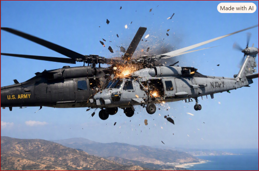
“Our own company [about] four years ago, we were involved in a midair collision in San Diego. One of our Black Hawk helicopters had a collision with a Navy Seahawk helicopter. No injuries, no fatalities, thank goodness. But it was an accident that happened in the traffic pattern at a tower-controlled airport, and we teach our students…that most midair collisions occur at tower-controlled airports. Just because there’s a control tower doesn’t mean you’re safe.
“Even when you think you’re safe under air traffic control, having a device like the C&CAS system is going to be a whole game-changer. We perform firefighting services on contract with the Forest Service and also with Cal Fire. And again, the incidence of close calls in the fire traffic area is just surprising.
“Recently, a couple of firefighting helicopters collided in Greece. The C&CAS system would have prevented that accident. This is a device we need; the technology is there, and we need to take advantage of it.”
C&CAS is still in development, and Cohen believes that the Ciconia product could be as small as a pack of cigarettes, weighing 200 to 300 grams. For the drone application, C&CAS would be a software solution or, if necessary, a small 20- to 25-gram processor.
As for cost, Ciconia plans to offer C&CAS for a monthly fee, so there is no big investment for the system.

