FAA’s different policy on Planned Cockpit Rest
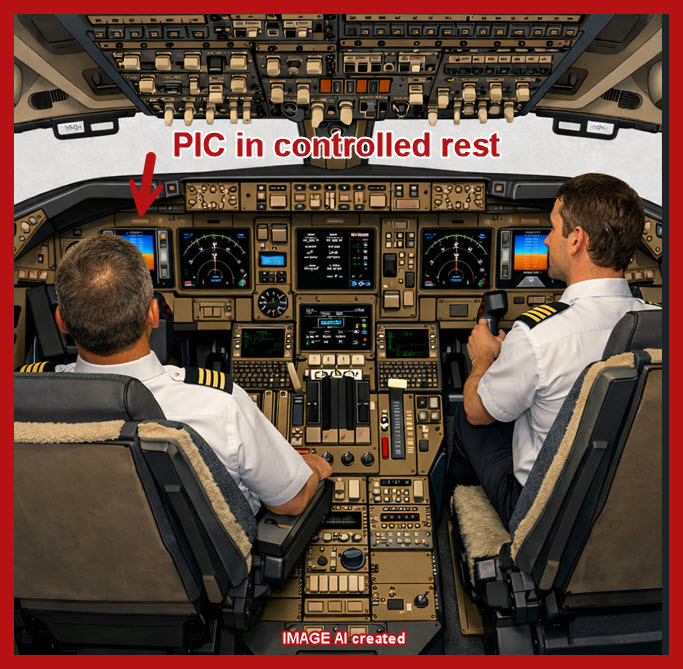
A WELL REGARDED STUDY FOUND THAT PLANNED COCKPIT RESTS CAN IMPROVE ALERTNESS AND PERFORMANCE has been adopted by many civil aviation authorities BUT NOT THE FAA. That’s curious; let’s try to find out why?
The referenced study (below) made significant findings. Planned cockpit rest (also called controlled rest on the flight deck) has been formally adopted by multiple foreign aviation authorities and airlines,
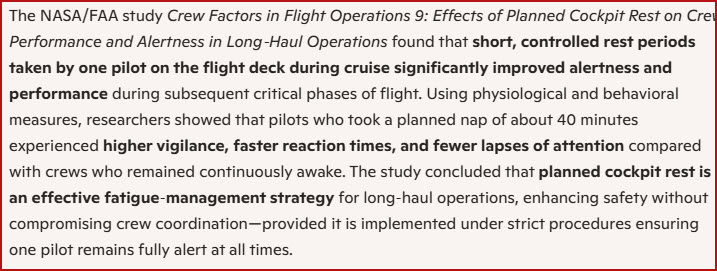
but not by the FAA. The FAA has never authorized controlled rest in the cockpit for Part 121 operations, despite the NASA/FAA study you cited (Crew Factors in Flight Operations 9) showing measurable performance benefits.
Foreign regulators do allow it under strict protocols, and several major long‑haul carriers use it operationally.
Transport Canada (TC)
-
-
- Allows controlled rest on the flight deck up to 40 minutes.
- Requires strict protocols: seat position, alarms, physiological recovery period, and cabin crew notification.
-
European Union Aviation Safety Agency (EASA)
-
-
- Permits controlled rest under AMC1 ORO.FTL.205.
- Requires:
- Maximum 45 minutes rest
- Mandatory 20-minute recovery period
- Cabin crew awareness
- No rest during high‑workload phases (climb/descent)
-
Civil Aviation Authority of New Zealand (CAA NZ)
-
-
- Allows controlled rest with similar limits and procedures.
-
Civil Aviation Safety Authority (CASA Australia)
-
-
- Permits controlled rest under operator fatigue‑risk management systems (FRMS).
-
ICAO
-
-
- ICAO endorses controlled rest as a fatigue‑mitigation option in long‑haul operations within an FRMS framework.
-
Airlines that use controlled cockpit rest
Many long‑haul carriers have adopted it under their national regulator’s rules:
-
-
- Air Canada
- Lufthansa Group
- Air France/KLM
- British Airways
- Qantas
- Cathay Pacific
- Singapore Airlines
- Emirates
- Etihad
- Air New Zealand
-
These carriers use controlled rest only on long‑haul flights, and only when:
-
-
- The other pilot is fully alert
- The aircraft is in stable cruise
- Cabin crew are informed
- Strict timing and recovery rules are followed
-
The FAA does not permit controlled rest on the flight deck for Part 121 airline operations. There is no regulatory or guidance material authorizing it, and FAA inspectors are instructed that:
-
-
- Rest must occur in designated crew rest facilities (Class 1/2/3 bunks or seats)
- Cockpit rest is not an approved fatigue‑mitigation strategy
- Any rest taken in the cockpit is considered non‑compliant with duty/rest rules
-
The FAA’s current rest regulations (14 CFR 117 and 121) focus exclusively on off‑duty rest and in‑flight rest facilities, not cockpit rest.
-
-
- Concern about public perception (“pilots sleeping in the cockpit”)
- Fear of overreliance on cockpit rest instead of proper off‑duty rest
- Preference for bunk-based rest on long‑haul aircraft
- Regulatory conservatism around fatigue management
-
Even though the definitive NASA research showed clear benefits, the FAA has not moved toward adoption.
The FAA’s long evolution of flight‑and-duty‑time rules has created a deeply structured, science‑informed, and highly procedural system that the AGENCY TRUSTS MORE THAN OPERATIONAL PRACTICES LIKE PLANNED COCKPIT REST. Over decades, the FAA built a comprehensive framework—Part 117, legacy Part 121/135 rules, fatigue‑education requirements, FRMS guidance, and multiple SAFOs—that treats fatigue as something best managed through predictable scheduling, protected rest periods, and formalized oversight, NOT IN‑FLIGHT RESTS.
This system reflects a regulatory culture that values uniformity, enforceability, and data‑driven modeling: pilots must show fitness for duty, operators must provide meaningful rest opportunities, and any deviation requires structured FRMS governance. Because the FAA already has a well‑researched, extensively vetted, and tightly regulated rest architecture, it naturally defaults to that system rather than adopting cockpit‑rest practices that introduce variability, rely on real‑time crew judgment, and fall outside the agency’s traditional prescriptive approach.
ALPA is known as the #1 advocate for all aspects of members’ safety, but controlled rest takes a back seat to PRIMARY POLITICAL/REGULATORY GOAL. Foremost in its public statements is the need for two well-rested pilots on the flight deck, which is contrasted against reduced crew models and eMCO/controlled rest. In support of this priority issue, ALPA opposes approaches that remove a second pilot (including “controlled rest”/single-pilot phases).
Significant improvement in pilots’ performance and alertness is the study’s well- substantiated conclusions. The research was led by DR. Rosekind2, whose credentials and work are impeccable—
At Stanford University, he served as Director of the Center for Human Sleep Research within the Stanford Sleep Disorders and Research Center — this was his first major leadership role in sleep science. At Yale University, he earned his M.S., M.Phil., and Ph.D. in psychology with a specialization in sleep and human fatigue. After completing his doctoral work, he undertook postdoctoral fellowship training at Brown University Medical School, where he continued advanced research in sleep, circadian physiology, and fatigue countermeasures.
Dr. Mark Rosekind served as a Board Member of the National Transportation Safety Board (NTSB) from June 2010 until December 2014.
The FAA’s formal “fitness for duty[1]” requirement for pilots is located in 14 CFR §117.5. It’s written in terms that are ENFORCEABLE, a term that does not fit with SMS/compliance preference. The agency’s investment in its off‑duty rest and in‑flight rest research, policy development and regulatory processing may be the reason why it has not changed its fatigue regimen. Why has the FAA resisted Dr. Rosekind’s study, three countries, all of continental Europe and ICAO plus 10 major airlines?

NASA studied pilots taking 26-minute naps during long flights and found THEIR PERFORMANCE IMPROVED BY 34 PERCENT AND ALERTNESS BY 54 PERCENT, evidence that in aviation, rest could be a safety tool, not a weakness
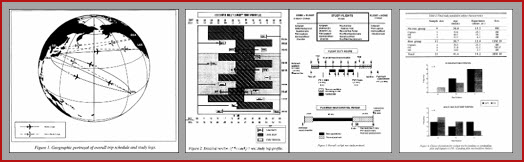
The aviation industry has long treated pilot fatigue as an inevitable cost of long flights—but a landmark NASA study suggests the solution might be simpler than better schedules or newer planes.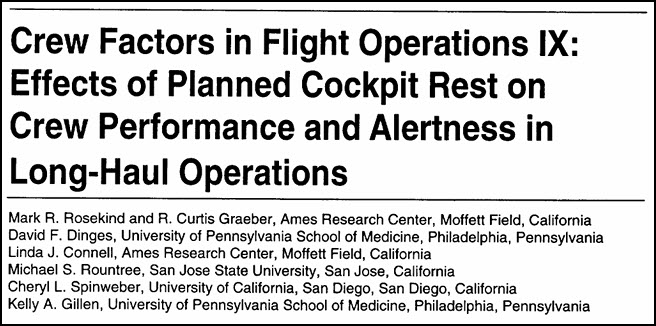
In the early 1990s, a group of NASA researchers arranged for twenty-one long-haul pilots on transpacific Boeing 747 routes to do something most airlines discouraged. THEY LET SOME OF THEM SLEEP. The full study was published by NASA Ames Research Center as a technical memorandum titled Crew Factors in Flight Operations 9: Effects of Planned Cockpit Rest on Crew Performance and Alertness in Long-Haul Operations, and it became one of the most cited studies in aviation fatigue research.
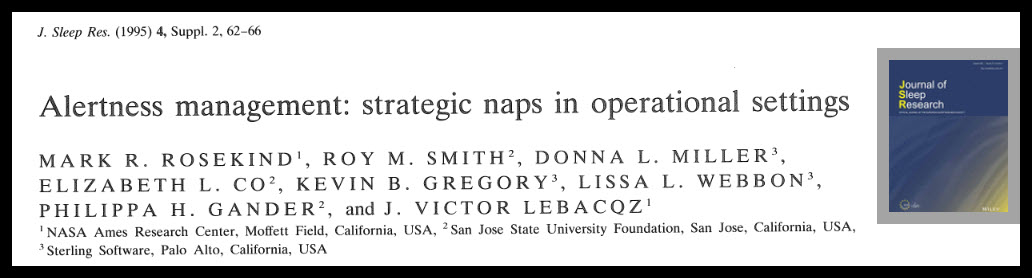 The version that circulates online is compact: A 26-MINUTE NAP IMPROVED PERFORMANCE BY 34 PER CENT AND ALERTNESS BY 54 PER CENT. Those figures are the ones usually cited from a 1995 summary paper by Rosekind and colleagues in the Journal of Sleep Research, “Alertness management: strategic naps in operational settings,” rather than from the detailed memorandum, whose own summary describes the effect in words rather than percentages. What gets lost in the compression is almost everything that makes the numbers meaningful.
What follows is a reading of one study and the policy history around it, not advice on how anyone should manage their own sleep. And it is worth being clear at the outset: this is one study, small and specific, not a settled consensus about rest in general.
What the study actually measured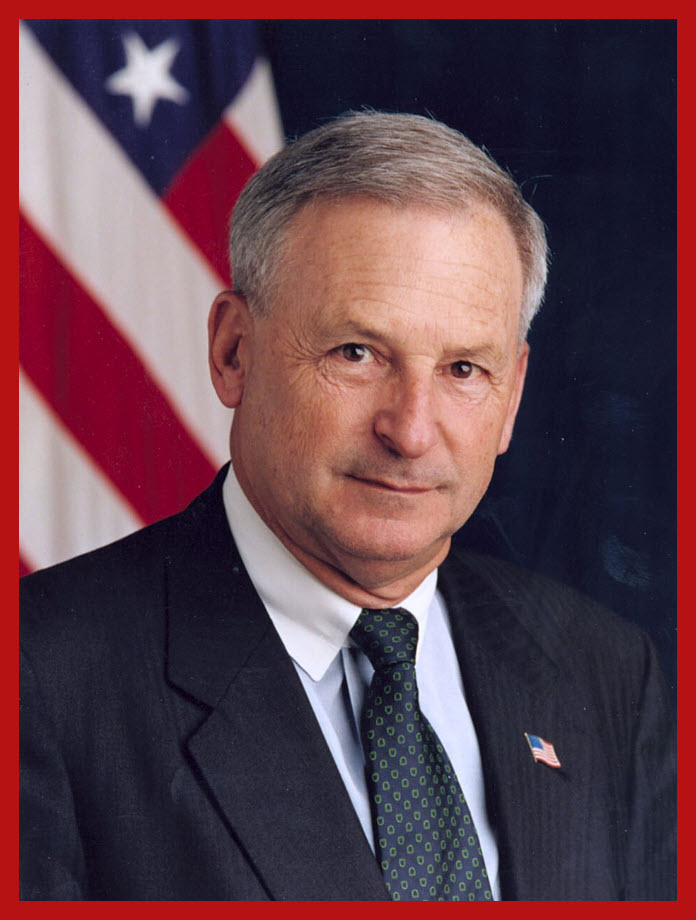
The work was led by Mark Rosekind[2], then at NASA Ames, with co-authors including R. Curtis Graeber, David F. Dinges of the University of Pennsylvania, and Linda J. Connell. The pilots flew regularly scheduled overnight trans-Pacific legs in three-person crews with no relief pilot available.
Twelve of them formed the Rest Group. During the low-workload cruise phase, each was given a planned 40-minute window to rest in the seat while a colleague flew. The other nine formed the No-Rest Group, given the same 40-minute block but told to carry on with normal duties. Throughout, the researchers recorded brain-wave and eye-movement activity, tracked reaction time on a vigilance task, and logged subjective alertness.
The rest-group pilots slept on 93 per cent of the opportunities offered. They fell asleep in an average of 5.6 minutes and slept for an average of 25.8 minutes, which is where the famous 26 comes from.
The 34 and the 54 attach to different measures. The 34 per cent refers to reaction-time and vigilance performance, tested with a psychomotor task. The 54 per cent, often written as “up to 54 per cent,” refers to physiological alertness derived from the brain-wave recordings, essentially a reduction in the brief involuntary lapses, or microsleeps, that show up on an EEG when someone is fighting to stay awake. Rosekind and colleagues report these figures in the 1995 summary paper. The underlying memorandum is more restrained: it states that the nap was associated with improved physiological alertness and performance, and that the benefit carried through the descent and landing, when it mattered most.
What the numbers do and do not say
The comparison is the part most summaries drop. These are not gains over a rested, sharp baseline. They are improvements relative to the No-Rest Group, a set of tired pilots getting steadily more tired across a long overnight leg. The napping crews were not turned into superhumans. They were held closer to functional while the others slid.
[1] The FAA’s formal “fitness for duty” requirement for pilots is located in 14 CFR §117.5.
That section states that each flightcrew member must report for duty physiologically and mentally prepared to perform assigned responsibilities at the highest level of safety, and it establishes joint responsibility between the pilot and the certificate holder to ensure meaningful rest and proper fatigue management.
[2] Mark R. Rosekind, Ph.D. is one of the most influential figures in modern transportation safety, recognized globally for his leadership in aviation, highway, and autonomous‑vehicle safety. With a career spanning NASA, the NTSB, NHTSA, and advanced mobility, he has shaped national policy, advanced scientific understanding of fatigue, and led major safety transformations across multiple transportation domains.
Dr. Rosekind currently serves as a senior safety leader in autonomous mobility, following his tenure as Chief Safety Innovation Officer at Zoox, where he built the company’s safety strategy for autonomous systems and operational testing. He previously served as Administrator of the National Highway Traffic Safety Administration (NHTSA), guiding the agency through the largest product recall in U.S. history and issuing the first Federal Automated Vehicles Policy. Under his leadership, NHTSA launched the Road to Zero Coalition, a landmark initiative to eliminate roadway fatalities within 30 years.
From 2010 to 2014, Dr. Rosekind served as a Board Member of the National Transportation Safety Board (NTSB), participating in seven major accident investigations and championing fatigue mitigation, impaired driving prevention, and multimodal safety improvements. Before joining the NTSB, he founded Alertness Solutions, a pioneering consultancy applying fatigue science to aviation, healthcare, and industrial operations.
Earlier in his career, Dr. Rosekind led NASA’s Fatigue Countermeasures Program at Ames Research Center, producing foundational research on sleep, alertness, and human performance that continues to shape aviation operations worldwide.
He holds degrees from Stanford University and Yale University, with postdoctoral training at Brown University Medical School.
Awards & Honors:
- NASA Exceptional Service Medal (plus six NASA group/team awards)
- Lifetime Achievement Award, National Sleep Foundation
- Mark O. Hatfield Award for Public Policy, American Academy of Sleep Medicine
- Automotive News Industry Leader of the Year
- World Economic Forum Fellow
- Multiple honors from the Flight Safety Foundation