Does NASA say that eVTOLs have a psychoacoustic noise problem ???
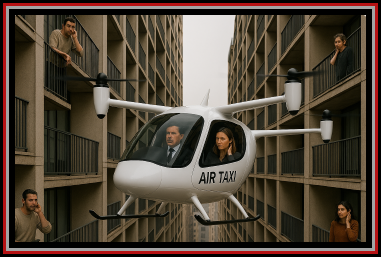
NASA Langley’s Varied Advanced Air Mobility Noise and Geographic Area Response Difference, or VANGARD has published a study. As characterized by FLYING (below), this quote from the report is being cited as a significant finding:

FLYING’s headline is … “The Results may surprise you” and the author proposes the following consequences:
-
- “agency can create special conditions for AAM aircraft that do not fit the Part 36 noise standards for tiltrotors. …”
- “FAA could also create air traffic arrival or departure procedures to route air taxi flights over areas that are sparsely populated or less sensitive to noise.”
- “Tribal, state, and local governments have the authority to develop and enforce zoning regulations…”
- Airport operators, meanwhile, can have the FAA review Part 150 Noise Compatibility Programs that would allow them to mitigate noise at their respective airports.”
Americans’ intolerance to all forms of aircraft noise has increased as the aviation industry has invested heavily in technology that reduces the “sounds” from their flights. Here are the numbers[1]:
-
- Modern aircraft are up to 75% quieter than their 1960s counterparts.
- The FAA reports that since 1975, the number of people exposed to significant aircraft noise (65 dB DNL or higher) has dropped by over 90%, even as air traffic has increased.
YET
-
- Community complaints have surged in areas near airports, especially after the FAA implemented Performance-Based Navigation (PBN), which concentrates flight paths over narrower corridors.
- The GAO (2022) found that “although advances in technology have led to increasingly quieter airplanes, community concerns about aircraft noise have persisted”.
- The FAA’s own outreach reports (Q2 2025) acknowledge that noise complaints have increased, particularly in urban areas with high flight density.
Though this list may include some realistic future actions (OBTW none are in the VANGUARD report), to propose them BEFORE the next crucial step which NASA noted may be premature–
“Many factors influence how humans respond to aircraft noise. This study was not designed to answer every question — for example, IT DID NOT LOOK AT THE POTENTIAL EFFECTS OF HIGH BACKGROUND NOISE MASKING AIR TAXI NOISE — but it provided the VANGARD team with initial insights.”
This objective anomaly is why there is a branch of science called psychoacoustics. Noise is often experienced as one of THE MOST SUBJECTIVE HUMAN SENSES because the brain layers meaning, emotion, and context on top of the raw acoustic signal. The physical sound is only the starting point; what we perceive is a blend of sensory input and psychological interpretation.
In recognition that sound perception is SUBJECTIVE to begin with, it is curious (perhaps just superficially) that VANGUARD posed its essential question with these loaded words—
“Imagine hearing this sound several times each day while outdoors and near your home. HOW ANNOYING WOULD THIS SOUND BE TO YOU?”
This wording pushes participants toward a particular mental frame, and that frame influences the ratings. does a few things:
-
-
- It anchors the listener to a specific scenario (frequency, location, proximity to home).
This increases consistency across participants but also shapes their emotional response. - It primes annoyance by asking directly about “annoying.”
PEOPLE TEND TO RATE HIGHER WHEN THE QUESTION USES AN AFFECTIVE TERM. - It assumes a context of intrusion (your home, repeated exposure).
That context tends to elevate annoyance ratings compared to neutral listening.
- It anchors the listener to a specific scenario (frequency, location, proximity to home).
-
However, annoyance studies use this kind of wording because it follows guidelines from ISO standards (e.g., ISO/TS 15666)
Most psychoacoustic annoyance research, which recommend:
-
-
- Asking directly about annoyance
- Providing a specific exposure scenario
- Using a numerical or categorical scale
-
This ensures that:
-
-
- Participants imagine the same situation
- Results can be compared across studies
- The measure reflects real-world impact, not abstract sound quality
-
If the goal were to minimize bias while still measuring annoyance, something like:
“Please rate your personal reaction to this sound if you heard it regularly near your home.”
This avoids the word “annoying” but still anchors the scenario.
In any event, the Vanguard study is full of sound and fury, but signifies that more research is needed and that the eVTOL OEMs need be prepared to produce credible data that support the quietness of this next generation of innovative aircraft.

NASA Studied Air Taxi Noise—The Results May Surprise You
Space agency surveyed about 360 participants living in New York City, Los Angeles, and Dallas-Fort Worth.
Thursday, February 26, 2026
According to NASA, background noise impacts the way people react to the buzzing and whirring of electric air taxis—but not in the way you might think.
The space agency this month released the initial findings from its Varied Advanced Air Mobility Noise and Geographic Area Response Difference, or VANGARD, study. The research’s most notable conclusion is that people living in AREAS WITH HIGH BACKGROUND NOISE (think urban centers such as New York City) tend to report more annoyance with the air taxis than those living in low-noise areas.
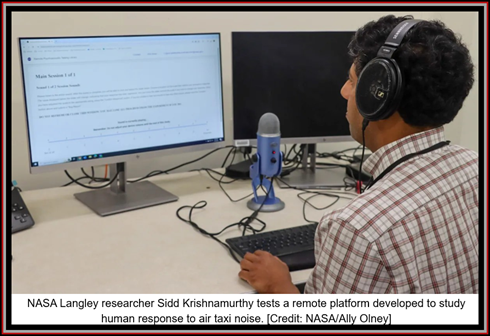
“We wanted to know if people in low or high background noise zones would be more annoyed by the air taxi sounds, and to what extent, even without their usual background sounds present during the test,” said Sidd Krishnamurthy, lead researcher at NASA’s Langley Research Center in Virginia.
NASA said the results of the study could guide the designs of advanced air mobility (AAM) aircraft manufacturers. American electric vertical takeoff and landing (eVTOL) air taxi companies Joby Aviation, Archer Aviation, Beta Technologies, and Wisk Aero all claim their designs will be substantially quieter than helicopters—IN ARCHER’S CASE, 100 TIMES QUIETER.
“Studies have suggested that aircraft noise can be a source of community annoyance, disrupt sleep, adversely affect academic performance of children, and could increase the risk for cardiovascular disease,” reads a 2024 Government Accountability Office report on the FAA’s legal authority to regulate aircraft noise.
The space agency does not have the power to create policy based on the study. But it could share its findings with the FAA, which is tasked with setting aircraft noise certification standards and gauging environmental impacts from noise. Part 36, for instance, contains noise standards for tiltrotor aircraft with swiveling propellers—a common feature of electric air taxis.
“With air taxis coming soon, we need to understand how people will react to a variety of future aircraft sounds,” said Krishnamurthy. “This test filled a critical gap, and its results will improve how we predict human reactions to noise, guiding the design and operation of future aircraft.”
Do Air Taxis Have a Noise Problem?
NASA’s Urban Air Mobility Noise Working Group recommended the VANGARD study back in 2020 as a way to augment the sparse data on human noise responses to AAM aircraft.
The study comprised nearly 360 people living in or near Los Angeles, New York City, and Dallas-Fort Worth—locations the aforementioned eVTOL air taxi firms are targeting for commercial operations.
Participants listened to 67 individual aircraft flyover sounds that simulated the operations of six different aircraft, including departures, approaches, and cruise. The vehicles included NASA-owned designs as well as industry concepts.
Participants were told to find a quiet environment and were prompted, without knowing which aircraft they were hearing: “Imagine hearing this sound several times each day while outdoors and near your home. HOW ANNOYING WOULD THIS SOUND BE TO YOU?[2]”
They rated their level of annoyance with each sound on a scale of 1 to 10. Participants also provided their ZIP codes so that researchers could sort them into low and high background noise areas.
People living in noisier areas reported, on average, higher annoyance scores with the air taxi sounds. Researchers hypothesized that those people may simply be more sensitive to extra noise.
A follow-on noise sensitivity test is expected to shed more light on the results, which will be expanded upon in a larger report in the coming months. However, THE STUDY IS NOT INTENDED TO BE COMPREHENSIVE—IT DOES NOT GAUGE, FOR EXAMPLE, HOW AIR TAXI SOUNDS COULD BE MASKED BY HIGH BACKGROUND NOISE.
Next Steps
Though NASA collected the noise response data, regulators such as the FAA could get the most out of it.
For example, the agency can create special conditions for AAM aircraft that do not fit the Part 36 noise standards for tiltrotors. The NASA survey could help it determine which designs may require those provisions.
The FAA could also create air traffic arrival or departure procedures to route air taxi flights over areas that are sparsely populated or less sensitive to noise. Per the 2024 GAO report, “modifications to existing routes or creation of new routes establishing where AAM aircraft fly” could require it to conduct a National Environmental Policy Act (NEPA) review, including an assessment of noise impacts.
Tribal, state, and local governments have the authority to develop and enforce zoning regulations—which would determine where vertiports could be built—among other measures. New York City law, for instance, requires all helicopter takeoffs and landings to be over water “to prevent unnecessary noise.” The city in April barred nonessential helicopter flights that do not meet the FAA’s strictest noise standards.
Airport operators, meanwhile, can have the FAA review Part 150 Noise Compatibility Programs that would allow them to mitigate noise at their respective airports.
The VANGARD research was led by NASA’s Revolutionary Vertical Lift Technology (RVLT) project, part of the agency’s broader research into AAM. Agency researchers are working with scientists, universities, and air taxi manufacturers themselves to study everything from noise and passenger comfort to traffic management and crash safety.
Jack is a staff writer covering advanced air mobility, including everything from drones to unmanned aircraft systems to space travel—and a whole lot more. He spent close to two years reporting on drone delivery for FreightWaves, covering the biggest news and developments in the space and connecting with industry executives and experts. Jack is also a basketball aficionado, a frequent traveler and a lover of all things logistics.
[1] Aircraft Noise: FAA Should Improve Efforts to Address Community Concerns | U.S. GAO;
; Responding to the Nation’s Aviation Noise Concerns, Q2 2025 | Federal Aviation Administration; Procedure, Preemption, and Persistent Noise: Why Aviation Law Struggles to Address Community Harm – Leech Tishman: Legal Services
[2] Leading question?
