FEAR of AI’s SMART—SAPIOMECHANOPHOBIA?
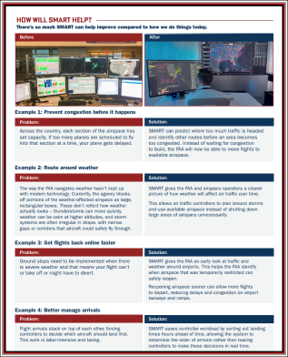
Twelve Members of Congress, see below AeroTime, have urged the FAA to “stop” using of its Strategic Management of Airspace, Routes, and Trajectories (SMART) because they want to see the AI system’s “testing and training.” The basis of their interdiction was that they had “not seen safety evaluation and testing reports or been made aware of efforts to train aviation safety personnel.”
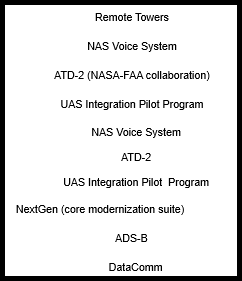
Like SMART, none of the programs in this box required new legislation because the FAA already had authority under Title 49 U.S.C. § 106 to modernize and operate the National Airspace System. Congress was informed through budget hearings, not separate bills-
What has the FAA told the public about SMART? From a briefing by the Secretary and the Administrator, here is what this system is programmed to do:
“…Federal Aviation Administrator (FAA) Bryan Bedford today unveiled the Strategic Management of Airspace, Routes and Trajectories (SMART) – a cutting-edge tool that centralizes 200 data streams – including weather patterns, flight paths, traffic flow, and controller staffing metrics – into one platform. SMART’s AI-supported engine then synthesizes all this data to provide a comprehensive visualization of where planes are going, how much traffic the system can handle, and where congestion or weather could cause challenges.
AVIATION SPECIALISTS CAN USE THE PLATFORM TO SEE WHAT CONDITIONS WILL BE IN THE FUTURE AND MAKE RECOMMENDATIONS TO FIX THE PROBLEMS BEFORE THEY ARISE.
Key benefits of SMART include:
-
- Fewer delays & cancellations: Flyers will spend less time waiting on the tarmac, circling above their arrival airport, or dealing with diversions.
- Optimized airspace: Unlocks more capacity with more efficient routing around bad weather and congestion.
- More predictable operations: Preventing disruptions before they happen will reduce stress on controllers, let them focus on their more mission – safety.
- Lower ticket prices: When airlines waste less fuel, reduce staff overtime, and have more planes arrive on time, operating costs fall. That means cost savings for consumers.
- How it works:
- At the beginning of each day, thousands of scheduled flights face built-in delays because demand for airspace can exceed an airport’s capacity. When too many flights are scheduled to use the same airspace at the same time, congestion builds and delays follow. Weather can further reduce available airspace capacity, forcing the FAA to reroute flights or shutdown large portions of the airspace. The result is a system that too often has to react to disruptions as they happen and unnecessary delays for passengers.
- SMART fixes this by moving the FAA from a reactive approach to a predictive one. Instead of waiting for congestion to build, SMART uses data to help the FAA anticipate demand, weather and airspace constraints and plan hours, days and even weeks ahead.
- The FAA began using SMART in a limited mode today in the airspace around Washington, D.C. and plans to gradually expand it to other parts of the country. SMART cannot be used to replace the critical role air traffic controllers play or take over control of an aircraft. All of SMART’s recommendations are reviewed by FAA staff, and LOCAL LEADERSHIP AT AIR TRAFFIC CONTROL FACILITIES CAN CHOOSE TO ACCEPT OR PASS ON THESE SCHEDULING SUGGESTIONS.
American Airlines CEO Robert Isom, Southwest Airlines CEO Bob Jordan, and Airlines for America CEO & President Chris Sununu, all made it clear that they support SMART. They also have the highest level of understanding of the ATC system’s technology, its strengths, and weaknesses. They see that the congestion, in particular the reduction of operations at O’Hare Airport for example, can benefit from AI’s ability to integrate all of the relevant variables that require reduction of the ATC volume.
To supplement the FAA’s description, outside research finds the following insights into SMART:
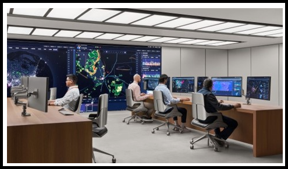
SMART’s core function is to predict problems before they happen. Its cloud‑based AI engine that continuously analyzes ~200 operational inputs to predict congestion, weather impacts, and capacity constraints before aircraft push back.
IT IS FUNDAMENTALLY A STRATEGIC PLANNING TOOL, NOT A TACTICAL CONTROLLER.
SMART runs continuous forecasts on traffic demand by airport and sector, weather impacts (convective, wind, ceiling, visibility), runway configuration changes, airspace constraints (SUA activity, flow restrictions, and staffing‑related capacity limits It produces hour‑ahead and multi‑hour‑ahead predictions of where the system will break down.
The system predicts problems like sector overloads, arrival banks that will exceed acceptance rates, departure pushes that exceed runway throughput, weather corridors that will close, and En route choke points (ZNY, ZDC, ZTL, ZFW, etc.) These are recommendation before the problem emerges.
SMART can generate recommended actions (reroutes around predicted congestion, departure metering or spacing, ground delay program alternatives, flow‑rate adjustments, dynamic route options (DROs), and weather‑avoidance paths
These recommendations go to the ATCSCC and facility Traffic Management Units. There those with greatest familiarity with the relevant airspaces decide what should and can be done.
SMART is not empowered to issue clearances, to separate aircraft, to make regulatory decisions, and autonomously control traffic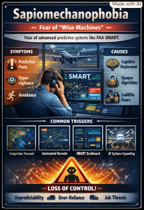
INNOVATION can be threatening- fear of losing a job, of becoming obsolescent, of unbridled power, etc. This phenomena traces its roots to 1811 when a group of British textile workers, called the Luddites literally destroyed the machines that made them no longer needed. They protested against the introduction of mechanized looms and knitting frames, which they believed threatened their skilled jobs and livelihoods. Social scientists have already identified terms for the phobia about AI: Algorithmic anthropomorphism[1], Cognitive opacity anxiety[2], Synthetic empathy illusion, Technophobia, Aiphobia, and Sapiomechanophobia[3]. Hopefully Sapiomechanophobia, if it exists, will diminish as this computer enhancement of ATC system safety is better understood. Perhaps if SMART’s role as a supplement to controllers’ decisions, not as a replacement, the aversion to this AI tool will lessen.

US lawmakers urge FAA to pause AI traffic tool at Washington-area airports
 More than two dozen US lawmakers are urging the Federal Aviation Administration (FAA) to stop using a new artificial intelligence tool to help manage Washington-area air traffic until it answers questions about safety testing and staff training.
The request follows the September 21, 2026, launch of limited operations involving flights at Reagan National (DCA), Washington Dulles (IAD) and Baltimore/Washington International (BWI) airports.
Representative April McClain Delaney, a Maryland Democrat, said the congressional letter has been sent to Transportation Secretary Sean Duffy and FAA Administrator Bryan Bedford. Lawmakers said they had not seen safety evaluation and testing reports or been made aware of efforts to train aviation safety personnel.
“I’M CALLING ON THE FAA TO PAUSE THIS ROLLOUT, SHOW US THE SAFETY TESTING, AND EXPLAIN WHO IS ACCOUNTABLE WHEN SOMETHING GOES WRONG,” McClain Delaney said.
Called Strategic Management of Airspace, Routes and Trajectories, or SMART, the system draws together about 200 data streams, including weather, flight paths, traffic demand and controller staffing. It uses that information to forecast congestion and suggest scheduling changes before delays begin to cascade.
The FAA says SMART technology does not replace air traffic controllers. Agency staff review its recommendations, and local air traffic control leaders can accept or reject them.
The lawmakers want details of testing under conditions such as severe weather and equipment outages, along with information on consultation with airport authorities, airlines and aviation safety workers.
They also asked how the FAA would assess an initial 90-day evaluation of the technology, what conditions would have to be met before expanding the system nationwide, and who would be accountable if a recommendation contributed to a safety incident.
The letter’s co-leaders include Representatives Alexandria Ocasio-Cortez, Don Beyer, Kweisi Mfume, Suhas Subramanyam and Sarah Elfreth.
Air Space Intelligence is developing SMART alongside a replacement for the FAA’s traffic flow management software. The agency says the tools will help airlines and traffic managers adjust routes and departure times earlier, reducing delays and making better use of available airspace.
The FAA announced plans for a gradual expansion beyond the Washington area when it launched the system in September.
Airline officials also raised concerns before the launch about how SMART would fit into their operations. Those concerns eased after the FAA clarified that the tool would initially have a limited role.
By the September 21 rollout start date, executives at United, Delta, American and Southwest had publicly welcomed the initiative. Delta CEO Ed Bastian said the airline supported SMART, while American CEO Robert Isom stressed the need for careful implementation.
[1] attributing human motive to AI,
[2] distress from not understanding how AI reaches conclusions.
[3]a theoretical, AI‑specific phobia; meaning “fear of wise machines.”
