Boeing’s new NORTH LINE, adding B-737 production, HOW’S THE SAFETY???
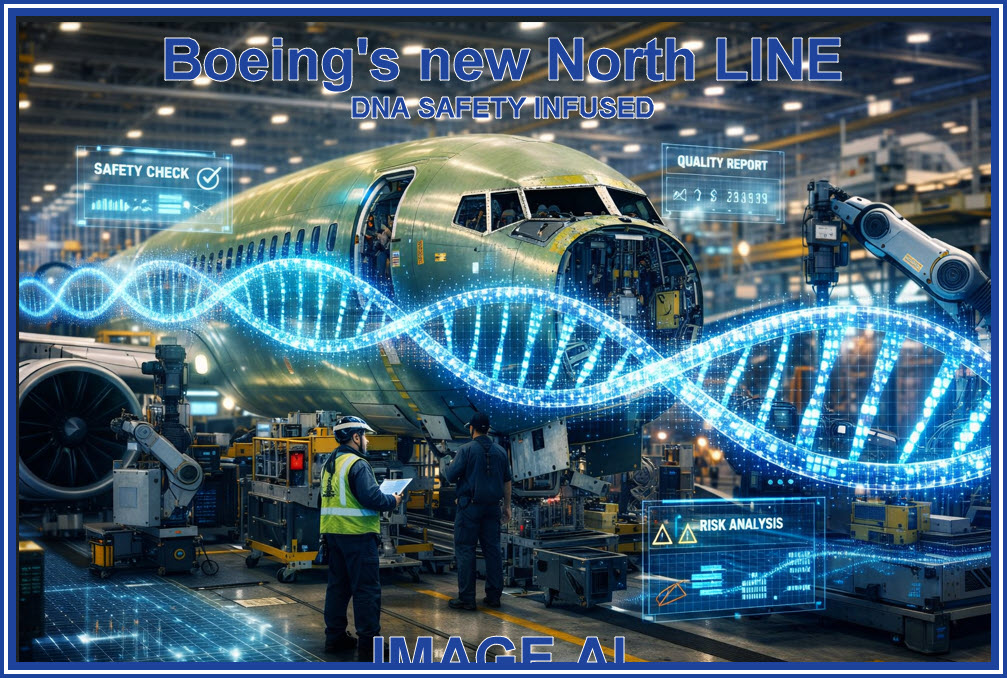
Boeing announces the opening of new B-737 production with its reconstruction and retooling of a North Line in Everett, WA as described in the company’s press release (below). The Seattle/Kansas City manufacturing facilities have received much attention from the FAA as mentioned by the FAA Administrator Bedford-
- Bedford told Reuters that the FAA is comfortable with Boeing increasing 737 MAX production from 42 to 47 aircraft per month, with further rate hikes expected within 90 days.
- He emphasized that “it’s important for the country that Boeing is successful,” adding that the FAA’s focus is on ensuring quality and safety are built into the frames at the factory, not corrected through rework.
- The FAA lifted a prior cap of 38 aircraft per month (imposed after the 2024 Alaska Airlines incident) and approved Boeing’s move to 42, then 47, with a target of 52 aircraft per month early next year.
The addition of the ability to deliver more of the much demanded B-737 aircraft is a test of Boeing’s reinvigorated SMS, QA, QC and Safety Culture. With the establishment of Don Ruhmann (quotes[1]) as the company’s CHIEF AEROSPACE SAFETY OFFICER, there has been considerable progress.
The North Line project has been led by Vice President and 737 Program General Manager Katie Ringgold. She has underscored that Boeing is engaged in a “relentless war for quality and a war against defects,” noting that the company has reduced traveled work by 75% and strengthened supplier inspections, including a dozen early‑stage fuselage checks. She also highlighted that Boeing has adopted a “documented and disciplined method” for factory‑level safety decisions, ensuring aircraft only move forward when teams determine they are safe to do so. [more of her safety initiatives[2]] Ms. Ringold has spent time out in these hangars showing her high attention to safety details
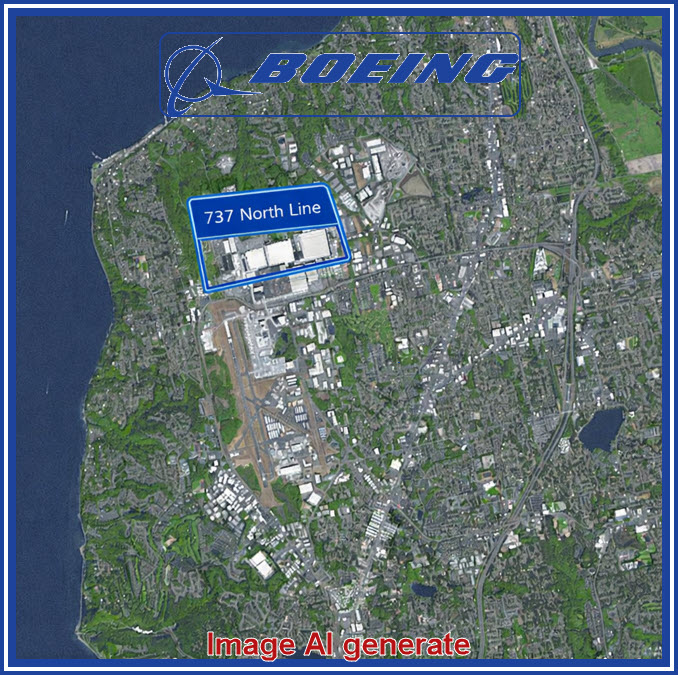 Boeing’s official Everett North Line announcement reinforces this approach: new hires and veteran widebody mechanics undergo structured foundational training and cross‑training in Renton, followed by low‑rate initial production at Everett to validate process stability and quality. Together, these leadership statements frame the North Line as a deliberate, safety‑driven expansion built on strengthened training, tighter supplier oversight, and more rigorous factory‑level safety governance.
Research (various sources)has found these specific steps applied to this recent enhancement of the company’s top product completion rate at the North Line.
- Training emphasis: Boeing states the Everett North Line is being staffed with a mix of new hires and experienced mechanics from Renton, Everett, and Moses Lake “to ensure safety and quality standards are consistently met across 737 production.”
- Cross‑training in Renton: Veteran Everett mechanics are sent to Renton to learn the 737 program before Everett begins operation. Example quote from a senior mechanic (FAA/customer coordinator):
“We are doing the training right… even folks like me who have been around for a long time are in Renton now getting familiar with the program and the product before the North Line starts.”
- Structured On‑the‑Job Training (SOJT): New Everett hires complete 12 weeks of foundational training plus SOJT in Renton to ensure they understand the 737 build process.
- Low‑Rate Initial Production (LRIP): Boeing confirms Everett will begin with LRIP — a safety‑driven, slow‑rate startup process used to validate quality and process stability.
Only time will tell, but an athletic aphorism says “Words Spoken < Work Done.”
The Boeing management team has put in place an impressive panoply of safety awareness enhancements. Keeping that focus as orders increase will be the test.
Objectively measuring your Safety DNA is an almost impossible assignment for internal resources. Someone–with experience in a variety of aviation work places and with good ability to listen—is more likely to determine where the attention needs to be focused—try JDA
North Line team readies Everett for 737 MAX production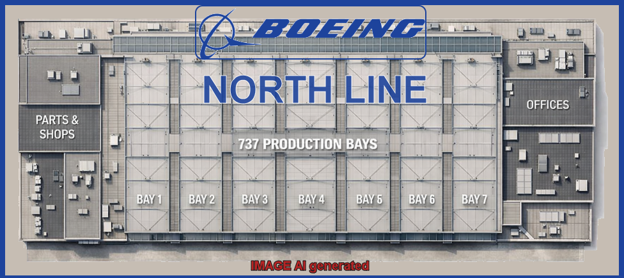
Boeing will open a new 737 MAX production line this summer in Everett, Washington, where the company will manufacture 737s for the first time. The North Line will expand capacity for single-aisle production, allowing Boeing to better meet market demand.
- The North Line will be capable of building all 737 MAX models and will initially focus on producing the 737-8, 737-9 and 737-10.
- Production in Everett will replicate the 737 build process used in the Renton factory, apart from the introduction of the 737 Wing Transport Tool, which will ferry partially completed wings for final assembly in Everett.
With construction and tooling of the new line ready to go, the focus is now on hiring and training hundreds of teammates who will work on the North Line.
Building the team: The North Line team will include a combination of newly hired employees and existing teammates from Renton, Everett and Moses Lake. This will help ensure safety and quality standards are consistently met across 737 production and that new teammates have support from experienced mechanics.
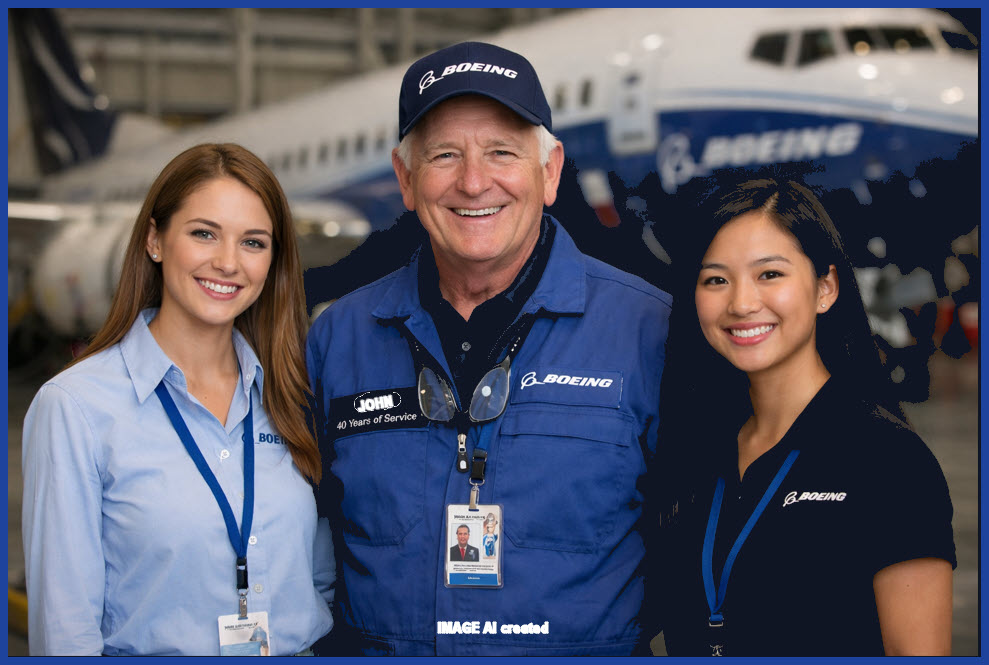 One such mechanic is John V., who has worked for Boeing for nearly 40 years, most recently as a workplace coach for the Quality team in Everett. He brings experience from 747, 767 and 777 programs to his new role as a Federal Aviation Administration (FAA) and customer coordinator for the North Line.
Fresh faces: Jaden M. and Alondra P. joined Boeing in late 2025 as some of the first teammates hired for the 737 North Line.
“Opening a new production line is something special,” said Jaden M., who installs the dorsal fin in Flow Day 1. “So we have to do it right. Training went smooth, and I’m excited and ready to get home to our shop in Everett.”
Following 12 weeks of foundational training, Jaden and Alondra recently completed their STRUCTURED ON-THE-JOB TRAINING (SOJT).
SOJT pairs new mechanics with experienced teammates to hone the skills learned in foundational training and better understand the jobs they will ultimately do. Teammates for the North Line will complete their SOJT in Renton.
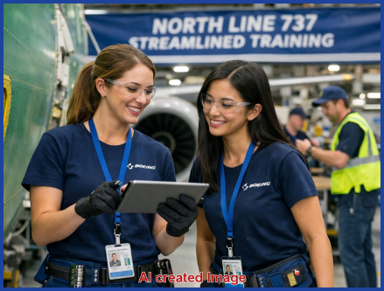
“Training was so positive and refreshing,” said Alondra R, an electrician for Flow Day 1. “It was different than any training I’ve done from other jobs. My managers and the workplace coaches were always there to make sure I got my questions answers and felt confident in my work.”
| Safety and quality: Once the North Line begins operation, the program will complete a process known as low rate initial production (LRIP). During LRIP, the build process is intentionally slowed to provide additional checks and make any adjustments to the production system to support standard flow times in the future. |
“It’s like running,” said Jennifer Boland-Masterson, production leader for the Everett line. “We know how to do it, and we’ve done it before, but we need to warm up our muscles. You don’t start with a marathon. You start with shorter distances and build up from there.”
Boeing will use the first set of airplanes built on the LRIP line to demonstrate conformity to the FAA — allowing the North Line to operate under Boeing’s productions certificate, PC700.
Following the completion of LRIP and conformity airplanes, the North Line will be integrated into the overall 737 MAX flow and production, adding capacity for production rates above 47 airplanes per month.

Boeing CEO on the North Line Opening
“We’re not going to push airplanes out the door if we’re not stable and the production system isn’t producing a high-quality product,” Ortberg said. “We’ll move when the production system says we’re ready to move.”
Ortberg added that the supply chain for the 737 MAX is stable to support future rates.
North Line Activation: Once up and running this summer, the North Line will complete an initial build process known as low- rate initial production (LRIP) that is designed to support a slow and methodical ramp up. This allows teams to conduct additional checks and make adjustments to the production system as the first airplane moves down the line.
[1] “Continuous learning is required to achieve the highest levels of safety… Our learning informs how we design and build our products, how we gather and assess operational data, and how we flow safety improvements back into our engineering processes and out to those who operate and maintain our products.” “Our perspective broadened after a serious accident in early 2024… We learned ways to accelerate the alignment, integration and adoption of the enterprise SMS deeper into our business units, including design, production, product support, and our supply chain.” “Safety risk management is a key element of a safety management system, and we built and helped model with our program team a safety risk management build model that evaluated the effect of rate changes on all the different processes that actually would deliver an airplane.”
[2] Cultural change and safety focus: “We took time to deeply reflect on our production system… and make meaningful and arduous changes.” Stopping the line to enforce quality:“ We essentially went to a rate zero… We demanded a level of quality improvement from one of our major suppliers.” SMS‑based factory‑level safety decisions: “A documented and disciplined method to make SMS‑based decisions on line boards at our factory level… the working team at the airplane level made appropriate decisions on when and if the aircraft was safe to move forward.”

