The raison d’être for ADS-B is SAFETY; not an ATM
Aviation’s best known expert on all things Air Traffic Control, Robert Poole[1], takes issue with AOPA’s opposition to allowing airports (among others?) to use the data emitted from ADS-B units to assess fees ( N.B. without the benefit of the data recorded by this equipment, AIRPORTS ALREADY are able to identify and collect fees from these aircraft[2]). AOPA’s SVP government Affairs Jim Coon fully quoted objected as follows:
“The bill passed by the U.S. House of Representatives does nothing to stop airports, local and state governments, or any other entity from charging or collecting fees and taxes—it just takes away the ability for tax collectors and airports to exploit a safety technology for their economic gain.”
The Reason Foundation article (see below) summarizes the GA position as:
“misusing a safety technology for airports’ economic gain.”
The ATC expert then enumerates all the other possible uses of the ADS-B information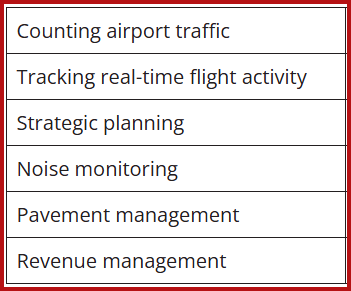
From this list, Mr. Poole concludes
“The idea that ADS-B is ONLY A SAFETY TECHNOLOGY is belied by the numerous uses airports have found for this technology.”
All uses do not justify the creation of some asset. The FAA is limited in what it can do by what Congress authorized it to do. Case in point, if the FAA proposed that the ADS-B technology is being required to advance the ease of airports’ collecting of landing fees, there would be no statutory basis. Indeed, the FAA’s NPRM requiring aircraft operators to install this expensive safety equipment SPECIFIED THE STATUTORY BASIS—
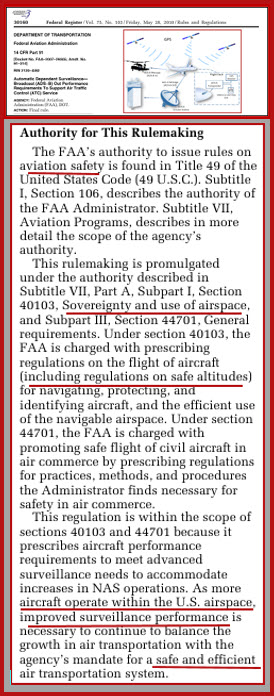
No mention of facilitating airports’ revenue; yes, there are a number of reasons why this equipment is needed in the approximately 38k words (En Route Conflict reduction, ATC Performance, Capacity Enhancements, Airspace Efficiency, and Fuel Saving Benefits).
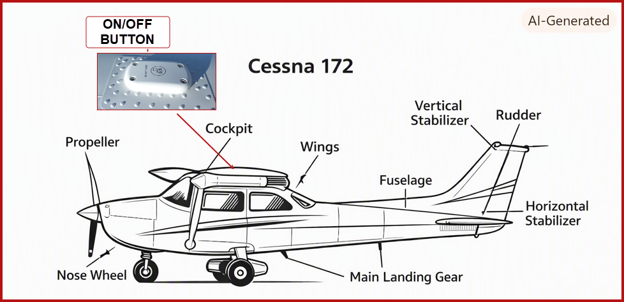
Coon’s citation of safety seems to escaped Mr. Poole’s criticism—the ADS-B, as the DOW has shown, can be turned off. So, when a Cessna 172 plane is on Final to XYZ airport which has the ADS-B money machine, the pilot turns off his unit. QED–SAFETY CONCERN!!!
The Many Uses of ADS-B
`The general aviation community is fighting hard to prevent airports from using Automatic Dependent Surveillance–Broadcast (ADS-B) data to charge landing fees. Jim Coon, the Aircraft Owners and Pilots Association’s chief lobbyist, refers to using ADS-B information to deal with landing fee avoidance as “misusing a safety technology for airports’ economic gain.”
The idea that ADS-B is ONLY A SAFETY TECHNOLOGY is belied by the numerous uses airports have found for this technology. A 2026 report from the Airport Cooperative Research Program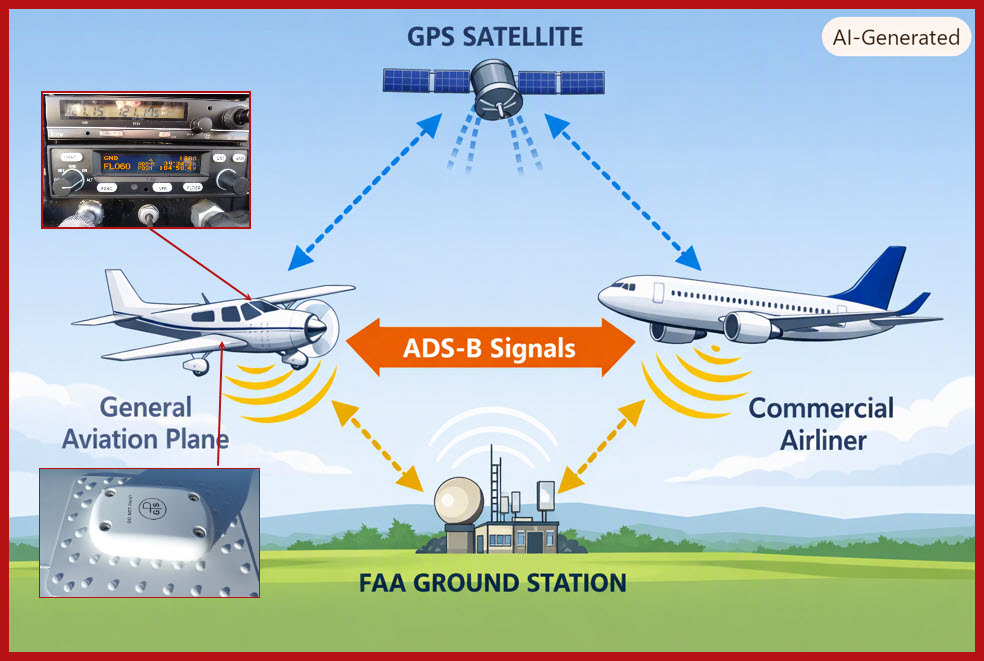 (ACRP Synthesis 145) documents the large array of uses airports have found for this important aviation technology. The study team used an online survey that was sent to 150 airports and other relevant aviation organizations. Responses were received from 17 commercial airports, 16 general aviation airports, and 9 reliever airports. Overall, 93% of the respondents use ADS-B data. And it’s hardly used only as a “safety technology.”
Among the reported uses are the following:
| Counting airport traffic | 93% |
| Tracking real-time flight activity | 93% |
| Strategic planning | 61% |
| Noise monitoring | 41% |
| Pavement management | 28% |
| Revenue management | 24% |
This is only a partial list, covering the most common uses. Note that none of these are “safety” uses of ADS-B information.
Given the large benefits that airports now derive from ADS-B information, both major airport organizations (AAAE and ACI-NA) are expressing concerns about Congress being bamboozled into restricting ADS-B to purely air safety uses. At a June hearing, Todd Hauptli, CEO of AAAE (American Association of Airport Executives), said that airports are very concerned about House bill language that would preclude airports from using ADS-B data to prevent landing-fee avoidance. AAAE and ACI-NA (Airports Council International-North America) issued a joint message on this.
While Congress weighs the pros and cons, the GA community is working at the state level to ban landing-fee billing based on ADS-B information. A June 25 Aircraft Owners and Pilots Association (AOPA) news release was headlined, “Louisiana Becomes Third State to Ban ADS-B-Based Billing.” Such a state-level ban of a federal policy would likely fail a legal challenge, but it makes good PR for AOPA’s constituency.
[1] Director of Transportation Policy, Reason Foundation ;Searle Freedom Trust Transportation Fellow, Reason Foundation ;Member, GAO National Aviation Studies Advisory Panel; Member, Air Traffic Control Association .Education-B.S. in Mechanical Engineering, MIT M.S. in Mechanical Engineering, MIT, Graduate work in Operations Research, NYU; Adviser to Presidents Reagan, George H.W. Bush, Clinton and George W. Bush. Among the first to propose commercialization of U.S. ATC; his model influenced Canada’s 1996 ATC corporation (NAV CANADA)
[2] Airport-operated systems (traditional method):Tower logs (for towered airports): controllers record aircraft ID and movement counts; Ramp/operations staff: manual logging of N‑numbers for landings or parking, Noise‑monitoring systems: some airports use noise sensors tied to radar/ADS‑B tracks to identify aircraft type and movement, Airline/tenant self-reporting (rare for GA)