Petition for Rulemaking on Human Trafficking reminds all of the need for vigilance
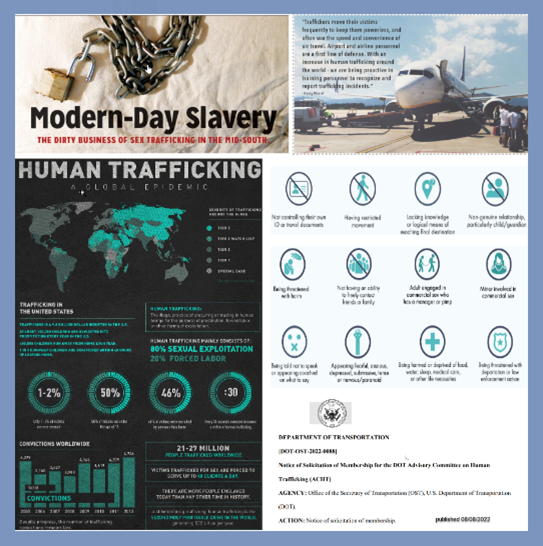
Thanks to the leadership of Joe DelBalzo, our founder, HUMAN TRAFFICKING, has been a recurrent theme here. This list shows that Joe’s direction was realized:
-
-
-
-
-
-
-
- JUNE 10, 2015
- JUNE 10, 2015
-
-
-
-
-
-
Aviation’s Role In Stopping Human Trafficking; What Will You Do?
-
-
-
-
-
-
-
- OCTOBER 16, 2015
-
-
-
-
-
-
10 TELLS To See & Save Trafficking Victims Moving In Air Transportation—Please Share Them With Peers
-
-
-
-
-
-
-
- JANUARY 4, 2016
-
-
-
-
-
-
2016 Resolution: Make AWARENESS Of Human Trafficking A Personal Priority, Please
-
-
-
-
-
-
-
- FEBRUARY 3, 2016
-
-
-
-
-
-
-
-
-
-
-
-
-
- DECEMBER 12, 2017
-
-
-
-
-
-
#Eyesopen Should Be Part Of Every Aviation Professional’s Constant Awareness
-
-
-
-
-
-
-
- FEBRUARY 21, 2018
-
-
-
-
-
-
TWO REAL HUMAN TRAFFICKING SAVES
-
-
-
-
-
-
-
- APRIL 22, 2019
-
-
-
-
-
-
PLEASE READ AND BE AWARE OF THIS IMPORTANT HUMAN SAFETY MESSAGE
-
-
-
-
-
-
-
- FEBRUARY 2, 2020
-
-
-
-
-
-
PLEDGE TO FIGHT HUMAN TRAFFICKING IN AIR TRANSPORTATION
-
-
-
-
-
-
-
- JUNE 4, 2020
-
-
-
-
-
-
Proof That YOU Can Help Prevent Human Trafficking Somewhere In Aviation
-
-
-
-
-
-
-
- APRIL 6, 2022
-
-
-
-
-
-
DOT And DHS Joint Initiative On Human Trafficking—BLUE LIGHTING
AvWeek (below) published an article about a Petition for Rulemaking requesting that the FAA inspectors be required to surveil their certificates for Human Trafficking training (existing course materials, actual class schedules, attendance %, well designed and position posters for reinforcing awareness…) Thanks to the initiative of DAVID DOWNEY, the FAA will have to respond to his PRM.
NOTHING SO INSPIRES SUCCESS THAN SUCCESS” is a French aphorism from the 1820s–1830s. Perhaps, each certificate holder should be required to publicize its wins periodically?
Saved by a Miracle: Ticket Counter Agent Rescues Teen Girls from Suspected Human Trafficking Plot
Flight Attendants Train to Spot Human Trafficking
The message can be passed without judgment and with proper instruction, places no risk on the individual who identifies a likely VICTIM with this advice-
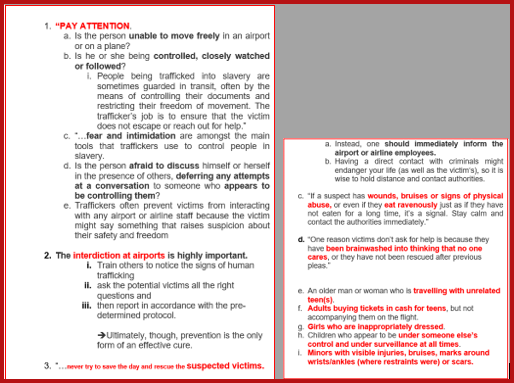
10 TELLS to See & Save Trafficking Victims moving in Air Transportation—please share them with peers LINK 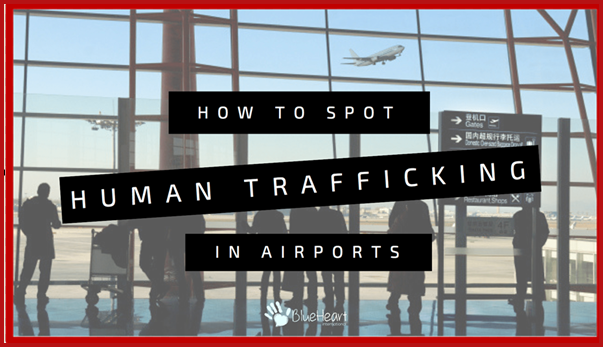
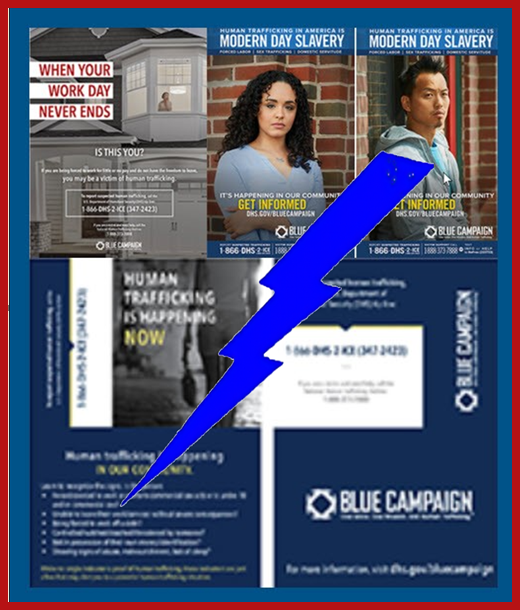
DOT and DHS have initiated a concerted effort to STOP HUMAN TRAFFICKING. The comprehensive awareness and detection campaign starts with training aviation industry personnel to identify potential traffickers and human trafficking victims, and to report their suspicions to federal law enforcement. More than 350,000 aviation personnel have been trained to identify and report suspected human trafficking. Training now includes flight attendants, pilots, gate agents, ticket counter staff, and other passenger‑facing roles, mandated by federal law (FAA Extension Act of 2016; FAA Reauthorization Act of 2018). The broader DHS Blue Campaign (of which BLI is a component) notes increased public engagement and more calls to the National Human Trafficking HSI Tip Line as a result of its awareness initiatives.
One success story comes from the Metropolitan Washington Airports Authority Combatting Human Trafficking—
The U.S. Department of Transportation awarded the Airports Authority second place in its annual Combating Human Trafficking in Transportation Impact Awards 2024. The Department’s annual Combating Human Trafficking in Transportation Impact Award aims to incentivize individuals and entities to think creatively in developing innovative solutions to combat human trafficking in the transportation industry, and to share those innovations with the broader community.
- Awareness and Education
- Collaboration and Partnerships
- Vigilance and Reporting
- Support for Victims
- Continuous Improvement
Useful advice—
How is US Aviation doing in attacking Human Trafficking?
- 800+ victims assisted
- 2,545 trafficking‑related arrests
- 405 convictions
- 280,000+ individuals trained through the Blue Lightning Initiative
There is no hard data about saves because—
Despite the clear operational impact, there are no publicly available, peer‑reviewed studies quantifying:
- Number of victims directly identified due to BLI
- Reduction in trafficking incidents attributable to BLI
- Comparative effectiveness vs. other anti‑trafficking interventions
This is common in trafficking‑related programs because:
- Case data is sensitive
- Investigations are long‑running
- Attribution is difficult (multiple agencies and tips contribute to each case)
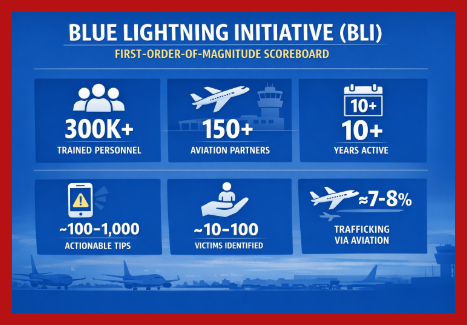
Perhaps there is some way to create a first order of magnitude scoreboard that will be prominently displayed in all aviation facilities-
Mr. Downey’s petition is timely, if nothing else to reinforce the need for vigilance. THANKS!!!
Who’s Watching for Human Trafficking in Aviation?
Former FAA official says Congress required training, but operators aren’t seeing it in FAA oversight.
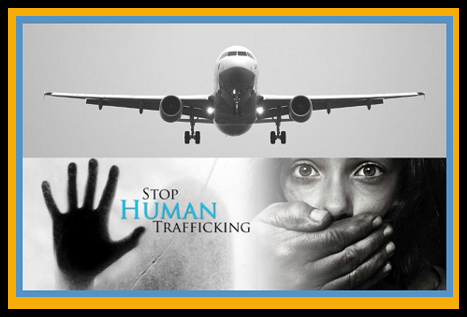
A former senior FAA official is asking the FAA to revise Parts 121 and 135 to REQUIRE HUMAN TRAFFICKING RECOGNITION AND RESPONSE TRAINING for certain airline and charter employees — training he says Congress already directed but that has not been built into the regulatory and oversight structure operators typically follow.
DAVID DOWNEY, who previously led the FAA’s Rotorcraft Directorate in Fort Worth, said his interest sharpened during the COVID-19 era as he tried to understand how trafficking could occur through aviation without obvious border-crossing markers.
“This was during COVID, when the whole Jeffrey Epstein thing popped, and I wondered, ‘How does somebody fly people extraterritorially? There’s no passports and there’s no customs,’” he said. “So I started looking into it, and the answer was he never left the United States. He flew international airspace, but he flew from the U.S. to the U.S. Virgin Islands.”
Downey submitted a PETITION FOR RULEMAKING Jan. 2. The FAA acknowledged receipt Jan. 7 and assigned it Docket No. FAA-2026-0038, telling Downey the agency expects the decision to take longer than 120 days.
His argument is less about new training content around human trafficking and more about making existing requirements visible and verifiable within the FAA regulatory environment.
What Downey Says Is Missing
Downey points to federal statutes that call for human trafficking awareness training for flight attendants and certain customer-facing airline personnel. The FAA issued an Information for Operators bulletin, InFO 19002, to alert operators to those statutory requirements and to point them to existing training resources. But Downey said the practical result has been uneven awareness and little, if any, structured FAA follow-through.
He said an aviation attorney pushed him to focus on what the law actually says about the human trafficking training and who it’s written to.
“She sent me back a note and said, ‘Dave, you have to read the law,’” Downey said. “The law says it’s written to carriers, not to the FAA. I showed it to a former FAA air carrier inspector who used to be in Washington, and he read it and he goes, ‘I didn’t discern that it wasn’t to the FAA, even if it says carriers.’ So what’s happened is the FAA’s done nothing.”
In his view, that has allowed the issue to sit in a gray space.
“There is no rule. There’s no op spec. It’s not in the 8900,” he said, referring to an FAA policy handbook. “So it’s just a gaping hole and everybody thinks because this InFO is out there that something’s being done.”
He said he has pressed the point directly with operators.
“When I’m at Verticon or HAI or other things, I’ll talk to DOs or chief pilots and go, ‘Hey, do you guys know about this?’” Downey said. “And they rarely do.”
A Measurable Impact
Downey said DHS estimates aviation accounts for a measurable share of human trafficking activity.
“The presentation that was done by Sean Burnett from DHS … they estimate that it’s probably about 7% to 8% of all human trafficking is done through aviation,” he said, adding, “IF YOU STOP 7%, YOU STOP 7%. THAT’S STILL HUGE.”
From there, he said, he gravitated toward the practical question of who in the aviation system is most likely to notice something that does not look right; not just in a cabin, but on the ground.
“At smaller airports … it’s the ramp rats. It’s the people putting gas in there, servicing the lavs, catering, mechanics at the FBO — they see everything that goes on there,” Downey said.
He described his view as adding awareness where people already have eyes on the operation.
“If you’re sitting in the FBO and you’re aware that you need to be paying attention to this and you see something that looks a little unforward, you can just pick up the phone and make a call.”
What Training Looks Like in Practice
Downey said he is not proposing an elaborate curriculum. He repeatedly returned to the idea that the content already exists and can be delivered without major disruption.
“It’s all in how the FAA writes the op spec,” he said. “And again, it’s a 15-minute video. I mean, it’s not like you’ve got to go away for eight days on a type rating.”
He also emphasized that reporting, in his telling, is designed to be simple for aviation employees who may not know what to do in the moment when they think they see signs of human trafficking.
“The two program managers I’ve talked to at DOT and DHS have said if somebody suspects something on an airplane, all they need to do is report the carrier, the flight number and the seat number,” Downey said. “They’ll take it from there. You don’t have to do anything. They have a whole bevy of people that can go research that.”
Downey said he has heard variations of the same concern from frontline airline workers.
“Just talking to flight attendants, they’re like, ‘I think I’ve seen it, but I didn’t know what to do.’”
What Comes Next
Downey said he expects the next meaningful step would be the FAA opening the door to public comment if it decides to move forward.
“I’m hopeful that they would give us at least a 60-day comment period so that it could get through the news cycle two or three times,” he said, while also acknowledging how timing can vary. “But having been at the agency, if you don’t want a lot of work, you make it a very short comment period.”
He framed the goal as human trafficking awareness paired with a clear, standardized place in FAA oversight rather than a niche effort that only a limited set of operators encounter.
“We’re supposed to have done this. The training material already exists,” Downey said. “We need the rule changed.”
[The AvWeb article includes a copy of the Petition for Rulemaking]

