ORD’s 2026 summer schedule mess was predicted in 2015
Way back in 2015, JOE DEL BALZO, the founder of this safety blog, gave THE FAA his professional opinion PREDICTING THAT the then pending O’Hare Master Plan would add runways capacity that exceeded the capacity of the FAA ATC ORD tower, TRACON and En Route (ARTCC) as proposed in the EIS. The FAA did not accept his expert analysis.
President Trump’s Secretary of Transportation Duffy and FAA Administrator Bedford have assembled the airlines serving Chicago’s O’Hare International Airport to (a) tell them that the ORD ATC capacity cannot handle the significant proposed increases in summer operations and (b) under anti-trust guidelines, ordering the carriers to reduce their schedules to keep the ATC load to 2,800 operations per day. (see David Shepardson’s informative included before).
Based on the FAA’s 2018 Airport Capacity Profile: Chicago O’Hare International Airport, the bottleneck is the result Mr. DelBalzo predicted, Here is what the FAA’s numbers tell—
-
-
- 2,800 operations/day is the FAA’s stated safe, sustainable level.
- FAA documents note that airline schedules exceeding this level create “severe congestion” and strain ATC resources
-
-
-
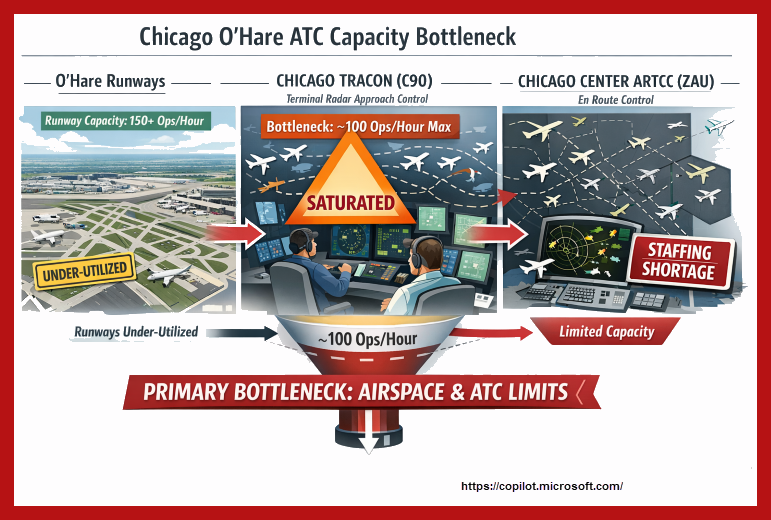
- The FAA equates this to ~100 operations per hour (combined arrivals + departures).
- This is not a theoretical maximum—it is the PRACTICAL, DEMONSTRATED ATC CAPACITY given current runway use, staffing, and terminal constraints.
-
-
-
- The FAA has repeatedly stated—most recently in scheduling‑reduction notices and congressional correspondence—that the BINDING CONSTRAINT at O’Hare is terminal and en‑route airspace saturation, especially at Chicago TRACON and Chicago Center (ZAU).
- Runways, taxiways, and gates are NOT the limiting factor today; the airspace system is.
- The FAA’s Airport Capacity Profiles (the successor to the old Benchmark Reports) provide detailed runway‑configuration throughput modeling for ORD, but the most recent public FAA action gives the clearest operational number: 2,800/day ≈ 100/hour.
- Chicago TRACON (C90) is staffed at only ~75% of required levels and is “already saturated” during peak periods.
- Chicago Center (ZAU) is at ~85% staffing, limiting throughput into/out of ORD.
- FAA acknowledges that TRACON and en‑route sector loading—not runways—are the binding constraint on ORD’s arrival/departure rate.
- FAA’s scheduling‑reduction notice frames the issue as overscheduling relative to ATC capacity, not airport infrastructure.
-
Further proof of the source of the limitations on use of the existing runways is the pointed letter from 2 Senators to the FAA:
 U.S. Senate Democratic Whip Dick Durbin (D-IL) and U.S. Senator Tammy Duckworth (D-IL) today sent a letter to Federal Aviation Administration (FAA) Administrator Bryan Bedford about the urgent need for greater FAA investment and efficiency at Chicago O’Hare International Airport (ORD). Specifically, the Senators’ letter urged the FAA TO PRIORITIZE ORD FOR AIR TRAFFIC CONTROL (ATC) STAFFING AND TECHNOLOGY, TO ALLOW FULL USE OF ORD’S RUNWAY CAPABILITIES, and to give full and fair consideration to federal grant applications to invest in ORD’s Terminal Area Plan project to increase gate capacity.
Having seen airport expansion cases, it is clear that forecasting demand has been an art not a science. Now, with the visibility of the FAA’s ATC technology is so subject to criticism, the estimates of the computer/radar/communication systems need to be more carefully assessed. Building ground capacity that may be constrained by the ATC will increase the likelihood of community objections.
Also, the FAA’s ability to meet the needs for people to handle ATCers in ATCTs, TRACONs and ARTCCs (recruit, train and retain, plus pay them during Congressional budget debacles) is also an important variable in this planning calculus. The Government Accountability Organization has been extremely critical of the FAA’s management of the size of and need for its workforce and has recommended that
“FAA (1) establish and document measurable goals for its processes to
recruit, hire, and train controllers;
and
(2) analyze the information it collects to inform decisions about improving those processes.”
In the context of these lessons, Joe’s judgment that runways would create more operations than ATC SHOULD be included in future airport expansion plans???
FAA Plans to Reduce Flights at Chicago O’Hare, Cites Boost in Schedules
Reuters
By David Shepardson
WASHINGTON, Feb 27 (Reuters) – The Federal Aviation Administration plans to reduce flights at Chicago O’Hare airport this summer, SAYING MAJOR AIRLINES HAVE OVERSCHEDULED FLIGHTS, the agency said on Friday.
The FAA will convene a schedule reduction meeting[1] with major airlines on March 3 after United Airlines said it plans to add about 200 flights per day and American Airlines announced a smaller increase in flights. The FAA plans to reduce flights for the summer flight season, which starts March 29 and runs through October 25.
The current schedules would make 2026 the busiest summer ever at O’Hare.
The FAA said airlines have published schedules that show more THAN 3,080 DAILY OPERATIONS – takeoffs and landings – on peak days this summer, compared with 2,680 daily operations last summer. The FAA said the “increase is significant and would stress the runway, terminal, and air traffic control systems.”
The FAA said O’Hare is currently handling about 100 hourly departures and arrivals each, resulting in about 2,800 total daily operations. The agency said that is manageable “given the current infrastructure and staffing resources.”
AGENCY PROPOSES LIMIT
The agency is proposing to adopt a 2,800 per day limit throughout the season “to prevent large-scale operational disruption while also allowing air carriers to operate within the airport’s demonstrated manageable capacity.”
United plans to operate 780 flights a day from Chicago O’Hare this month, up from the 541 flights on average it operated per day last year. The carrier said it is increasing its mainline departures from O’Hare by 20% over last summer.
American Airlines said in December it would add 100 additional daily departures to more than 75 destinations from O’Hare in time for spring-break travel, which is a 30% increase in spring departures compared to 2025. Daily departures will rise from 484 last summer to 526 this summer.
American praised the FAA and Transportation Secretary Sean Duffy “for taking proactive action to ensure the operational integrity of the airfield and airspace in Chicago. The FAA now has the opportunity to achieve an improved customer experience for passengers traveling from, to, and through Chicago this summer.”
United praised the FAA and Duffy for convening the meeting. “We share their commitment to running a safe and reliable operation out of O’Hare and look forward to a collaborative discussion,” the airline said.
FAA Administrator Bryan Bedford told airlines in a closed-door meeting the agency was concerned about the ability of O’Hare to function this summer with the additional flights and noted the agency last summer convened a schedule reduction meeting and cut flights at Newark to address congestion woes.
(Reporting by David Shepardson; Editing by Deepa Babington, Rod Nickel)
Copyright 2026 Thomson Reuters.
[1] FAA initiates scheduling reduction process at Chicago O’Hare for Summer 2026
The statute requires the Administrator to establish flight reduction targets and notify carriers at least 48 hours before the meeting. Carriers must direct any reduction offers to the Administrator rather than to other carriers.[12] Notably, the § 41722 meeting addresses only domestic scheduled carrier operations. The notice states that the FAA will separately initiate steps under the International Air Transport Association (IATA) process to manage foreign carrier operations at ORD as necessary.[13]
Because scheduling reduction discussions could raise antitrust concerns, the FAA has coordinated meeting procedures with the Department of Justice (DOJ) Antitrust Division. The notice includes an exchange of letters between FAA Chief Counsel William McKenna and Acting Assistant Attorney General Omeed A. Assefi…In its responsive letter, the DOJ stated that it is “not presently inclined to initiate antitrust enforcement action” against carriers that participate in the meeting as described, while expressly reserving the right to bring an enforcement action against any conduct that violates the antitrust laws.[15] This language reflects the DOJ’s current enforcement intention – not an approval, immunity grant, or binding commitment against future enforcement.