NTSB’s “greater scrutiny of skydiving and flightseeing” slow and hard v. a CAVEAT EMPTOR sign as a quick, smart fix
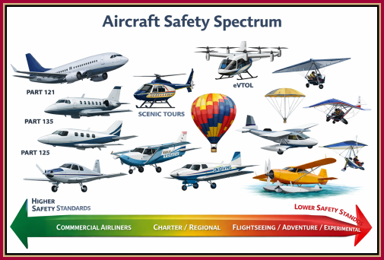
From its earliest days in 1938 under the Civil Aeronautics Authority, the FAA’s regulatory philosophy has been to apply differing levels of scrutiny to different kinds of flight operations—a tiered approach that balances public risk with operational freedom. Airline and commuter carriers have always faced the most rigorous oversight, while private and recreational flying has been governed by lighter, operator‑responsibility standards. This graduated system reflects the agency’s belief that safety regulation should match the exposure of the traveling public.
After some recent tragedies, the NTSB has made a strong case for the FAA to increase its surveillance of flightseeing helicopters flightseeing planes and skydiving aircraft. Its plea does not acknowledge this historic principle. The Board has repeatedly called for elevating the standards applicable to these operations; their exhortations grow with every tragedy. Their frustration with the lack of regulatory response is rooted in the accusatory phrase “loophole,” which is defined as:
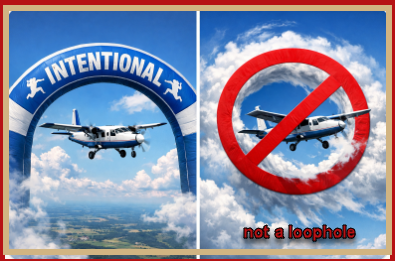 A loophole is an ambiguity, omission, or technicality in a system
—like a law, contract, or rule—
that allows someone to legally avoid complying
with its ORIGINAL INTENT or obligations.
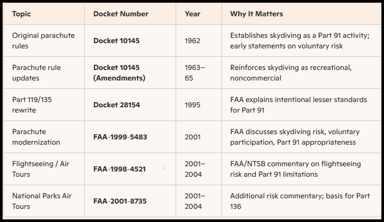
The regulatory history of Part 91 has intentionally set lesser safety standards than Parts 121 and 135, including direct evidence from the regulatory record, FAA statements placing safety responsibility on the operator. Here is AI’s review of initial promulgation onto recent dockets:
- FAA acknowledges that Part 91 passenger‑carrying operations have lower safety oversight than Parts 121/135.
- FAA is considering imposing higher standards (maintenance programs, recurrent training) on skydiving and other Part 91 operations — meaning these standards are not currently required. [1]
- FAA cites NTSB findings that Part 91 flightseeing and parachute operations have elevated rissk.
Further references to this intended demarcation of standards are found in the Chief Counsel library of opinions:
- A skydiving flight that departs and returns to the same airport remains a Part 91 operation so long as it fits within the exceptions of 14 CFR §119.1(e) and does not exceed the 25‑mile radius limitation.Federal Aviation Administration
- The FAA has repeatedly held that:
- Skydivers are not “passengers” being transported to a destination.
- A same‑airport return does not trigger Part 135 or Part 121.
- The only regulatory trigger is whether the operation exceeds the limits of §119.1(e) or involves carriage for compensation or hire.
o Anderson Interpretation (June 26, 1997)
-
- Although this interpretation concerns nonstop sightseeing flights, the FAA uses it as a direct analogy for parachute operations.
- The FAA held:
- “Non‑stop sightseeing flights which began and ended at the same airport and were conducted within a 25‑mile radius … qualify for the exception under §119.1(e)(2).” Federal Aviation Administration
This compendium of text repeating the original intent of the differing standards for these flights, but it also shows the degree to which the FAA’s past statements will create a high hurdle to radically alter their approach to regulating these flights.
Frequently, the NTSB castes aspersions on the FAA’s laxity in adopting the Board’s recommendations, which the Chair, in particular, seems to think her words are ex cathedra. The Administrator does not share such papal powers; he and his team must comply with a myriad of statutes, Executive Orders, OMB Circulars as well as helpful intercessions by the Hill and DOT. The most difficult hurdle is the tests of OIRA Circular A-94. The entities most effected by a stricter regimen are all small companies and based on Congressional guidance they are a protected class.
In recognition of the long, statutorily mandated process, the FAA has issued a virtual library to inform the public exactly about the level of scrutiny these flights NOW, not after the Federal Register publishes all of these papers :
- AC 105-2E – Sport Parachuting Focus: Safety suggestions, risk awareness, and compliance with Part 105. Public‑facing value:
- Explains FAA’s primary responsibility: protecting air traffic and persons/property on the ground.
- Covers jump pilot training, aircraft maintenance, parachute equipment, and procedures for FAA authorization for removed/modified doors—critical for briefing the public on what “properly approved” skydiving aircraft and doors look like.
- 14 CFR Part 136 – Commercial Air Tours Focus: Defines “commercial air tour” and “commercial air tour operator,” and sets special rules for sightseeing flights. Public‑facing value:
- Used to explain when a “scenic flight” is actually a regulated commercial air tour, and what standards apply.
- AC 136‑5 – Enhanced Flight Following Center (EFFC) for Commercial Air Tour Operators Focus: Operational control, risk mitigation, and safety responsibilities for air tour operators. Public‑facing value:
- Provides language on risk mitigation strategies and joint flight safety responsibilities that can be adapted into public‑facing materials about how reputable operators manage sightseeing risk.
- Other Air Tour Advisory Circulars (e.g., earlier AC 136‑1 series) Focus: Passenger briefings, operational practices, and compliance expectations for sightseeing flights. Public‑facing value:
- Source material for explaining door safety, restraint systems, weather minima, and route planning to the public in plain language
- 14 CFR Part 105 – Parachute Operations Focus: Regulatory baseline for intentional parachute jumping. Public‑facing value:
- Defines when and how parachute operations may be conducted.
- Provides the framework for explaining to jumpers that compliance is primarily on the operator and jumper, not the FAA, beyond airspace and ground protection.
- 14 CFR Part 91 – General Operating and Flight Rules Focus: General rules that parachute operators and jump pilots must follow. Public‑facing value:
- Basis for explaining that many skydiving flights are conducted under Part 91, with fewer prescriptive safety requirements than Parts 121/135—so passengers must understand the risk profile and operator responsibility.
An action, which the FAA may be able to enhance the public’s awareness of the safety level of these flights might be to require the operators to include a large “caveat emptor” sign– is to mimic the 14 CFR § 45.23(b) requirement.
 The owners of amateur‑built and experimental aircraft must post “EXPERIMENTAL” signage[2]. The labeling requirement on isn’t just a bureaucratic label — it is one of the FAA’s most deliberate, purpose‑built public‑risk warnings in all of Part 91. It exists specifically to alert members of the general public that the aircraft does not meet the safety standards of a type‑certificated aircraft under Parts 23, 25, 27, or 29. The regulation specifies that the letters must at least 2 inches high, and near each entrance to the cabin, cockpit, or pilot station.
This is one of the few FAA‑mandated consumer‑facing warnings in aviation. Like the prospective skydiving/flightseeing passengers would be Warned of Lesser Safety Standards and
- Alert passengers that the aircraft does not meet standard airworthiness certification requirements
- Signal increased risk compared to type‑certificated aircraft
- Place responsibility on the operator and the passenger to understand the risk
- Prevent the public from assuming airline‑level safety
FAA Order 8130.2 (Airworthiness Certification) explains that the marking is required so that:
“Persons are made aware that the aircraft does not meet the certification requirements of standard category aircraft.”
Would not such an immediate response to the risks enhance safety quickly rather than the long complex process of rewriting the standards applicable to flightseeing and skydiving operations.
The warning under 14 CFR § 45.23(b) has worked for those who made decisions immediately prior to boarding their flights. Those who seek to see sights from the unique perspective of an aircraft would receive the same sort of admonition. People who choose to jump from planes would also get a notice about the vehicle they are choosing for their adventure.

Regulators Urge Yet More Rules For Sightseeing Aircraft And Skydiving
Recent Skydiving Accident Renews Calls From NTSB For More FAA Oversight

Investigators say it is too early to say what caused the skydiving crash that killed 11 and the pilot in Butler, Mo., but that it may be time to examine factors tied to federal oversight for certain types of air operations.
The National Transportation Safety Board (NTSB) has been urging the Federal Aviation Administration (FAA) to put in place tougher safety standards for sightseeing airplanes and helicopters and other operators WHO DO NOT FACE THE SAME SCRUTINY FROM SAFETY REGULATORS AS AIR TAXIS OR CHARTER FLIGHTS.
The NTSB in the past has suggested changing that rule to require the FAA to treat all skydiving and sightseeing aircraft more like small commercial commuter flights. That would mean more frequent and formal oversight of things such as maintenance and training.
NTSB chairwoman Jennifer Homendy said last year after a sightseeing helicopter plunged into New York City’s Hudson River, killing five Spanish tourists and a pilot, that these types of operators undergo fewer safety inspections, do not carry black-box crash recorders and do not maintain systems for spotting and fixing safety problems. “This is a concern we’ve raised for a number of years,” Homendy said at the time.
 The NTSB has complained for years that federal rules treat skydiving planes and many sightseeing aircraft more like airliners, despite carrying paying customers. The same goes for “living
 history” flights involving historic aircraft.
“It’s always frustrating when we see things that the FAA hasn’t acted on with our recommendations and then we continue to see accidents in that arena,” NTSB vice chairman Michael Graham told the Washington Post Monday, echoing his colleague’s message from a year ago.
“IT’S A LOOPHOLE,” said Jeff Guzzetti, a former FAA and NTSB accident investigator, in an interview with the Post. Most people don’t know about it, Guzzetti said. A NTSB report noted that the public is “likely unaware that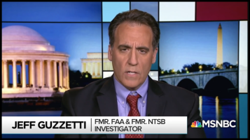 these operations have less stringent requirements than other commercial aviation operations.”
A 2021 NTSB report called for the FAA to reevaluate its treatment of air tours, noting there’s “a long history of concerns about the safety” of these flights because they “are not held to the same maintenance, airworthiness, and operational standards” as most other air carriers.
The report said safety standards for skydiving and sightseeing flights, based on its investigations of multiple accidents, found “a lack of structured pilot training, deficiencies in pilot skills and decision-making, and inadequate aircraft maintenance were occurring.”
FMI: www.ntsb.gov
[1] Relevant dockets – Docket No. 10145 (1962); Docket No. 10145; Amendment 91‑XX (1963–1965 updates); 1995 Rewrite of Part 119/135 (The Modern Framework for “Commercial vs. Noncommercial”), Docket No. 28154Source: 60 FR 65913 (Dec. 20, 1995) [ It created Part 119, which defines when an operator must comply with Part 121 or 135. It explicitly distinguishes private carriage (Part 91) from common carriage (Parts 121/135). It contains multiple statements that the FAA intentionally imposes lesser safety standards on Part 91 because THE OPERATIONS ARE NONCOMMERCIAL, VOLUNTARY, AND OPERATOR‑RESPONSIBILITY‑BASED. 2001 Parachute Operations Final Rule (Major Modernization of Part 105)
- Docket No. FAA‑1999‑5483Source: 66 FR 23543 (May 9, 2001) This is the most important modern parachute rulemaking. Why this docket matters: It explicitly discusses skydiving risk, voluntary participation, and why Part 91 oversight is appropriate. It references the 1962–1965 rulemaking and confirms that the FAA has always treated skydiving as a Part 91 recreational activity. It contains FAA statements that skydiving is inherently risky, but that the FAA’s role is to regulate airspace and aircraft, not the sport itself.
[2] Not only will this option lead to very quick conveying of information to the people considering these flights, but from a regulatory compliance perspective, oversight of long list of applicable safety regulations would further strain the FAA’s already stressed inspectors.
