It Happened in Las Vegas—But What Did It Reveal (or not) About eVTOLs?

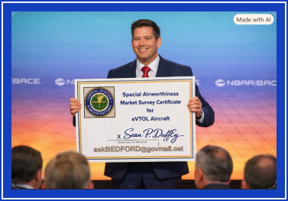
Much of the eVTOL revolution has emanated from Washington. President Trump’s Secretary Duffy chose Las Vegas, NV to make a TRULY MONUMENTAL ANNOUNCEMENT at NBAA’s BACE. The announcement is so remarkable that the President Trump’s DOT press release is the first section of this post- READ ABOUT
SPECIAL AIRWORTHINESS
MARKET SURVEY
CERTIFICATE
{SAMSC}
Below that description, there are some questions that are raised by this NOVEL pronouncement.

Trump’s Transportation Secretary Sean P. Duffy Announces First-Ever Special Airworthiness Market Survey Certificate for eVTOL Aircraft
Wednesday, October 21, 2026
LAS VEGAS, NV – U.S. Transportation Secretary Sean P. Duffy today announced the Federal Aviation Administration (FAA) has issued a first-of-its-kind SPECIAL AIRWORTHINESS MARKET SURVEY  CERTIFICATE to BETA Technologies to conduct flight operations with its ALIA eVTOL aircraft (A250). This marks the Trump Administration’s latest move to unleash American innovation in our skies and unlock the future of flight in America.
In March, Secretary Duffy unveiled the eIPP program to begin testing advanced air mobility aircraft and their real-world applications. The eight selected projects span 28 states and partner with leading aircraft manufacturers, operators, and state partners, including:
- Urban air taxi services
- Regional passenger transportation (including short Takeoff and Landing aircraft)
- Cargo and logistics networks
- Emergency medical response operations
- Autonomous flight technologies
- Offshore and energy-sector transportation
What this means:
AFTER CAREFUL REVIEW BY FAA SAFETY EXPERTS, BETA’s A250 aircraft is now authorized to conduct flight operations with operators and participants for the purpose of conducting market surveys. The certificate also expands the geographic scope of BETA’s operations, allowing the aircraft to fly in more environments and gather more data.
Why it matters:
The safe integration of next-generation Advanced Air Mobility (AAM) aircraft into the national airspace is essential to ENSURING THE U.S. LEADS THE WAY in aviation innovation. AAM has the potential to reshape how Americans live, work, and connect by enhancing rural and urban transportation, strengthening cargo operations, and advancing both medical and military transportation. This certification takes the industry one step closer to that reality.
“Incredible things are happening in aviation thanks to President Trump and his commitment to innovation. The FAA’s special airworthiness certification of BETA’s A250 aircraft is another critical step towards enabling the future of flight in America,” said U.S. Transportation Secretary Sean P. Duffy. “I want to thank our incredible safety team at the FAA for their hard work and congratulate BETA on reaching this milestone. From bringing the next generation of aircraft online to modernizing our nation’s air traffic control system – we are delivering generational wins for the flying public at record speed.”
“The FAA is committed to working with American innovators to safely integrate these new aircraft into our national airspace, while maintaining the rigorous safety standards that have made the United States a global leader in aviation,” said FAA Administrator Bryan Bedford.
“This authorization brings vertical flight CLOSER TO THE PEOPLE AND PLACES that will put it to work, building on BETA’s track record of industry firsts. We completed the first crewed eVTOL transition flight in 2024, were first to receive market survey authorization for our CTOL, and now we’re first with our VTOL,” said BETA Technologies Founder and CEO Kyle Clark. “Operators can now experience the A250 firsthand and begin planning how it fits into their businesses, from connecting communities to moving people and goods at a lower cost. That’s an important step toward commercial adoption, and we’re grateful to the FAA for developing the regulatory framework that makes these operations possible.”
Secretary Duffy will discuss the announcement later today at the National Business Aviation Association (NBAA) convention in Las Vegas…

QUESTIONS, QUESTIONS, QUESTIONS
??????????????
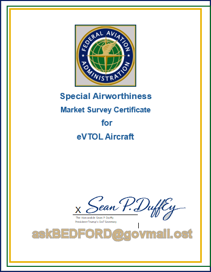 Before addressing these questions, the White House, DOT, and FAA lawyers and airworthiness technicians deserve recognition. Their creation of an eIPP plan, the OTA, and this new category of certification is exceptional and beyond the imagination of some of those who previously help those positions.
- The first question is where can one find the definition of what constitutes an SAMSC? The Secretary provided a link (https://www.faa.gov/aircraft/air_cert/aw_cert/special_aw_certificates) clicking on it reveals this list:
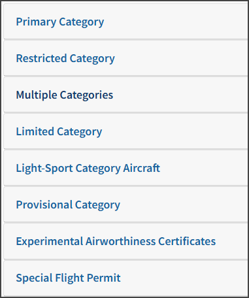
Which came from 14 CFR 21 Subpart H
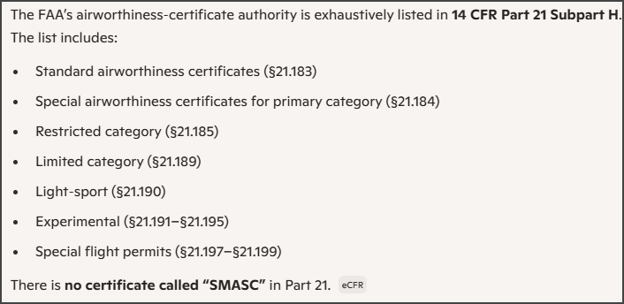
While §21.195 — Experimental airworthiness certificates: Aircraft to be used for market surveys, sales demonstrations, and customer crew training might be said to be applicable,
If the FAA Safety Experts (engineers?) have completed a “CAREFUL REVIEW,” was it based on AC 21‑12C, the FAA’s advice to applicants for SPECIAL FLIGHT PERMITS under §21.197–§21.199? That advisory circular asks
- WHAT THE FAR/ AC REQUIRES FROM THE APPLICANT?
AC 21‑12C reiterates the mandatory items an applicant must submit under §21.199, including:
►Purpose of the flight
►Proposed itinerary
►Required crew
►Specific ways the aircraft fails to meet airworthiness requirements
►Applicant‑proposed restrictions for safe operation
►Any other information needed for FAA to prescribe operating limitations
►FAA EVALUATION: “CAPABLE OF SAFE FLIGHT”
The AC explains how FAA inspectors determine whether the aircraft is safe enough for the specific ferry/delivery/demo flight requested. This may include:
-
-
- Reviewing maintenance records
- Inspecting the aircraft
- Requiring functional checks or test flights
- Imposing special limitations (e.g., day VFR only, no passengers, altitude caps)
-
This authority comes from §21.199, which allows the FAA to make or require inspections or tests before issuing the permit.
► Operating limitations
AC 21‑12C explains that the FAA will ATTACH OPERATING LIMITATIONS to the permit, consistent with §21.181(a)(2) (time‑limited validity) and §21.197 (purpose‑limited authority). Typical limitations include:
-
-
- Weather minima
- Routing restrictions
- Fuel requirements
- Crew qualifications
- Prohibition on carrying passengers or cargo
-
These limitations become part of the Special Airworthiness Certificate (Special Flight Permit) itself.
►Authorized purposes (from §21.197)
AC 21‑12C restates the five regulatory purposes for which SFPs may be issued:
-
-
- Ferry to maintenance or storage
- Delivery or export
- Production flight testing
- Evacuation from danger
- Customer demonstration flights (new production aircraft) Plus the overweight ferry provision in §21.197(b).
-
The last three tests may legitimatize the SAMSC name, but what are/were the airworthiness criteria for the Secretary’s CAREFUL REVIEW on which SAMSC was based?
►What AC 21‑12C does not do
-
-
- It does not create new certificate categories.
- It does not authorize new operational purposes beyond §21.197.
- It does not provide technical airworthiness criteria.
- It does not allow flight of an aircraft that is not capable of safe flight.
-
It is strictly a procedural advisory circular.
- WHAT OPERATING LIMITS (181(a)(2) WERE ATTACHED?
►BETA Technologies Founder and CEO Kyle Clark is quoted as saying:
“This authorization brings vertical flight CLOSER TO THE PEOPLE AND PLACES that will put it to work… Operators can now experience the A250 firsthand and begin planning how it fits into their businesses, from connecting communities to moving people and goods at a lower cost.”
►Mr. Clark’s comment may not have elevated to a full recognition of his regulatory limitations, but §§21.181(a)(2) and §21.197 mandate that safety requires that Weather minima and Routing restrictions be set for the ALIA eVTOL aircraft (A250). Given the as-of-yet unknown places and missions that the SAMSC will authorize, surely there must be some more precise document that meets the regulation requirements and AC guidance? The operational benefits of a certificated eVTOL is capable of limitless flights; so, those guard rails contemplated by the rules appear to be an absolute.
-
-
- If the use of PART 21 SUBPART H does not justify the use of a heretofore UNKNOWN CLASS OF AIRCRAFT, what THEN?
-
►FAA would have to:
-
-
- Publish an NPRM
- Receive public comment
- Publish a Final Rule
- Amend Part 21
- Update FAA Orders & guidance
-
No NPRM or Final Rule exists for SMASC.
-
-
- Insurers rely on the FAA’s determination of airworthiness and they are well familiar with the existing certificate categories
- They may query whether the SMASC is the sort of clear regulatory basis they require
- They employ experts who will assess the SMASC’s defined operating limitations (or not?)
- At best they have whatever data that eIPP has generated and if they have access to those numbers, they will either apply known risk models or have to develop a complex algorithm for this category of flight
- No insurer has published underwriting guidance for “SMASC”
- No evidence exists of policies issued referencing “SMASC”
-
This is an issue earlier posed FAA, LLOYD’s and eIPP? (June 2026). Either the OEMs were able to obtain coverage or the risk/reward calculation of flights without insurance determined that it was an acceptable option. Both outcomes suggest that my strategic eye suffers from myopia. IF EIPP & OTAS AS WELL AS SMASC WORK, THEN AMERICAN AVIATION AND ECONOMY WILL BE SEEING DIVIDENDS FOR THEIR ENTERPRISE!!!

