ICAO’s fixation on CO2 Emissions need not delay Airlines’ immediate Contrail Reduction
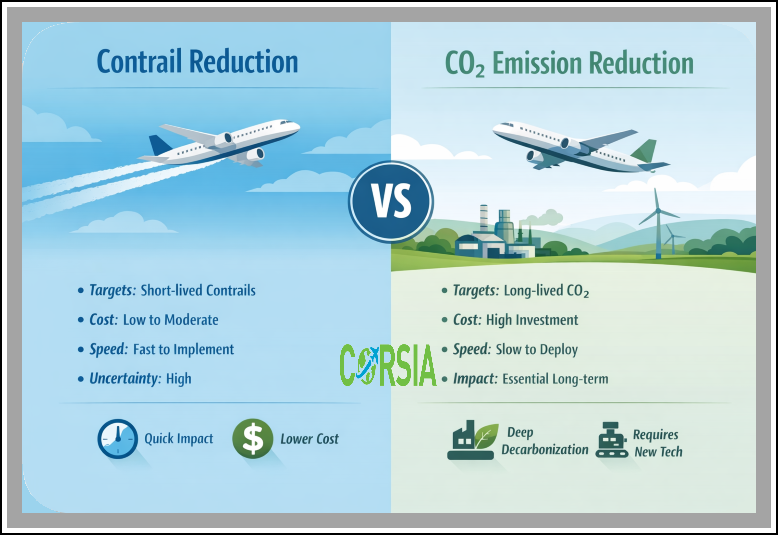
AIN’s managing editor filed a report on a NEW RESEARCH EFFORT by Boeing, Honeywell, and the University of Reading, supported by Aerospace Technology Institute. The goal of this impressive initiative is to “improve understanding of contrails and their climate impact.” A second impressive study by Thales and French charter flight operator Amelia has already accumulated two years of tests with important results.
The International Civil Aviation Organization (ICAO) Council issued, on March 27,2026, new CO2 emissions standard–10% more stringent; a more stringent CO2–applicable to new aircraft type designs as of 2031 and a new standard for deliveries of in-production aircraft types from 2035. THERE WAS NO MENTION OF CONTRAILS OR NON‑CO₂ CLIMATE IMPACTS. The absence of any mention of contrails by the Montreal UN aviation safety is attributed to:
-
- CO₂ and noise fall under Annex 16 certification standards (aircraft design).
- Contrail mitigation is an operational and meteorological issue, not a design standard.
- ICAO has been studying contrails within CAEP, but has not yet integrated them into binding standards.
While, ICAO is still in the “framework and research” phase, while Europe, the US, and airlines are already running real‑world contrail‑avoidance trials.
In addition to AIN’s review of the two studies, there are other significant efforts to assess the potential of contrail-avoiding strategies:
SATAVIA (DECISIONX)
-
-
- What it does: Optimizes flight plans to avoid regions where persistent warming contrails are likely to form, using high‑resolution atmospheric modeling.
- ESA & UK Space Agency have funded SATAVIA’s DECISIONX contrail management trials with 12 airlines (Condor, SunExpress, Icelandair, etc.).
- ~65 flights optimized
- >2,200 tCO₂e equivalent warming avoided
- <0.4% fuel burn increase on medium‑haul flight
- Status: Voluntary, commercial service; operationally real, but not mandated.
-
Google / American Airlines / Breakthrough Energy / Eurocontrol
-
-
- What they built: An AI‑driven contrail prediction and avoidance tool using satellite imagery, weather, and flight path data.
- Result: In real‑world tests with American Airlines, contrail generation was reduced by more than half on participating flights.
- Mechanism: Small altitude changes (a few thousand feet) to avoid humid layers where contrails would persist.
-
These efforts show:
-
-
- Technical feasibility: You CAN AVOID A LARGE FRACTION of warming contrails with modest trajectory changes.
- Operational viability: Impacts on fuel and time can be kept small.
- But still voluntary: AIRLINES OPT IN; ANSPs and regulators haven’t made it a requirement.
-
Regulatory Requirement involves processes that are slow; whereas airlines CAN AND MAY IMPLEMENT NOW CONTRAIL MITIGATION PROCEDURES without negative impacts on fuel and time. To summarize the merit of implementing Contrail Avoidance now:
-
-
- Climate impact magnitude
- Aviation CO₂: Aviation is ~2.5% of global anthropogenic CO₂ emissions.
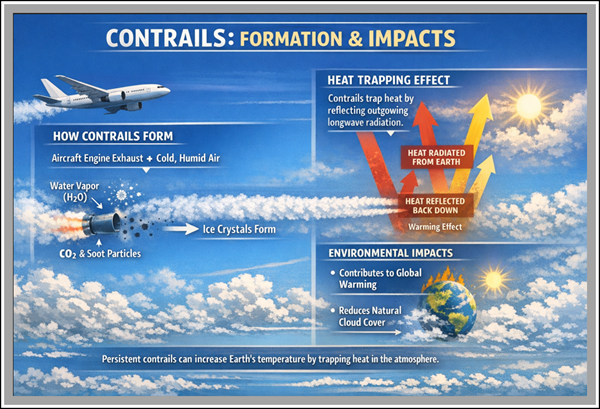
- Non‑CO₂ (contrails, NOₓ, etc.): Multiple assessments now suggest that non‑CO₂ effects (especially contrail cirrus) are comparable in total warming to aviation’s historical CO₂ impact—possibly of the same order of magnitude as all aviation CO₂ since the 1940s.
- Contrail formation and concentration
- Mechanism: Contrails form when water vapor and particulates (soot, aerosols) from engines encounter cold, humid air at cruise altitudes, forming ice‑cirrus clouds.
- Skewed contribution: A relatively small fraction of flights (those passing through specific ice‑supersaturated layers, often at night) produce a large share of warming contrails.
- Mitigation potential
- Operational avoidance: Route/altitude adjustments to avoid ice‑supersaturated regions can cut contrail warming substantially. A DLR analysis of 85,000 routes found that a ~73% reduction in contrail climate effect could be achieved with <1% increase in CO₂, with a ~99% PROBABILITY OF NET CLIMATE BENEFIT.
- Fuel/engine effects: Lower soot emissions (via cleaner combustors, SAF, or hydrogen in the long term) reduce ice crystal number and can weaken contrail cirrus.
- Uncertainties
- Physics and monitoring: We still lack robust per‑flight monitoring and prediction tools; contrail radiative forcing is highly variable by time of day, region, and weather.
- Regulatory status: Non‑CO₂ effects are not yet regulated like CO₂, and metrics for integrating them into policy (e.g., CO₂‑equivalent over different time horizons) are still debated.
- Climate impact magnitude
-
Contrail mitigation does not interfere with CO₂‑centric policy — and it does offer near‑term climate benefits Contrail mitigation is operational, not technological
-
-
- CO₂ reduction strategies (SAF, hydrogen, new engines, new airframes) require new fuels, new infrastructure, or new aircraft.
- Contrail mitigation requires small altitude or routing adjustments on a subset of flights.
- Because the mechanisms are different, there is no conflict with CO₂‑centric regulatory frameworks like:
- ICAO CO₂ Standard
- CORSIA
- EU ETS
- SAF blending mandates
-
These systems measure or price CO₂, not contrails — so contrail avoidance sits alongside them, not in competition.
Contrail mitigation can deliver climate benefits now, not in 2035–2050
The science is consistent:
-
-
- <3% of flights cause ~80% of contrail warming
- Avoiding those flights’ contrails can cut aviation’s near‑term warming by 20–40%
- Fuel penalties are typically 0.1–2%, depending on the route and method
-
That means:
-
-
- High climate leverage
- Low operational cost
- No need to wait for new aircraft or fuels
-
This is why contrail mitigation is often described as the highest‑impact near‑term climate lever available to aviation.
It simply adds a parallel operational layer that reduces non‑CO₂ warming.
Think of it as:
-
-
- CO₂ policy = long‑term decarbonization
- Contrail mitigation = short‑term climate damage reduction
-
Engine‑centric CO₂ reduction
-
- Research cost profile
- Focus: Higher bypass ratio turbofans, open rotors, ultra‑high efficiency cores, hybrid‑electric concepts, hydrogen combustion, and SAF production pathways.
- Scale: Multi‑billion‑dollar programs per engine/airframe family over 10–20 years, plus large public funding for SAF and hydrogen infrastructure.
- Implementation cost
- New engines/airframes: Airlines must purchase new aircraft or re‑engine existing fleets; OEMs bear huge R&D and certification costs.
- SAF scale‑up: Requires refineries, feedstock supply chains, blending, and distribution infrastructure at airports; capital expenditures in the tens to hundreds of billions globally over decades.
- Hydrogen: Even more capital intensive—new aircraft architectures, cryogenic storage, airport hydrogen production, and handling.
- Research cost profile
ICAO, by organizational design, takes time to implement or change standards; getting nations to agree on terms that apply (albeit not mandated) to CAAs. The results of the Montréal deliberations will impact regulatory systems with a wide range of climates, terrain, governmental power/status/staffs, aviation community (sophisticated to not so much), national priorities, etc. Not having advanced its standards for Contrail Avoidance need not deter airlines from acting NOW!!!
Honeywell and Boeing Seek Improved Contrail Assessments
Partners aim to integrate more effective sensors on aircraft to measure contrail formation
By Charles Alcock • Managing Editor
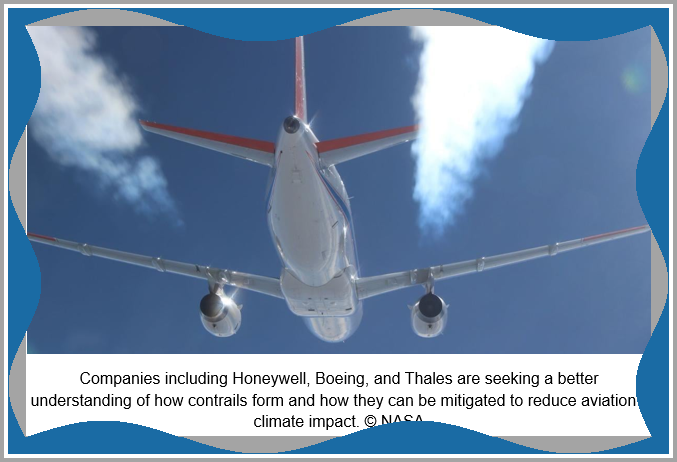
Honeywell and Boeing are teaming with the UK’s University of Reading to develop a new type of aircraft-based sensor they say could improve understanding of contrails and their climate impact. PROJECT MIST, announced on March 18, has received funding from the Aerospace Technology Institute, which is backed by industry and the UK government.

The focus of the work is to improve in-flight atmospheric sensing capabilities to increase the accuracy of contrail forecasting and enhance weather modelling. The partners did not say when or how they intend to start flight trials with innovative technology resulting from the project.
Contrails are clouds of ice crystals formed when hot, humid jet engine exhaust mixes with very cold air at high altitudes. According to the partners, current humidity sensors have limited measurement capabilities and are not widely used on commercial aircraft that could be collecting data. Alternative technologies are available, but these can require significant redesign work to be deployed by airlines.
 Honeywell is responsible for Project Mist’s sensor hardware integration and systems integration tasks, building on the group’s extensive experience with sensing technologies for aircraft. The company’s site at Yeovil in the UK is directly involved in the work.
Boeing’s contribution to the project involves aircraft integration, testing, and operational expertise to evaluate sensor performance. This work will be led by the airframer’s team in Bristol, UK, supported by colleagues from Seattle.
The University of Reading’s Department of Meteorology is contributing its experience with contrail modeling and climate analysis. It has been involved in research into the climate impact of aviation for more than three decades, in part through its involvement in European initiatives looking at the impact of emissions other than carbon dioxide—for example, EASA’s Aviation Non-CO2 Expert Network.
French Airline Trials Contrail Avoidance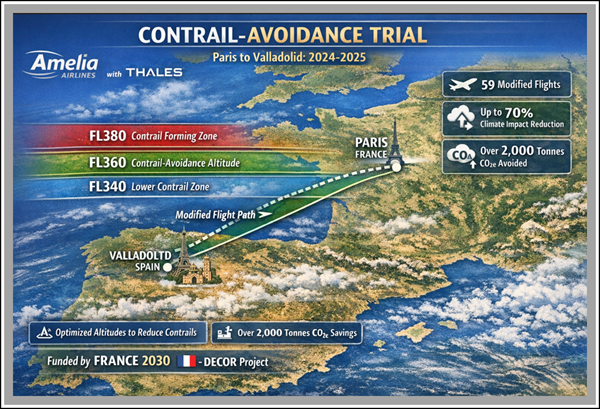
In related news, Thales and French charter flight operator Amelia this week announced they have expanded contrail-avoidance trials that started in 2024 on flights between Paris and Valladolid in Spain. Thales has helped the airline to modify the altitudes at which its aircraft fly to avoid contrail formation without the need to change routes and burn more fuel.
In 2025, Amelia started using the Thales flight planning tools on its fleet of Airbus A319/320 and Embraer ERJ-145 aircraft. The partners reported on March 19 that over the course of the year, this initiative—which is part of the French government-backed Decor program—REDUCED THE AVERAGE CLIMATE IMPACT OF EACH FLIGHT BY AROUND 70%.
Amelia’s approach has been to focus its mitigation efforts most on the relatively small number of flights in which contrail formation is most persistent and the greatest climate warming impact is caused. Using modeling developed with Thales, the operator said that it has AVOIDED BETWEEN 2,000 AND 2,500 METRIC TONS OF CO2-EQUIVALENT EMISSIONS DURING 2025 ALONE. This outcome was achieved from making altitude adjustments to just 59 out of 6,400 flights operated last year, while incurring less than 0.1% increase in fuel consumption as a consequence of the changes.
“By targeting high-impact flights, we remove the barrier of scientific uncertainty about the magnitude of the phenomenon and focus on immediate action,” commented Adrien Chabot, Amelia’s director of sustainability.