GREAT ALPA Back-to-Basics campaign, but refining scope makes it BETTER???
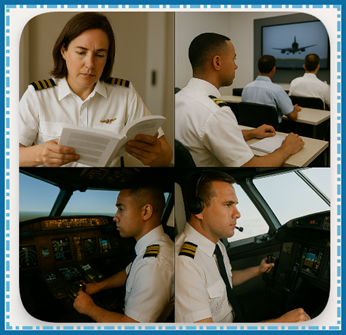
Boeing 787 Captain Wendy Morse, ALPA 1st VP, has opined that her cockpit peers need to ENHANCE THEIR UNAUTOMATED FLYING SKILLS. She based her recommendation on unspecified SAFETY data. Along other experts who agree, the Captain’s initiative is meritorious and should begin soon.
According to the FAA, there are about 92,000 pilots flying for 66 airlines. That universe of cockpit skills required for each aircraft type flown and all of the PICs/SICs constitute a HUGE TRAINING CHALLENGE. Dividing the men and women who are authorized to manipulate the controls into age, flying hours, trainings, demands of their current assignments, etc. further complicates this pedagogical task. Perhaps the Captain’s data[1] provides more granularity, but if not (likely), the deficiencies identified further broaden set of needed remedial skills.
A massive hand-flying program designed to reinforce all of these skills will require substantial training (away from flight time) and will strain the classrooms/simulators/planes availability. A generalized syllabus will not necessarily address the differences in this NEW hand-flying trainees and may not focus on the equipment or operating environment of each airline.
This list attempts to inventory the range of possible subjects that fall under Captain’s Morse call for improved performance in the cockpit—
- Aircraft Control Mastery: Smooth, coordinated use of ailerons, rudder, and elevator to maintain stable flight.
- Energy Management: Judging pitch, power, and drag to keep airspeed and altitude within safe margins.
- Spatial Awareness: Constant reference to horizon, runway, and visual landmarks for orientation.
- Instrument Cross-Check: Rapid interpretation of multiple gauges (airspeed, altitude, attitude, vertical speed) without reliance on automation.
- Precision in Maneuvers: Ability to execute steep turns, climbs, descents, and approaches with accuracy.
Cognitive and Mental Attributes
- Situational Awareness: Continuous mental “map” of aircraft position, weather, traffic, and ATC instructions.
- Focus and Concentration: Sustained attention during long flights and high workload phases (takeoff, landing, emergencies).
- Memory and Recall: Accurate retention of ATC clearances, checklists, and procedural steps.
- Decision-Making Under Pressure: Rapid evaluation of options during failures or unexpected events.
- Mental Flexibility: Ability to shift between visual flying (“outside-in”) and instrument flying (“inside-out”) depending on conditions.
Technical and Procedural Skills
- Accuracy of Data Input: Correct entry of headings, altitudes, speeds, and frequencies into radios and navigation systems.
- Checklist Discipline: Methodical execution of normal and emergency checklists without omission.
- ATC Communication: Clear, concise, and correct readbacks; careful listening to avoid misinterpretation.
- Workload Management: Prioritizing tasks (aviate, navigate, communicate) when workload spikes.
- Manual Navigation: Proficiency with charts, VORs, NDBs, and raw data approaches when automation is unavailable.
⚖️ Physical and Psychomotor Attributes
- Hand-Eye Coordination: Fine motor control for precise inputs on yoke, rudder pedals, and throttles.
- Kinesthetic Sensitivity: Feeling subtle changes in aircraft attitude, vibration, or trim.
- Endurance and Stamina: Maintaining performance during extended manual flying without fatigue.
- Multitasking Ability: Balancing control inputs while monitoring instruments and communicating with ATC.
If possible, it appears that before beginning this ambitious exercise, REFINING THE SCOPE of this important safety initiative and hopefully DEFINING A MORE FOCUSED SET OF SPECIFIC SKILLS for the reinforcement tasks would be worthwhile. Each airline’s existing SMS data may target the areas to be included. If not a FOCUSED SAFETY RISK MANGEMENT effort (something akin to a Flight Risk Assessment Tools exercise (FRAT)) should produce key markers for the airline seeking this analysis. We have experience in both of these FAA sanctioned safety assessments and should add insight into any airline’s thoughtful introspection.

Union Urges ‘Back-to-Basics’ Approach to Pilot Skills
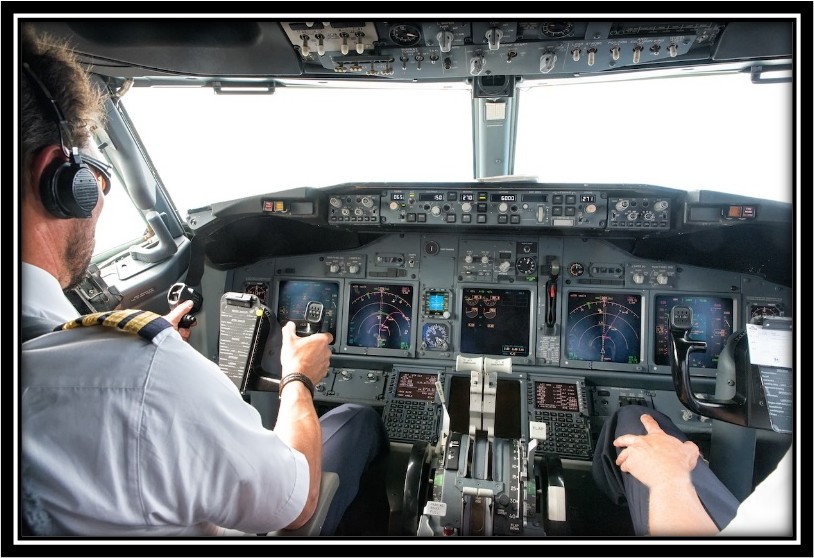
ALPA vice president doubles down on hand-flying, training quality, and technology’s role in safety.
Boeing 737 flight deck [Credit: Shutterstock/Atosan]
The Air Line Pilots Association (ALPA) is calling for a renewed emphasis on fundamental flying skills as automation becomes more common in air carrier operations.
In a recent interview at the Skift Aviation Forum in Fort Worth, Texas, ALPA first vice president Wendy Morse, a Boeing 787 captain, said the union is advocating for pilots to “go back to our roots” by maintaining strong manual-flying proficiency throughout their careers.
The union represents over 80,000 airline pilots at 43 carriers.
“So the biggest thing is [getting] back to basics…We have to maintain a basic level of flying, a basic level of flying skills, and we have to continue to maintain those basics,” Morse said. “This business about positive rate, gear up, [and] put on the autopilot is not a good idea. We have to keep flying the airplane so that we’re good at it.”
Morse added that she routinely hand-flies the aircraft to cruise altitude.
“People are like, ‘Oh, my gosh, all the way to 37,000 feet?’ Yep,” she said. “That’s what I do because I like to fly.”
‘Losing Their Skills’
She said the industry recognized the need for more manual flying through safety data that showed pilots’ hands-on skills were beginning to erode.
“The data was saying that pilots are losing their skills,” Morse said. “So we need to start [suggesting] to them and recommend that we think you should be flying planes—hand-flying the airplane.”
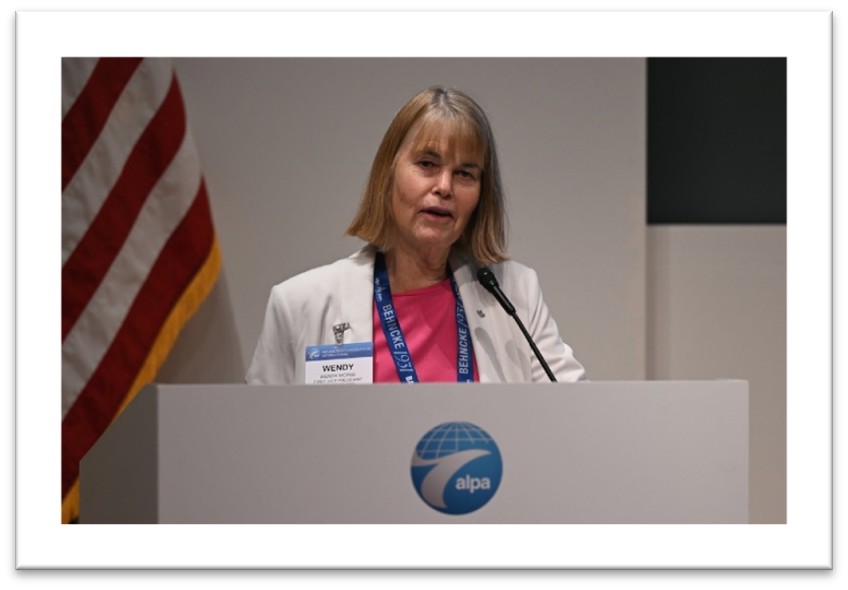
ALPA first vice president Wendy Morse [Credit: ALPA]
TEXT NOT RELEVANT TO THE SUBJECT MATTER
Addressing cockpit staffing, Morse referenced ALPA’s “Safety Starts With Two” campaign opposing single-pilot airline operations. She criticized past proposals from Airbus and others to reduce cockpit crews.
“They decided one pilot in the cockpit was a good idea because it would cost less money,” she said, describing scenarios in which the sole pilot might need to leave the controls. “Who’s at the controls? Oh, nobody’s at the controls.”
She said efforts to advance reduced-crew operations are “paused and not over.”
Morse emphasized that technology is valuable when it supports pilot decision making, citing terrain-avoidance systems and real-time turbulence tools on flight decks. She said artificial. intelligence will likely assist with learning and data analysis but stressed that it must be monitored
“We have to be very careful to not let AI give us bad data,” she added, noting that data-sharing programs have been the “game changer” in improving safety over the past two decades.
[1] All of the information collected under the FAA’s authority are disaggregated to protect the individual’s identity.

