FAA’s AC great advice for dealing with the Pilot-COMPUTER Interface
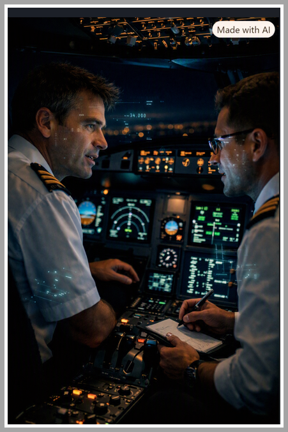
Pilot-Computer interface is one of the most exasperating aviation safety issues facing the industry today. The safety benefits of automation are obvious, but how well does the human function when the machine “replaces” the cockpit team? That’s a subject that has drawn the attention of the JDA Journal (a/k/a Federal Aviation Administration (FAA) Knowledge & Insight), for example:
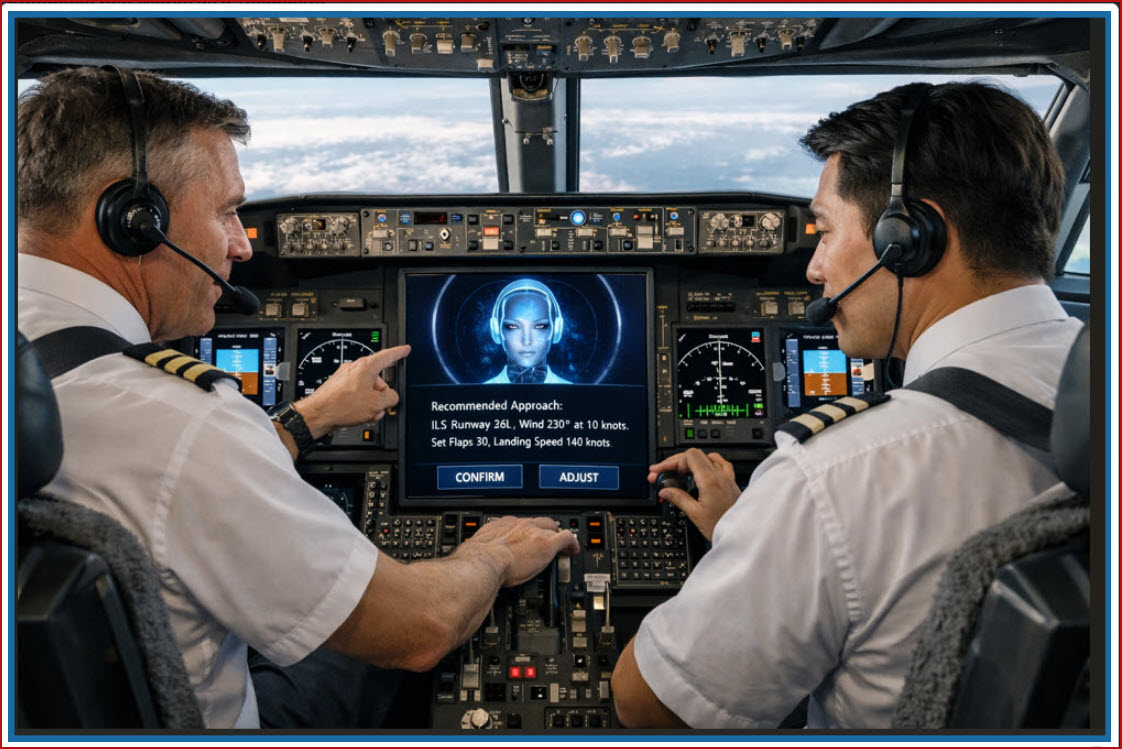
 Boeing’s new cockpit design- EXPLAINABLE AUTOMATION—PLUSES AND MINUSES???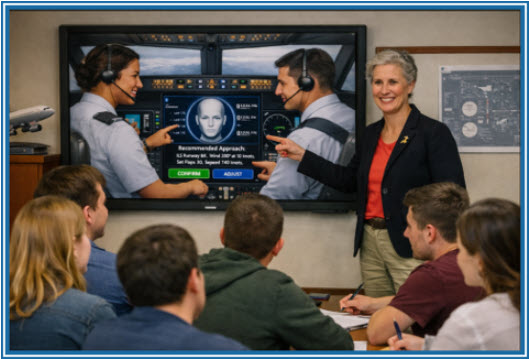
Congratulations to FAA Flight Standards Service for issuance of AC-120-71B Standard Operating Procedures and Pilot Monitoring Duties for Flight Deck Crewmembers, an important guide on how operators (not just P121,135, but all flight organizations) should design, implement, evaluate, and update Standard Operating Procedures (SOPs) and how they should define and train Pilot Monitoring (PM) duties. In short: it tells operators how SOPs should be built and how crews should use them to ensure predictable, safe flight‑deck performance.
{additionally, the below is Simple Flying’s very useful analysis of this seminal document.}
Thirty-four pages and six chapters of clear advice on how to convert the complex, nuanced concept of COGNITIVE CREW FLYING into simple, memorable simple declarative sentences that work in the cockpit. N.B. this AC provides meaningful parameters on how to design Standard Operating Procedures that explicitly design practices for:
-
-
- pilot monitoring – i.e.,
- independently verifying navigation, altitude, speed, flight mode annunciations, and compliance with air traffic control clearances.
- deliberate division of duties
- creates another layer of redundancy, allowing one crewmember to detect programming errors, incorrect mode selections, or unexpected aircraft behavior before they affect the safety of the flight.
- pilot monitoring – i.e.,
-
 Here are the major subjects included in the AC—
-
-
- Triggers for Creating or Modifying SOPs
- SOP Development Process
- Writing SOPs
- Checklist Development
- Pilot Monitoring (PM) Duties

- SOP Implementation and Training
- Documentation, Revision Control, and Distribution
-
This exercise involves a new mindset and your translation of these principals to your ecology may benefit from outside resources.

Why The FAA Tells Airline Pilots To Keep Mentally Flying The Aircraft Even With Autopilot On
For much of a modern airline flight, the autopilot controls the aircraft with remarkable precision. It follows programmed routes, climbs and descends to assigned altitudes, captures instrument approaches, and can even land in extremely poor visibility under the right conditions. To passengers, that level of automation suggests the pilots’ workload largely disappears once the autopilot is engaged. Inside the cockpit, however, the opposite philosophy applies. Rather than relaxing, pilots are expected to CONTINUE MENTALLY FLYING THE AIRCRAFT.
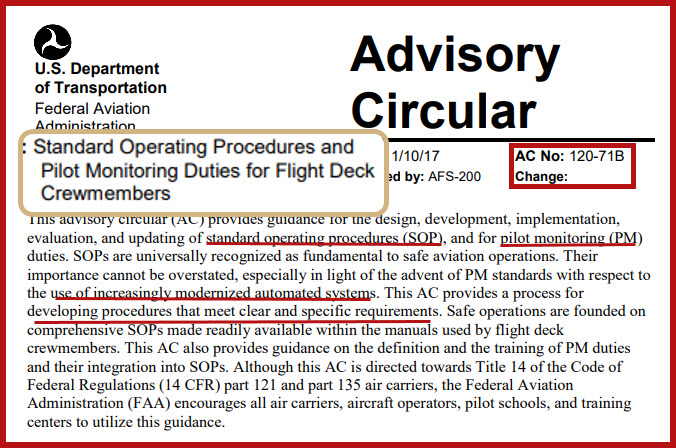
That principle sits at the heart of the Federal Aviation Administration’s Advisory Circular 120-71B, which instructs flight crews to “STAY IN THE LOOP BY MENTALLY FLYING THE AIRCRAFT“ even when the autopilot is engaged. The guidance reflects decades of research showing that automation can reduce workload while simultaneously increasing the risk that pilots become passive monitors rather than active managers of the flight. Modern airline operations therefore treat the autopilot as a powerful tool, not a replacement for pilot judgment. Understanding why the FAA places such emphasis on mentally flying the airplane reveals one of the biggest challenges of today’s highly automated flight decks: preventing the crew from falling behind the aircraft they are supervising.
FAA Wants Pilots To Stay In The Loop, Not Simply Watch The Automation
The phrase “mentally flying the aircraft” appears straightforward, but it describes a specific way of THINKING rather than a physical flying technique. Even with the autopilot controlling the airplane, pilots are expected to anticipate every climb, turn, descent, and level-off before it happens. Instead of waiting to see what the aircraft does, they continually ask themselves what it should do next. If the airplane behaves differently than expected, the discrepancy can be identified within seconds. FAA Advisory Circular 120-71B emphasizes that pilots should monitor the flight instruments just as they would during manual flight. That means continuously cross-checking altitude, airspeed, navigation, vertical path, and aircraft configuration rather than assuming the automation has selected the correct action. The guidance also reminds crews that programming the flight management system is only part of the task. Equally important is confirming that the aircraft is actually following the intended flight path after each selection is made.
One of the FAA’s strongest recommendations is to verify the Flight Mode Annunciator, or FMA, every time a change is made on the autopilot mode control panel. The FMA is a small display that tells pilots exactly which lateral and vertical guidance modes are currently active. It serves as the aircraft’s confirmation that the requested command has been accepted. If the displayed mode does not match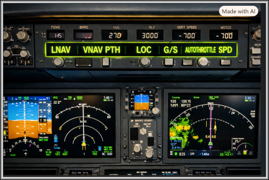 what the crew expected, pilots are expected to identify the difference immediately rather than discovering it later through an unexpected climb, descent, or course deviation.
The FAA’s guidance reflects an important reality of modern automation. The autopilot does exactly what it has been instructed to do, not necessarily what the pilots intended it to do. Remaining mentally engaged throughout the flight allows crews to detect incorrect mode selections, programming errors, or unexpected transitions before they become operational problems, particularly during the busy arrival and approach phases when workload is naturally increasing.
Automation Surprise Is A Human Problem, Not A Computer Problem
One of the biggest risks in a highly automated cockpit is not that the aircraft suddenly behaves unpredictably, but that the crew misunderstands what the automation is about to do. Human factors researchers Nadine Sarter and David Woods described this phenomenon as “automation surprise,” arguing that modern flight management systems should be viewed as powerful and independent agents whose actions must be continuously interpreted by the pilots supervising them.
Unlike a traditional mechanical system that responds directly to a control input, today’s flight management computers make decisions based on hundreds of programmed rules, aircraft performance calculations, navigation data, and active flight modes. As a result, an airplane may begin climbing, leveling off, or changing its lateral path for reasons that are entirely logical to the computer but not immediately obvious to the crew if they have lost track of the automation’s current state.
Research has consistently found that while automation lowers workload, IT CAN ALSO REDUCE VIGILANCE. Instead of actively scanning flight instruments and anticipating the aircraft’s next action, pilots may become passive observers during long periods of routine flight. That reduced engagement makes it more difficult to recognize subtle changes in aircraft behavior, particularly when the automation transitions between modes without any physical input from the crew.
Studies examining airline operations have found that MODE CONFUSION remains a recurring issue despite decades of advances in cockpit technology. One survey of 145 airline pilots reported an average of approximately two mode confusion events per pilot each year. Vertical Navigation, or VNAV, generated the greatest number of reported issues, particularly during arrivals and approaches when the flight management system is simultaneously managing altitude constraints, speed targets, and descent profiles. Those phases of flight leave little time for crews to diagnose an unexpected automation response before additional decisions are required. This research explains why FAA guidance emphasizes ACTIVE MONITORING rather than PASSIVE SUPERVISION. Closing that gap requires constant attention, disciplined cross-checking, and a willingness to question the automation whenever its behavior differs from the crew’s expectations.
Asiana 214 Demonstrated The Consequences Of Losing Mode Awareness
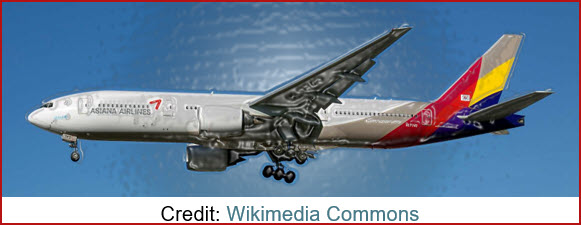
The importance of mentally flying the aircraft became painfully clear on July 6, 2013, when Asiana Airlines Flight 214 crashed while landing at San Francisco International Airport (SFO). The Boeing 777 struck the seawall short of the runway after descending below the proper glide path, resulting in three fatalities and dozens of injuries. Investigators determined that the aircraft itself was functioning normally. Instead, the accident exposed how CONFUSION ABOUT AUTOMATION could erode situational awareness during one of the busiest phases of flight.
The approach was flown with a combination of automation modes that the crew did not fully understand. As the aircraft descended, the pilots EXPECTED the autothrottle to maintain a safe airspeed. However, the system was not providing the protection they believed it was, allowing the aircraft to slow well below the target approach speed. By the time the crew recognized the developing situation, there was insufficient altitude to recover before impact.
The accident also highlighted another concern that has received increasing attention from regulators and training organizations: diminished manual flying proficiency after extended reliance on automation. Investigators concluded that the crew became overly dependent on the aircraft’s automated systems and did not recognize the unstable approach soon enough to initiate a go-around. The National Transportation Safety Board found no evidence that the automation malfunctioned. Rather, the crew misunderstood its operating mode and failed to monitor the aircraft’s energy state effectively.
For the FAA, Asiana 214 reinforced why active monitoring remains essential regardless of how advanced an aircraft becomes. Pilots are expected to verify not only where the airplane is going but also how it is being controlled and whether the automation is behaving as intended. Mentally flying the aircraft creates that continuous comparison between expectation and reality, helping crews recognize a developing problem while there is still time to intervene. The lesson extends far beyond a single accident and continues to shape airline training programs around the world.
Why Monitoring Skills Matter As Much As Manual Flying
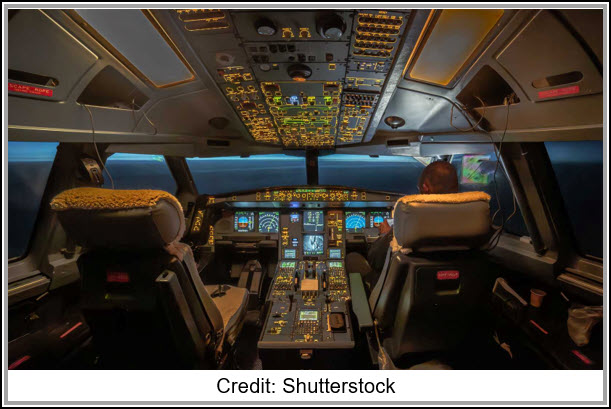 As flight decks become increasingly automated, airlines are placing greater emphasis on MONITORING SKILLS alongside traditional stick-and-rudder proficiency. Flying an aircraft by hand remains an essential competency, but modern crews spend much of their time managing sophisticated systems rather than physically manipulating the controls. Success therefore depends on maintaining situational awareness, understanding automation logic, and recognizing when the aircraft is no longer doing what was intended.
STANDARD OPERATING PROCEDURES {as crafted by AC-120-71B’s direction} denote that the pilot flying focuses on managing the aircraft’s trajectory, while the pilot monitoring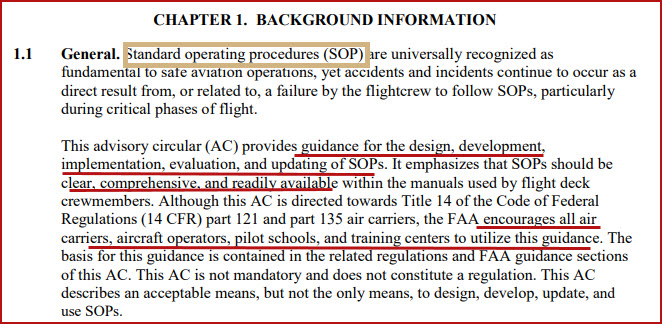 independently verifies navigation, altitude, speed, flight mode annunciations, and compliance with air traffic control clearances. This deliberate division of duties creates another layer of redundancy, allowing one crewmember to detect programming errors, incorrect mode selections, or unexpected aircraft behavior before they affect the safety of the flight. Researchers are also exploring ways to make automated flight decks more intuitive. Human factors studies have recommended clearer contextual information, improved highlighting of active flight modes, and display layouts that reduce unnecessary clutter. The goal is not to reduce automation but to help pilots understand its decisions more quickly, particularly during high-workload phases such as arrivals and approaches when multiple mode changes can occur within a short period.
The FAA expects automation to play an even larger role in future airline operations, making disciplined monitoring increasingly important rather than less. As aircraft systems continue to evolve, the MOST EFFECTIVE CREWS will not simply be those who know how to operate the automation. They will be the ones who consistently stay ahead of it, maintaining the same level of awareness and anticipation that they would if they were hand-flying the aircraft from takeoff to landing.
