Embry-Riddle student highlights the risk to GA pilots from UV rays

A recent study issued by the National Academies “Assessing Radiation Exposure, Health Outcomes, and Mitigation Strategies for Flightcrew Members”, raised concerns about the “impact of galactic cosmic radiation and, in rare instances, solar energetic particles associated with solar storms.” That addresses the risks that flight crews are exposed as follows:
Cosmic‑radiation exposure increases noticeably once an aircraft climbs above the thickest part of Earth’s atmosphere — roughly above 25,000–30,000 feet — and rises rapidly through typical cruise altitudes (35,000–41,000 feet).
The caution raised by that exposure which is primarily focused on commercial aircraft crews.
A graduate at EMBRY-RIDDLE’s Prescott, AZ campus, Sofia Prevatt, has conducted research about the GA pilot community’s awareness of their need to take prophylactic steps for their flying. General aviation pilots are exposed to two types of ultraviolet radiation while flying:
-
-
-
-
- UVB — short‑wavelength, higher‑energy
- UVA — long‑wavelength, lower‑energy
-
-
-
UVB radiation. Most GA aircraft windshields — whether acrylic (Plexiglas) or polycarbonate — block the majority of those rays That means UVB‑related risks like sunburn are greatly reduced inside the cockpit.
UVA: The Real Concern
Long‑wavelength UVA penetrates acrylic and polycarbonate much more easily. This matters because:
-
-
-
-
- UVA reaches deeper into the skin
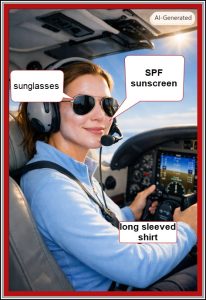
- It contributes to skin aging, wrinkles, and some skin cancers
- Exposure is higher at altitude, where the atmosphere is thinner
- The left side of the face and arm (for left‑seat pilots) receives the most exposure
- UVA reaches deeper into the skin
-
-
-
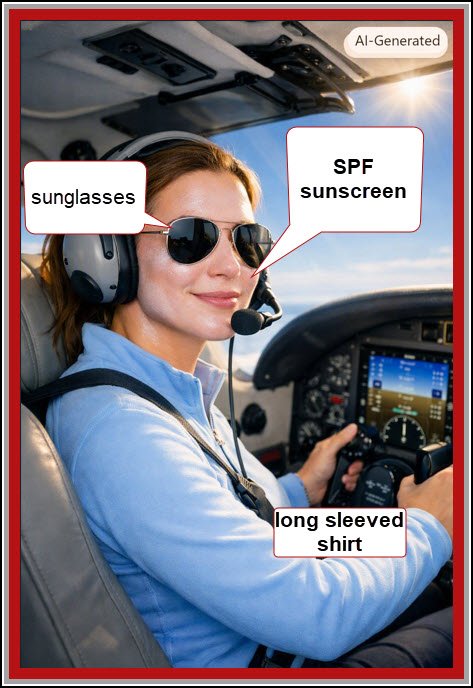
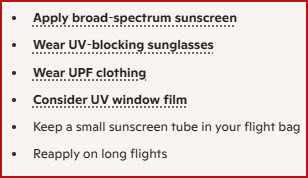 Sofia Prevatt, the student at Embry-Riddle Aeronautical University who wrote the article to raise awareness (see the below article), documented the knowledge of her classmates about the need for sunglasses, SPF cream and long sleeved shirts while in the cockpit. Here is a card with her recommendations on a card suitable for pilots’ flight bags-
Following aviation safety’s ever vigilant, perspicacious approach, Ms. Prevatt intends to go beyond and “involve collaborations with Embry‑Riddle’s engineering students to explore cockpit materials that better limit radiation exposure.”
Safety is the job of any aviation professional. This story shows the breadth of people who can contribute significantly to reducing risks. Keep your eyes open for anything that can be improved.
Eagle Conducts Undergraduate Research on Student Pilot Perceptions of Melanoma Risk
- Author Keaton Ziem
- Date July 14, 2026
Commercial airline pilots flying at high altitudes face exposure to ultraviolet radiation.
To help understand pilots’ attitudes toward this risk, SOFIA PREVATT, a recent Forensic Biology graduate at Embry‑Riddle’s Prescott Campus, conducted a survey of Aeronautical Science students to assess their awareness.
Commercial airline pilots are exposed to high levels of solar radiation[1] because the air is thinner at cruising altitude, offering less natural protection.
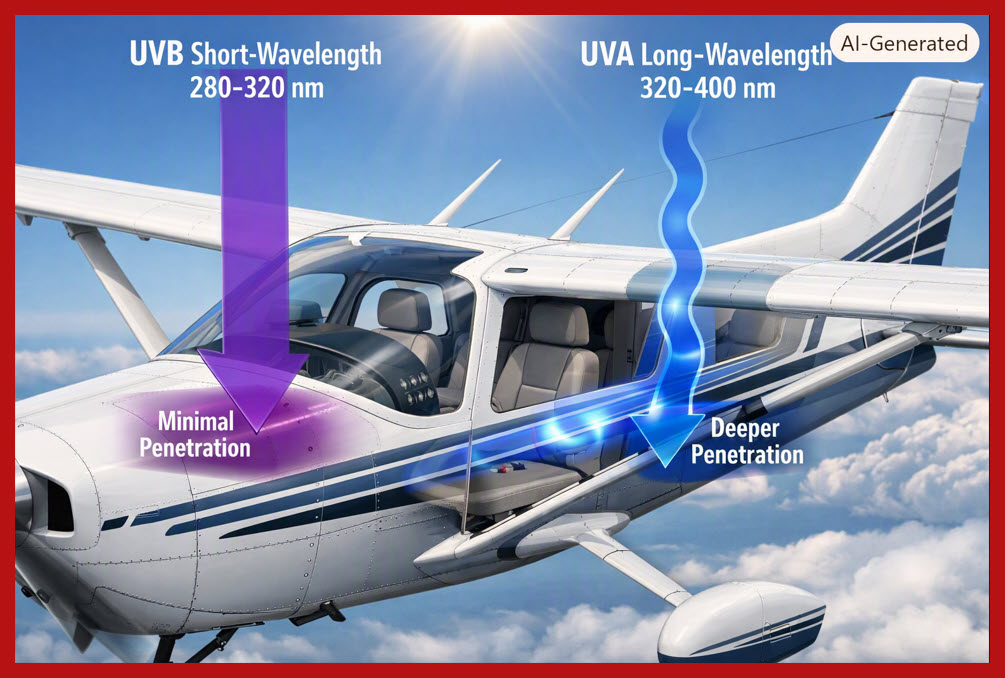 There are two types of solar rays: short-wavelength UVB and long-wavelength UVA. While cockpit windshields are designed to block most UVB radiation, they may allow a substantial portion of UVA radiation to pass through.
One 2015 study in JAMA Dermatology measuring ultraviolet exposure in aircraft cockpits found that pilots FLYING AT 30,000 FEET for about an hour may receive a level of UVA exposure comparable to that of a 20-minute tanning bed session. Cosmic radiation also increases at higher altitudes.
Chronic exposure to such radiation has been linked to melanoma, a form of skin cancer, said DR. STEVE WAPLES, assistant professor of Biology and Chemistry at Embry‑Riddle and a faculty advisor on the project. “Pilots have higher incidence than the general population,” he said.
In her survey of 120 Aeronautical Science students, Prevatt found that 82% of them believed pilots MAY FACE an increased risk of melanoma.
However, fewer students reported consistently taking protective measures against UV exposure. While 67% of respondents reported wearing sunglasses during flight, only 24% said they used sunscreen and 32% reported wearing long sleeves.
That gap highlights an opportunity to reach pilots early in their training.
“Pilots appear to be open to the idea, which allows us the opportunity to provide them with information regarding their risk,” Prevatt said.
Robert L. Sumwalt, executive director of Embry‑Riddle’s Boeing Center for Aviation and Aerospace Safety — and a pilot himself for over 30 years — stressed that melanoma risk in the cockpit is a well‑documented concern that is sometimes overlooked.
“The research happening at Embry‑Riddle is the type of work that moves our industry forward,” he said. “By identifying emerging hazards early, gathering the data and turning it into practical safety improvements, we can improve early-career pilots’ understanding of the risks they face, keeping them safe as they progress over the course of their careers.”
Prevatt said her research could also involve collaborations with Embry‑Riddle’s engineering students to explore cockpit materials that better limit radiation exposure.
“If manufacturing of planes or the use of any type of materials in plane design can be implemented to reduce these exposures, that is yet another way to keep pilots safe,” she said.
Prevatt began the research during an internship with the University of Arizona’s Skin Cancer Institute and has since continued developing it at Embry‑Riddle with support from faculty mentors and the university’s Undergraduate Research Institute.
“They’re taking all the skills they learn in the classroom, and they’re applying them to answer questions and troubleshoot problems,” said Dr. Anne Boettcher, assistant dean of Undergraduate Research at Embry‑Riddle’s Prescott Campus. “They’re already doing all the things they’re going to need to do in the workforce.”
As she prepares for a FUTURE IN MEDICINE, Prevatt plans to continue researching cancer, including melanoma risk in pilots, and to raise awareness about cancer prevention.
[1] Radiation at flight altitudes comes from space–Galactic cosmic radiation — steady background radiation from outside the solar system. Solar energetic particles — bursts of radiation from the Sun during solar storms. These are forms of ionizing radiation, meaning they can affect cells in the body. Exposure occurs when aircraft fly above most of Earth’s protective atmosphere.