3 major CONTRAIL CO2 reduction studies are progressing; must gather info for regulatory approvals

Two recent articles announced important research efforts to measure the impact of CONTRAILs in carbon emissions and assess strategies that will reduce this aerial effluent.
- Germany’s DLR has equipped a business aircraft with sophisticated instruments to measure the “exhaust” from a commercial airliner THAT the commercial aircraft flights
- JAL is instrumenting some of its Boeing 787-9 aircraft- A FIRST-with onboard equipment that will also gather information to ” valuable atmospheric data enabled by aircraft regularly flying broad regions.”
These actions, plus the US’s (→ below) should be among the leaders in efforts to reach the 2050 Net Zero Carbon goal. WHY? According to several sources, CONTRAIL MITIGATION ranks among the most cost-effective and high-likelihood aviation climate strategies today. Unlike SAF or hydrogen, contrail avoidance doesn’t require new technology—just smarter routing and forecasting. Uncertainty remains in quantifying exact climate benefits, but consensus is that the risk of “doing more harm than good” is very low. In the short term, contrail avoidance may deliver larger climate benefits per dollar than CO₂ reduction technologies, while long-term decarbonization (SAF, hydrogen) remains essential. Contrail avoidance is a “no-regret” strategy—cheap, feasible, and impactful—ranking at the top of near-term aviation climate solutions.
Comparison with CO₂ Reduction Strategies underline the value of this initiative:
- Contrails’ climate impact ≈ aviation’s CO₂ emissions: Persistent contrails can warm the atmosphere as much as all CO₂ from aviation.
- Targeted avoidance: Avoiding just the most warming flights could cut contrail-related warming by 20–40% with minimal fuel penalties.
- Cost-effectiveness: Abating 1 ton of CO₂-equivalent via contrail avoidance is far cheaper than renewable energy or direct air capture.
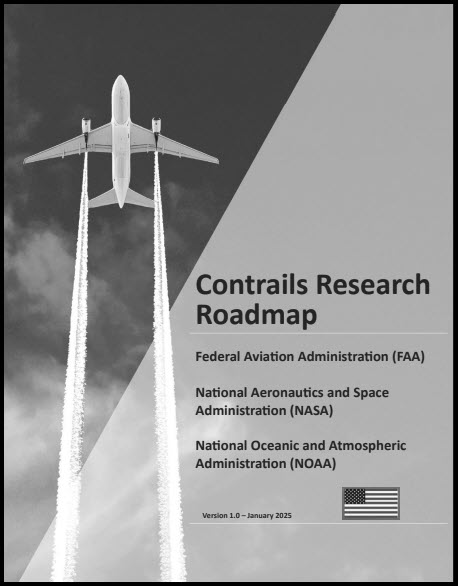
→The US’s strategy is outlined in the Contrails Research Roadmap (2025):
- Atmospheric Science: Understanding physical/chemical processes of contrail formation.
- Weather Prediction: Forecasting atmospheric regions prone to persistent contrails.
- Cruise Emissions: Studying how advanced engines, sustainable aviation fuels (SAFs), and hydrogen affect contrail formation.
- Operational Management: Developing tools for contrail avoidance without compromising safety.
These broad areas of research have been refined into these industry/government collaborative projects:
- NASA–GE Aerospace CODEX (2024): Contrail Optical Depth Experiment using aircraft sampling to measure contrail thickness and radiative effects.
- Airline Demonstrations: Boeing’s ecoDemonstrator program and NASA DC‑8 flights have tested contrail formation under different fuels and engine technologies.

- Sustainable Aviation Fuels (SAFs): Industry trials show SAFs can reduce soot particles, lowering contrail formation likelihood.
- Engine Manufacturers: GE, Pratt & Whitney, and Rolls-Royce collaborate with NASA/FAA to study how combustion technologies affect contrail emissions.

The transition from research to regulation likely will involve some or all of these steps:
- curating information for environmental approvals (FAA, EASA and ICAO),
- STC’s to modify (if that is the next step) the engines or aircraft
and
- perhaps full certification if needed for new aircraft design or GREENER powerplants.
The research process tends to be very focused on the scientific and engineering aspects during these steps. It might be wise to insure that these subsequent, potentially delay inducing steps do not slow the regulatory decisions that must be completed before these advances are authorized.

Falcon 20E Tails German Airliners To Assess Contrails
Germany’s Aerospace Research Center is measuring contrail formation
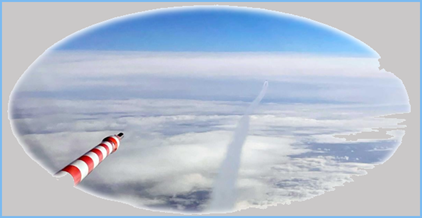
A probe has been fitted to a Falcon 20E jet that DLR is using to measure contrail formation from airliners.
By Charles Alcock • Managing Editor
November 27, 2025
Germany’s DLR Aerospace Research Center has deployed a Dassault Falcon 20E aircraft to monitor contrail formation in European airspace. On Wednesday, the agency reported that the specially equipped jet has been following airliners operated by German carrier TUIfly.
The exercise is part of the EU-backed A4Climate project, which involves 17 other partners from nine countries, including Austrian flight planning group Flightkeys, which is helping DLR to gather data. The project will analyze 400 scheduled flights that have been selected on the expectation that they will generate few contrails as part of an effort to understand how the condensation from jet engines can be minimized.
Researchers are combining data gathered from the flights with other measurements taken from the ground. Satellite data will be used to verify the patterns identified.
DLR has acknowledged that it is hard to adhere to optimum routes that would reduce contrails because of operational factors, including weather and flight delays. The A4Climate team is also addressing how new aircraft engines and alternative fuels could contribute to contrail mitigation. They are looking at how soot and volatile particles in the exhaust plume can change over periods of up to 30 minutes and what this means for the condensation that results in contrails.
Over the two-week flight campaign that started this week, DLR’s Falcon is largely tracking TUIfly flights from Germany to Egypt. Based at the agency’s Oberpfaffenhofen facility near Munich, the business jet flies around 10 kilometers (6 miles) behind the airliners to take measurements in its wake.
Aircraft-Based Atmospheric Observation Project “CONTRAIL” Transitions to Next-Generation Aircraft
Japan Airlines Co., Ltd. (hereinafter “JAL”), JAL Foundation, Meteorological Research Institute of the Japan Meteorological Agency (hereinafter “MRI”), National Institute for Environmental Studies (hereinafter “NIES”), and JAMCO Corporation (hereinafter “JAMCO”) jointly announce that the aircraft-based atmospheric observation project, “CONTRAIL” (*1) (hereinafter the “CONTRAIL Project”), will commence atmospheric observations using the Boeing 787-9 aircraft starting December 4, 2025.
The CONTRAIL Project is a collaborative research initiative that utilizes commercial aircraft to observe greenhouse gas concentrations (mainly carbon dioxide (CO2)) and their isotope ratios in the upper atmosphere at wide spatial scales and high frequency. The aim is to elucidate the global carbon cycle and climate change mechanisms. Continuous upper atmosphere CO2 observations using commercial aircraft (*2) represent the WORLD’S FIRST ATTEMPT OF THIS KIND. Data collected through the CONTRAIL Project are highly valued by researchers both domestically and internationally, contributing significantly to global research efforts.
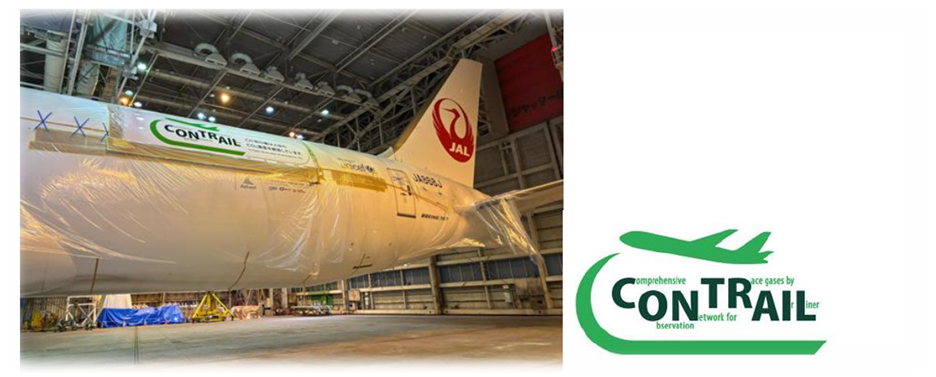
Boeing 787-9 (Registration JA868J) Modified to CONTRAIL Specifications
Since the project’s inception, JAL’s aircraft and network have been leveraged to measure greenhouse gases in the upper atmosphere. As JAL’s main aircraft Boeing 777 are gradually being phased out, the scope and frequency of atmospheric observations has decreased. Now, the development and aircraft modification for TWO OBSERVATIONAL INSTRUMENTS — the CONTINUOUS CO₂ MEASURING EQUIPMENT (CME) (*3) and the AUTOMATIC AIR SAMPLING EQUIPMENT (ASE) (*4) — for installation on the next-generation Boeing 787-9 have been completed. Additionally, modifications of four more aircraft are planned within FY2025, which will further strengthen the observation system. The operation of the JAL 787-9 also allows resumption of observations over India and equatorial regions, and for the first time, observation over the Middle East is expected.

JAL participates in the CONTRAIL Project as part of its “Eco-First Commitment” (*5). Moving forward, the five parties will continue contributing to understanding of climate change mechanisms and global environmental protection through the collection and analysis of valuable atmospheric data enabled by aircraft regularly flying broad regions, with strong teamwork and support from the Ministry of the Environment.
(*1) CONTRAIL: Comprehensive Observation Network for Trace gases by Airliner
https://www.cger.nies.go.jp/contrail/
(*2) Continuous high-frequency data acquisition using international scheduled passenger flights.
(*3) CME: Continuous CO₂ Measuring Equipment
(*4) ASE: Automatic Air Sampling Equipment
(*5) “Eco-First Commitment – Initiatives for Global Environmental Conservation by Leading Environmental Companies”
Details: https://www.jal.com/en/sustainability/environment/environment-management/ecofirst/.
