The PURPLE UAS PORTAL matters— COULD IT DO MORE?
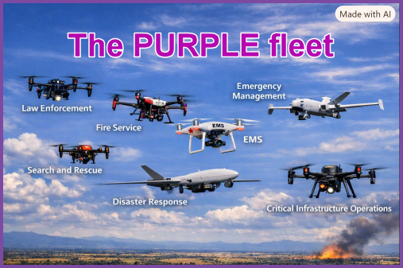
Wichita State University and a consortium of Kansas State as well as the Kansas Crewed and Uncrewed Aerial Systems Association announced (below) that a service labeled FIREPOINT is available to for organizations in the law enforcement, fire service, ems, search & rescue, emergency management, disaster response, and critical infrastructure operations. Their offering is a state-of-art FAA certification for these first responders organizations (not the pilots) with the following valuable services:
-
-
- Safety Management Systems (SMS) tools
- Hazard reporting
- Risk‑assessment workflows

- Corrective‑action tracking
- Operational oversight dashboards
- Training content hosting
- Documentation management
- Agency operational coordination
-
Expediting the certification process for these critical functions is a valuable addition to this sector—WELL DONE FIREPOINT and PURPLE UAS PORTALtm .
These MUST GO flights[1] involve risks inherent in the flights, incidents from which their peers might learn. Strawman name PURPLE OPS UAS RESOURCE (POUR)?
 Having assembled all of the elements that the individual operators need, the consortium could expand this initial tool into an SMS site that captures all of their alumni’s operational experience. The team might consider extending its service beyond a portal to initial certification. The POINT today is a major milestone along the way, but expanding a CAS-like source of ongoing lessons learned from each carrier’s issues would make POUR a potent safety tool.
Each Purple organization would then use their SMS process with some level of similarity by virtue of the initiation source. This common SMS process will simplify POUR’s design
Event Review Committee, established as the internal, cross‑functional group to
-
-
- Review incoming safety reports
- Determine root causes
- Recommend corrective actions
- Assign preventative measures
- Ensure non‑punitive handling (for voluntary programs)
- Integrate findings into the operator’s SMS
-
For the Part 121 and 135 operators the above information is incorporated into
-
-
- ASAP (Aviation Safety Action Program)
- FOQA (Flight Operational Quality Assurance)
- ASRS‑derived internal investigations
- Internal hazard reporting systems
- SMS safety‑risk‑management workflows
-
These systems may not best for these small operators; so POUR could be designed to minimize the input effort (with pre-existing categories for each segments most common problems [check box plus details as needed]). All of the information submitted by the carriers (i.e., the individual ERC inputs) would be de-identified upon submission and amalgamated to help find significant trends.
The consortium and its computer would use its alumni’s participation to produce timely feedback like:
-
-
- Hazard reporting
- Event Review Committee workflows
- Corrective‑action tracking
- Safety dashboards
- FRAT (risk assessment) tools
- Mission‑readiness checks
- Operational oversight
- Agency‑wide safety analytics
-
This elevates the portal from a training/certification system to a full operational safety backbone for first‑responder UAS programs.
The POUR’s tabula rosa format likely will become more granular over time. Hypothetically, the Law Enforcement profile may not have significantly common lessons; while (a “WAG”) EMS and SAR have enough similarity to make them a “CLASS” of POUR reports.
Today’s PURPLE participants include the OEMs and it is possible that access to their UAS’ reports would be of value to them.
The great idea conceived by FirePoint Innovations Center at Wichita State University, in the Kansas Crewed and Uncrewed Aerial Systems Association and Kansas State University, to establish the PURPLE UAS CERTIFICATION PORTAL. Its value might be enhanced by adding the PURPLE OPS UAS RESOURCE. NO?

WSU’s FirePoint launches certification portal for public safety drones
By WSU Strategic Communications
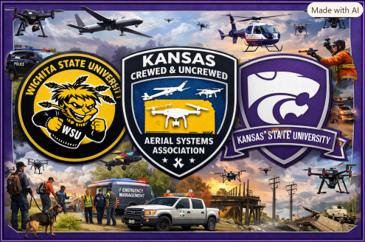
The FirePoint Innovations Center at Wichita State University, in partnership with the Kansas Crewed and Uncrewed Aerial Systems Association and Kansas State University, has announced the launch of the PURPLE UAS CERTIFICATION PORTAL, a new certification pathway built to accelerate the deployment of reliable, mission-ready unmanned aircraft systems (UAS) for public safety agencies.
Purple UAS was designed specifically for LAW ENFORCEMENT, FIRE SERVICE, EMS, SEARCH AND RESCUE, EMERGENCY MANAGEMENT, DISASTER RESPONSE AND CRITICAL INFRASTRUCTURE OPERATIONS. The portal delivers a transparent, independent certification process tailored to the unique demands of public safety missions.

“Purple UAS offers a practical path to move advanced technologies out of development and into the field,” said STEVE CYRUS, FirePoint executive director. “By streamlining certification and reducing rework, we can help companies bring secure, compliant UAS solutions to the first responders who rely on them.”
“We see strong demand from manufacturers pursuing public safety missions, and Purple UAS meets them with clarity and structure,” said TROY HARDING, director of K-State’s School of Integrated Studies.
A defining strength of Purple UAS is its ability to leverage qualifying prior federal certifications, including Blue UAS and applicable Green UAS evidence, to reduce redundant reviews and shorten certification timelines. Existing evidence may be used to meet portions of the Purple UAS framework, while public safety-specific elements undergo independent evaluation to ensure readiness and compliance.
The Purple UAS Portal provides manufacturers and agencies with centralized access to certification guidance, educational materials, pricing, FAQs, and online application tools.
“Public safety agencies need purpose-built, FCC-compliant UAS they can trust,” said ROGER POWERS, KCUASA executive director. “Purple UAS was conceived with those needs at the forefront.”
Manufacturers, public safety agencies, and industry partners can learn more at kcuasa.org/purpleuas.
[1] Alaska’s aviation environment, particularly the “bush pilot” segment, is known for its unique operational pressure because flight is often the only way to move people, supplies, or responders: high operational pressure, limited alternatives to flight, challenging weather/ terrain, and elevated risk tolerance

