TC process merits faster processing; AI can help with speed, but not ready for AIRWORTHINESS CRITERIA?
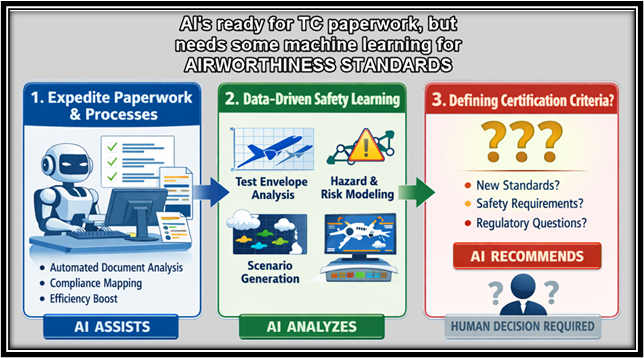
ePlane has published an important article about the FAA’s glacier like move towards utilization, particularly in its Airworthiness certification. Public FAA data does not publish a clean, annual count of aircraft certification applications. Multiple authoritative sources show a SHARP RISE IN CERTIFICATION WORKLOAD OVER THE PAST 5–10 YEARS. This surge in TC requests is driven by new aircraft categories (eVTOL, UAS, advanced propulsion) and post‑MAX oversight reforms. The FAA itself acknowledges that this surge has produced material delays in certification processing, though it does not publish a single “average delay” metric. Episodic examples are cited to confirm that multiple applications have stalled in the multiple AIR offices.
The author points to the announcement that the SMART[1] program will include AI for Air Traffic Control. while it is encouraging that the value of this super analytical tool can be applied in the airspace, it is unclear whether it will be applied to TC processing and/or establishing airworthiness standards.
AI can accelerate FAA certification only if it is used in tightly bounded, evidence‑driven ways: (i) automating the paperwork, traceability, and compliance‑mapping burden and (ii) supporting—but never replacing—human‑led development of test criteria, safety analyses, and assurance methods. Both uses must follow the FAA’s AI Safety Assurance Roadmap principles, which emphasize incremental deployment, data assurance, and strict human accountability. The (i) prospects are good, (ii) time will be necessary for sound reasons.
- Paperwork Process Acceleration–AI can ingest airworthiness standards (Part 23/25/27/29, Part 33, Part 35, ACs, policy memos) and automatically map them to applicant artifacts. AI can automatically classify artifacts (test reports, conformity documents, design data, safety assessments);generate structured summaries for FAA engineers; flag missing evidence, inconsistent references, or outdated revisions—supporting the FAA’s principle of using AI for safety‑enhancing analytical tasks. Applicants, especially in proposing novel technologies, are likely to submit multiple revisions, AI can identify which requirements, tests, and documents are affected. AI can pre‑screen applicant submissions, highlight anomalies, and route documents to the correct discipline (structures, systems, propulsion, human factors).
These are tasks which will expedite the TC review and which are well within AI’s wheelhouse of competence.
AI to Develop Test Criteria & Safety Assurance Methods[2] is more sensitive: AI CANNOT “DECIDE” SAFETY REQUIREMENTS; certainly now at its level of decision science. According to credible opinions, these are limitations on AI’s analytical reliability for complex criteria with a high safety consequence potential-
-
-
-
- Optimizing proxy metrics that don’t match true utility.
- Ignoring causal structure — acting on correlations.
- Poor uncertainty calibration leading to overconfident actions.
- Feedback loops that entrench bias.
- Lack of governance or rollback for harmful policies.
-
-
The strengths of this technology (“machine learning,” “robotics,” and “cognitive computing”) can support the development of criteria by analyzing data, generating candidate test envelopes, and identifying risk patterns—while humans retain full responsibility.
Here are tasks that may be immediately appropriate assignments for TC SMART- Deriving Test Envelopes from Large Operational Datasets, Hazard Identification & Risk Modeling, and Scenario Generation for Flight Testing & Simulation. Working with these building blocks MAY educate the computer and gradually MAY permit assigning more complex issues. The FAA’s Roadmap for Artificial Intelligence Safety Assurance explicitly states
“The responsibility for systems to meet their requirements rests with the system designer and AI developer, not the AI itself.”
While the TC applicants are justified in their delay complaints, AI’s as-of-yet uneducated decision capability could unwittingly accept RISK.

Certification Delays-FAA Struggles to Keep Pace as Aerospace Industry Advances in AI
April 27, 2026By ePlane
Challenges in Modernizing Air Traffic Control and Certification
The Federal Aviation Administration (FAA) has long grappled with antiquated air traffic control systems and chronic staffing shortages. These longstanding issues have been further compounded by recent challenges, notably the rapid integration of artificial intelligence (AI) within the aerospace sector. The agency now confronts the pressing task of aligning its regulatory and operational frameworks with the swift technological advancements reshaping the industry.
Budgetary constraints and workforce reductions, particularly during the Trump Administration’s Department of Government Efficiency (DOGE) policy era, have significantly strained the FAA’s capacity. These cuts have affected not only air traffic controllers but also TECHNICAL AND MAINTENANCE PERSONNEL, undermining the agency’s ability to maintain pace with industry demands. LESS VISIBLE BUT EQUALLY CONSEQUENTIAL are the growing delays in FAA certification processes, which have slowed markedly in recent years. These delays impact a wide array of aircraft programs and manufacturers. While Boeing’s protracted efforts to certify the 737-7, 737-10, and 777-9 models have attracted considerable attention, other companies are similarly affected. For instance, Israel Aerospace Industries’ Bedek division experienced a two-year delay in its 777-300ER passenger-to-freighter conversion program, and Mammoth Freighters, a start-up competitor, only secured its Supplemental Type Certificate (STC) in April, missing its original 2025 target.
The CAUSES of these certification delays are multifaceted, encompassing intellectual property licensing disputes, internal engineering challenges, and the complexities of regulatory compliance. However, A CORE ISSUE REMAINS THE FAA’S DEPENDENCE ON OUTDATED TOOLS SUCH AS SPREADSHEETS AND HARD-COPY DOCUMENTATION, even as the aerospace industry increasingly adopts AI-driven methodologies. Leading manufacturers including Boeing, Airbus, GE, and Pratt & Whitney are leveraging AI to accelerate aircraft and engine development, creating a widening gap between industry innovation and regulatory oversight.
The Urgency of AI Integration and Regulatory Adaptation
The challenge is particularly pronounced with the emergence of new entrants in the aerospace market, such as electric vertical takeoff and landing (eVTOL) aircraft and unmanned aerial systems. These technologies DEMAND NOVEL CERTIFICATION STANDARDS AND REGULATORY FRAMEWORKS, yet the FAA’s current infrastructure is ill-prepared to accommodate the rapid pace of innovation. Conflicting regulations further complicate the certification landscape, presenting unforeseen obstacles for manufacturers striving to bring new technologies to market. 
In response to these pressures, THE FAA IS INITIATING EFFORTS TO MODERNIZE ITS SYSTEMS. Central to this initiative is the development of AN AI PLATFORM KNOWN AS SMART, designed to extend the prediction window for air traffic conflicts from the existing 15 minutes to as much as two hours. The contract for this system has attracted competition from major technology firms including Palantir, Thales, and Air Space Intelligence, each proposing distinct approaches to government AI procurement. This competitive process highlights the urgency for the FAA to adopt advanced technologies and underscores the high stakes for industry players seeking to influence the future of air traffic management.
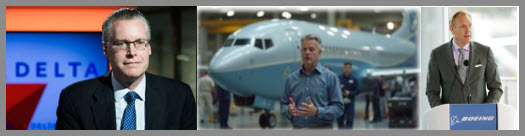 Industry leaders have been outspoken in their calls for reform. Delta Air Lines CEO Ed Bastian has urged the FAA to embrace AI as a critical tool to address persistent air traffic control challenges. Brian Yutko, Boeing’s Vice President of Product Development, has characterized the industry as being on the cusp of an AI revolution, while Pat Shanahan, former Boeing executive and current CEO of Spirit AeroSystems, anticipates that AI will play a pivotal role in commercial aircraft development within the next two years.
As the FAA endeavors to reconcile regulatory oversight with accelerating technological innovation, it faces intensified scrutiny over certification delays and mounting pressure from industry stakeholders. The success of the SMART program and the broader adoption of AI will be instrumental in shaping the future competitiveness and safety of the U.S. aerospace sector.
[1] he FAA’s SMART (Strategic Management of Airspace Routing Trajectories) program is primarily designed to enhance air traffic control (ATC) by improving safety and efficiency in managing airspace. This AI-powered system aims to predict airspace conditions and potential conflicts well in advance, allowing for proactive management of air traffic. the AI technologies developed could extend their benefits to various aspects of aviation management, enhancing safety and efficiency across the industry.
[2] None of the aviation experts’ quotes are specifically focused on AI for TC criteria.