Prospects for Advanced Electric Aviation Powerplants (2025–2050)
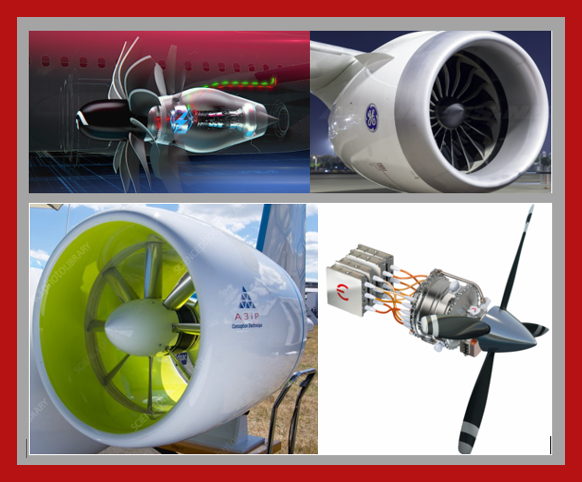
Electric powerplants are highly touted for their positive environmental benefits, but doubts about their utility beyond GENERAL AVIATION and REGIONAL AIRCRAFT is still unproven. Past posts show mixed reactions to the prospects of these new sources of population:
- The Yin and Yang of transitioning to Electric Aircraft
- Eviation on hold for electric flight- PULL THE PLUG?
- The Graduate’s advice in 2026 context- BATTERIES- so many technologies- FAA path?
NEW NEWS-
- NASA is actively researching the viability of this green fuel and in the following report indicates that there has been progress.
- GE AEROSPACE, a partner with NASA, explains that its embed electric motor/generators for use with a high-bypass commercial turbofan to supplement power during different phases of operation. Is showing promise.
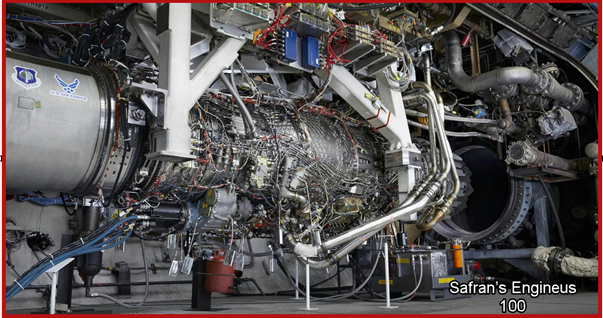
- SAFRAN proudly announced that its ENGINEUS 100 has been CERTIFICATED by the European Union Aviation Safety Agency (EASA)
- 125 kW of power while weighing only 40 kilograms.
- minimizing weight is critical to maximizing range, payload capacity, and safety.
- the creation of NEW CERTIFICATION STANDARDS AND EXTENSIVE TESTING PROTOCOLS
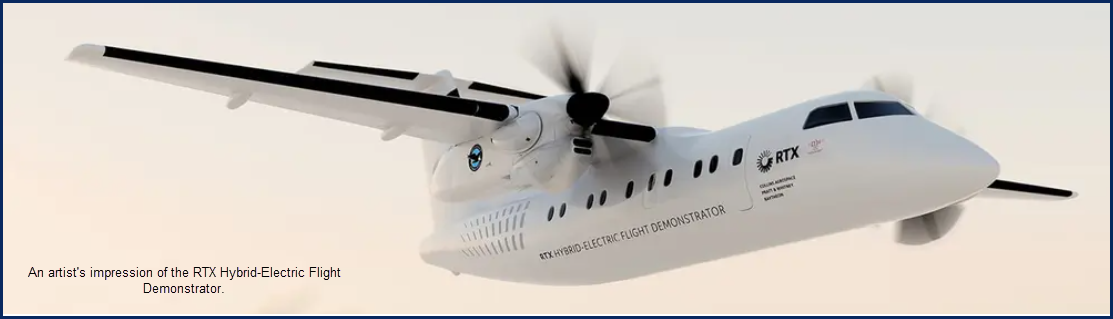
- RTX reviews the status of its Hybrid-Electric Flight Demonstrator’s experimental propulsion system. The government of Canada is supporting this potential powerplant for REGIONAL AIRCRAFT. It will pair a thermal engine with an electric motor
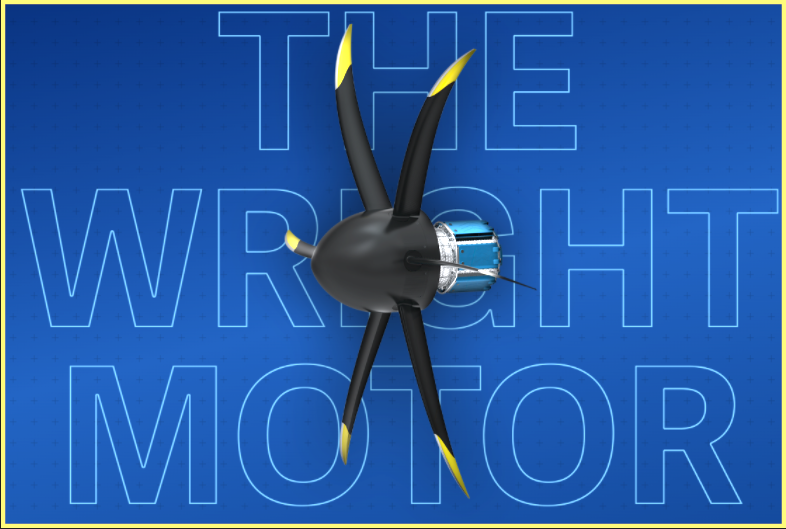
- Wright Motor says that its 2.5 megawatts (MW) of shaft power “paves the way toward enough thrust for optimal lift during the most critical moments of a flight — a new standard in electric aviation.”
- AERO ENGINE CORP OF CHINA releases progress on its the AEP100 turboprop engine and the AES20 turboshaft engine — have entered the airworthiness certification phase- both are for GA airplanes.
Here are the results of an AI-created state‑of‑the‑industry assessment of the prospects for advanced electric aviation powerplants across regional, single‑aisle (A320/B737 class), and long‑haul widebody segments—grounded in the latest research and trade studies from NASA, academia, and industry.
Prospects for Advanced Electric Aviation Powerplants (2025–2050)
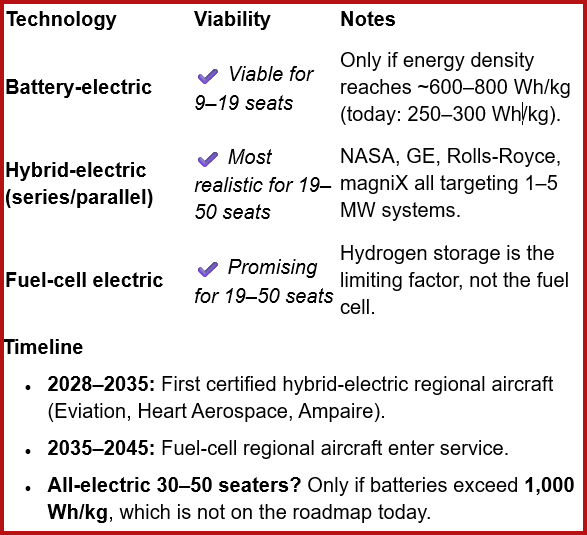
- Regional aviation (9–50 seats): Electrified propulsion is coming first. Hybrid‑electric is viable in the 2030s; all‑electric only for very small aircraft.
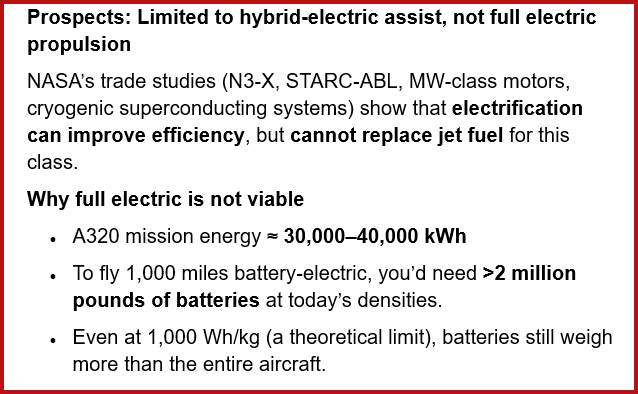
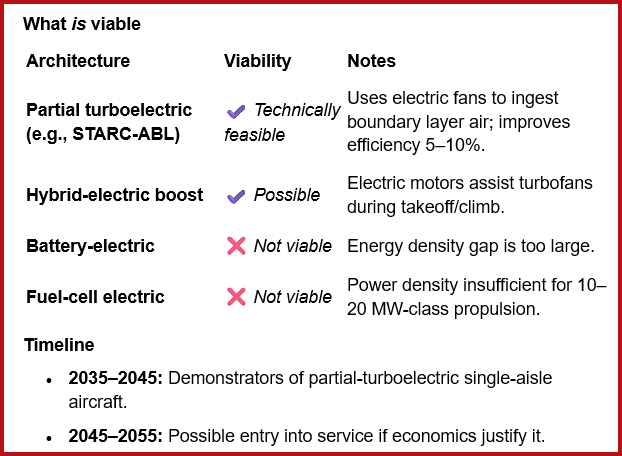
- Single‑aisle commercial (A320/B737 class): Hybrid‑electric is technically feasible but only as partial‑turboelectric architectures. Battery‑electric is not viable this century without a physics breakthrough.
- Long‑haul widebody: No foreseeable path to battery‑electric or hybrid‑electric propulsion. Only hydrogen (combustion or fuel cell) or SAF can decarbonize this segment.
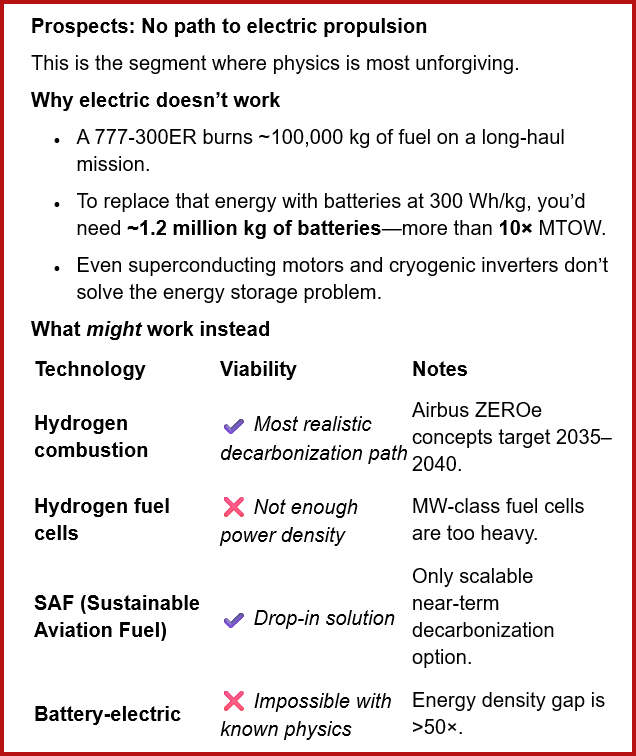
The AI wisdom noted some technologies that may be game changers:
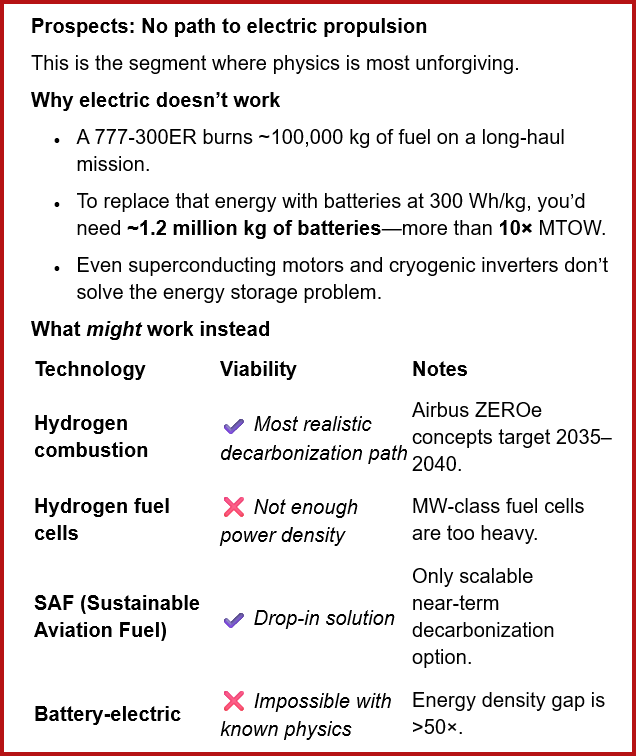
The research came to these conclusions;
Electric propulsion is not a universal solution.
It will transform regional aviation and UAM, but not long‑haul.
The future of commercial aviation propulsion is segmented:
- Electric + hybrid → regional
- Hydrogen → medium‑range and possibly single‑aisle
- SAF → long‑haul
- Turbofans → remain dominant for decades
As new information becomes available, posts here will try to keep you current (bad pun, sorry)!!!

NASA’s Electrified Aircraft Propulsion

NASA’s Glenn Research Center leads innovation and development of new aviation technologies to enable the next generation of more efficient commercial air transportation.
Electrified Aircraft Propulsion (EAP) offers new possibilities for improving efficiency and reducing energy consumption in aviation. Through innovative technologies, concept vehicles, flight demonstration projects, and ground testbeds, NASA’s research in EAP is reimagining the way we fly.
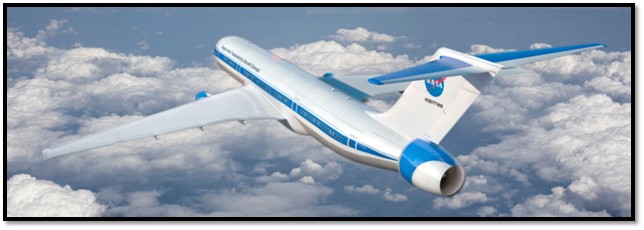
Integration Timeframe Mid-2030s
An artist’s rendering of the Single-Aisle Turboelectric Aircraft with Aft Boundary Layer Propulsion (STARC-ABL) with its innovative aft Boundary Layer Ingestion (BLI) tail fan.
NASA’s innovative systems, components, and tools are bringing us a step closer to a future of more efficient, electrified flight.
How can we use electricity to power large-scale commercial aircraft? What kinds of technologies will help us reduce fuel consumption during flight? From high-efficiency electric motors to lightweight materials and revolutionary superconducting technologies, NASA’s electrified aircraft propulsion developments are helping answer some of the toughest questions when it comes to aviation electrification. Learn more about the powertrain components, materials, and energy efficient technologies powering a new era of flight.
NASA’s High-Efficiency Megawatt Motor (HEMM) is a 1.4 megawatt electric machine designed for future electrified aircraft propulsion systems. While the exterior looks like a standard motor, the inside houses advanced technologies that enable the machine to increase power capability while minimizing weight and loss.

GE Aerospace further advances development of hybrid electric engines with NASA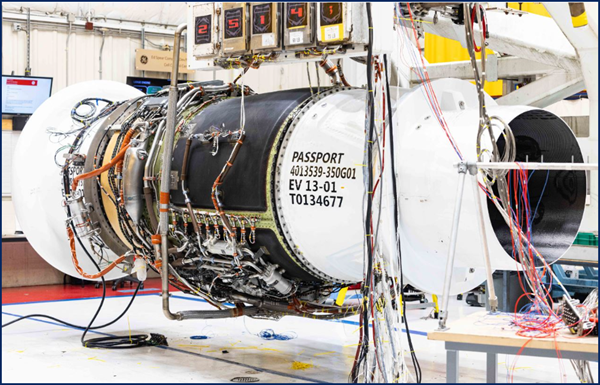
EVENDALE, OHIO – GE Aerospace (NYSE: GE) is developing a hybrid electric demonstrator engine with NASA that will embed electric motor/generators in a high-bypass commercial turbofan to supplement power during different phases of operation.
This includes modifying a Passport engine with hybrid electric components for testing through NASA’s Hybrid Thermally Efficient Core (HyTEC) project. It’s one of several efforts GE Aerospace has underway to mature technologies for more electric aircraft engines and is being advanced as part of the CFM International Revolutionary Innovation for Sustainable Engines (RISE)* program.
Embedded electric motor/generators will optimize engine performance by creating a system that can work with or without energy storage like batteries. This could help accelerate the introduction of hybrid electric technologies for commercial aviation prior to energy storage solutions being fully matured.
…
Initial component-level testing of electric motor/generators and power electronics has been completed for the HyTEC Turbofan Engine Power Extraction Demonstration. Systems testing took place at GE Aerospace’s EPISCenter in Dayton, Ohio. Additionally, a baseline test of the Passport engine to characterize performance before hybrid electric components are added was completed at the company’s Peebles Test Operation, also in Ohio.
Results of the hybrid electric component and baseline engine tests are being used to evaluate and update models in preparation for a ground test.
…
Hybrid electric development
In another NASA collaboration, GE Aerospace is maturing an integrated, megawatt (MW)-class hybrid electric propulsion system as part of the Electrified Powertrain Flight Demonstration (EPFD) program. Plans for EPFD call for ground and flight tests of the hybrid electric system this decade, in collaboration with Boeing, using a modified Saab 340B aircraft and GE Aerospace’s CT7 engines.
GE Aerospace has achieved multiple milestones over the last decade for development of a hybrid electric propulsion system, including a 2016 ground test of an electric motor-driven propeller. In 2022, GE Aerospace completed the world’s first test of a MW-class and multi-kilovolt (kV) hybrid electric propulsion system in altitude conditions up to 45,000 feet that simulate single-aisle commercial flight at NASA’s Electric Aircraft Testbed.
GE Aerospace plans to hire more than 900 engineers in 2024, reflecting its continued focus on innovation to support current aircraft engine programs and develop new technologies for the future of flight. View job openings at invent.ge/engineering.

New Electrified Engine Poised to Transform Aviation in the Next Decade
March 8, 2026By ePlane AI
A SIGNIFICANT TRANSFORMATION is unfolding in the aviation sector as electric propulsion advances from experimental stages to certified, market-ready technology. The recent CERTIFICATION of SAFRAN’S ENGINEUS 100 by the European Union Aviation Safety Agency (EASA) marks a pivotal moment, establishing fully electric power as a credible option for operational flight. Industry experts regard this certification not merely as a technical achievement but as a clear signal to manufacturers, regulators, and investors that electric propulsion has attained a level of reliability and trust necessary for broader adoption.
Certified Power in a Lightweight Package
Central to this development is the Engineus 100, a compact electric engine that delivers 125 kW of power while weighing only 40 kilograms. This impressive power-to-weight ratio sets a new benchmark for electric aviation, where minimizing weight is critical to maximizing range, payload capacity, and safety. Securing EASA approval involved the creation of NEW CERTIFICATION STANDARDS AND EXTENSIVE TESTING PROTOCOLS, including arc-fault detection, environmental stress assessments, and endurance trials. These rigorous evaluations have not only validated the Engineus 100’s performance and safety but have also laid the groundwork for future electric propulsion certification frameworks.
Immediate Impact and Market Adoption
The Engineus 100 is primarily targeted at short-range aviation applications such as pilot training, regional transport, and utility missions. Designed for small aircraft accommodating two to four passengers, it offers a flight range of up to 100 kilometers on battery power alone. This makes it particularly suitable for flight schools, tourism operators, and urban or regional shuttle services, where concerns over noise pollution, emissions, and operating costs are increasingly prominent. Early adopters include both innovative startups and established aerospace manufacturers engaged in developing light aircraft, hybrid demonstrators, and modular test platforms.
Electric propulsion offers several distinct advantages, including reduced maintenance requirements due to fewer moving parts, high torque at low revolutions per minute which enhances propeller efficiency, and significantly lower noise levels that improve community and airport acceptance. Additionally, the technology produces zero in-flight carbon dioxide emissions at the point of use and incorporates digital systems for predictive health monitoring, enhancing operational reliability.
Industrialization and Scaling Up
The future success of electrified aviation hinges on THE ABILITY TO SCALE PRODUCTION EFFECTIVELY…
Nonetheless, scaling production presents significant challenges. The industry must secure reliable supply chains for advanced materials, including rare-earth magnets and power electronics components, while navigating complex regulatory environments to ensure safety and compliance. The substantial upfront investments required from manufacturers and operators may also temper the pace of adoption in the near term.
Competitive Landscape and Future Horizons
The emergence of electric propulsion has elicited mixed reactions within the traditional engine manufacturing community. Some incumbents view the shift with skepticism, confronting the risk of obsolescence unless they adapt. In response, several established firms are pursuing their own electrification initiatives, forming strategic partnerships, or acquiring specialized companies to maintain competitiveness.
…
As the industry addresses the intertwined technical, regulatory, and market challenges ahead, the certification of the Engineus 100 stands as a landmark achievement, heralding a new era in which electric propulsion is poised to reshape aviation over the coming decade.

RTX’s Hybrid-Electric Plane is One Step Closer to the Sky
Monday, 09 March 2026
The intricate web of cables, hoses and wires waited in a test cell at a Pratt & Whitney Canada facility on the outskirts of Montreal. In a control room nearby, about a dozen people – some of whom had worked on the system for years – gathered and watched. With the click of a mouse, the power began flowing to their creation.
Courtesy of RTX
That creation was an early version of the RTX Hybrid-Electric Flight Demonstrator’s experimental propulsion system for a REGIONAL AIRCRAFT. It will pair a thermal engine with an electric motor – and, the team hopes, tap into a new era of fuel efficiency for aviation.
The project is supported by the Canadian federal government and provincial government of Quebec along with a range of partners across industry and academia. It also reflects RTX’s company-wide approach to innovation; it combines an advanced thermal engine from Pratt & Whitney Canada, a 1-megawatt electric motor from Collins Aerospace, and a 200-kilowatt-hour battery system from the startup H55, backed in part by RTX Ventures, the company’s venture capital arm.
The goal of the project is to show a 30% improvement in fuel efficiency compared to today’s most advanced regional turboprops. The team also hopes the project will show what’s possible in designing future aircraft.
“Pratt & Whitney is the quintessential thermal engine maker, and Collins Aerospace is the quintessential aircraft system supplier on the planet,” said David Venditti, Pratt & Whitney’s program manager for the demonstrator. “There’s no other place really in the world where we have all of those experts and resources coming to bear and developing a technology like this.”
The demonstrator combines an advanced fuel-burning thermal engine from Pratt & Whitney with a 1-megawatt electric motor built by Collins Aerospace. A special gear system connects the two and keeps the propeller turning, whether the power comes from the engine, the motor, or both.
That question depends on the stage of flight. THE THERMAL ENGINE WILL POWER THE PLANE DURING CRUISE, AND THE ELECTRIC MOTOR WILL DO MOST OF ITS WORK BY HELPING WITH THE TAXI STAGE, AS WELL AS THE POWER-INTENSIVE FLIGHT MODES OF TAKEOFF AND CLIMB.
The motor will get its energy from a battery pack with a 200-kilowatt hour capacity – enough to power the average American home for nearly a week.
Thermal engines convert only about 30% to 40% of their fuel to useful energy – the rest is lost to heat or friction between moving parts. Electrical systems are more efficient, converting more than 90% of their energy into mechanical power.
Electric systems are common in cars, so why haven’t they taken to flight? There are two main challenges: weight and managing high voltage.
Hybrid-electric propulsion for a regional aircraft requires thousands of battery cells linked together operating at high voltage levels. That creates a risk of overheating or electrical arcing, where electricity jumps from its path and forms a miniature lightning bolt between the battery and something next to it.
Having to solve for arcing is a relatively new problem in aviation, Venditti said.
“The voltage level we’re using for our system surpasses anything that’s in production right now in aviation,” he said. “Normally you don’t have batteries assisting in the prolusion of aircraft.”
The team is using several methods of protection, but one of the main solutions is the design of the battery itself.
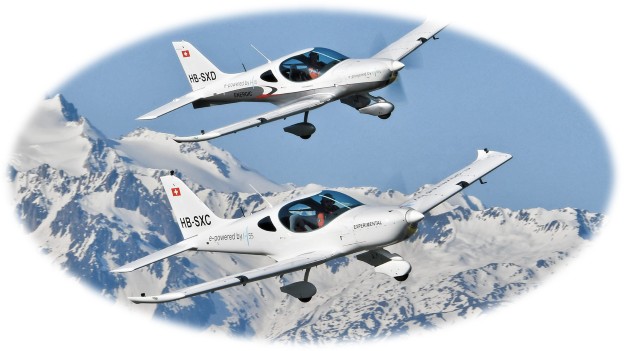
For help on the battery system, Pratt & Whitney enlisted H55, a Swiss company with backing from RTX Ventures. The demonstrator’s battery is based on technology H55 has already put into flight on smaller aircraft, including an all-electric two-seater.
RTX’s demonstrator is much larger but will rely on a modified version of H55’s existing system, with more batteries and added protections at the aircraft level. Pratt & Whitney Canada built on H55’s safety mechanisms with features specific to the demonstrator, including an extra fireproof box that can vent gases and flames in an emergency. It is also modular, meaning batteries can be installed throughout the aircraft to distribute weight.
By using a battery system whose baseline version is already in flight and has passed relevant European Union Aviation Safety Agency tests, Pratt & Whitney can take advantage of a system that’s designed for safety and proven compliance, said Anthony D’Ambrisi, who leads design, testing and certification for H55’s electric propulsion systems.
“Our team has built and flown six airplanes with more than 2,000 hours of electric flight time without any incident,” D’AmbrIsi said. “H55 has accumulated hands-on experience in certification and airplane integration, allowing us to deliver Pratt & Whitney with a safe, efficient and certifiable product.”
H55 is a spinoff of Solar Impulse, a project that resulted in an airplane that flew around the world powered by just solar panels and batteries. That accomplishment, D’Ambrisi said, showed H55’s cofounders that electric propulsion was no longer a technology of the future.
“A lot of people from the aerospace industry were thinking it will be in the far future. WE SEE THE CHANGE ARRIVING ALREADY TODAY,” D’Ambrisi said. “I think the team here at H55 is proud to set the standard and show that this technology works well, it’s safe and can be certified. It’s real. It’s not just papers or presentations anymore.”
At RTX, the demonstrator has already marked many firsts. Teams at Collins Aerospace and Pratt & Whitney overcame many challenges as they modified the engine and electric motor and worked to integrate the two.
For example, it was the first time Pratt & Whitney had installed lithium-ion batteries in a test cell, which required building a special, ventilated cabinet the size of a small moving truck to house them. And it was the first time they had to charge a battery of its size – only there wasn’t a charger on the market that could do it, so they worked with the Innovative Vehicle Institute and the National Research Council of Canada to build one.
Over the next year, the RTX Hybrid-Electric Demonstrator team will continue ground testing and begin working with AeroTEC in Moses Lake, Washington, to install hardware on the aircraft. As they prepare for their first flight, they’ll meet the same rigorous safety standards that they would for certification while setting precedents for new standards, which will provide valuable insights for future projects.
While they’ve already demonstrated their concept, taking it a step further to flight will show its true potential and answer more questions about how to best use hybrid-electric propulsion.
[excerpted]
2.5 MW of shaft power on the world’s most advanced electric motor for aviation
Unmatched thrust at the lightest weight
The Wright Motor’s 2.5 megawatts (MW) of shaft power paves the way toward enough thrust for optimal lift during the most critical moments of a flight — a new standard in electric aviation.
-
- Unmatched Power: With up to 2.5 MW of power (3x higher than commercial-off-the-shelf), our propulsion unit delivers unrivaled performance, providing the energy needed to drive next-generation vehicles and vessels.Exceptional Power Density: Boasting specific power up to 16 kw/kg (3x higher than commercial-off-the-shelf), our propulsion unit maximizes energy output while minimizing size and weight, offering a compact solution for a wide range of applications.
High Efficiency: With an efficiency rating of 96%, our propulsion unit ensures efficient energy utilization, reducing stored energy requirements, environmental impact, and operating costs.Proven Track Record: Developed in collaboration with leading research institutions such as NASA and ARPA-E, our propulsion unit will undergo rigorous testing to demonstrate its exceptional reliability and performance.
- Unmatched Power: With up to 2.5 MW of power (3x higher than commercial-off-the-shelf), our propulsion unit delivers unrivaled performance, providing the energy needed to drive next-generation vehicles and vessels.Exceptional Power Density: Boasting specific power up to 16 kw/kg (3x higher than commercial-off-the-shelf), our propulsion unit maximizes energy output while minimizing size and weight, offering a compact solution for a wide range of applications.
Megawatt advantage for full passenger loads
Lift is a function of thrust minus drag, and by keeping our motor lightweight and drag-efficient, we minimize the lift required and maximize performance.
- Flexible Power Options: Our propulsion unit offers peak power of 2 MW at 800 VDC and 2.5 MW at 1200 VDC, providing versatility to meet diverse application requirements.High-Speed Performance: With a rated speed of 7,500 rpm and 2,550 Nm of rated torque, our propulsion unit delivers high-speed performance. Please see our white paper here that describes the system mass benefits of a medium-speed machine for propeller-based applications.Integrated Inverter Technology: WM2500 is equipped with eight integrated inverters, each rated to 250 kW of power.
Multiple Outputs: The EPU is designed to direct-drive a ducted fan, power a propellor through a single-stage gearbox, or perform as the genset of a 4 MW class turbogenerator.

Aircraft engine maker targets breakthroughs
New models to help tap into general aviation market, low-altitude economy
By Zhao Lei
AERO ENGINE CORP OF CHINA, the nation’s leading maker of aircraft engines, will continue tapping the general aviation market this year, planning to advance certification and flight tests for several new products, according to a senior expert.
Shan Xiaoming, chief designer at the AECC Hunan Aviation Powerplant Research Institute in Zhuzhou, Hunan province, said the company aims to achieve new breakthroughs in the general aviation market in 2026.
“Two of our major models designed for the general aviation sector — the AEP100 turboprop engine and the AES20 turboshaft engine — have entered the airworthiness certification phase,” Shan said. “We hope they can receive the type certificate from the civil aviation authority before the end of this year.”
Meanwhile, several other new types, including turboprop, turboshaft and hybrid-electric motors, will conduct maiden flights this year and be displayed to the public at airshows, she told China Daily in an exclusive interview in Beijing.
…
AECC will also accelerate research and development of new models for green, unmanned and smart aircraft, while advancing the design and certification of hybrid-electric and all-electric propulsion systems. Shan said the company hopes these systems will enter the market by 2030.
…
In recent years, as the low-altitude economy has emerged as a highly anticipated new sector, general aviation has regained momentum. Local governments and companies across the country are racing to gain a foothold in the sector, generating strong demand for general aviation equipment.
…