Mexico Paid the FAA US$52.8M to Restore Its Safety Rating—Now It Wants to Cut ATC Funding by 75%. Is the Golden Eagle Shooting Itself in the Foot?
A report, actually a complaint, argues that the proposed cut in Mexico’s AFAC + SENEAM the agencies responsible for safety oversight and air navigation. The Mexican trade association that represents the country’s aviation interests, CANERO, and the highly respected global airline association, IATA, point out that the cuts proposed by Ministry of Infrastructure, Communications, and Transportation1 likely will devastate the safety of the national airspace system.
The timing of this reduction is exacerbated by the fact that the Mexican aviation system is under its 4th interaction with the FAA to put its airspace in order:
2010 FAA IASA Audit
-
-
-
- Outcome: Downgrade to CATEGORY 2
- Reason: Staffing shortages, documentation gaps, and regulatory oversight deficiencies in the then-DGAC.
-
-
FAA Technical Assistance: 2010-2013
-
-
-
- Cost: Not publicly disclosed (Mexico did not publish a line-item budget for FAA support during this period).
- Outcome: Restored to CATEGORY 1 IN 2014
- Notes: This was Mexico’s first modern downgrade. FAA provided multi-year technical guidance, audits, and follow-up reviews.
-
-
2021 FAA IASA Audit
-
-
-
- Outcome: Downgrade to CATEGORY 2 in 2021
- Reason: AFAC lacked sufficient technical staff, procedures, and documentation to meet ICAO standards.
-
-
FAA Technical Assistance: 2021-2023
-
-
-
- Cost: MX$902 million (=US$52.78 million)[1]
- Outcome: Restored to CATEGORY 1 ON 14 SEPTEMBER 2023
- Notes: This was the most expensive and politically visible recovery effort. AFAC’s budget was increased specifically to regain compliance.
-
-
Add to this litany, this summer, the FAA initiated another assessment of the Mexican aviation safety performance and even AFAC has acknowledged that warned “we’re doing very badly”, specifically word has leaked that internally they expect to see downgrade in the following critical areas:
-
- AFAC was not meeting ICAO critical elements
- Training gaps had re‑emerged
- Documentation was incomplete
- Staffing shortages were worsening
Yes, this list of deficiencies looks very much like the 2021 analysis to downgrade.
What has SICT found to support its drastic cuts in the face of likely FAA 3rd downgrade in the past 16 years? AI says:
The MX$902 million spent in 2023 was criticized by senior officials as:
-
-
- fiscal austerity
- political frustration with AFAC
- belief that FAA assistance should have “fixed” everything
- anxiety about the upcoming FAA IASA audit
-
-
-
- shift blame
- reduce the agency’s autonomy
-
-
-
- spending
- “excessive”
- “unnecessary”
- “a burden”
- spending
-
AND
-
-
- The administration is shifting control of airports and aviation operations to the military
-
AFAC states that the Ministry of Finance and Public Credit (SHCP) will guarantee the NECESSARY RESOURCES FOR AFAC to develop its regulatory, supervisory, and oversight functions, as well as actions aimed at strengthening operational safety in the country.” History and AI analysis cast some shade on this optimism-
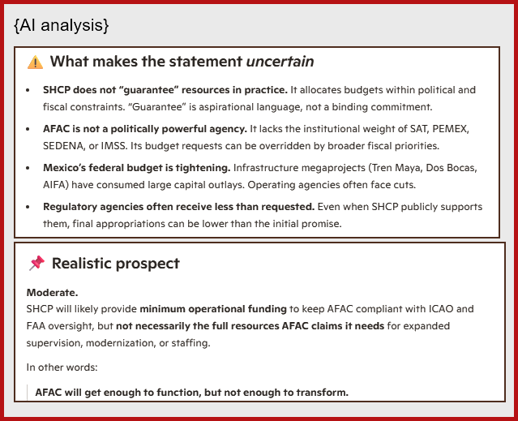
The Mexican policy makers have created quite an enigma—
-
-
- Stick with their analysis and cut the aviation systems budget
-
and
OR
-
-
- fund the AFAC and SENEAM budgets to the level that CANCERO and IATA argue is necessary for safety
-
- hope that the FAA regards the promise to adequately support the national airspace as they did with the India DGCA.[4]


The FAA IASA assessment team has an abundance of evidence to downgrade Mexico. Given the tension between the two countries, an order from 1600 Pennsylvania Avenue not to pull the trigger on Category 2, the solution must come from America’s southern border. Is the Golden Eagle likely to shoot itself in its foot?
Aviation Groups Warn Against Proposed 74% Cut to Mexico’s AFAC

By Óscar Goytia | Journalist & Industry Analyst –
Leading aviation trade associations have voiced STRONG OPPOSITION to the Mexican federal government’s proposed fiscal year 2027 budget allocation for the country’s civil aviation regulator, warning that severe funding cuts jeopardize the agency’s operational capacity at a critical moment for safety oversight.

The National Chamber of Air Transport (CANAERO) and the International Air Transport Association (IATA) issued a joint response calling on government authorities to reconsider the proposed reductions submitted by the Ministry of Infrastructure, Communications, and Transportation (SICT)[5] to the Chamber of Deputies as part of the 2027 Economic Package.
Under the federal budget proposal, the spending category designated for “efficient and competitive airports”—which encompasses both the Federal Civil Aviation Agency (AFAC) and Navigation Services in the Mexican Airspace (SENEAM)—is set to receive MX$1,114.5 million (US$65.70 million). This figure reflects a REAL-TERM FUNDING REDUCTION OF 75.7% COMPARED TO THE BUDGET AUTHORIZED FOR THE CURRENT FISCAL YEAR.
The contraction is even more pronounced for AFAC specifically. The national aviation regulator is slating a proposed budget of MX$175.4 MILLION (US$10.34 MILLION) FOR 2027. This allocation represents a real reduction of between 73% and 74% —stripping away more than three-quarters of the public funds provided to the agency during 2026.
Industry groups, commercial pilots, and academic experts argue that the reduced figure leaves the regulator severely underfunded. According to AFAC’s own estimations, the agency requires at least MX$2 billion (US$117.88 million) annually to maintain proper operations, a funding threshold it has never received since its creation in 2019. Airline representatives, airport operators, and agency personnel have consistently stated that historical underfunding has compromised basic security, supervision, and oversight functions across Mexico’s air transport system.
The timing of the proposed fiscal constraint comes during a sensitive period for national air safety evaluation. Last month, the US Federal Aviation Administration (FAA) conducted an audit of AFAC under the International Aviation Safety Assessment (IASA) program. The results, expected in October, will determine whether Mexican aviation maintains its Category 1 safety rating OR FACES A DOWNGRADE TO CATEGORY 2.
A Category 2 rating imposes legal limits preventing domestic airlines from adding new routes or expanding flight frequencies to the United States. Mexico has previously experienced two separate downgrades to Category 2, both of which stifled growth across the domestic sector due to systemic deficiencies within the national aviation authority.
“During recent years, the sector has faced a combination of challenges that have significantly increased its costs and operational complexity, such as high fuel prices and repercussions stemming from disputed bilateral regulatory processes, among others. All of this demands a solid aeronautical authority with technical capacity, operational strength, and adequate financial resources for its correct operation,” Canaero and IATA stated in a joint release.
The trade associations warned that reducing funding while the industry requires administrative stability creates substantial risk. “In an environment where the industry requires a solid and strengthened authority, this measure generates great concern regarding the institutional and financial capacity of the regulator, as well as the serious consequences that this decision could have on the sector,” the organizations stated.
“CANAERO and IATA make a respectful call to the Ministry of Finance and Public Credit and to the Chamber of Deputies to reconsider this measure with a comprehensive vision, ensuring the necessary resources so that AFAC can fully comply with its responsibilities for the benefit of the national aviation industry,” the statement continued.
In response to industry concerns, AFAC released a statement Thursday evening assuring commercial stakeholders that additional funding will be made available outside the primary framework of the 2027 Economic Package.
“The Ministry of Finance and Public Credit (SHCP) will guarantee the necessary resources for AFAC to develop its regulatory, supervisory, and oversight functions, as well as actions aimed at strengthening operational safety in the country,” the agency declared, stating the additional funds will “strengthen its institutional capabilities and address the priorities of the national aeronautical sector.”
AFAC did not clarify whether its formal line-item budget would be amended during congressional debate, nor did it disclose the precise mechanism or amount of the additional capital pledged by the federal government.
- FAA technical assistance
- FAA follow‑up audits
- Inspector training
- Oversight system upgrades
- ICAO compliance documentation
- Staffing increases
- Corrective actions required by FAA
[2] Mexican airlines are facing significant challenges in profitability, with cumulative net losses totaling approximately US$389 million in the first half of 2026, despite record revenues driven by higher fares. The performance of these airlines is influenced by factors such as rising fuel prices and limited economic growth, which complicate their revenue generation from both domestic and international markets
[3] Aeroméxico: Mexico–U.S. routes are its highest‑yield international segment, driven by business travel, VFR (visiting friends & relatives), and strong premium cabin demand. Aeroméxico’s total revenue: MX$103,012 million (2024). A large share of this comes from U.S. routes (LAX, JFK, IAH, ORD, ATL).
Volaris: Mexico–U.S. is its most profitable international segment, with consistently high load factors (87.9%). Volaris revenue: MX$58,320 million (2025). U.S. routes are the backbone of its international strategy.
Viva Aerobus: Mexico–U.S. routes are its highest‑margin international operations, benefiting from ultra‑low‑cost cost structure and strong cross‑border demand. Viva revenue: MX$45,619 million (2025).
Across all carriers, Mexico–U.S. flying is the largest international revenue contributor and the most profitable international region.
[4] The FAA’s 2021–2023 audit cycle included:
- On‑site IASA audit (Oct 2021)
- Follow‑up consultations (2022)
- Final determination (April 2023)
The FAA concluded DGCA meets ICAO standards, and therefore India continues as Category 1. This determination was based on DGCA’s demonstrated corrective actions.
[5] The Mexican Ministry of Infrastructure, Communications, and Transportation (SICT) — Secretaría de Infraestructura, Comunicaciones y Transportes — is Mexico’s federal cabinet‑level department responsible for national infrastructure, transportation systems, and (historically) communications policy. Air transportation — supervising aviation policy through agencies like AFAC (civil aviation authority) and SENEAM (air‑navigation services).
