FAA Flight Surgeon crafting Pilot/ATCer Mental Health balancing safety and assistance
NBAA, a major contributor to Mental Health & Aviation Medical Clearances ARC, has published the attached Regulatory Hot Topics on the FAA’s new policy on mental health treatment which aims to streamline the medical process for pilots and controllers seeking mental health treatment. The business aviation association is well regarded for its professional staff and not surprisingly two of its people participated in the ARC. Based on that experience, they provide specific advice for all pilots and ATCers on how to best avail themselves of this new policy.

A Hot Topic post is intended to be brief. This new policy represents a sea change in the FAA’s mental health policy, a trail that may be traced to a new Federal Air Surgeon. Reviewing the history of the agency’s dealing with a Hobson’s choice—between “protect the public at all costs” and “encourage honest disclosure and treatment”
With no inside information, it appears that when Dr. Susan Northrup became Federal Air Surgeon in 2021, the FAA’s record on pilot/ATC mental health became one of visible movement toward greater access and disclosure, but always constrained by the core mandate: protecting the public from low‑probability, high‑consequence risk.
An external catalyst for this new look at Pilot Mental Health was the DOT OIG report (July 2023): The watch dog found that
“…the FAA has comprehensive procedures to evaluate pilots’ psychological health, but noted that pilots are often reluctant to disclose mental health conditions, which limits the FAA’s ability to mitigate safety risks. The report recommended improvements to encourage pilots to report and seek treatment for mental health issues.”
 The Flight Surgeon initiated the Mental Health & Aviation Medical Clearances ARC charter (Dec 2023)
As an adjunct to the ARC Dr. Northrup convened the 2023 – Aeromedical Summit, which brought industry, unions, peer support, and mental‑health experts together. A conduit for expert input the mental‑health agenda.
The ARC final report (April 1, 2024) made 24 recommendations across barriers to disclosure, handling diagnoses, interim risk mitigation, international benchmarking, and education/stigma reduction. It explicitly mapped the process from disclosure to aeromedical decision and catalogs “barrier narratives” (culture, trust, fear of career loss). The list-
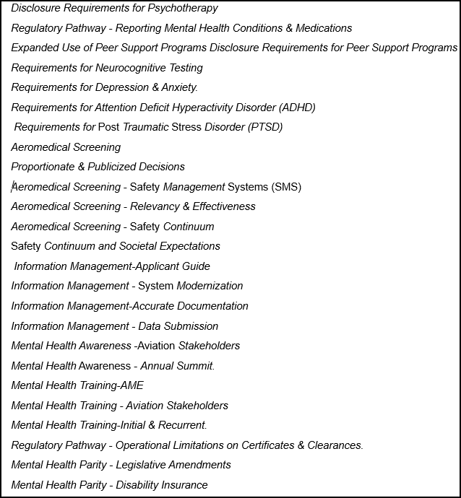
The implementation began with Northrup’s June 2024 Federal Air Surgeon’s Medical Bulletin describes how Office of Aerospace Medicine began implementing changes even before the ARC report was final: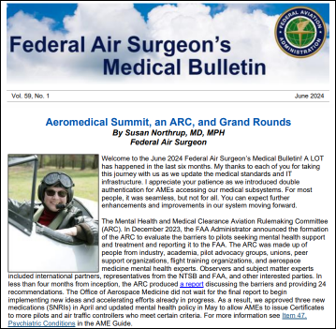
-
- Approval of three new SNRIs (antidepressants) in April 2024
- Updated mental‑health policy in May 2024 to allow AMEs to issue certificates to more pilots and ATCs who meet defined criteria, rather than defaulting to deferral.
- She frames the strategy as “Educate, Early intervention, Evolve”—reduce stigma, encourage early treatment, and gradually modernize standards as science develops.
The FAA brought the new process to the AMEs by Grand Rounds regular policy‑update sessions focused heavily on mental health, with CME credit, to make AMEs more comfortable issuing rather than reflexively deferring. Congress on a bipartisan basis, added its policy touch by passing the Mental Health in Aviation Act, in which

Instructed “the FAA to handle pilot and air traffic controller (ATC) mental‑health disclosure, treatment, and certification. At its core, the Act requires the FAA to revise medical regulations (including 14 C.F.R. Part 67) WITHIN @ years, to encourage pilots and controllers to seek help and disclose mental‑health conditions without fear of automatic punitive consequences. PLUS:
- explicitly encouraging seeking treatment for mental‑health conditions and ordering honest disclosure of symptoms or diagnoses
-
- incorporating NTSB recommendations on aviation‑workforce mental health
- urging increased use of clinical studies, diagnostic manuals, and protocols used by licensed professionals
- seeking input from pilot unions, ATC unions, AMEs, and other stakeholders
The timeline now reaches the recent (see below) explicit counseling/psychotherapy guidance to the AME Guide and publishes “Information for Psychotherapists Treating Pilots and ATCS.”
The balance remains, some individuals using psychotropic medications are disqualified for aeromedical certification unless covered by listed exceptions. Aviation Medical Examiners are still directed to defer issuance and forward records to the Aerospace Medical Certification Division (AMCD) in cases involving psychiatric medications.
This means the fundamental tension in pilot mental health remains: the FAA now explicitly encourages therapy, but the regulatory framework still penalizes many forms of treatment that involve medication. A pilot who seeks counseling for anxiety and receives a prescription for an SSRIs (Selective Serotonin Reuptake Inhibitors) still faces a potentially career-disrupting certification process. The acceptable medicine has increased from
-
-
- Fluoxetine (Prozac)
- Sertraline (Zoloft)
- Citalopram (Celexa)
- Escitalopram (Lexapro)
-
To now include
-
-
 NRIs (Serotonin-Norepinephrine Reuptake Inhibitors)
 - Venlafaxine (Effexor XR) and Desvenlafaxine (Pristiq)
-
a major step toward modernizing mental‑health policy.
The FAA’s safety mission is built around preventing rare but catastrophic events—Germanwings 9525 and similar cases are the shadow over every mental‑health policy discussion. The ARC’s background section explicitly cites those incidents and the earlier Pilot Fitness ARC, reminding everyone that a single failure can be system‑defining.
That said mental illnesses are not binary; severity, insight, treatment adherence, comorbidities, and stressors vary widely. The ARC acknowledges that the FAA must make decisions under clinical and data uncertainty, which makes broad “expansive” categories risky. To navigate that Hobbesian between safety risk and fairness to these aviation professionals, FAA uses fair, nuanced treatment to encourage their seeking help. The psychotherapists and AMEs have been taught to identify different risk profiles in a cockpit vs. a control tower (e.g., sudden incapacitation vs. gradual cognitive drift, or impulsivity vs. fatigue).With that diagnosis explicitly define conditions that are considered operationally specific and the levels and types of limits mitigate the risk.
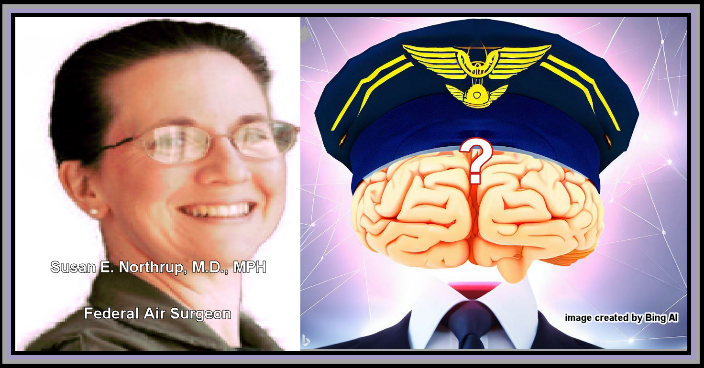
Over the Federal Air Surgeon’s five years in the job, she is trying to move the frontier of what can be safely accommodated—without pretending that mental illness can ever be fully de‑risked in safety‑critical roles. The FAA under her is more open to treatment and disclosure, but still fundamentally risk‑averse when it comes to catastrophic potential, which is why broad, expansive declarations about “acceptable” mental illness remain so hard.


Industry Challenge
The FAA’s new policy on mental health treatment aims to streamline the medical process for pilots and controllers seeking mental health treatment. Business aviation professionals should seek mental health services if needed and encourage colleagues to do so as well.
NBAA Response
NBAA will continue advocating for FAA policies that support mental health while maintaining safety.
NBAA recently welcomed the FAA’s updated aeromedical[1] policy on mental health.[2] The new policy[3] encourages pilots and aircraft traffic controllers to SEEK COUNSELING AND OTHER MENTAL HEALTH SUPPORT EARLY. Now, pilots and controllers receiving various forms of talk therapy and peer- support services are much more likely to leave their aviation medical examiner’s (AME) office with a medical certificate in hand.
NBAA played a key role in advocating for these changes, which are, in large part, a result of recommendations made by the FAA’s Mental Health & Aviation Medical Clearances Aviation Rulemaking Committee (ARC)[REPORT 4/1/24].
NBAA’s Director of Safety and Flight Operations. Mark Larsen, CAM, said, “EARLY INTERVENTION AND TREATMENT of a mental health concern is preferable to restore mental wellness. This new policy helps reduce the stigma of mental health concerns and empowers pilots and controllers to seek treatment early and maintain their medical certification.”
The new policy directs AMEs to focus on the underlying condition and potential impact on safety, rather than treating talk therapy/counseling itself as a concern. An AME can issue a medical certificate to pilots or controllers who are able to function well, without jeopardizing safety. If the AME has safety-related concerns, they can defer the decision to the FAA.
| “NBAA encourages pilots and controllers to ‘preflight’ their medical certification.” |
MARK LARSEN, CAM NBAA Director of Safety and Flight Operations
Sharing the New Guidance
Pilots and controllers should also share new FAA guidance with their therapists. This new guidance provides a format for therapists to provide a brief SUMMARY OUTLINING THE PATIENT’S DIAGNOSIS, SEVERITY, RESILIENCE AND ABILITY TO SELF-MONITOR. Pilots should provide this summary to their AME.
“NBAA encourages pilots and controllers to ‘preflight’ their medical certification; that is, spend time getting prepared for your visit and assembling documentation that will help your AME issue a medical certificate directly, or minimize the time it takes for the FAA’s review,” said Larsen.
Review this new guidance for pilots and controllers, which provides a “road map” to medical certification while receiving counseling or other talk therapy treatment, to prepare for your next medical certification.
| “This latest policy is a critical part of a |
LAILA STEIN NBAA Flight Operations Specialist
Modernizing Pathways
The new policy on talk therapy and guidance for therapists is just the latest FAA initiative aimed at modernizing medical certification pathways for mental health conditions. Last year the agency revised guidance for pilots with anxiety and depression and added new medications to the list of approved medications to treat such conditions.
“This latest policy is a critical part of a much broader initiative by the FAA to modernize how it approaches mental health diagnosis and intervention in aviators,” said NBAA Flight Operations Specialist Laila Stein, who with Larsen participated in the ARC. “NBAA commends the FAA for collaborating with the industry to reduce barriers to seeking mental health treatment.”

Review NBAA resources surrounding medical issues at nbaa.org/medical.
[1] Therapy, Psychotherapy, and Counseling FAQs for Pilots and ATCS
[2] Information for Psychotherapists Treating Pilots and ATCS
[3] Not 100% clear if these are the updated policy referenced in this article

