eVTOL’s acceptance by the travelling public may not be impacted by the1st Crash
Below is a most insightful article warning that eVTOLs will need a PERFECT SAFETY RECORD to attain commercial viability in the near term. The author’s “history” lesson includes new forms of transportation that did not fail and did eventually succeeded.
That prediction is realistic, but there’s some good news that oddly may hide an early crash.
WHY DOES AEROPHOBIA impact the potential passengers on this greener, quieter and transportation positive service? Aviation’s innovation always is at the leading edge of aeronautical technology. Most people’s nervousness about flying — and especially about new forms of flight like eVTOLs — comes from a predictable mix of psychology, risk perception, media amplification, and human‑factors realities. The key point: the fear is rarely about actual crash risk (which is extremely low) but about how the human nervous system interprets uncertainty, loss of control, and vivid aviation incidents.
WHERE MIGHT AN EARLY CRASH OCCUR? AI predicts that the following 5 indicia correlate with the likely 1st eVTOL accident
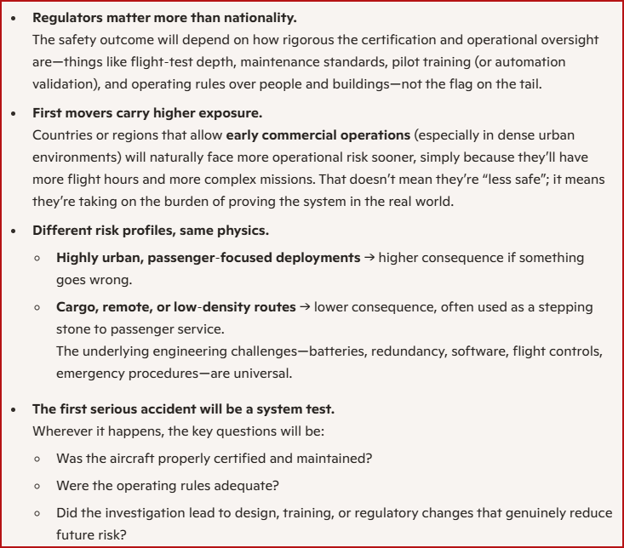
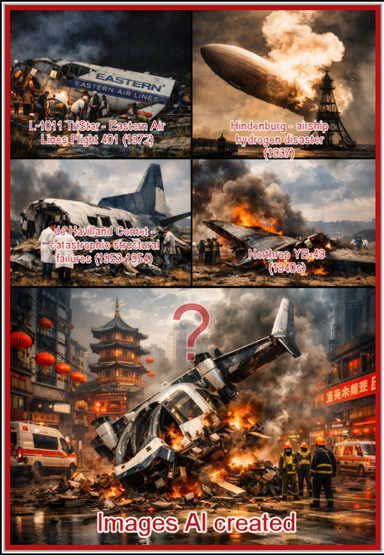
Without asserting that this is anything but a WAG, assume that the 1st eVTOL to have “inadvertent contact with the terrain”, NTSB Elwood Driver Elwood T. Driver[1], may be the PRC. While any accident, particularly any involving loss of life is a tragedy, this locus may be fortuitous-WHAT, you may say?!?!?
The PRC has maintained a long, institutionalized system of state control over news and information, including aviation accident reporting. This censorship framework evolved from Mao‑era propaganda management into today’s sophisticated digital and bureaucratic apparatus. As this panel makes clear–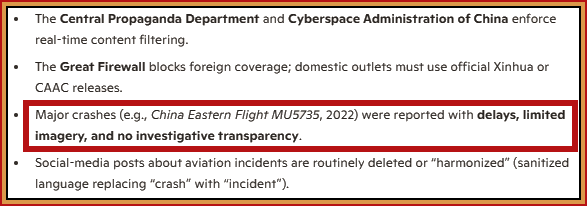
More relevant to the PRC’s “managing” what it reveals about its accident record, the International Civil Aviation Organization has repeatedly expressed concerns about China’s repeated failure to file ANYTHING on a timely basis in compliance with Annex 13. As noted in the above box, the best example of its inability to meet basic international safety rules was its extreme tardiness in explaining the probable cause of MU 5735, allegedly due to “national security”. IATA, the global airline association joined in this critique.
The likelihood that the PRC will not (maybe HAS NOT) report the accident of eVTOLs that it has certificated has been increased by these two articles in the past 3 days:
- A small plane slammed into the tallest skyscraper in China’s capital. Hours later, it was like nothing had happened. 6/27/2026
- “All references to the incident – and the shocking footage of it – had been scrubbed from Chinese social media. The government initially did not publicly acknowledge any incident had taken place. State media – including the country’s national broadcaster CCTV, headquartered across the road from the crash site – made no mention of the incident.
- “That’s thanks to the work of China’s army of censors and the Communist authorities’ obsessive control over information – particularly concerning events they believe may bring negative attention or consequences”
- Why a light plane crash in Beijing created a security dilemma for authorities 6/30/26
- “It comes as the “low-altitude economy” has BEEN IDENTIFIED AS AN EMERGING SECTOR BY THE CHINESE GOVERNMENT – referring to activities, businesses and services conducted in airspace below 1km (3,280 feet) such as drone flights.”
This may seem to some to be casting aspersions on the PRC because its certifications of the eVTOLs is well ahead in issuing airworthiness deliberations. In general, international aviation authorities are regarded as suspect WHEN THEY ARE CONTROLLED AND/OR OWNED, ITS DECISIONS ARE ESSENTIALLY CONTROLLED BY THE GOVERNMENT
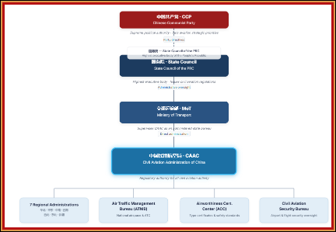
- CAAC (Civil Aviation Administration of China) is not an independent regulator. It is owned, controlled, and supervised directly by the State Council of the People’s Republic of China, and ultimately by the Chinese Communist Party (CCP) through the Ministry of Transport and the Party’s Central Committee.
- COMAC (Commercial Aircraft Corporation of China, Ltd.) is 100% state‑owned, controlled by a consortium of major PRC state‑owned enterprises (SOEs), and supervised by the State‑owned Assets Supervision and Administration Commission (SASAC) — meaning it is effectively owned and directed by the Chinese government and CCP.
Another example of the low regard of the PRC’s airworthiness determination is shown by EASA’s slow review of COMAC. The pan European aviation authority is proceeding slowly because the C919 still requires extensive validation of systems integration, reliability, and documentation:
- EASA has increased its presence in Shanghai to support certification, but progress remains slow.
- EASA Executive Director Florian Guillermet warned that approval could take 3–6 more years, reflecting the depth of design‑integration and reliability assessments still required.
- Independent analysis suggests approval may not come until 2028–2031, citing persistent technical and documentation challenges.
The first eVTOL crash, as with any over-the-horizon aviation involves initial hiccups. Frequently such events involve problems not identified by the CAA, but while bad can be corrected. Little missteps are ordinarily manageable and the public accepts the correction(s) as acceptable. As the Quartz article points out that the aerophobia associated with eVTOLs measured by EASA puts this fear at a higher range—
- A European safety agency study foundthe same pattern across 4,000 residents in six cities: 83% expressed initial enthusiasm for air taxis, but safety emerged as the dominant concern once they imagined the aircraft operating above their neighborhoods.
IT IS A FAIR BET THAT THE INITIAL EVTOL CRASH MAY INVOLVE A PRC AIRCRAFT, BUT THE WORLD MAY NOT KNOW ABOUT THIS SEMINAL EVENT DUE TO CHINA’S PROPENSITY FOR HIDING SUCH EVENTS. It will require a knowledgeable media to distinguish that aerial vehicle as opposed to nations which are known for their certification integrity.

Electric air taxis need a perfect safety record. They won’t get one
A single accident has derailed every new transportation technology. Electric air taxis are nearly commercial and statistically guaranteed to have one
By Anthony Lopopolo Updated June 24, 2026
Electric air taxi companies have real aircraft, real flights, and real money behind them. Joby Aviation is a partner in five of eight federal pilot projects. Archer Aviation has a factory ramping up in Georgia. The Federal Aviation Administration has created a formal regulatory pathway for what it calls the first new category of civil aircraft since helicopters. The industry is now years, not decades, from commercial reality.
THE OPTIMISTIC CASE HAS NEVER BEEN STRONGER. It also rests on an assumption that deserves scrutiny: that the industry can reach commercial scale without a serious, public, fatal accident.
The history of novel transportation technologies suggests it can’t. When that accident comes, the damage won’t be measured in engineering setbacks. It will be measured in public trust, regulatory retrenchment, and years of lost momentum.
The cost of a single failure
Any new technology must compile thousands of safe hours to build confidence, but a single failure can destroy it. Two recent cases show how that plays out.
1.On March 18, 2018, an Uber $UBER -2.32% autonomous test vehicle struck and killed a 49-year-old pedestrian in Tempe, Ariz. The National Transportation Safety Board found the probable cause to be the safety driver’s failure to monitor the road, compounded by Uber’s “inadequate safety culture.” By any technical assessment, the crash was an outlier. Human and organizational failures caused it.
None of that mattered. Uber suspended all autonomous vehicle testing across San Francisco, Pittsburgh, Phoenix, and Toronto. Arizona revoked Uber’s testing permit entirely. Rivals such as Waymo became more cautious, and by December 2020, Uber had sold off its entire autonomous vehicle unit. One death set the most well-funded autonomous vehicle program in the country back by years and contributed to its corporate abandonment.
2.The pattern holds at a larger scale. Two crashes killed 346 people aboard Boeing $BA +1.06% 737 Max aircraft, and the FAA grounded the entire fleet on March 13, 2019. It took 20 months and a wholesale redesign before the aircraft flew commercially again. Boeing disclosed a $5.6 billion reduction in revenue and pre-tax earnings in a single quarter, and the financial toll kept growing for years.
Boeing was the world’s largest aircraft manufacturer with a decades-long safety record. The damage reshaped global regulatory behavior and eroded passenger confidence in the 737 Max for years.
Curiosity without confidence
Electric air taxi companies are essentially asking the public to board a vehicle category that has never carried a commercial passenger. The FAA’s certification framework {below FN[2] added to explain exactly what/what not will be issued by the FAA OTA v. TC???), which prioritizes safety above all else, is built around that reality. The certification bar is high precisely because the margin for error is zero.
A 2023 AAA survey of nearly 1,000 U.S. adults found that 68% were afraid to ride in a self-driving vehicle — a 13-percentage-point jump from the prior year and the largest single-year increase since 2020. That fear persists in a technology category with millions of cumulative miles driven. A European safety agency study found the same pattern across 4,000 residents in six cities: 83% expressed initial enthusiasm for air taxis, but safety emerged as the dominant concern once they imagined the aircraft operating above their neighborhoods.
The industry isn’t naive about the fragility of public trust. Test incidents have already occurred. The NTSB documented a February 2022 crash of a Joby Aviation pre-production prototype during a remotely piloted test flight near Jolon, Calif. A propeller blade separated at about 210 miles per hour, triggering cascading failures that destroyed the aircraft. No one was injured because the test was conducted over uninhabited terrain. Joby implemented design changes and continued its flight test program, but the incident showed that mechanical failures will occur. And the consequences of such a failure with passengers aboard would be of a different order entirely.
A timeline under pressure
Early commercial aviation faced the same dynamic and navigated it — but at a far greater cost. A 1931 crash that killed Notre Dame football coach Knute Rockne prompted public demands for stronger federal oversight, according to the FAA’s historical record. A 1935 crash near Atlanta, Mo., killed Senator Bronson Cutting of New Mexico and forced Congress to investigate federal aviation oversight directly. Those incidents drove the passage of the Civil Aeronautics Act in 1938, creating an independent safety authority that evolved as more accidents and investigations accumulated. Aviation safety regulation was the byproduct of decades of public outrage.
Electric air taxis don’t have that kind of time. They’re publicly traded, burning cash, and promising investors a timeline measured in years. United Airlines CEO Scott Kirby, who signed a conditional order for electric air taxi aircraft, said in March 2026 that he now opposes operating the vehicles near crowded hub airports, saying he doesn’t believe they can be operated safely without disrupting existing flight operations. When an airline CEO behind a billion-dollar-plus order begins backing away before a single passenger flight, the reputational fragility of the enterprise becomes visible.
The most likely scenario isn’t that electric air taxi technology fails. It’s that it works well enough to enter commercial service, builds a solid early safety record, and then encounters the statistical inevitability of a serious incident.
[1] Driver, who served as an NTSB Board Member from 1978 to 1982, was indeed one of the first to use the expression “inadvertent contact with the terrain” in official remarks and safety‑seminar contexts. He applied it specifically to Controlled Flight Into Terrain (CFIT) accidents, emphasizing that these events involved airworthy aircraft under pilot control that nonetheless struck the ground due to situational‑awareness failure, not mechanical malfunctioning Driver signed up for the Army Air Corps in 1942. He became a Tuskegee Airman and was sent to the European Theatre where he recorded an aerial combat kill over Anzio, Italy. He retired from the Air force as a Major in 1962
[2] https://jdasolutions.aero/blog/faa-lloyds-and-eipp/ EXCERPT– DroneXL’s article on the status of the FAA’s/DOT’s eIPP is a tremendous summary of the who, what, where and when of this landmark Trump Administration initiative. One element of this innovative expedited flight testing is that the eVTOLs will operate in REVENUE service without the FAA’s issuance under 49 U.S.C. § 44701 for a Type Certificate, Production Certificate or Airworthiness Certificate. In lieu thereof, eIPP “will operate under OTHER TRANSACTION AUTHORITY (OTA) (???)agreements that BYPASS THE TRADITIONAL CERTIFICATION-BEFORE-COMMERCIALIZATION SEQUENCE.” As DroneXL reports, cities, states, authorities, OEMs, and other participants are literally SPRINTING to meet the eIPP’s ambitious schedule for start-up.
