MEXICO’s FAA is in trouble again and PAST HISTORY may have been a reason why

An astute Mexican reporter, below, has uncovered a repeat in his country’s aviation relationship with AFAC, the national aviation safety authority. Here is the reoccurring pattern between the FAA’s IASA and its peer agency just south of the border.
The significance of the 2021-2023 period is explained by this account of that period—
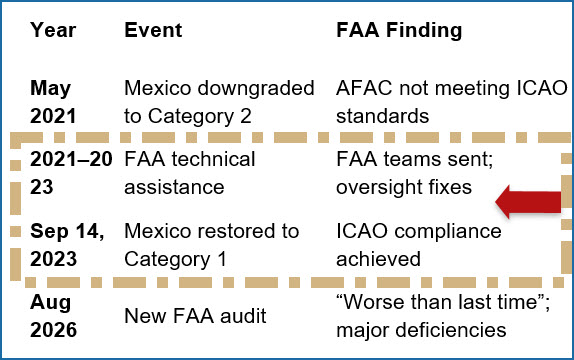
Mexico’s Agencia Federal de Aviación Civil (AFAC) allocated ₱902 million Mexican pesos — roughly US $52.8 million — for the 2021–2023 FAA technical assistance and corrective‑action program that helped restore its Category 1 safety rating.
That budget covered:
-
-
- FAA audit and follow‑up missions
- Training and certification upgrades
- Oversight system modernization
- Staffing and compliance improvements required under ICAO standards
-
The payment was made through AFAC’s annual appropriations, not a commercial contract since the FAA provides fee‑for‑service technical support under U.S. law rather than selling services directly.
Because Category 1 was restored on 14 September 2023, the FAA’s corrective‑action verification and technical‑assistance work MUST HAVE BEEN COMPLETED SHORTLY BEFORE THAT DATE, likely in late August or early September 2023.
The FAA reinstatement was CONDITIONED on AFAC’s compliance with 5 critical safety improvements:
-
- Increase and sustain AFAC’s operational budget
Condition: MEXICO COMMITTED TO increase AFAC’s budget so it could hire inspectors, conduct surveillance, and maintain ICAO compliance.
Status (2026): NOT MET
-
-
-
- AFAC’s budget has been cut every year since Category 1 was restored.
- Funding is down 37% from the level used to regain Category 1.
- AFAC says it needs MX$2 billion annually, but is far below that.
-
-
Impact: This is the single most serious breach of the commitments.
-
- Maintain adequate numbers of trained technical personnel (inspectors)
Condition: AFAC had to hire and train sufficient inspectors to meet ICAO oversight requirements.
Status (2026): NOT MET
-
-
- AFAC now lacks sufficient trained technical personnel to conduct full inspection programs.
-
Impact: Directly threatens ICAO compliance in licensing, certification, and surveillance.
-
- Sustain compliance with ICAO safety‑oversight standards (multiple annexes)
Condition: Mexico agreed to maintain compliance across ICAO annexes covering:
-
-
- Personnel licensing
- Airports
- Air navigation
- Surveillance obligations
- Safety issue resolution
-
Status (2026): PARTIALLY MET / AT RISK
-
-
- The FAA’s 2026 audit is examining five ICAO annexes because deficiencies have re‑emerged.
- FAA auditors are preparing recommendations after field evaluations.
-
Impact: Compliance is no longer assured, prompting the new audit.
-
- Maintain the corrective‑action system implemented during 2021–2023
Condition: Mexico had to keep in place the oversight systems, documentation processes, and certification pathways built during the downgrade period.
Status (2026): PARTIALLY MET / UNDER REVIEW
-
-
- FAA is conducting a 339‑question technical review to verify whether AFAC still meets ICAO standards.
- The review exists because the FAA believes some commitments may not be sustained.
-
-
- Ongoing compliance verification (follow‑up audits)
Condition: Mexico agreed to allow periodic FAA follow‑up audits to confirm continued compliance.
Status (2026): MET
-
-
- FAA is conducting the scheduled August 10–14, 2026 IASA audit.
- This is part of the bilateral safety‑oversight mechanism.
-
-
- New emerging instances
-
-
- “Vamos muy mal. Peor que la vez pasada” (“We’re doing very badly. Worse than last time”)
- Deficiencies in technical staff training
- Problems with certification processes
- Weaknesses in English-language radiotelephony competency (RTARI)
-
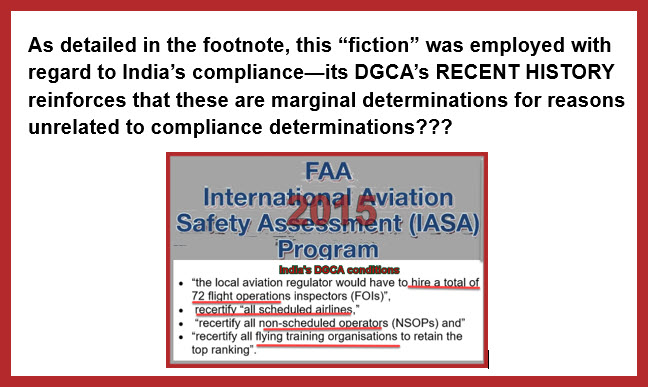 Mexico’s 2023 restoration came after a two‑year FAA technical‑assistance program, and AFAC publicly committed to sustaining certain improvements (budget, staffing, surveillance, documentation). Once the FAA determined AFAC met ICAO standards, the upgrade was unconditional [1], BECAUSE THE IASA FRAMEWORK DOES NOT TECHNICALLY ISSUE CONDITIONAL CATEGORY 1s.
Mexico’s aviation safety compliance is justified by all available evidence. The people of our neighbors to the South may perceive the timing of this AUDIT as politically tainted. [See fn.3 inter alia]. IASA CANNOT INVOLVE factors unrelated to safety. It is fair to say the India’s return to Category 2 and Mexico’s recent help in getting reinstated had shades of help from the Administration (e.g., this realistic image of a US Ambassador delivering Category 1 to AFAC).
After these unfortunate taints (all attributable to other Administrations), any shade over FAA’s independence among its global peers is not particularly helpful. For years the US has been able to caste aspersions on the impartiality of Russia, the PRC and other CAAs, the FAA must have a pristine record without any help. NO more Déjà vu. Thanks to Yogi’s memorable aphorism

By Óscar Goytia | Journalist & Industry Analyst – Tue, 08/11/2026
The US Federal Aviation Administration (FAA) has initiated a new safety assessment of Mexico’s civil aviation framework, PLACING THE COUNTRY’S CATEGORY 1 AIR SAFETY RATING AT RISK OF A DOWNGRADE AS REGULATORS EVALUATE THE OVERSIGHT CAPABILITIES of the CIVIL AVIATION FEDERAL AGENCY (AFAC[2]).
According to industry sources, Mexican aviation authorities have completed and submitted answers to a 339-question questionnaire issued by the US government to determine whether Mexico will maintain its top-tier safety status. Neither the FAA, AFAC, nor Mexico’s Ministry of Infrastructure, Communications, and Transportation (SICT) responded to official requests for comment regarding the review process.
 The review is being conducted under the FAA’s International Aviation Safety Assessment (IASA) program, which measures a foreign nation’s civil aviation authority against safety standards established by the International Civil Aviation Organization (ICAO). The technical evaluation examines primary aviation legislation, specific operating regulations, state civil aviation systems, safety oversight functions, technical personnel qualifications and training, technical guidance and tools, licensing, certification, authorization, surveillance obligations, and safety issue resolution.
Sources indicated that the ongoing audit focuses specifically on five ICAO annexes covering
- personnel licensing,
- airports,
and
- air navigation,
with FAA auditors preparing to issue recommendations following field evaluations and meetings with local officials. Aviation specialist Rogelio Rodríguez, consulted by El CEO, noted that the FAA’s process involves extensive field gathering and direct consultations, meaning final conclusions will not be immediate.
A core element of the US evaluation centers on Mexico’s compliance with commitments made when it recovered Category 1 status in September 2023, SPECIFICALLY PROMISES TO INCREASE AFAC’S BUDGET TO ENSURE ADEQUATE SURVEILLANCE. However, operational funding for the Mexican regulator has dropped by 37% since the status was restored. While AFAC executed MX$902 million (US$52.78 million) to recover Category 1 status in 2023, the approved budget for the current year was reduced by MX$244 million (US$14.28 million).
AFAC estimates that its operational needs require at least MX$2 billion (US$117.12 million) annually, a figure supported by the College of Commercial Pilots of Mexico (CPAM) and the Air Line Pilots Association (ASPA). The budget shortfall has left the agency without sufficient trained technical personnel required to execute complete inspection programs across all domestic air operators.
“It must be remembered that when the category was returned to us, it was conditioned. And they are reviewing us again. I HOPE THAT WITH THE 339 QUESTIONS THAT THE MEXICAN STATE HAS ALREADY ANSWERED, THAT WILL RESOLVE IT AND WE WILL NOT BE DOWNGRADED,” said Jesús Ortiz, general secretary, ASPA.
Ortiz pointed to funding as the primary vulnerability facing Mexican aviation oversight. “The big issue is the budget that is not allocated to AFAC. This budgetary issue needs to be addressed, and lawmakers must look at separating it, or if they do not want to grant it budgetary autonomy, allocate more resources to avoid a downgrade,” Ortiz said.
Mexico was previously downgraded to Category 2 in 2010 and again in May 2021 under former President Andres López Obrador, remaining downgraded for over two years before regaining Category 1 in September 2023. A Category 2 classification signifies that a nation fails to provide international-standard safety oversight. While existing flights to the US may continue under Category 2, domestic carriers are barred from adding new routes, expanding flight frequencies, or deploying new aircraft on authorized routes. This restriction benefits US airlines, which remain free to expand their market presence.
The safety audit follows prior regulatory disputes between the two nations. In October 2025, US Transportation Secretary Sean P. Duffy[3] blocked 13 proposed routes connecting the US to Felipe Angeles International Airport (AIFA) after the Mexican government suspended several US flights at Mexico City International Airport (AICM). No flights currently operate between AIFA and the United States.
Results of the FAA evaluation and requests for additional documentation are expected to be processed in the coming weeks.
[1] An interesting legal interpretation, and one used in 2015 for India, another POLITICALLY sensitive decision. INDIA’s aviation safety rating- 2015-2025 PRC’s power penumbra???; ICAO award for India’s DGCA safety improvements BUT post AI crash domestic criticism DISAGREES?; FAA and ICAO: prudent to reassess India’s DGCA???; INDIA’s DGCA is safe per 4 audits? Other factors? Time to consider an assessment void of geopolitical and other factors???; IATA’s lament about AAIB tardiness points to a deeper issue!!!
[2] The Federal Civil Aviation Agency (Agencia Federal de Aviación Civil, AFAC) is the government body responsible for regulating the civil aviation industry in Mexico. AFAC replaced the Directorate General of Civil Aeronautics (Dirección General de Aeronáutica Civil, DGAC) in Oct-2019. AFAC operates under the Secretariat of Communications and Transportation of Mexico. AFAC formulates government policy for the development of aviation in Mexico, oversees training, aviation infrastructure, and technical development as well as safety.
[3] Duffy “Mexico has not been in compliance with the bilateral agreement since 2022 when it abruptly rescinded slots and then forced U.S. all-cargo carriers to relocate operations. Mexico claimed it was to allow for construction to alleviate congestion at Benito Juarez International Airport (MEX) that has yet to materialize three years later. By restricting slots and mandating that all-cargo operations move out of MEX, Mexico has broken its promise, disrupted the market, and left American businesses holding the bag for millions in increased costs.”
“Joe Biden and Pete Buttigieg deliberately allowed Mexico to break our bilateral aviation agreement,” said U.S. Transportation Secretary Sean P. Duffy. “That ends today. Let these actions serve as a warning to any country who thinks it can take advantage of the U.S., our carriers, and our market. America First means fighting for the fundamental principle of fairness.”

