FAA and ICAO: prudent to reassess India’s DGCA???
The WASHINGTON POST (see below) has published a disturbing article that calls into question whether the aviation safety regulator of India is effectively[1] controlling the carriers under its jurisdiction.
According to the most recent U.S. Department of Transportation T‑100 data analyzed by Simple Flying, Air India carried approximately 1.11 million passengers on its U.S.–India nonstop flights in the 12 months ending October 2023.
That works out to:
- ~3,000 passengers per day on average
- ~1.29 million seats offered, with an average load factor of 86%
This includes all nine nonstop routes Air India operates between India and the United States.
Air India’s #1 passenger market is to/from the US, which it serves with 9 nonstop flights, with an average load factor of 86% and puts ~3,000 passengers daily in their planes. The carrier’s safety is regulated by the DGCA of India.
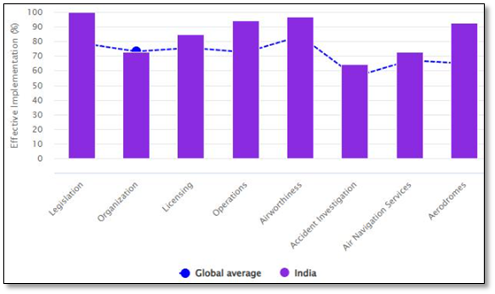
The FAA’s IASA review of this peer regulator found that it met the global aviation safety standards. ICAO also determined that the DGCA’s competence was mostly above the Global average. Furthermore, recently this international organization “…awarded the DIRECTORATE GENERAL OF CIVIL AVIATION OF INDIA a CERTIFICATE FOR ITS PROGRESS IN ESTABLISHING AN EFFECTIVE AVIATION SAFETY OVERSIGHT SYSTEM.” Here is the DGCA’s most recent ICAO USOAP rating-
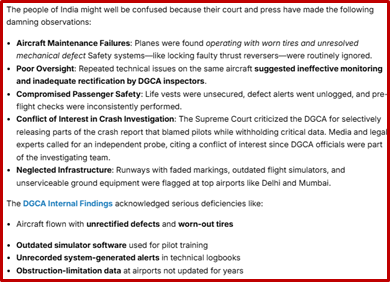
These passing grades do not comport with criticisms made by the press of India and even the regulator’s self-evaluation-
The world’s aviation community has been uncomfortable with India’s management of the AI 171 disaster. These are not nitpicking critiques, but substantive discomfort with the process–
India’s response to the tragic AI 171 disaster has mystified the international safety community.
- With no major experience decoding the B-787 black boxes, deciding to perform this critical investigative step in-house;
- Initially refusing to grant an ICAO observer access to the AAIB team and then reversing that decision.
- The unusually slow process and dearth of information of the AAIB’s investigation of this high profile and unbearably tragic accident.
- A very telling moment—the first press conference was not conducted by extremely well qualified Director of the AAIB, Group Captain G.V.G. Yugandhar. Instead, the initial briefing was led by the Civil aviation secretary Samir Kumar Sinha, a career Administrative Service Officer with no real aviation experience.
In fact, the NTSB convened a meeting with the India AAIB to review the process employed, information collected and potential findings!!!
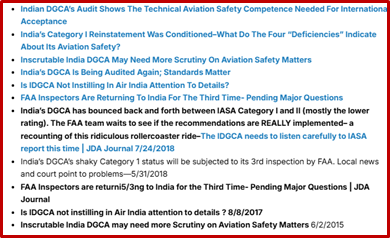
The country with the world’s largest population has had a bumpy, at best, history dealing with its aviation explosion:
The thousands of passengers originating in both countries have been told that the IASA and USOAP assessments –
THESE PROGRAMS EXIST TO VERIFY THAT FOREIGN CIVIL AVIATION AUTHORITIES MEET ICAO SAFETY OVERSIGHT STANDARDS BEFORE THEIR AIRLINES OPERATE .
It appears that FAA Administrator Bedford and ICAO President Toshiyuki Onuma should assure passengers around the world that flying on India’s two dozen airlines are indeed SAFE.
India’s aviation meltdown exposes long-brewing pilot fatigue crisis
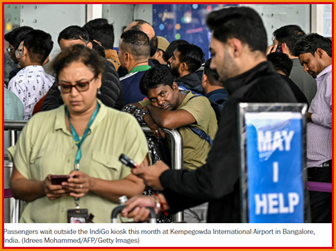
Aviation experts and pilot groups say IndiGo’s unprecedented scheduling crisis this month was due in part to an industry failure to address pilot fatigue.
December 29, 2025

NEW DELHI — Every couple of weeks, the Indian pilot is required to make three short-haul night flights over two consecutive nights. As she tries to rest up before her next daytime flight, the 40-year-old says she often lies awake worrying about her health.
“I don’t think I will live long if I continue flying,” said the Delhi-based pilot for IndiGo, India’s largest airline. “My body, my brain — everything has just shut down. This is zombie work.”
She was hopeful when she learned the country’s aviation regulator was instituting new rules to combat pilot fatigue — eliminating the most punishing flight patterns, limiting night landings and mandating longer rest periods. But when the rules finally came into force in November, chaos followed.
It coincided with an expansion of flight schedules, in part to accommodate India’s largest-ever wedding season, and soon cancellations and delays were piling up. By early December, IndiGo faced a snowballing disaster, described by pilots and aviation experts as a crisis unique in Indian aviation history. Almost 1 million bookings were affected between Nov. 21 and Dec. 7, the Civil Aviation Ministry told local media.
During the worst week, Indigo said it canceled about 4,500 flights, including almost all of those in and out of the capital of New Delhi on Dec. 5. Across the country, airport departure boards glowed red. Passengers were left with little information. Bags piled up and went missing.
“No airline, however large, will be permitted to cause such hardship to passengers,” Civil Aviation Minister Ram Mohan Naidu told Parliament on Dec. 9. But THE MINISTRY AND ITS MAIN REGULATOR, THE DIRECTORATE GENERAL OF CIVIL AVIATION (DGCA), TEMPORARILY EXEMPTED INDIGO FROM THE NEW RULES GOVERNING FLIGHT SCHEDULES TO HELP STABILIZE THE SITUATION. The 40-year-old pilot and her colleagues felt like they were back where they began.
“In the crossfire, the people who are actually getting hammered here are the pilots,” said a senior Indian aviator with five decades of experience, who, like others in this article, spoke on the condition of anonymity for fear of professional retaliation.
Aviation experts and pilot groups say the scheduling crisis in early December was not an aberration, but a predictable outcome for an industry that has long resisted addressing pilot fatigue.
“We always knew there would be a tipping point,” said an Indigo pilot based in southern India. “This wasn’t just cost optimization,” it was “cutting corners, pushing man and the machine to its absolute limits.”
In response to questions, IndiGo directed The Washington Post to public statements, including one from Dec. 3 that said, “minor technology glitches, schedule changes linked to the winter season, adverse weather conditions, increased congestion in the aviation system and the implementation of updated crew rostering rules … had a negative compounding impact on our operations in a way that was not feasible to be anticipated.” On Dec. 8, the company said it had paid out about $100 million in passenger refunds.
The DGCA and the Civil Aviation Ministry did not respond to requests to comment.
An aviation boom in a shrinking field
Two decades ago, India had a plethora of domestic carriers. IndiGo, known for its lean staffing, punctual takeoffs and fast turnarounds, steadily rose to dominance, powering the world’s fastest-growing aviation industry.
But that growth was accompanied by unprecedented consolidation. Since the early 2000s, at least three major Indian airlines have folded, and at least five have been acquired or merged, leaving two major domestic players: IndiGo and Air India.
IndiGo has continued to outpace its older, more established rival, amassing more than 60 percent of the domestic market and more than $800 million in profits, according to the company’s latest annual report. For those looking to fly out of smaller airports or to less-frequented cities, IndiGo is often the only available option.
Underlying IndiGo’s ascent, pilots say, was a culture of intense pressure around work schedules that reshaped industry norms, particularly after the coronavirus pandemic. “I have often gone to the brink before I get rest,” the senior pilot told The Post.
Amit Singh, who has more than three decades of experience in the cockpit, said pilot rest standards in the United States and Europe are designed to protect sleep quality through circadian modeling and fatigue research, while India’s approach has largely been based on counting hours. U.S. airlines are required to guarantee pilots eight hours of uninterrupted sleep opportunity and adhere to cumulative limits that account for fatigue over time, he said.
India’s rules, by contrast, have focused on how long a pilot is off duty — in some cases they provide more rest hours on paper, he said, but don’t account for whether that time allows for restorative sleep. The problem is exacerbated, Singh said, by “poor airline safety culture and regulatory oversight.”
After the chaos last month, IndiGo circulated an apology script for pilots to read from the cockpit. Two pilots told The Post they had refused to comply with the order.
“It is so infuriating that management … did not once apologize to us or sympathize with us,” said the Delhi-based pilot. “And I’m supposed to apologize on behalf of them?”
Flying on empty
The Delhi-based pilot said she now regrets the nearly $80,000 she spent on flight training. But her biggest mistake, she believes, was the contract she signed with IndiGo, which included clauses that require her to pay more than $50,000 to the company if she leaves before five years are up.
Pilots said such contracts are common at Indigo and Air India. The airlines say the financial penalties for opting out are necessary to help recoup training expenses.
Last year, the pilot in Delhi fell seriously ill. After she had exhausted her 12 days of sick leave, she said, the airline threatened to place her into a “dependability” program that freezes promotions, bonuses and travel benefits. She returned to work, she said, but her health has continued to suffer.
[1] To be 1000% accurate, the Post discusses the problems incurred by Indigo, the largest carrier in the world. If the regulator has issues dealing with its biggest certificate, it is fair to assume that its capacity to assure the compliance of Air India is equally lacking.
