BWB and AI- the moving FAA certification maze

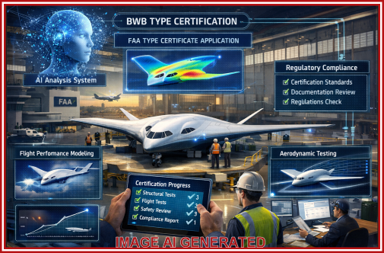
An absolutely fascinating article describes how JetZero is using AI, more specifically Physics-based agentic Al, to design the cutting-edge blended wing body (BWB[1]). The ZeroJet use of this advanced development of AI will be a challenge for the FAA staff’s airworthiness review.
There is no FAA rule or AC on which they could rely assessing this “AI‑based aircraft design “under Part 25. Though not yet explicit or in place, FAA policy documents and recent rulemaking[2] show how AI‑generated design artifacts might be used in the Type Certification process — and what constraints the FAA would impose. The key is that AI outputs are treated as the final design data that must meet existing 14 CFR § 25.1309, system safety, and validation requirements, not as an acceptable substitute for engineering judgment.
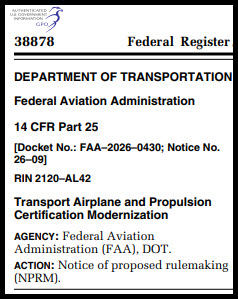
The FAA’s 2026 “Transport Airplane and Propulsion Certification Modernization” NPRM (posted on 06/26/2026 and open for comment until 08/25/2026) explicitly acknowledges that new materials, software‑driven systems, and novel architectures increasingly fall outside legacy rules, requiring special conditions and equivalent‑level‑of‑safety findings. The FAA proposes folding these workarounds into Part 25 to make certification of new technologies more predictable.
While AI‑assisted design is not named, but it clearly fits the agency’s use of the term–“novel design methods”, a phrase that indicates that structured justification will be required. Under the NPRM’s logic, AI‑generated design artifacts would need to be validated through the same mechanisms used for any unconventional design approach — e.g., special conditions, means‑of‑compliance, or ELOS findings.
The phenomenal processing of massive potential designs for the BWB proposal, fortunately, need not be part of JetZero’s TC package, although it would be advisable to brief the FAA staff about the options considered and reasons why the specific drawings were being used.
 AC 25.1309‑1B (2024) is the FAA’s primary guidance for system design and analysis. It emphasizes:
-
- Engineering judgment is required for any showing of compliance.
- Qualitative and quantitative methods must be validated.
- Highly integrated systems require deeper verification and independence analysis.
- FAIL‑SAFE DESIGN AND FUNCTIONAL HAZARD ASSESSMENT REMAIN MANDATORY.
JetZero’s AI‑generated design results (e.g., structural layouts, system architectures, load predictions, optimization outputs) would be treated as inputs to the safety assessment process, not as evidence themselves. The applicant must demonstrate:
-
- Traceability — how the AI produced the design data.
- Verification — independent confirmation that the AI‑generated data is correct.
- Validation — proof that the AI model is appropriate for the intended use.
- Independence — AI cannot be the sole source of safety‑critical conclusions.
- Repeatability — the AI process must produce consistent, auditable results.
This research identifies that the FAA does not accept “black‑box” design justification. Any AI tool must be embedded in a controlled, documented engineering process.
FAA Type Certification requires approved design data, verified compliance, and validated safety analyses. AI can contribute to these areas, but only under strict conditions. The FAA’s statements on AI leads to these likely categories of proofs-
Acceptable uses (with proper validation):
-
- Structural optimization (e.g., topology optimization)
- Aerodynamic shape optimization
- System architecture trade studies
- Load prediction and envelope exploration
- Failure‑mode discovery (AI‑assisted FMEA brainstorming)
- Human‑factors modeling (pilot workload prediction)
Not acceptable as standalone evidence:
-
- AI‑generated compliance findings
- AI‑generated safety assessments
- AI‑generated verification results
- AI‑generated test reduction without engineering justification
The FAA will require independent verification of any AI‑generated result used to show compliance.
Although not yet codified, FAA policy direction suggests:
-
- Model governance — documentation of training data, model versioning, and validation.
- Explainability — ability to show why the AI produced a given design output.
- Determinism or bounded nondeterminism — repeatable outputs or controlled variability.
- Human oversight — engineering review of all AI‑generated artifacts.
- Integration into SMS — AI tool risks must be part of the applicant’s Safety Management System.
JetZero, in the article below, may have anticipated the Human Oversight in stating that “our human in the loop is Norm Princen.”
AI can be used in aircraft design for Part 25 applications, but only as a design‑support tool. Its outputs must be independently validated, traceable, repeatable, and embedded in a conventional safety‑assessment framework. FAA rulemaking trends show increasing openness to novel digital methods — but not a relaxation of engineering rigor.
What Copilot has gleaned from the present record of FAA’s thinking on novel designs generally and AI based designs specifically is subject to change, almost on a constant, real time basis. The recent surge of aviation innovation has been a shock to a certification process which has leaned heavily on existing experiences/data. UASs, eVTOLs, BWBs, new materials, state-of-art engineering and a host of TC applications have caused the FAA to look for new approaches to address them. THE CRITERIA AND ANALYTICAL TOOLS BEING EMPLOYED ARE THE PRODUCTS OF ON-GOING EDUCATION AND EXPERIMENTS.
The Office of Advanced Aviation Technologies (OAAT) is charged with finding ways to design proofs that determine airworthiness without operational records from which reasonable extrapolation can rely. A possible path (AI generated) through this maze:
Define AI Use Cases and Boundaries
Identify exactly where AI will influence design—structures, loads, systems architecture—and document limits so AI outputs never replace engineering judgment.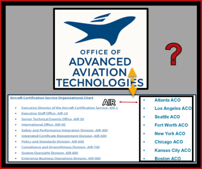
Establish Model Governance and Validation
Create a controlled process for training data, versioning, verification, and repeatability; demonstrate that the AI model is appropriate for its intended design role.
Integrate AI Outputs into Safety Assessments
Feed AI-generated design artifacts into FHA, PSSA, and SSA processes, ensuring independent verification and traceability under AC 25.1309‑1B.
Develop Means of Compliance Packages
Prepare FAA-facing documentation showing how AI-assisted analyses meet Part 25 requirements, including special conditions or ELOS if needed.
Demonstrate Cyber-Integrity of AI Tools
Show that AI tools and cloud environments are protected from unauthorized modification per FAA digital-system integrity expectations.
Submit AI-Influenced Design Data for Type Design
Provide validated, independently verified AI-generated design artifacts as part of the Type Design package, with clear traceability and human oversight.
Support Certification Testing and Continued Airworthiness
Use AI only as a supplemental analysis tool during testing and ensure ICA documents address digital-tool integrity and configuration control.
Even the most sophisticated engineering technical TC applicant may benefit from a consultant working on current TC requests.

Debrief: How Al Agents Can Design A Better BWB
GRAHAM WARWICK

The IMPACT OF ARTIFICIAL INTELLIGENCE (Al) is being felt throughout the life cycle of aerospace systems, even at the earliest stages of design where new tools are enabling the exploration of trade spaces to be automated, accelerated and expanded.
JetZero, the U.S. startup developing a blended wing body (BWB) configuration for commercial and military applications, has worked with computational geometry platform nTop and Al computing provider Nvidia to demonstrate the use of agentic Al in aircraft design.
The BWB configuration involves deeply interconnected aerodynamics, structures and propulsion. CHANGING THE WING CHANGES THE FUSELAGE AND VICE VERSA. Each iteration of the design traditionally involves lengthy manual updates to maintain the geometry.
NTop’s parametric geometry platform encodes the aircraft as a single interconnected model-outer mold line, structural wingbox, airfoil sections, engine nacelles, landing gear and interior volumes. As parameters are changed, the geometry regenerates correctly.

In the demonstration, the platform enabled JetZero, nTop and Nvidia to develop Al agents to populate design parameters, dispatch geometry tasks to cloud computing and route the outputs directly to aerodynamic analysis tools without manual intervention.
A single engineer could set up the analysis of a design parameter change across dozens of BWB configurations. The Al agents would run autonomously overnight, and the results come back structured and ready to enable design decisions to be taken, nTop says.
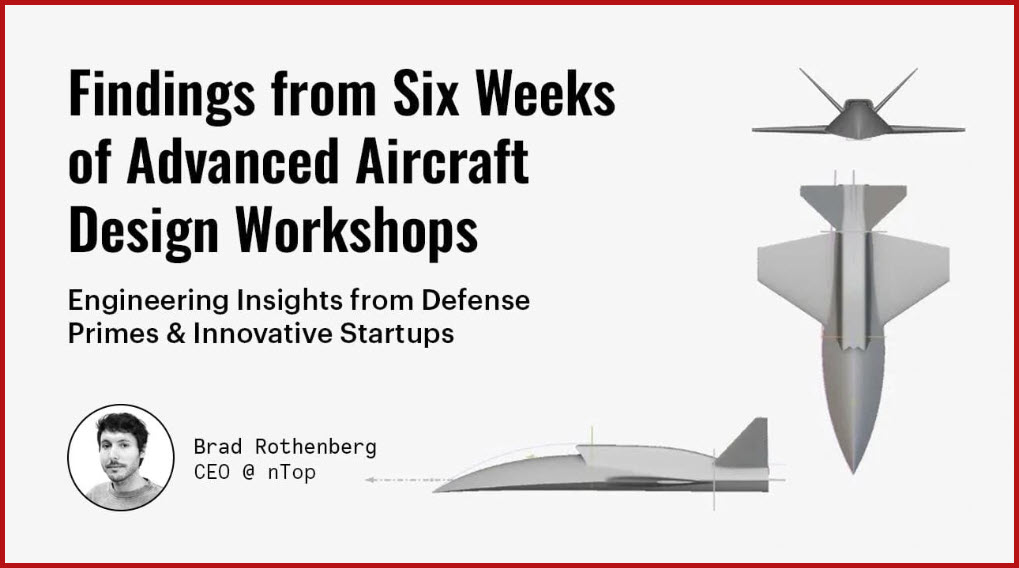 “You can think of nTop as a design throughput machine,’ CEO Bradley Rothenberg says. “The way that you build geometry models in nTop enables an order of magnitude increase in the number of configurations that can be explored and tied to high-fidelity simulation.”
Exploring new design tools is part of JetZero’s embrace of Elon Musk’s algorithm for disruption:
challenge every requirement,
delete parts
and
processes,
simplify and optimize,
accelerate cycle time and
automate
“We’re in that area how do we accelerate cycle time?’ JetZero CEO TOM O’LEARY says.
“We usually think of automation on the manufacturing end,” he says. “When we say automation, it’s in the sense of bringing decreased cycle time to the front end, looking at permutations in design trades when you are trying to close on a conceptual design.”
Normally in aircraft design Rothenberg says, engineers have to make a choice between moving fast using low-fidelity tools that make assumptions and moving more slowly using higher fidelity tools that bring more certainty.
“NTop allows you to answer those questions immediately, because it can represent high-fidelity geometry In a fast, lightweight and parametric way. such that Al agents can explore and answer questions that would have taken a long time, he says.
O’Leary gives the example of taking in changes requested by customers and iterating the design between semiannual meetings of its airline advisory group. “One of the hardest challenges is, in six months, to make all those changes, loft it, reconfigure it, and make sure you balance everything. That’s very difficult using legacy tools,” he says.
“NTop allows us to do two things we weren’t able to do without them. Decreased cycle time is going to allow us to go deeper, faster but also go broader, faster,” O’Leary says The design of JetZero’s BWB demonstrator is frozen, but the startup is running trade studies on the planned commercial airliner and military tanker versions.
“We’re running a million conceptual designs and coming to the point where we can compress the cycle time into a matter of days from months to get performance data on those designs and do it across tons of different iterations,” he says.
 For the demonstration nTop programmed the autonomous Al agents with the BWB design principles developed by Norm Princen, formerly Boeing’s chief engineer for BWB programs and now JetZero’s senior stability and control specialist.
“What was so successful in this program was having Norm sitting in the room with us and his rule sets being encoded into the Al algorithms and the parametrization logic, Rothenberg says. “OUR HUMAN IN THE LOOP IS NORM PRINCEN, O’LEARY ADDS.
NTop’s parametric geometry platform can be used up to preliminary design review fidelity. at which point detail design can be performed downstream in traditional tools It’s bringing more fidelity into conceptual and preliminary design so you’re answering questions that would have taken until detail design to answer, Rothenberg says.
The platform couples the geometry to low- and high-fidelity computational fluid dynamics and finite element analysis tools, structural loads and weights models and for smaller uncrewed aircraft, can even generate structures that can be manufactured and flown
Physics-based agentic Al[3] “is one of the biggest breakthroughs in the way humans interact with tools in the last 100 years or so,” O’Leary believes.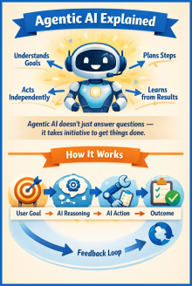
“We’re in the midst of the greatest transformation, arguably, in the history of human civilization,” he says. Instead of businesses being organized around who makes what decisions at what level, “It’s going to be more purely science, and it is going to result in better answers and better products ‘
‘It’s all about how you frame the question, and then the answer is not based on where you sit in the hierarchy or how many years of experience you have,’ O’Leary says. “It’s based on just running the science and not who decides to run
[1] https://jdasolutions.aero/blog/wright-to-b-w-b-aviation-innovation/;https://jdasolutions.aero/blog/is-the-blended-wing-body-the-green-aircraft-of-the-future/; https://jdasolutions.aero/blog/way-to-bwb-type-certification/
[2] With such a voluminous record, AI has been used to summarize the essential points of the FAA’s evolving AI policies.
[3] Agentic AI refers to artificial intelligence systems that can act independently and make decisions to achieve specific goals with minimal human intervention. These systems are designed to perceive, reason, and execute tasks autonomously, distinguishing them from traditional AI models that require constant human oversight.

