Should eIPP become the Low Altitude Operations Service mode in DOT?
The Civil Aviation Administration of China (CAAC) established LOW ALTITUDE SAFETY DEPARTMENT (LASD) that will focus on the safety and economic development of AAMs/UAMs/eVTOLs/UASs/Drones…?. Sounds like a good idea and especially apt for the intermodal, state-local mission of the US DoT. It may seem unduly Sinophile or even Unamerican to copy something from the PRC, but remember that this 4,000 + year old society is known for several significant inventions, most notably the Four Great Inventions: paper, gunpowder, the compass, and printing technology. The PRC has more experience operating at these lower altitudes; if nothing else, this Communist government has more plans and greater direct authority to its countryside than most countries
President Trump’s Secretary of Transportation has already created the Electric Vertical Takeoff and Landing Integration Pilot Program (eIPP), to form public-private partnerships with State and local government entities and private sector companies to develop new frameworks and regulations for enabling safe operations. WHY MIGHT A LASD[1] BE NEEDED?
The FAA’s eIPP is primarily focused on prototype operational data collection and regulatory pathway development for eVTOLs and AAM systems. By its own definition this is a short term “test case” to produce the data on which will FAA (or???) certificate. eIPP connects with state and local partnerships to sponsor the local proof of concept flying. It is not abundantly clear how under eIPP, for example, a city will approve eVTOL arrival/departure stations OR what the flight corridors will be established.
Regulating the Safety for the Low Altitude Economy will be a large, long term, challenging assignment. The technical demands on FAA airworthiness staff is already daunting, testing the existing capacity of the FAA staff. Decisions, whoever makes them NOW, will form the basis of the future eVTOL operations and that momentum established will be difficult to change.
The staff that interact with the eIPP participants should not be temporary. They need to be conscious of the likelihood that the safety parameters that are being tested may well become permanent. Reorganizing the eIPP team as a LASD will add to that awareness.
Analysts across FAA, NASA, and industry forecast tens of thousands of eVTOLs and civil drones operating in U.S. low‑altitude airspace within a decade. That scale would exceed the FAA’s current operational and certification bandwidth, which was built for traditional aviation volumes. The forecasts see massive fleets as this Copilot AI report shows-
UAS (drones)
-
-
- Commercial UAS fleet: FAA projects the US commercial drone fleet to reach about 12 million units by 2028; growth is still strong but slowing.
- 5‑year view: Extending that trend, a 1–1.3 MILLION commercial fleet in the early 2030s is a reasonable band.
- 10‑year view: If growth moderates but continues, 5–2.0 MILLION commercial units in the mid‑2030s is plausible.
- Recreational UAS fleet: FAA expects recreational drone sales to peak within the next five years, then flatten or decline.
- So in 5 years, you’re near the peak; in 10 years, likely flat or slightly down in count but with more capable platforms.
- Commercial UAS fleet: FAA projects the US commercial drone fleet to reach about 12 million units by 2028; growth is still strong but slowing.
-
AAM / eVTOL – fleet vs. activity
The data are thinner here; FAA focuses more on operations (departures) than on fleet size.
-
-
- FAA’s AAM forecast (risk‑adjusted) suggests that within six years of entry‑into‑service (EIS), AAM vehicles in the US could reach ~3.9 MILLION departures per year in the base case, with lower‑case scenarios still in the millions by that point.
- That implies:
- A fleet in the low hundreds in the first few years after EIS.
- Scaling to low thousands of eVTOLs in the US once you’re in the 5–10 year window post‑EIS, assuming utilization patterns similar to regional/commuter operations.
- Aviation Week’s AAM forecast projects a global fleet of about 600 in‑service eVTOL aircraft by 2030.
-
That’s consistent with a slow, safety‑driven ramp:
-
- By ~5 years from now: Hundreds globally, low hundreds in the US.
- By ~10 years: If integration, infrastructure, and economics cooperate, you’re plausibly in the low tens of thousands globally, low thousands in the US—but that’s an extrapolation, not an official numbe
Even on conservative trajectories, low‑altitude traffic volume (especially UAS + AAM combined) is orders of magnitude above legacy aviation, which is exactly why your instinct about needing a dedicated low‑altitude organization plus UTM is aligned with where the forecasts are pointing.
Traditional airspace is confined to altitudes, except near airports, which are well above the communities, but the interaction/litigation between the FAA ATC and local civic leaders and state/city elected officials is very time consuming. UTM will literally touch landing pads in these communities and the air vehicles will fly at low altitudes above the populace. If the past relationships provide any basis to predict what the interaction between and among the FAA with individual citizens, neighborhood groups and the plethora of government officials will be overwhelming:
-
-
- That UAS flew by my apartment building at 2 am and its blinking lights woke me up.
- City Council member passed a law prohibiting the local utility from making the high level electric power connection (like opposition to data centers).
- eVTOL service from suburbs to downtown; the city agrees to reduce ground congestion, but the suburb blocks zoning for a station anywhere near its houses.
- A UAS flying in urban airspace is clocked by a local LEO at a speed which the city prohibits.
- eIPP participant sets up an eVTOL port which violates the eventual standards.
-
THESE ARE ENCOUNTERS THAT ARE NOT ALWAYS FRIENDLY. The complainers rarely know about, or even accept the concept of FEDERAL PREEMPTION. The point is that these contentious conversations are likely to occur during eIPP and also likely to influence the public’s long term opinions about these low-flying vehicles.
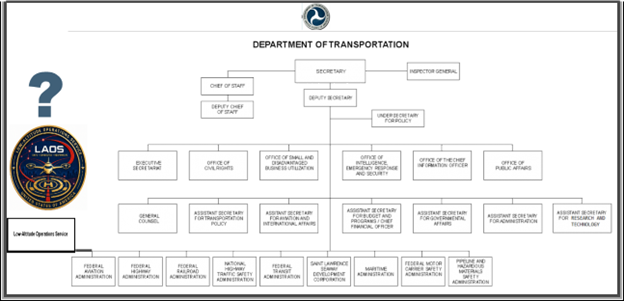
Thus, it might be prescient to create NOW a new “modal administration,” separate from the FAA but within the DOT. For improvement by some clever acronym creator, Low‑Altitude Operations Service (LAOS) will be the temporary name and its mission will be:
To manage, regulate, and enable safe, scalable low‑altitude civil aviation — encompassing AAM, eVTOLs, UASs, and drone logistics — below 500 ft AGL.
A strawman organizational structure might look like
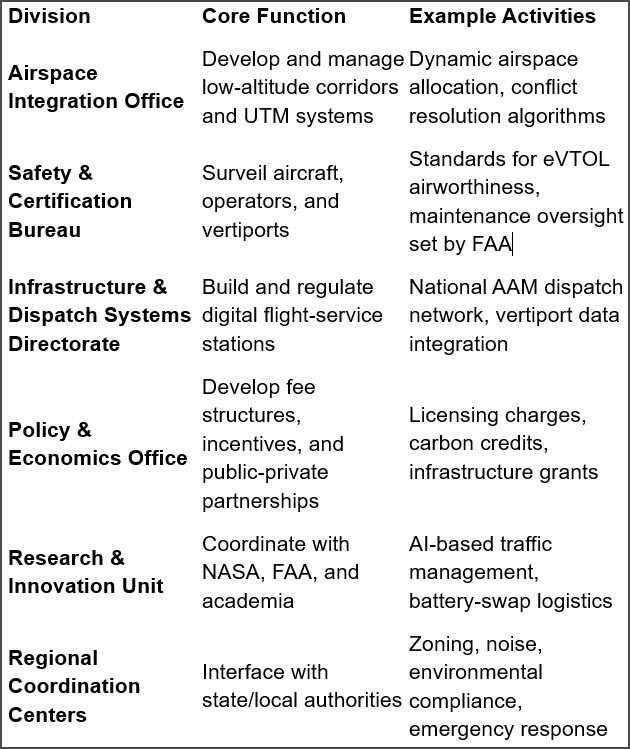
The FAA would retain airworthiness and pilot certification authority for traditional aviation and this segment of operations. LAOS would assume operational management of low‑altitude systems, digital flight‑service, and vertiport certification.
LAOS would participate in FAA’s System Wide Information Management (SWIM) and other common information needs. The rub between the old ATC and the proposed LAOS UTM will be facilitated by the proximity of the two organizations in DoT comfy consolidated head quarters.

China’s civil aviation regulator sets up low-altitude safety department
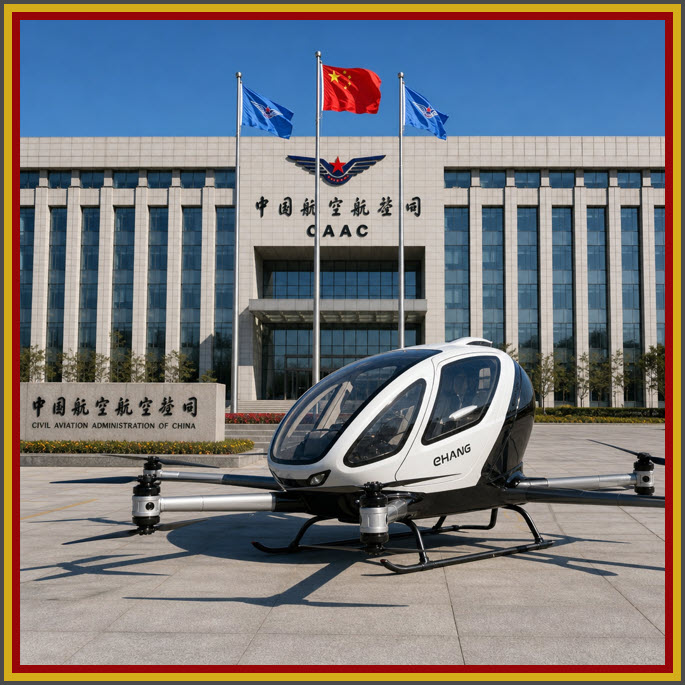
BEIJING, May 13 (Xinhua) — The CIVIL AVIATION ADMINISTRATION OF CHINA (CAAC) has established a LOW-ALTITUDE SAFETY DEPARTMENT, as the country steps up efforts to foster the low-altitude economy.
The new department is responsible for formulating development plans for low-altitude civil aviation, coordinating low-altitude safety and development, and building low-altitude flight service dispatch platforms and flight service station systems, according to the CAAC.
The move came as China has intensified efforts to tap the low-altitude economy, which refers to the economic activities and industries centered around manned and unmanned aerial vehicles operating in the airspace usually within 1,000 meters above the ground.
In December 2024, China’s National Development and Reform Commission established a department dedicated to the low-altitude economy to formulate and organize the implementation of strategic as well as mid-term and long-term development plans, provide policy recommendations, and coordinate major issues related to the sector.
The country’s low-altitude economy has seen rapid growth in recent years. Its market size is expected to exceed 3.5 trillion yuan (about 511 billion U.S. dollars) by 2035, according to the CAAC. ■
[1] Later referred as Low Altitude Operating Service.